Showing posts with label ghana. Show all posts

Wednesday, August 09, 2023

How AI is used to produce new diverse stories hidden in plain sight.

Astory about a young police officer who travels to the UK in the 1950s from West Africa seeking a new life shows a future of AI evolving filmmaking. And it will particularly benefit communities.

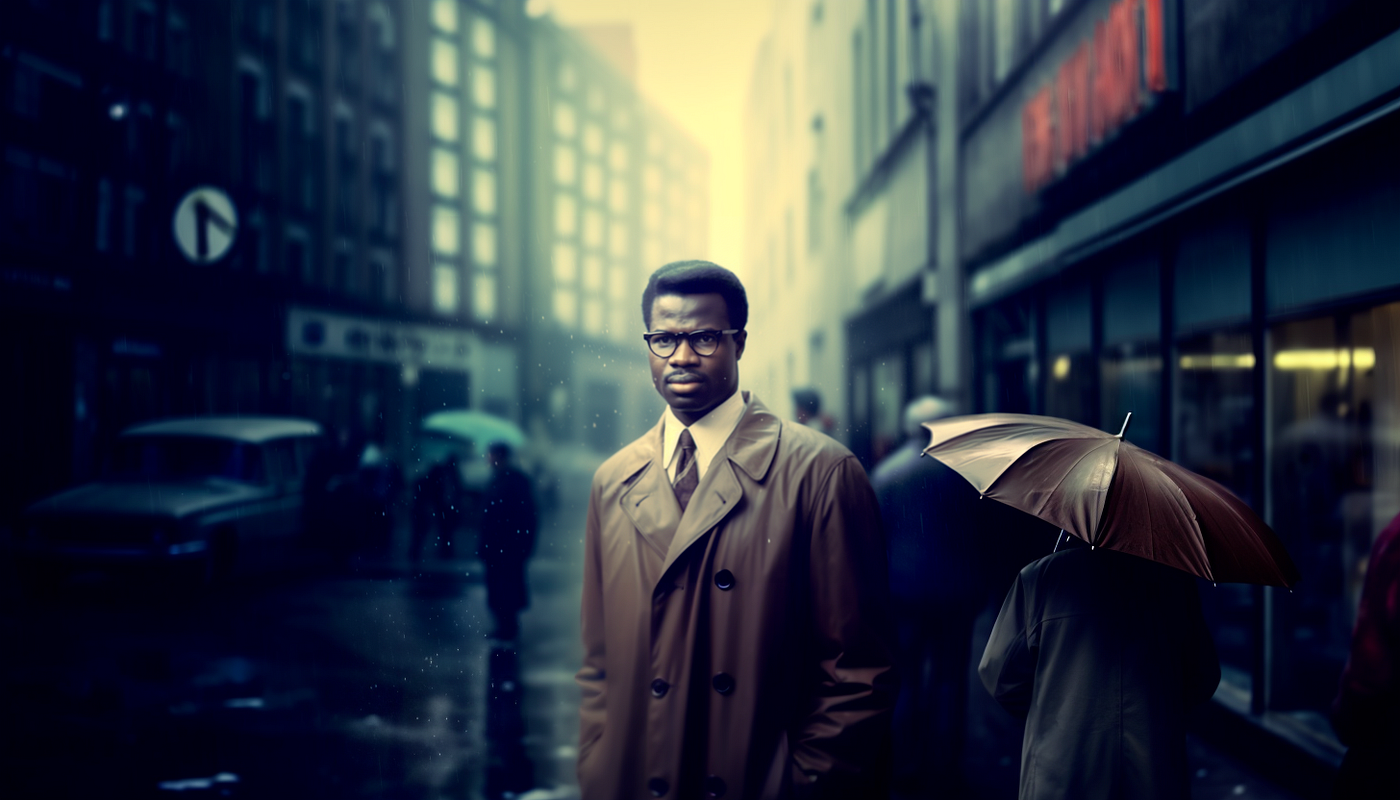
AI was used to recreate half of the visual scenes from researched documents.

The officer Edward Gyimah was 25 years-of-age when he travelled to Britain in 1955 on a government scholarship from what was then called the Gold Coast. The Gold Coast would become Ghana in 1957 — the first African country to achieve independence from Britain.

The story called “Chairman — The Ghanaian”, is just one of the lesser well known narratives of 1000s of West Africans who made Britain their home in the 1900s. Chairman is a term of respect used in Ghana to address a senior figure.

“Chairman — The Ghanaian” is the story of my father. I’ve been finding material (a suitcase of letters, photos and his passports) 17 years since he passed away which paints a vivid picture of his trials and travels.

The photos prompted quite a reaction on social media when I posted resulting in people posting photos of their parents too. Several people, such as Marcus Ryder MBE, Henry Bonsu and Jo Holmes left comments.

The issue I had, which is commonplace is, there was limited archive to expand on his story. But the use of Generative AI has solved that problem. The promo below is a first iteration, and already I can see new improvements and new apps I could use. By 2027, I can’t imagine where we’ll be.

Journalism and AI

I’ve been a journalist for more than thirty years and have worked for outfits such as Channel 4 News, BBC Newsnight and ABC News. And also as a technologist and artist I’ve been involved in several media innovations. The angle I come at with AI is largely different from dominant views. Some of the innovations I’ve championed include:

  • Cinema and video journalism — a study and work showing how a new breed of journalists, some from the BBC, use cinema’s langue to tell stories
  • Mobile journalism and VR — creating a mobile film Bass Culturea 500k Arts and Humanities Council project, which was shown on the big screen at Regents cinema where the Lumieres brothers screened their films
  • Creating platforms that have appeared on Apple’s website — creating one of the first video magazine platforms in 2004 before YouTube which would win a Knight Batten Awards

Innovation tends to be accompanied by apocryphal stories and the “industry-is-dead” themes. So what of AI? What’s so different ?

The impact of the industrial revolution on artisans provides a framing for the future. Not unlike painters who were the news people of their day reconstructing scenes from memory, Gen AI for many practitioners fulfils the same function.

Critics speak about the ethics, and that can’t be ignored, but there were ethics that were overcome with the generation of art, and photography in the 1800s. It resulted in the introduction of broadly agreeable standards. The same will happen with Gen AI.

Industrial manufacturing markedly reduced the work of carpenters, carvers and metallurgists, but in time there was a premium for having worked produced by experts.

The promo I’ve produced using AI takes the viewer through my father’s ups and downs, and his eventual return to Ghana with us, his children. His motives for coming to the UK, abandoning a career in the police force was to study and return to Ghana. His life mirrored scores of Africans coming to the UK on scholarships. He would return home almost 20 years after his arrival.

Whilst Africans have been in Britain since the 1600s. According to one of the foremost authorities on African history, Professor Hakim Adi author of West Africans in Britain 1900–1960, after 1945 there was a fundamental change which saw the number of West African students, including women, in Britain increase. Professor Adi writes:

By 1945 this figure had risen to over a thousand, about two thirds of whom came from Africa, the vast majority of these West African (mostly from Nigeria and the Gold Coast)… by 1948, divide over 1000 west African students in the country.

Today, Black Africans outnumber Black Caribbeans in the UK. The 2021 census says of England and Wales was 59.6 million:

2.4 million people (4.0%) were from black ethnic groups — 1.5 million of those identified with the black African ethnic group (2.5%), and 0.6 million with the black Caribbean ethnic group (1.0%)

In constructing the promo, amazingly I was able to create photos of dad from AI that my close family did not realise were AI generated. Whilst the impact of AI will be colossal, and will reshape the industry it won’t based on forecasting lead to AI media utterly usurping actual media and people.

They’ll be a secondary workforce burgeoning just as we’ve witnessed with multimedia, but mainstream has not disappeared, anymore than actors will. And if you’re a Trekker, seriously there’s the future writ large in front of us all.

Chairman was one of a number of ideas I took to Ghana in April and was taken to meet the former President of Ghana John Kufuor and several CEOs by one of Ghana’s leading academics Prof Kofi Asare Opoku.

The President took a keen interest in the work and requested I continue to probe.

One of my main aims is to teach a new generation of its efficacy and where it could help in media. Its hugely important that its adoption is wide and absorbed particularly by students from the Global South, where technology and media access has historically been challenging and led to deep chasms in the knowledge economy.

AI will accelerate a new information horizon and its vital data and industry participation towards shaping existing biases, that will be baked into the future alone, are addressed. But what are the odds of this? Media as a business is forever gazing at its bottomline navel, looking to new ways to up its profits. AI is its Sapphire.

Yet by itself is AI is a tool, it’s not sentient yet to think by its own, so it’s the thinking process towards creativity which has huge currency. Systems thinking, design thinking and cinema journalism are a few of the methodologies used to enhance this future filmmaking form.

To that end, I’m in talks with a number of people, academic outfits and bodies, and look forward to inviting AI storytellers, practitioners and academics, to the University of Cardiff where I’m based. We’ll share and publish work. More recently I’m honoured to have been invited to join the Pan African Heritage Museum in Ghana as a member of its academic and curatorial Council. AI storytelling will have much to say in Museums.

I’d like to thank Prof Prof Kofi Asare Opoku, Professor Pash Obeng, and Senior Kojo Yankah founder of the Pan African Heritage Museum for their ongoing suport.

I’m a reader/ Associate Professor at Cardiff University with a specialism in innovation and Story Labs. You can contact me here Gyimahd@Cardiff.ac.uk For more click here

Monday, May 30, 2016

I’ve just read Jeff Jarvis (pictured) Mass Media’s Death… and felt inspired to write this.

I have just finished reading “Death to the Mass. Media must rebuild its business around relevance and value, not volume”, by the indefatigable Jeff Jarvis — a modern eclectic media philosopher.
Jarvis straddles the analogue and digital world of journalism with a firm prognosis of its woes. I first came across him at Dale Peskin @dalepeskin and Andrew Nachison @anachison WeMedia conference at the BBC and Reuters in London, in 2006.
Those were effervescent days, as trad. media experts tried to hold onto their halcyon memories. The bruising between journalists and bloggers was gargantuan. ‘You’re not a real journalist’ were the experts’ riposte. Jarvis in his trademark wit was carving up naysayers.
I had been invited by Wemedia to share a podium on the future of news. I was rubbish! I behaved too meekly; the usual hyper me had deserted, stuck in the bathroom. Afterwards I made a line for Jarvis for a swift interview.
Here’s the exchange below. Years later, in fact 2014, Jarvis invited me to CUNY as part of a group of people talking about the future of news. I continued to talk ‘rubbish’ with the following.
If video was going to be the next big thing on the web before YouTube struck, I said, which got me my Knight Batten award in 2006, cinema journalism — self expression and some — will in the future separate the wheat from the chaff.
Jarvis might not remember this, but his words afterwards were something to the effect I liked your idea cuz it’s mad.
I was reminded in his article about an interview I did with my MA students in 2006 called ‘If’. If you could change one thing, I asked, what would that be? Fears of Islamophobia crop up and listen to what Daniel Kofi (pictured) says at 1.13".
Daniel chides the media for reporting events with no recourse to wanting to getting involved in the issues for social public good. It’s an absurd idea by any standards. Journalists report, and like wildlife photographers don’t get involved in nature’s fights.
Jarvis writes in his article.
Rather than continuing to try to maintain our content factory, whose real business is selling eyeballs by the ton, imagine instead if news were a service whose aim is to help people improve their lives and communities by connecting them not only to information, but also to each other, with a commercial model built on value over volume
Daniel’s feeling this. I’m a Brit-Ghanaian. I get this too. I went to school in the former British colony and remember its television output. But at some point, the relentless mass export of the Western TV model hit Ghana too. That style of news’ attrition, ‘ he said, she said’ popularised by Jay Rosen, and ‘if it bleeds it leads’ carpeted any semblance of what TV as a social glue could achieve. In this post looking back on the BBC I explain why.
The history of innovation has often been the transmogrification of ideas, or a tool, modified, sometimes lifted wholesale from one culture or discipline to another.
Kofi’s idea of media that existed in Ghana not so long ago could have currency in today’s journalism, but the experts no doubt would mock its approach. Further back, take the impressionism movement in France in the mid 1800s. They owe a debt of gratitude to Commodore Matthew Perry who would bring back from Japan wood block prints that the French would covet.
Facebook’s notion of connecting people as content, amplified from Locke, Searls, Weinberger and Levine’s The Cluetrain Manifesto is predicated on the ideas of what communities were once, neighbourly, homely places where every one shared, spoke over the garden wall, mimicking civic journalism (circa 1990).

Outside journalism’s big tent, technology has become its defibrillator. InWhen Old Technologies Where New, author Carolyn Marvin brings some cautious thinking to this perennial tech-fest in news. One by the way which has been created in no small measure by businesses and marketeers seeking to create new revenue streams, but it’s also served a purpose breaking up TV and traditional journalism’s monopoly.
Take mobile journalism, a word coined in the 1960s by the late Robert Drew, but found new marketing fame as a paradigm shift in the swift flow of information in this millennium . So far so good. But in its dominant incarnate its architects seek to homogenise its form and style towards traditional broadcasting’s achilles. And the idea that it’s the cure all also repeats analogue journalism’s mistake. Source and pick the best tool for the job and let no one tell you differently.
Marvin’s book shows that the frenzy surrounding present tech isn’t new. We’re wowed by technology. It can often break leaving editorial thinking in its wake. We’re left to suss it out through what Professor Brian Winston calls a supervening necessity. That is, once we find a social purpose for the tech it kicks into action. But who prescribes that social framing? The victors write history. Have you ever thought why, say, given all the art-painting movements in the world, you’d struggle to come up with a handful from Africa. Meanwhile, more tech doesn’t necessarily alter the way the tone and message travels within reportage.
We gather around technology and create deterministic and causal meaning based on a hegemonic modes of thinking, but societies aren’t static. Their tastes and needs change, notwithstanding their irrational concerns too.
Once again, these instincts are more redolent in different cultures, or eras, than the ones we might recognise in our own. Today, journalism often resembles what a senior BBC exec calls ‘air conditioned’ journalism as brilliantly illustrated in this piece by a BBC journalist.

Professor Michael Schudson, author several books, such as The Power of News describes journalism as a cultural product shaped by literary and social conventions. It’s something we’ve tended to forget, because of this dominant thesis that surrounds the form, which jettisons cultural and social references.
Which brings me neatly to my conclusion. If you could tell stories, aided by technology to be nuanced with story form’s language, providing insights into primary and sub conscious meaning ( heaven’s knows we need it), where you could break the rules because PR and marketeers have you over a barrel (churnalism), what form of journalism would that be?
Working with Jarvis is another person, I’m a fan of. Travis Fox, now a lecturer at CUNY has a way of storytelling that plays on cultural nuances. There’s no cacophony of tech, but someone behind the lens who is a humanist wanting to tell stories that, as the video below illustrates, resembles, cinema.

Sunday, December 14, 2008

International video journalism 2009

For 15 years I have belonged to Chatham House, whose US equivalent is the Council for Foreign Relations.

I have had a good share of international stories but haven't been as active as I'd like to be recently in producing original stories.

Next year I hope that'll change.

I have got a couple of police stories planned and would dearly like to return to a report I made earlier looking at intel and young people.

You can see the trailer on the front page of viewmagazine.tv, as well as short piece working with the Financial Times.

Meanwhile, there's an interesting pdf on Chatham House putting into prespective Ghana's elections.

The off agenda election
Ghana has been presided over by President Kufuor, nicknamed The Gentle Giant, for the last 8 years.

This present election has been nail bitingly close.

Kufuor's man Nana Akufo-Addo picked up 49.13% of the vote, whilst his rival John Atta Mills supported by Ghana's previous president Jerry Rawlings took 47.92% of the vote.

According to the electoral commission, reported on the BBC, because neither broke through 50% this means a run-off on the 28 December.

The significance of Ghana's election passing off peacefully cannot be down played. Particularly as it's used its patriarchal status to shape its own image abroad.

Kuffuor has played a huge role in African business and democracy

I'm wondering if there are any Vjs who could point us to their reportage.