Wednesday, August 09, 2023

“Oppenheimer” and the lit fuse for engaging filmmakers and news making.


It’s a sprawling magnum of emotionally fuelled storytelling. Transcendental in its ambition, non linear and complementarity in its delivery.

Nolan’s Oppenheimer (2023) thematically plays on his movie heritage which is diverse, yet moored in the art of memory. Is that not the way for all great filmmakers, the continentals such as Bresson, Godard, Jean and Renoir, then Wells whose Citizen Kane is also an example of synchronicity?

I’ll return to memory in a moment. For there’s something else his vision for this film mimics, captured in the essence of the science that his characters are seeped in — Quantum physics and complementarity.

In life, Niel Bohrs in 1926 acting on Einstein’s 1905 proposal of the duality of light, formally cracks its. Light is both particle and wave. Ergo the world, or even the movie world, is both inner consciousness and outer feelings.

The idea that events are happenings collapsed together around multiple interactions of chained causes and affects — is Quantum, and also synchronicity (see Junger). Synchronicity — things that seem meaningless knit together into some coherent form.

In more hyper flexed kinetic cinema it’s “Everything Everywhere All at Once (2002), and Iñárritu’s Babel (2006).

I was a chemistry and maths graduate approaching the 1990s — not a good one, before I became a journalist, filmmaker and artist in residence at one of the UK’s prestigious centres, The Southbank Centre.

I had a weakness in deciphering inorganic reactions; I loved Organic and can still see on the board the nucleophilic attack of Nitrogen on its benzene molecule leading to Tri-Nitro-Toluene (TNT). But I had no hope for where my chem career would take me , and hence in my second year of Uni lost my hunger for science’s abstruse approach and its delivery and became fascinated in radio and the science history of innovators. My MA radio dissertation was on DNA and its new breakthroughs interviewing Baroness Warnock, before I got a job at the BBC.

I’ve a sweet tooth for science movies. The brilliance of Oppenheimer, fiction as it is, was bringing together physicists and players in dialogue: Bohr, Einstein, Teller, Strauss, and Oppenheimer.

It’s not entirely original. Playing on BBC I-player at the moment is Sam Waterston’s Oppenheimer; a 1980s seven-part mini series. There are parallels with Nolan’s script, yet Nolan’s visuality, the intensity of repartee dialogue creates an edge — as if there wasn’t one already.

There are many piquant moments and it’s widely reported that Nolan held fast to the Pulitzer Prize-winning bio by Kai Bird and Martin Sherwin’s American Prometheus: The Triumph and Tragedy of J. Robert Oppenheimer

Nolan also, its reported acknowledges cinematic license, much like Oliver Stone altered some scenes on his epic Nixon.

That conversation between Einstein and Oppenheimer which becomes a homing pigeon; the need for Einstein to run calculations to validate the world would not end on the explosion of the A-bomb, never happened. It was Nobel Prize winner Arthur Compton who directed the Manhattan Project’s University of Chicago that got the call. Einstein was just a better film figure for this dramatic arc Nolan told The New York Times.

Oppenheimer as a nod to quantum physics, for what some scientists see as a poor choice of words, means a particle can exist in different places. It’s explored cinematically by different expositions in varying time space happening at once: various hearings, a love tryst, and the science narrative towards to creating Trinity (the bomb). What then knits it together for its denouement is memory.

Nolan’s giant jigsaw puzzle of a film, much like in some ways his Tesseract in Interstellar (2014) culminates in different time frames falling neatly together. It’s the Rosebud moment from Citizen Kane.

This post isn’t an article about the film per se rather the idea expressed in Tenet (2020) as “Just feel it”. So what’s the quantum lit fuse?

Filmmakers have perfected the art of borrowing. “They watch each other’s work and learn how to tackle scenes that have gone before” writes Mark Cousins in his erudite “A Story of Film”. I’ve written about Nolan’s films in the past and what it offers. Tenet, Dunkirk, and Interstellar.

In training the UK’s first newspaper journalists to become video journalists in 2005 I created a feature news piece influenced by the kinetic movement of the camera inspired by Paul Greengrass’s work.

I’ve built a career in news and journalism which has had a problem with memory. If the very nature of news is what’s new, then arguably during its inception you could point to current affairs and documentary to perform the function of remembering. Admittedly there’s only so much you can do with 2 minutes. But these structures in journalism are constructs that suited television journalism at its birth, but in the world today are inadequate.

Professor Catherine Loveday, a psychologist and regular contributor to the BBC talked to me about memory and journalism. Here’s an excerpt:

Loveday: A news story is a shorter piece of information. It may be something that doesn’t engage you as much and so you don’t pay too much attention to it. More importantly it hasn’t necessarily got a narrative that runs through it. So you don’t invest in the story psychologically or immerse yourself the same way you would a film in which you’re relating to the characters integrating it with your own knowledge base and experience.

Dunkley Gyimah: So how does that happen?

Loveday: So one of the things is how deeply you process something. The second is how engaging it is. The third, which is related is how much attention you pay it. The forth is the different kind of formats that the same sort of information is presented to, so if there’s any kind of repetition. So for example in a film you might have music in it and the music might allow you to engage emotionally more with what’s going on.

So it’s employing more than one sense, so visual sense and auditory sense. I know this happens with documentary, as well as with the news but not to the same extent. Those are some of the things that make film memorable…There are some formats that are more memorable than other. ’There’s a bit of discrepancy around this but we tend to remember visually more easily than auditory stuff.

Dunkley Gyimah: Because?

Loveday: Memory tends to be more visual, using more visual areas of the brain. If I ask you to remember something from last week or ten years ago, fifteen years ago, it tend to be visual. The other thing with narrative is that we are primed as human beings to remember stuff as narrative. We try and reconstruct our life and our kind of world as narrative, and we need to do that to in order to place ourselves in context in the rest of our lives.

Memory is at the heart of how people function. Yet it’s often rendered obsolete in journalism. You can gaslight, and all but believe there’s no consequences, that obscenely, “Black people benefited from slavery because it taught useful skills”, and that’s it!

Nolan’s gift to me, like I said we all take and modify something from auters is to reimagine how in a world of 2030, even now, how our memories will serve us in media in a world where we’re reliant on AI.

If the media did not already exist of an event, if the past is strafed with representation harms that are caked into AI what then? The Interdisciplinary school in London made a video in which it asked Gen AI text to image about how Barbie would look in territories like Sudan and South America. It’s worth a look.

How can I take Nolan’s thoughts to create a piece of work, which becomes immersive and triggers engagement?

How does Nolan prompt me as a filmmaker, artists and educator?

This is one example: a two minute project promo featuring the story of my father, a policeman in the Gold Coast in the 1950s, who came to Britain to advance his career. We’re unravelling several interesting story arcs, but we’re bereft of archive. What though if relying on memory we could build these scenes in Gen AI?

Tuesday, July 04, 2023

In the AI world unfolding, how you’ll need your super power to work : diversity as you should know it!

They’re coming for you. Not the AI per se, but the CEOs driving AI. And to ensure you can still make a living you need to find your super power. That much I’ve told several writers recently, some from the BBC.

The CEOs won’t save your job. Their vision is to push the boundaries of tech knowledge, make considerable wealth, achieve Maslow’s highest order in its hierarchy of needs, and maximise shareholder profits. There’s nothing intrinsically wrong in this if you believe in the unfettered machinations of the market. But all is not well, was it ever?

The consequences of so many people losing their jobs, first it was unskilled labour, now the skilled and creatives are realising the heat, would border on incivility in society and a political class literally operating behind defences minimising contact with their electoral shareholders.

So what’s the solution? There is a model that could work, that could stave off complete disruption of work and leisure. It’s been proved to work and it won’t stem from CEOs stopping any AI development until policies are framed.

It’ll require human-ai co-operation and for humans it’ll mean finding your super power. And where might you acquire it from?

Onthe 11th May 1997 in New York City the world’s most formidable chess player Gary Kasparov would do something that shocked the world. He lost a chess tournament to a computer, IBM’s Deep Mind.

The world of AI had taken a major prize. A nascent technology in terms of its prowess today in neural networks and reinforcement learning, it provided an insight into the future.

That future was a year later when in June 1998 in León, Spain, Kasparov fought back. His solution, he explained would make chess players better, make the game more accessible to a wider audience, and would ameliorate technologists. It was a move that de facto set up a blue print for human-ai interaction.

Advanced chess, his design, brought humans and computing power together. It was predicated on his belief that some part of what humans did in chess was better served by computers, tactics. Kasparov could detect gains from individual moves — a feat bestowed on grandmaster chess players seeing the board in several patterned plays. But computers had an Achilles; they were poor at overall strategy — the overall sum of the game.

The game brought a different type of player to chess. By deploying teams these new winners harnessing AI knew how to use it to analyse their games and to find the best moves whilst they focused on the long game — strategy.

Strategy, involves emotions, though some CEOs will say that needs to be removed from the decision making. HBO’s fictional drama Succession, lays it all out. And Moravec’s paradox tells us computers are crap at emotions. Cue Star Trek Data’s emotion chip.

Another simple way of explaining strategy would be for me to decide what I wanted to write in this article and why ( strategy) and have Google Bard write it. But, and this is the but, I may even likely alter the text because it lacks that something, based on mine, or in your case your super power.

Success for chess and its players then? However there’s a catch! What do chess, football, Journalism, and many other professions have in common with each other? Generally they’re based on cognitive patterns in ‘narrow worlds’ that are discernible and can be replicated for solutions. Hence the more experienced you are, generally the better you are at solving these problems.

Narrow worlds point to specific domains which operate under codified guidelines. The term was coined by John McCarthy in his 1956 paper, “Programs with Common Sense” about AI solving domain specific problems..

Problem solving based on “narrow worlds” deploying experienced hands has been the accepted thought process that nominally has served society well. But there’s a false premise lurking in this the world we inhabit today, and with AI in our shadows.

Author with students circa 2006

For the last twenty odd years I’ve been teaching and training cohorts in computational, design and behavioural skills. That was rebooted in 2016 as the Digital Lab, and 2019 when, with a colleague, we launched Emerging Journalism, or as like to call it Applied Storytelling or the LAB.

An observation of students who take that elective tend to have a range of interests, from music, games, art, language and in some cases have n extraordinary super power in which they have an extraordinary gift for visualisation over words. That’s not to say they can’t or won’t write — some have gone on to become editors of national newspapers.

Yixiang, was a formidable concert player. She hid that from us, but there was a different quality to her work which when I questioned she revealed this. She’s now a senior financial journalist.

It’s more how they’re able to express themselves and see the world differently. My job at the lab is to enhance that, and my colleague and I do so by collapsing several, oft unrelated disciplines that impact thinking.

Almost all students come to the lecture with an idea and by our third lab start to turn on themselves and express their super power. How to solve a problem first guided by some expression, but by not being conventional. In fact the key statement is diversity.

No, wait, wait! For that brief moment, you might have thought “oh yeah right, I see!” Diversity here envelops culture, thought, hobbies, your life outlook, approach to problems.

Your super power is based on diversity of being and thought et al. The more different you are, and aren’t we all different, the more your super power for problem solving comes into play. In fact, the definition of the word super power is really your uniqu power. Super power is to think diversely.

Another observation from years of interactions, teaching and training is how diversity of thought within a homogenous group is different from that in a heterogenous group. It’s the unpredictable vs the crowd solution. And that’s not say the crowd solution isn’t right; of course it is and will be. But the expressive collective approach from the unknown is a super power, and one that AI will struggle to capture.

So how do you get there? Self nurturing. The students I first see already posses what philosopher Isaiah Berlin called Fox qualities. These are individuals that delve into many things. They realise the procedural and come to assess conceptual frameworks for dealing with issues.

Journalism isn’t writing, it’s problem solving and in an AI rich world, that added quality for the next gen is to harness the many discursive approaches emerging. In our lab for journalists we refer to them as Applied Storytellers for the application of a host of solutions towards creativity.

In many ways this approach makes sense. The problems that have beset us from old have relied on tried and tested, formats from another generation, a chess board in which the play is determinable from set patterns.

We tacitly and expressively know some of these approaches don’t work. Our attempts at addressing them have been swiped by old hands we deign know best. But these problems are still there. They are wicked problems that require innovative approaches, not for the sake of them, but now, this time, what AI will do.

To make a big thing of it, there needs to be a bigger discussion across disciplines and institutions. This is what my students say of the programme we run below. I’d like to have that massive discussion.

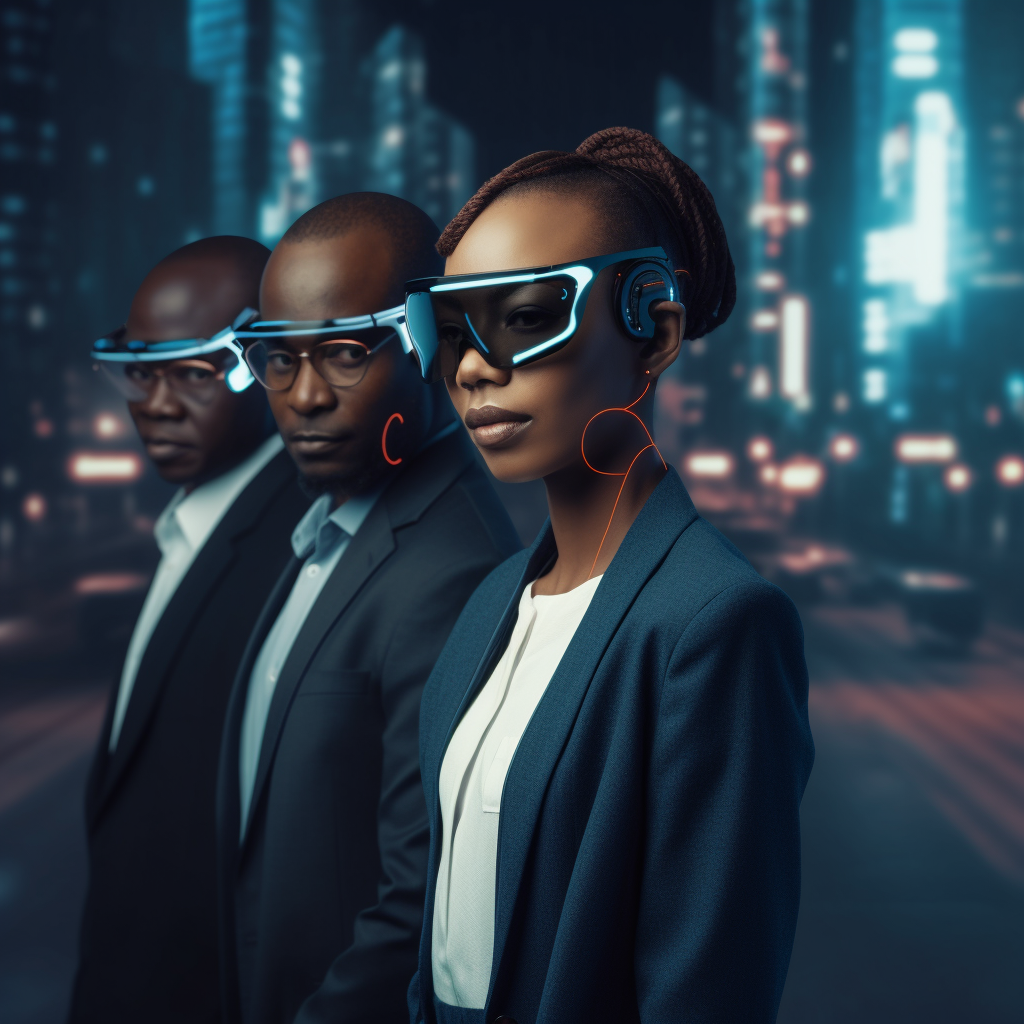
NB: If you’re a TV network we’ve devised an international game that we think is pretty amazing. It’s not unlike the reality game Physical: 100 and one I was involved in as editor for Nato’s War Games. Most images in this article were AI generated.

—

Here’s my scoping of my super power = diverse thinking. I’m British and Ghanaian. I grew up in Ghana, attended Prempeh College (Ashanti King Prempeh II’s college), I graduated in Applied Chemistry at Leicester, studied modules in Global Finance at LSE, then became a journalist.

I became an artist, and artist in residence at the Southbank Centre, hired by Jude Kelly CBE. My PhD from Dublin covers cognition and storytelling. I read several books a year. I’ve travelled and taught in Russia, China, India, Egypt, Ghana, South Africa, Canada, US, across the UK and Europe.

A lecturer at uni who worked in the health system and had knowledge of the ff said I had dyslexia, for the way I processed information. True or not, it’s never been a weight. You can read more about my background here 

Lies, Damn Lies, Ai and damn Truths- How TV News could overcome its lack of trust. It’s an AI and political move.


In less than a decade television news will be transformed. The screen you’re used to viewing on national networks will be transformed, not because executives sought to, but AI forced them to.

These are just some of our stories bringing together great young minds and experts in a platform being realised from an Innovation fund.

Arguably, one of the most tendentious aspects of television news are interviews and false hoods or lies promulgated by interviewees and presenters. The motive often lies in the idea that fact checking will take a while and a lie will transfer half way around the world, before, if anything it’s corrected.

How often might you have caught yourself screaming answers at a screen, or criticising a presenter because they missed the obvious follow up?

What then if online displays not only indicated either the likelihood of a falsehood by providing evidence in real time? This could be done now from our own ideation. Its use will be a political one first before it breaks into the norm. Another aspect that will have currency is establishing for viewers the relationship between journalists and their interviewees, providing watchers with information on the notion of objectivity.

Last year I was one Google’s reviewers for their EU Innovation news fund. One of the awardees was developing what I refer to as “social indexing”. The app reveals connections between the journalist and subject. I’m looking forward to catching up with their work in the future, as we look to our developments which will be documented in a forthcoming new platform.

All this comes at a time when trust is journalism is diminished and television news often appears powerless at addressing in real time skewed or propagated false narratives. That said TV News still tends to rank higher in trust levels above newspapers.

The problem with television News at present is embodied in the Icarus paradox in which the success of its process or product can be viewed as the reason for continuing with the status quo. Icarus’s success in flying also blindsided him to dangers ahead mapped out by author Danny Miller in a book of the same name.

From 2006 viewmagazine.tv reporting from New York and Miami — Can you trust the Media

Trust in journalism has been on a downward spiral for a while. In 2006, the figure was put at 44 percent of Americans. CBS’ 60 minutes and Dan Rather’s broadcast, dubbed Rathergate, and a September 2004 Gallup Poll illustrated how the American people took a dim view of the 4th estate.

Former New York Times writer Jayson Blair’s actions may have already sullied public opinion. Yet in each case of recognising Trust, the answer appears to be, as reported in Niemann labs’ Journalism faces a crisis in trust. Journalists fall into two very different camps for how to fix it a new form of journalism or ways to up trust levels.

These haven’t worked because it’s not just journalists that are at fault. The solution then is to make visible in real time actions via on-screen displays.

Imagine this exchange?

Presenter: Are hospital waiting lists coming down
Interviewee: yes
AI Index (AIIN) ( in real time with sources e.g. NHS England) Hospital waiting lists are
Presenter. [Interviewee] as you can see here on AIIN ( Ayan) this is the true figure. Would you care to correct what you said.

Presenter: You quoted a figure before. AIIN’s showing that figure was used by a health lobby, and that not only is there a social connection between you and that lobby, but a personal one. Your brother-in-law works there.

In the 1990s Bloomberg Business introduced a matrix on-air visual schema providing real time economic data for viewers. Deploying systems thinking applied across the product and process, we see how we can use AI (product) in a model that addresses the current problems with television’s transmission. It’s been sometime in the making when I presented to educationists and school children across the UK the concept.

Some notes on my work.

In 2005 I advocated from building a model online video hyperlinking reported within The Economist. This would help into drilling deeper into narratives. In 2006 I built a theoretical prototype Outernet (profiled on Apple Inc’s Pro front page here) , saying in years to come we’s be streaming from homes.

In 2006 in this article for the Press Gazette I further stated that different storylines could be placed online in “Acres of innovation — so what can video do for you?” No network was doing this at the time.

Over the years I’ve won various awards including the Knight Batten Award for Innovation in Journalism ( the first Brit to do so) and have lectured around the world including being picked as the 2018 Asper visiting professor of Journalism at the University of British Columbia.

I’m an Associate Professor/ Reader at the University of Cardiff where I run a programme in innovation and AI and have had a career in journalism working for top flight news outfits.

You can read more of my work as an news producer and innovator here

If you subscribe you’ll be the first to hear about out our new platform design © 16 Storeys which delves into the future by bringing together exciting young and expert practitioners across a range of disciplines.

In it I’ll be showing AI for news making and film making (such as this below), and the global MasterClass I’m set to deliver to documentary and filmmakers. I’ll explain why I believe it will greatly aid minorities.

If you’re in news, into AI, or a tech funder do drop me an email Gyimahd(at)Cardiff.ac.uk
Dr David Dunkley Gyimah
Associate Professor in Innovation in journalism and tech