In my 15 years as a video journalist, I have fought many battles, witnessed many things. I have worked in Apartheid South Africa; my doc was the only non-South African feature played during their historic election. I would be introduced to Nelson Mandela. I worked for Lennox Lewis with with his fight against Tyson.
I produced South Africa's first African co-production. I have dived with specialist divers and military personnel on an open sea expedition to the ruins of WWI, almost buying a one-way ticket. I have been shot at. I produced a promo within 24 hours aired on CNN. I shot designer Ozwald Boateng's first promo.
I have been in prison - the notorious Wormwood Scrubs - talking/filming Life inmates. In each event I have had my camera with me. Each time, that which I seek to do I have been told can not be done.
The professionals will tell you, it is impossible to be multiskilled. But everything we do is multiskilled. Before the ubiquity of the motor car, professionals would tell you, mastering this vehicle was a job alone in itself. Before the mass production of the stills camera, we were told only the professionals can take pictures.
Before the industrial revolution, the technology revolution, the very job you are doing now would have been seen as impossible. The only thing the professionals would like you to believe is that you can't understand what they know.
In Britain, before Journalism was gentrified, before it became white collar, for 100s of years in the back streets of London, East End "blue collar's peddled news slips and gossip.
Here therefore is my emerging manifesto - the decree of the video journalist.
The video journalists Manifesto.
WHATS' NEVER BEEN DONE AWAITS TO BE DONE
1. I am a video journalist: I crave creativity, loathe that which is predictable. It is my job to look for truth.
2. I can move alone in any terrain. Experience is my blanket. Swarming (groups of Vjs coming together) increases my range.
3. I will be told by those who believe they know best that it can't be done. I must accept that they don't understand my job, my limitations. Nothing is impossible.
4. When they look at a blank piece of paper they see nothing, when I look at a blank canvas, I see the orgins of motion graphics, film and information coming together.
5. I start a dialogue. My packages can be open ended, begging further questions and dialogue. My work is never done. Each thread leads into a new tapestry of ideas and dialogue, which I relish. Herein lies the possibilities of deep video linking
6. My greastest allies are the hundreds of contacts I am yet to meet. I am surrounded by ideas, people, who have a story to share. And I often shoot-on-the-fly, unrehearsed; news in unpredictable. 7. Failure is an option. I must be allowed to fail. I do not court it, but is is a precondition of creativity. I am a researcher with a camera, experimenting with the template which has driven news production. I write my story as it unfolds and sometimes I know, just like a newspaper journalist, I may have to spike my story. Visually it just didn't work.
8. I am lean. I carry no excess weight or baggage. I am a specialist. I kill only that which I can eat, lessening the load and burden which others artificially absorb. There are some shots such as court and "big game" reportage where I may be unsuitable. There are risks as a solo journalist, but discretion is on my side.
9. My job is never done. My camera is my third eye. My camera goes where I go.
10. Like an actor I crave new parts, Like a footballer I make endless runs into the goal mouth searching for scoring opportinities. My work rate is phenomenal. But I'm trained to undershoot so my work load is made lighter.
11. I am a child of a bygone era. There were others before me. The first film makers were VJs [ Victorian VJs] I respect and build on their skills. My fall back is history, convention; my milestone is the future.
12. I am a designer, an editior, a producer, a director, a reporter, photographer an designer. I am a jack of all trades and a master of them.
13. I represent a new discourse in story telling and journalism blurring the boundaries between technologist and artisan, the net and TV, a writer and visual blogger.
14. I hear pictures, see sound, absorb words and can visualise music -all of which makes me a more attuned VJ.
15. Mi6 Video journalism allows me to strip a story bare: the podcast, blog, article, video, and multimedia
16. The tools of my trade: a powerful laptop, editing software, rugged rucksack, collapsable tripod, High Definition DV Cam, water, pen, firewire cable, external 200 g hard drive.
17. My software includes: Final Cut Studio, Photoshop, Dreamweaver, Photoshop, In design, After Effects and Flash
18. It's all in the story. My job is to craft it visually.
19. The Net - the most powerful broadcast media-in-waiting is my natural home.
20. The benefits of video journaism are many; but the ink definning video journalism is not dry. It is many things to all people. To me its is an aggressive, sometimes stealth way of shooting where the results of my labour will outdo those of bigger crew.
21. The work of Claudio Von Planta, Scott Rensberger, Rosenblum, Naka Nathaniel, Ruud - just some of the doyens of videojournalism illustrates the aforementioned point.
22. This manifesto is not complete
23. Belatedly added. Videojournalism is but another thread sowing the tapestry of our many stories, but what's next? What will come to define in our contracted timeline the new discourse and new tools. Qu how might videojournalism evolve?
24. Create alternatives to the convention ~ that may surprise you
25. Experiment or expire - a run on demo or die from MIT
26. Acknowledge that online the environment is interactive, your package can have multiple entry points.
27. Think expansively, shoot lean. Think like a detective entering a crime scene. If you think too narrowly, too traditionally, you're in danger of missing the new story, the new clues.
28. Videojournalism, blogging, photography are daughters of multimedia which may well require a multi modal language approach i.e. you could be the one to better define the new language.
29. Mi6 VJ says you can shoot and strip a package 6 ways,. You're a conductor controlling the play of any instrument at any time in unison. But you'll need to appreciate the capabilities of the instruments.
30. Add value to the visual conversation rather than exclusively always seeking a reaction. There is a difference. Being confrontational does not always lean towards resolution
31. It's not multimedia that is impossible. it's how you're conditioning your thinking.
32. It is an evolving language atracting jack of all trades and masters of all.
This is a precipe of my talk to an influential design group, which is preparing its submisssion to the minister wo overseas this sector
THE OUTERNET - 21st century internet.
My talk focused on the Outernet – a manifestation of an emerging era of the internet which will have far reaching implications beyond that of the net itself.
We’ve seen glimpses of it in science fiction movies like Stephen Spielberg’s Minority Reports, where electronic billboards react with the user, where screens had the ability to recognise individuals via a number of arrays e.g. voice, iris ideintification, which are indeed a reality and today.
The Outernet is an outward front facing internet in public spaces – a html/css driven televisual medium delivering bespoke video programmes and ideas for the deliverer to end users.
It will be is possible because broadband at 8mb plus enables the streaming of DVD quality programmes.
Thus the biggest revolution to communications is the next crossroads of download speeds – an optimum 8mb. It’s also the biggest threat to the existence of television.
Imagine that: a council, an estate, a shop, an individual responsible for a “web site” with moving image information and advertising. There will be no OFCOM rules to navigate, no licenses on broadcasting. Decency and impartiality will be in the hands of the beholder.
We’re seeing early signs of this already in UK political site 18 Doughty Street, Al Gore’s US teen site Current.tv and perhaps even my own work viewmagazine.tv
As a news broadcaster, designer and video journalist, there are a number of facets to reconcile.
• A fundamental shift in the design of web sites; sites will look increasingly like TV screens and vice versa e.g. BBC • A shift to database as opposed to time-tranistion programme. This has already contributed to the success of Youtube. • A much more streamlined and cost effective way of programme making. This will involve video journalists – one person news crews – working more closely with subjects. This has been the path the UK newspaper industry is taking, which I have been involved in as a consultant and trainer. • A fundamental shift on news and hierarchy. We should no longer entertain the artificialness of the news agenda which supposes news and programming should be centralised. One of the most exciting ideas to emerge is some work I’m undertaking with a senior government advisor on crime. The community we’re entering will, with a number of safety measures intact, be making programmes about the social impact they’re experiencing – which will be of interest to other groups attempting to find solutions. We’re experimenting on placing outernet screens within the estate. • Gametheory: embracing new paradigms to combine journalism and design. The work we produced, The Family, for Channel 4’s digital awards is an example of this and one which I integrate into my lectures as a senior University lecturer • A greater embrace of designers and information flow producers • An examination of video hyperlinking and new technologies to strengthen our understanding of information.
I believe all the above is doable. The work I have produced in the US and Germany, both of which have won prestigious international awards demonstrates the need for looking at complexity, and Initiatives such as 'Designing for the 21st Century' to enrich all communities.
Times reports the big one. If you're an independent, be afraid be very afraid. The BBC may have been slow in catching up with the new media thing but this news from the Times is enough to make any newspaper and broadcasting exec throw their coffee on the cat.
Landmark BBC -Youtube deal "Executives at the Corporation believe this is the best chance for the BBC to “crack America” while Google — the owner of YouTube — say that it is the largest content partnership it has struck in the website’s short history
Wired Magazine's feature in January looked at whether Youtube would usurp traditional media. I doubt it, but the future is data base television.
But the BBC's has been busily trying to strike all manner of deals including a memorandum of understanding with Microsoft which should be interestng to watch.
When I interviewed the BBC Director General at the WeMedia summit, it was obvious then that Mark Thompson believed the corporation should be doing a lot more to exploit the future and attract the next generation.
I'm looking to write a more expansive feature on viewmagazine, together with an insider view of London Underground's Cross Track Projection ( XTP).
Meamwhile, there will be lots of jubilation within the pastel covered walls of the BBC's exec media land.
4.26 a.m. We used to mock fellow collegues doing this at boarding school: TDB - till day break. And woe betide you got lugged with an edit or had the ignomy of a new site to lauch in what we called the death march.
But the cause of my enforced insomina, a hapless inexperienced so so and so at my host site, whose poor and inconsiderate instructions led to viewmagazine.tv - my site being deleted from the server.
Pain... you don't know the half of it. But there was a job to be done. Get the Masters journalism online, who this year will clearly win something, see my dean, have another meeting around 10' 0clock and then get home and look for one of six back up files to load.
I'm on a 1mb pipe which is excrutiatingly slow compared to the 100mbit janet network at uni. And as I sit here uploading the files on one mac, i watch the slow progress of the load bar move knowing that if I don't get all my podcast assets up, when Itune refreshes in the morning around 8 0clock, I'll be kicked off.
So a word of warning in dealing with your Host etc. Double question everything they ask you to do. Don't worry about sounding like an echo chamber: " So you want me to delete this. Are you abs sure, cuz that means I lose this".
Ultimately the trouble is a young buck who would have answered his 100th call with me, was on auto response. Not really caring that I had a specific issue that initially needed fixing. Graeme, his name, customer service at Fasthost didn't seem to understand that his attitude was costly and that ultimately more of those and it's the good reputation of what's claimed to be the best host in the UK, Fasthost, that gets sullied. They've been extremely helpful in the past, but this memory won't go away any time soon.
It's 4.38 now and a 50mb file has uploaded 30mb - at the rate of 1mb per minute.
An 8 year old weighing 14 stones risks being taking into care. A 15-year-old boy is shot dead in his home. News items seperated by a few days.
News searches for stories and is not a repository for social welfare news practitioners may argue. Their job to sell stories. But is there another function news has negated, yet could serve a deeper purpose in this century?
The above stories all depend on value and currency to their constitutents. An 8 year old now runs the top of the news agenda, while the aftermath of a 15 year old falls of the radar. One is about the fear and risks, the other is about the fear and risks
Do we care that much? Should we care that much to see news take on a greater social responsibility? The purists will argue emphatically NO.
Over the course of a few days there was much harumping and hand wringing at a nation gripped by guns.
Over the next few days there will be much much harumping and hand wringing at a nation gripped by obesity.
Is there any secondary, evolving purpose for public acess news other than to bring you a slice of the day's: Oh my God!
The trouble with news is that its been designed by default to be transient with no accountability. But if enough people cared about each issue could they not design their own news ie force the agenda and its ranking in a schedule - a data base.
I don't have any solutions other than to observe the futility and absurdity of this thing called News.
After 911, I think it was the NYT who pledged to keep the news on their front page. They needed to keep this in the public domain. Being off the page did not mean the issue had disappeared.
So what is this called news and how might it better serves as a social anayltical tool rather than a screen of ions showing the lastest thing to shock.
Where do we get ideas from? How do we comprehend news? And what role can design play in creating a fresh paradigm in our evolving news environ?
At the University of East London I was invited to a gathering magic in complexity consisting of PHd and practicing media artists and designers, many connected with Smart Lab - a brilliant schollarly playground where ideas are transformed into a cacophony of practical devices.
It's easy for news managers to be cynical about "thinkers", particularly when much of what might be discussed falls outside their sphere of importance and indeed influence.
The theme of the event: magic in complexity. Complexity theory is a brand of science which studies behaviour and seeks to deconstruct events and attributes which may seem vacuous, but are held together by models. In effect, those who generate ideas upon ideas may well have found a suitable template that allows that, whilst many of us might just say: I'm not creative; not so.
Ant hill colonies, tele-infrastructures, online gaming particularly and the way we access info all fall into complex theories which the Smart Lab unravels.
I was invited to share my ideas on the Outernet - a place I'm convinced the world is heading to too soon. Stephen Spielberg's Minority Report gave us a glimpse.
However I was more fascinated with some of the themes evolving from the debates, which inturn got me thinking about news structures. Cast your mouse around and all the major video play sites e.g. Youtube, Myspace, Ifilm are following a trend - a database -library look and feel.
Then examine our behaviour on these sites. Marketers call it the customer pathway. What seems obvious is the emergence in a short period a dominant look and feel, which may well come to characterise television in the near future.
The design process is often viewed as something designers do when instead, design is all about the dissemination of information in a more ergonomic aesthetic way. Exception, designers tend to think in spatial terms ( the architecture and the information) while most news managers are concerned with the content.
It's a real road to damascus to suddenly realise how we might better equip ourselves for the never ending comms tasks ahead of us, when we consider how much complexity theory may help.
I've shot some film which I intend to package into a short item soon. Within that we'll hear from Alison Waugh, a PHD reasearching ideas and space.
Question: where and when do you get your ideas? Answer says Alison - from her research th three Bs: bath, bed, and bus.
Water is an incredible stimulus - just being in the shower creates an environment for the translumination of ideas. I'll come back to that word in my video package. Being on a bus, movement, provides another haven for ideas. Ergot she says, that's why it's a good idea to have the cofee machine down the coriddor. Bed, those twilight periods of just waking up are a major stimulating place where the brain sorts out complex behaviour.
Bath? I said in my best BBC Radio Today's John Humphrey's voice. "Oh yes", she responded. You can here more of how to get stuuck into complexities in a week's time on Viewmagazine.tv
Complexity in design is a relatively new area for me, but one which I could come to relish. Today I was invited to a gathering of innovative designs, examining complexity, game theory, emergence, and strange attractors to name a few.
The event took place at UEL and the Smart Lab run by the ebullient Liz Goodman. It's pretty late so I'll talk more about it tomorrow
Responding to a post from Adrian Monck's blog who writes
Monck’s Maxims® of video news online: "No newscasters. News anchoring is a presentational trope borne of the complex organizational demands of analogue TV studios. The newscast is to online as Top of the Pops is to YouTube."
Interesting how the origins of new ideas often reside in past genus e.g. Addison and Steele. Sorry an after thought.
An intriguing operation, yet to be replicated innovatively today, stems from Channel One circa 96.
The station had a "sadie"-like news system. On air it looked live, but these were prerecorded links from the presenters.
This had a huge number of benefits. Oh and you could opt in real Live if you wanted e.g. New Years.
But the format lends itself to the future of supermarket news ie off-the-shelf.
I agree the presenter is a product of the hollywoodisation of news and that a youtube/ agency model of news consumption has a rising currency harking back to another maxim "news you can use".
However if presenter-led news stays the course, here's an idea of how to customise your own in a database driven news economy.
Click your ipod, devise your menu of news reports, then scroll through the menu for those prerecorded links from your favourite presenter.
Today, Paxmanesque, tomorrow Snow. Each click brings revenue to the network or online station that employs the presenter.
On the other hand, if you're brand presence resides in various territorities you might just be able to live off your click rate - something I mentioned to Christiane Amanpour as a panelist at the Front Line Club. I'll post the vid soon.
Like I said the genus relating to a new idea may well have something in common with, in this case, the juke box, which is as old as the news agency.
Six weeks into the Masters programme for Online Journalism and the students have impressed. But something else happened that only perhaps other lecturers/teachers will recognise, they gave something back. Perhaps it was not so overt. We opened up the web further to look at redesigns and spoke about Gillmore.
How can we influence that which has not been made. Part of Gilmore's book about We Media is about projection. Yes it looks back at a scholarly timeline of the media, but it only serves to ask: what now?
In examining, The Mirror, Telegraph, The Sun, The Times et all, a couple of things are emerging.
Sites are becoming more televisual- that was bound to happen see blog/article here from two year back.
But also some pros are sensing a greater cleaness about design. Under the bonnet that's CSS, but the aesthetic is more scandanavian, than Brit or even US/Chinese - which tends to favour portal dense sites.
Opening a site means using spatial colours. In selling a house, marrigold, according to a recent survey in Britain from Estate agents is preferable. It creates the illusion of space.
Space, weight and symmetry are the parameters, and more, that hold the grid for design together.
So late last night I looked to change some of these parameters on my own site.
The colour has been one I have long admired and once purchased a suit from the excruciatingly expensive but de rigour designer, Ozwald Boateng. There's something about pastel, what I call offset colours. The Times has executed that brilliantly with the lime green colour scheme it now employs for its new site.
So what do you think? The classic black - which will always have a place - and the hexidecimal 6600cc colour.
Also without making the site any more dense with images, it's now occurred to me there can be a far greater use of the front page with a popularity index and further links highlighting blogs.
Having said all that I will want to on occasion revisit the predominant panoramic quadrants, but am also aware that the new structure sets up a natural hiearchy.
UK newspaper journalists put themselves through an 8 days boot camp programme to learn video journalism, while one of the largest police forces tests them by opening up a recent murder case. 8 Days.
8 Days took the international video journalism award for independents in Berlin'a annual award
1. Intervention - accept that the age of intervention to help this generation is far below 15 years - perhaps as young as 8-10 when young boys start to figure out the peverse attraction of a maligned together ness as in gangs. Perhaps what's needed is a heavier dependence on life-skills presented by a 'different' sort of teacher, capable of engaging latch key students after school, who would otherwise be up for grooming in their troubled neighborhoods
2. That at the heart of society ills is a break down in discipline. Children's rights are to be applauded but at the point when they challenge adults, even in the event of being admonished, something's wrong. Progressive liberal laws need to be reexamined, unless like the prime minister you believe gun crime is being committed by a small section of offenders - which it possibly is - but the implication is we (society) shouldn't lose our perspective.
3. Stripping teachers of any power empowers unruly kids looking to fill a power vaccum. I was once physically assualted reporting from within a school. The headteacher looked on powerless.
4. A society can't have it all ways. Some good liberal friends of mine in South Africa carry guns - some are broadcasters. "They need their Glocks for protection, against criminals", they say. I raise a non judgemental eyebrow. Now put a stressed out kid with a grudge, and no reasoning skill in the place of the broadcaster.
5. Accept politicians do not have the answers. Most politicans will never be privy to the level of unaceptable behaviour from youngesters. Yes, their children carrying guns etc. It's a world away from that transcribed to them via news headlines or even from constituents. If politicians were serious about this, they'd be moe aggresive behind the scenes campaigns and embrace of community heads who have some idea.
6. Accept that when politicans want to do something - a priority issue - dangerous dogs act, invasion of iraq - they'll muster all available resources to make it work, irrespective of the odds.
7. Tougher gun laws e.g. lower the age of criminality to 17 will have some effect, but how much. Gangs exploit the law by making minors carry guns. You're only forcing an even younger generation to become the custodians of illegal arms through the actions of those older.
8. The pressure to join a gang is intolerable for youngsters. My nephew attended a good Catholic school. His mother worked double time - white collar job - to keep him their. But in growing up he was lured by the 'intoxicating' lifestyle of friends on his estate, who could do what they wanted, anytime at anyplace. By the time my sister-in-law had a hang of what was going on, it seemed almost too late.
9. There exist in Britain a lost generation. They're gone, unreedemable. They don't respect authority and live by their own code of conduct and summary justice. That much I witnessed also in the townships of South Africa - where the I first heard the term lost generation. If you were an actuarist you'd probably say there's nothing you can do about it. Liberal society believes that a henous cop out.
10. Stronger show of force. Some are bored, some aren't salvagable. Some have no idea what they're doing. Dis them in any number of ways you'd consider irrelevant and the consequences could be dire. They're not bothered by TV News or newspaers, so there needs to be an alternative show of force to demonstrate society's unaccaeptance. e.g. million man march. It won't stop it over night, but will raise the consciousness of the issues and the legacy.
11. The media has a fundamental point to play. Unlike some countries that use TV as social tool, we in the west haved far advanced on that, so we watch what we want with the understanding that the broadcaster has limited rights, and beyond that its up to you. If there's an audience, there's a buck to be made. There have been assualts every other day in the UK. The media would have you believe it's only happening now. Before hand it wasn;t interested. And two days after what's happened, it's yesterday's news and has moved onto something else. If this issue merited national emergency we'd see a different media response. Wasn't it the New York Times that ran with the 911 story in some form on its front page for a whole year? Somebody wanted to keep the tragedy in the consciousness of the nation.
12. Yes it's about money, but also aggressve intervention with parents who have lost control of their charge. What can be done? Accept that nothing will change, because after all the hullabaloo, what WILL fundamentally change tomorrow? New prisons?
Mark Jones, a veteran 20 year news man now working for KRON4 Bay Area News Station, San Francisco summed it up: traditional news making is anachronistic.
Most new outfits trawl the newspapers looking for news, then depending on how detailed the newspaper has covered the subject, they'll send a news crew out.
Funny, newspaper have never really taken credit for that. In the 50's with TV News becoming a main stay of the media landscape - many publishers originally laughed it off as a fad - newspapers had to adopt a different approach.
Many became more feature-led or weighted with commentary. They could no longer break stories in the way electronic news could. But what they still had was the nose for developing news features and putting specialist personnel into the field to nuture contacts.
TV borrowed the format of using specialists and also poaching talent from the publishing world. Video journalism gives newspapers the edge again. Out researching their story, they can film the construct. Meanwhile, the fight for news is taking a secondary turn.
Newspapers have always dabbled in video scoops. Now they can strategically combine it with their own online output. Note the Sun Newspaper's exclusive video scoop featuring the cockpit exchange between US A-10 tankbuster planes attacking a Britsih convoy on March 28 2003. They could then follow it up with exclusive articles, effectively keeping the spot light on them.
I find this all very fascinating and have done since sitting in my bunk bed days at boarding school where I wrote my first article for our college magazine on the Neutron Bomb. Does anyone remember the Neutron Bomb?
So finally, this weekend I completed my first draft of a chapter in a book I have been wanting to publish, but perhaps now believe I have some substantive material to commit to old traditional paper. " Oh yes you smell that? Do you smell that? books son. Nothing else in the world smells like that. I love the smell of books in the morning."
I will be posting samples online for you to comment and include your views hopefully in the finished product.
The book is part biographical within the context of media work, part "how to" and part about self-help, the unwritten word of working in the media - short cuts etc. I hope it in some way also helps invigorate those who might see themselves in my shoes. Aristotle said it in so many words: there's no such thing as special, other than aplying those hard grafting days. For me it's the hard graft, simplified for you.
Some of my former colleagues and students have been extremely gracious in acknowledging some of these and I will leaning on your wise words and counsel again. So please comment.
Here however are the chapters in the first draft annotated with what I believe they try to achieve.
VIDEO JOURNALISM BOOK
CONTENTS
VIDEOJOURNALISM The beginning, middle and the end Notes: This chapter is the thread - telling how VJ came to the UK, via Channel One, which I worked for. It looks at early working practises, going as far back as the 1900s and examples from the 1960s which I refer to as the victorian vjs. Then I chart how the BBC adopted Vjism. I interviewed Channel 4s executive in 2000 who lost out to being the first major company to adopt the format. I would in 2001 be invited to speak at the BBC managers conference in Birmingham. The chapers unveils all the techical and creative know how at shooting like a VJ, many from my own experience, with examples drawn from noticeable VJs and also my work with the Press Association, newspaper groups and lecturing Masters and MBA students.
THE LEGACY OF BBC and CHANNEL 4 PROGRAMME MAKING BBC reportage to South Africa’s Through the Eyes of a Child. Notes: BBC Reportage and Def II's Network were without question turning points in British current affairs creative film making in the late 80s, early 90s. Firstly, more importantly it was driven by youth telling stories about youth. Many of the styles and sleek ad-world creative look on British TV stems from what Reportage and Network 7 acheived. Not suprisingly, many of those who went through its revolving door are now big figures in the TV industry. I worked for Reportage in 1993 and that series run taught me more in TV making than a silver-haired man with brogues could. We made some mistakes but there was a strong formula. After Reportage I moved to South Africa and within two months was given a huge project: Through The Eyes of Child. I posted the pilot of the series on view magazine last week. BBC Reportage I believe was the perfect template for understanding the radical nature of video journalism. Simply, because Reportage under Janet Street Porter was radical. At WTN, which would become APTV, news driven primarily by pictures becomes the focal point - with an emphasis on how to quickly turn around copy and video. I hated and relished the job. Channel 4 News - where I spent 4 years freelancing offers an alternative insight to programme making to the BBC. Centralism Vs indeference. And then political programme making which is very structured. I had various stints working under Andrew Brown - the chancellor's brother. One of the progs I'll dissect was an audit I produced during the election weighing up what all parties had to offer.
RADIO PLAY Radio, Podcasts and critically acclaimed BBC Radio 4’s First Time Voters. My first love and my first point of contact with the media was when as a first year Applied Chemistry undergraduate I approached my local BBC station to become a freelance radio journalist. BBC Leicester is where I made all my mistakes. It's where also a roll call of British talent has emerged, which meant I was really learning from the best. Those included Julian Worricker and VJ Sharma who would set up Britain's Asian Network. Radio is pivotal. Sound is paramount. In video journalism, you're also the sound recorder. Radio's package - the term given to a feature - is the height of the podcast. Understanding the iambic penatameter nature of speech will make you a better radio features maker. My trajectory in the 90s was working for the BBC's london station co-presenting and produding a thursday one hour show, which was sandwhiched between an unknown Vannessa Feltz and Chris Evans. My peak though was a BBC Radio 4, 40 minute feature, called First Time Voters in which I would solicit the views of four South Africans voting in their first election. That feature played on BBC 4, The BBC World Service, then the chiefs of South Africa Radio heard it and bought it. It was played on the eve of their historic election - the only foreign feature played on SA Radio during their election run. Podcasting is the package with a few things to heighten the sense, which I talk about.
THE UNITED STATES OF AFRICA Video Journalism on the Continent. At last year's WeMedia conference that old chestnut arose. How will we help Africa's media? It's madness. A problem that exists could easily be handled with nothing more than training and the small video cameras. That's notwithstanding the ethics and system of rule in countries that may thwart reputable reportage. But in practical terms what networks like Ghana need is equipment. What they can't afford is the discriminatory high investments that comes with setting up a broadcast station. I was asked to be a consultant for Ghana TV on and off for three years. In a station that serviced the whole of the country, they had three beta cameras - only one was working and it was seconded by the president - and two editing mobile panels. One of the most ambitious projects on the continent was undertaken by a friend and ex-head of CNN. He wanted to know how easy it would be to produce the first international co-production between Ghana and South Africa. My idea was to use video journalism. The net result was Africa ( Ghanaian and South Africa journalists) producing their stories of interest. The chief executive wanted one good one hour programme. We came back with seven programmes. I was introduced to Nelson Mandela and was relayed a request from the president of Ghana. The programme had a huge impact bridging further ideas and collaboration between the two countries. After featuring Mccan Erikson's Herd Buoys - one of the most successful advertisers in South Africa - currently handling campaigns for the World Cup, they were invited to Ghana to adress government and industry. In this chapter I explain how we achieved what we did and why I believe Apple's broadcast solution is ideal for African broadcasters.
IDOCS - Interactive Documentary Evolution In 2001 working at a Soho advertising company, a colleague and I hit on an idea of reproducing a documentary which was initially made for Channel 4. The Family took on a new life when it went online. It was an interactive documentary, which ( my first awards submission) netted us runner up in the Channel digital awards. Idocs comes with a formula that's replicable across any docs. Lennox Lewis' team saw it and asked us to pitch for their account. We lost in the final selection, but Lennox's team understood the combination of the web and video journalism, so asked me to join their outfit for the fight with Tyson. Videojournalism meant I could be discreet. And my web skillls meant at 3 in the morning after the fight I was writting copy for their news on Lennoxlewis.com. The idocs formula was used to produce a series of online promos. Remember this is 2002 - and Flash was not well known outside of the design community. Hillman Curtis who I stumbled upon in 1999 was my inspiration. Idocs will deconstruct some of the promos made but also give a behind the scene look at being the only journalist in the world allowed into the Lennox camp. Sorry that's not meant as boastful, but Lennox's team turned down every media organisation imaginable and their PR team would ocassionally remind me. Maybe they revelled in the thought. I still have with me original footage I haven't posted of filming on my super 8 mm inside the Tyson camp.
VJ’s VIABILITY Pop Promos and Advertising XTP, Kuyah, and Wars - 3 different projects but all of which pull on the techniques of video journalism. This is probably the starkest illustration of how versatile Vjism technique is. XTP is Cross Track Projection and the use of ads on London underground being trialled at Tottenham Court Road statoin. Viacom UK contacted us at re-active.net and we devised 5 degress of motion showing how different movement could equate to a structured cost. Pop promos is an area I have dabbled in - again using structural form - to make an arduous process simple. Couple of weeks ago my nephew wanted a video, so in the space of 5 hours I taught him and he shot his first promo - not fully completed - but not bad. Advertising looks at one of the most high pressured campaigns I have been asked to front. CNN International reccommended me to a client who wanted an ad on air within 24 hours and was willing to pay for the premium. The bidding war that was sparked made me think whether journalism was really where I should stay working. With no assets, no brief, no pictures, I had 18 hours to make it work. Here I deconstruct the production process. The ad made it on CNN International the next day.
NATO’S WAR GAMES The reporting of war A growth area for vjism - war corresponding. There have been many instances of personnel in the field as VJs, with modern figures as the BBC's Leithhead and the award winning Ruud Elmendorp. There have been casualties. Wars attract the media and many freelancers and I have been no exception. Photographers are at most risk and the transition to video journalism comes with risks as well, but photo journalists and video journalists share a lot in common. The skillset's are more or less the same. No coincidence then that Digital Photographer - by Dirk Halstead marries the two. Here I deconstruct work in Ghana with the US Special Forces training ECOWAS soldiers preparing for assignments in war-torn Liberia. I also look at an incredible excercise working with Nato as an editor-in-the-field. Video journalism and back pack journalism offer an immediacy to war and conflict reportage that is still unmatched in traditional broadcasting, barring the use of video-sat phones.
8 DAYS - The making of the first VJs from Newspapers *International VideoJournalism Awards, Berlin This is the chapter more complete than the others and charts how to make long format features. 8 Days is the story of the UK's first newspaper journalists learning to become VJs. It won the international VJ awards in Berlin.
ACADEMIA The Net and Digital Diversity A critique in academia. What should be a lab for ideas has become a quality assurance excercise. No bad thing, but while we give students the basics shouldn't we also be seeking to to let them experiment and come up with models for the future? In the US when you look at the web, it's an eye raiser that a lot of innovation has come from students.
Our lack of innovation in the UK comes down to structure and a hierachy, where the system has little notion what huge potential lay ahead if they took the reigns off.
Podcasts, MUDs, Atavars, Second life in academia are to be welcomed. Innovation overall is unfolding, but there's too much inertia. Here I'm looking at a comparative approach to different countries including Ghana - with its high standards in university.
I'll also round up views emerging from Digital Hollywood's conference where I shared a podium on education in the 21st century. As a quality regulator within the Broadcast Journalism Training Council, I'll give my views on observations from universities around the country. Here Chatham House rules may apply.
VIEWMAGAZINE.TV Mi2 Videojournalism - Shoot, Cut, Mix, Code, Publish 5 ways. *Batten Awards for Innovation in Journalism, US There are many things the media industry willl say can't be done. But we fail to remember that the media is still young and growing, particularly electronic media and the web. Execs will tell you what not to do. There will be hundreds of conferences this year extolling virtues of broadcasting, pubishing and the web.
Our role is to listen, deconstruct and see if we can build anew. An excercise I run in lectures is to randomly pick a site, a tv news show and show flaws. Often ideas are cross national. So being aware of different cultures helps. A masters student asked about the garish nature of Chinese web sites. I disagreed, the Chinese culture revells in bright primary colours ( reds).
Viewmagazine was another pet project asking what if. Its 1t took 1st place honours at the US Batten Award. I speak about website's becoming more televisual. That video would be key. That the language of reportage would change to incorporate aspects of zoo media. Here I walk readers through through viewmagazine's initial incarnation. How senior personnel believed it didn't have a chance . I also look at a number of new websites and what they're achieving. I'm fortunate here because the nature of viewmagazine attracts others who are breaking traditional practices that I can share them with you.
BROADBANDERS - TV’S DEUTEREONOMY Next Generation Web and TV, the OuterNet and Video Hyperlinking *WeMedia Felllowship, American Press Institute. The future of the medium. Marshal Mculhan's future as I visualise it, Blade Runner, Minority Report et al. The clearest ideas thus far include video hyperlinking, the outernet and green screen second life. I could write a whole novel here from my fantasising mind.
Your comments are duely welcomed.
Labels: BBC, Channel 4 News, hyper linking, outernet, video journalism, video journalist, videojournalism, videojournalist
Global something - the view from my house resplendent in white cold satin, however tells me something is odd. Could it be that within a couple of years we wil be experiencing snow in april - good song title- or even july?
Do you think we ought to shift the celebration dates around? Christmas in what was once summer. How about doing something to ease global warming? Now that's an idea.
A recent report (link soon) raises concerns the web could, is, about to go under. It wasn't built for video. Sorry, my view - the web implode? That will never happen!
A catastrophic disruption of the web because we have too much video??? Well a few national security advisors might have something to say to telcos - "sort it out people"
If the net goes down the disruption to the world econmy.. Well . . .
Having said that the security services could "lease" lines to priority alpha services.
The net going under is the same debate, different content to the national grid, or highways failiing. This news is often designed as a catalyst to get people working, or set up a denial clause.
"Mr President, Prime minister I warned about this several times".
Creative people make videos, technicals design structure and capacity, and poilcy wonks devise wall gardens.
The people most to gain here, again the accountacts counting the cost and returns of new fail safe systems.
Nuclear threat The threat of a nuclear explosion is real says a report by chatham house - the organistion I have been a member of foor 13 years.
Watching 24 brings it home. Their latest story line has several suitcase nuclear explosions set to go off.
Many security experts may well be thinking its not a case of if, but terrifyingly, when.
Big Brother in the news again, but this time one of its execs, Endemol’s (UK) MD of Digital Media, Peter Cowley lamenting how woefully the UK lags behind the US when it comes to made-for-broadband and mobile content.
Now as a programme maker myself who's sat in on a fair few commissioning soirees, there are obvious, small minded as they are, reasons for this.
So before I act out of character I'll say to this to the 2007 generation of programme makers "go yonder and use broadband"
Make those programmes, club together, become a tour de force. Find that job, but please do not foresake a frontier wide open to stake your claim because your employee of potential one thinks little of it.
Something I remember saying at the Front Line Club, you are the brand now, and woe betide anyone telling you you can't cut it. Because if you think differently and strongly about it there is a market ready to debunk that assumption.
So why we are lacking? Would you entertain the idea of a super Teso being built in your backyard if you were the only major super market in town? Those who get this would rather keep quite. Actually it's not even that. Many prog makers still see the Net/Broadband as a piddly little indulgence for geeks.
Hey did you see that girl swallow her eyeball and then place it back in on Youtube
er sorry where did you see that on the tube... that's disgusting @$^!!
No.. youtube
Ahh that!
Many execs will give short shrift, but you only have to look at figures like Kevin Sites, JD Lassica and Cairo Live which ranks in the top 20,000 in the world.. that's enormous traffic and power for an individual.
And the future we're entering is about personlisation. I don't say TV will die, but the more great content you see online (you're probably already spending a fair few minutes travelling the blog rounds), then the less time you have to make an appointment with TV.
Sheduled programming will come in for a pasting, so go to broadband and wreak professionalism. Viva la BB
I'm no cultural snob, nor is my lack of watching the most suucessful show on earth got anything to do with high brow-low brow, but that simply I just don't watch Big Brother and neither have I blogged it until today.
Watching Ms Goody on News of the World's (NOTW) interview yielded a couple of thoughts.
Should she be forgiven.. should she not is not what I'm onto here, but the footage of her crying.
Ms Goody is news, more so in her contrition state. There's many a headlines and newspapers to sell charting her come back, so NOTW will make a few bob from selling her film interview around the world, not to mention the newspaper interview (ah we'll see)
But the bit where she's breaking down and invoking the symapthy of viewers towards her children is a point many in her position would have made. And you have to feel for her, but the starkness of the edit smacks of some kind of cynicism to manipulate.
In part it's television news' failure for context and also for Ms Goody's PR team, which behind the camera will be be partly controlling what you and I see. There's too much at stake in cash signs and earnings for many attached to the Goody empire. The millionairess however would have final say.
Looking helpless with full blown tears tends to work, but this is a gamble. Ms Goody has already attracted attention as a master manipulator. She would have been aware of what she was up to in the BB House, even if you can attribute some of her antics to a lapse in judgement.
Had Shilpa been evicted, in her mind it would have probably vindicated the comments she meted out.
In the film Broadcast News William Hurt's character reveals how to cry on cue. No suggestion Ms Goody did so much, but remember she's got the editing say.
I'd like to see the footage after the interview camera stopped rolling, and if I was seriously demented, the conversation with her aides would go something like this
Goody: Was that alwrite? Team: Yes, I think you nailed it Goody: Wasn't a bit too much? Team: noooo, I think you got the balance just right Gooody: But you dont fink it makes me look stoopid or something Team: We'd be the first to tell you Goody watches footage: Yeah that's strong. I fink my makeup's running though? NOTW: Thanks Jade, you were great. Ring you tomorrow to talk about the other things Jade and team leave NOTW team asked by others: So what do you think? NOTW Team: Beeep, beeeeeep, beep she hasn't got a beeep beep beeeeep beep.
Expect a fair newspaper commentators to weigh in, firstly because they'll be running spoilers against the NOTW and how they judge what their readers want to hear, and secondly, this issue isn't closed as the UK's Race Czar Trevor Phillips is keeping the affair alive asking for heavy censure against the BB team and Channel 4's exec.
Been enjoying looking at a range of work from extraordinary video journalists and multimedia gurus. Some I'm aware of Naka Nathaniel, bloody nice guy as well; JeJen Friedberg http://www.jenfriedberg.com/ David J. Leeson-pulitzer prize winner Mindy McAdams- journalist & author and online journalism educator; Joe Weiss- developer of Soundslides, a multimedia authoring application; Cynthia O'Murchu www.wideopenmedia.co.uk; Ruud Elmendorp; Kevin Sites; and Rob Curly
"We've got to get back to basics. We've got to get back to basics. We've got to get back to basics".
A refrain I'm hearing more and more. A backlash to the new deal in a cyncial attempt to play out the last vestiges of our worth as old time journalists or that simply there's a fundamental flaw in the production of today's journos.
Like most things perhaps a bit of both. If journos can't write what good is a blog. If they don't know structure sod any multimedia wizzardry they're likely to produce. If you're an educationist I can hear you already: "here here!"
If you're outside of that, phlurh! What's the fuss about?
The exclusively mutual worlds of traditional vs new seem poles apart, yet in the ever revolving door of innovation one thing seems clear: an understanding of the foundations; the building blocks of journalism, that which provides us with a moral and ethical compass as well as a hearty understanding of how to tell a story.
Foundation came up as a talking point at the Broadcast Journalism Training Council meeting at the BBC. The BBC is soon to launch a scheme, still in draft phase so Chatham House rules, that will give a leg up to new journos entering the profession.
Meanwhile my podcast interview with City University's head of journalism, Adrian Monck reveals his thinking about how the basics influence everything else. Sort of guess what? All this new media stuff wil not do away with the fundamentals.
Its is the new black and I doubt we've heard the last if its universal utterance so early in the year. Only thing is will ex-Tory Prime Minsiter John Major be swept back into power. Seems his slogan is finally catching on
"A lecturer at a West Yorkshire university has abolished traditional lectures in favour of podcasts. Dr Bill Ashraf, a senior lecturer in microbiology at Bradford University, says the move will free up time for more small group teaching."
At the beginning of my teaching semester, I posted a blec ( web lecture) or Wele (A web lecture designed to be in the wiki format, though still some work to be done on the Wiki part). But it remains one of the most accessed pages from my logs.
It's probbaly not making my work any easier, but it is a transcript almost of the lecture I'm giving with various links for students. The pod has a much better ease of production, but , and these are issues students will likely grapple with.
1. Can it replace the lecture. No, but that's not what Dr Ashraf is saying 2. The quality of the lecture now resides on a new variable - how good is your pod. Other presentation skills come into play 3. What do the echelons of the university think about it?
"Your giving away trade secrets" is the refrain. On the other side of the spectrum, the University of Westmintser's out going vice chancellor, Dr Geoffrey Copland believes soon everything wil be open souce, and even podded - a direction that's been taken by the Open University.
At a Wiki Wednesday meeting in central london - a gathering of hard core wiki enthusiasts - I met a technician from Ravensbourne College who said they'd be using podcasts, so Dr Ashraf may not be the first, however certainly it appears to be the fiirst time it's been reported on.
I am hoping to catch Dr Asraf for a chat, if his inbox isn't full of requests which it probably is. Skype? Well yes except most unis firewalls don't allow skype penetration.
We'll get there. First few steps by Dr Ashraf. Giant leap follows.
Very sad news indeed. I never met the Godfather, but by proxy, like millions was touched. I hope to write a fuller article soon, digging into my vinyl collection from the King label and the whole fraternity of the jbs, Lynn Collins, Fred Wesley, Maceo whom I had one of my best interviews with.
"When Mr Brown turned round and waved his finger at you as if he were conducting, he was actually docking your wages", says Maceo Parker.
This is obviously not how the hardeest working would want to be recognised, but it's what I remember most from that interview. James Brown is dead. Long live the King (label). Long live the JBs.
"So where would you like to be in ... say 5 years time?"
The clocks ticking away. Your palms begin to secrete even more. You're sitting opposite 3 figures. One's fidgetting with a pen, the other gazing at you as if you're about to confess a crime, and the interlocutor is waiting.
"I would like to be an editor"
There's a pregnant silence.
1 MINUTE EARLIER - DEJAVU "So where would you like to be in ... say 5 years time?"
Clocks ticking. . .
"I would like to be a foreign reporter
Silence. .
OK PEOPLE CAN WE SCRUB THE TIMELINE BACK EVEN FURTHER I'M READY THIS TIME.
'So where would you like to be in ... say 5 years time, David?"
I don't ****ing know. What the **** do you think I am a futurologist. If I said I wanted your job. You'd think I was an arrogant a***. If I pitch myself any lower, you'll think I lack ****ing ambition, so where do I wanna be in 5 years. Truth? Doing something I love doing. Being successful at what I do.. Yeah, not because of you. But because of the hard work, I'm going to put in and the law of averages.
SILENCE
I walked out of the interview room thinking that's what I would really like to say, but I'm weak and feeble. My final answer was average. My clenched fist almost made it past my oesophagus.
There is ambition; what we love doing; drive; bloody mindedness; and the law of averages.
A loose assessment (1.2.3.4.5.6.7.8 seconds, there!) leads me to a conclusion - how we so easily misconstrue and become determinants at what they mean.
Ambition is good in the US. In the 80s it took on a more aggressive persona: "Greed is Good"- ala Wall Street's Michael Douglas' character.
In the UK ambition is to be left in the fridge with the half used can of beans. We all love doing something and working in the media has a high "I love my job quotient". But here too there are tacks on the floor. How much do I love you to want to stay on late and impress the editor who will remember my radiant chuckly reply when I spoke of drive, and combed my thoughts which screamed "Bloody mindedness".
We all want success: to be the best postman, most accomplished burglar, and a good journalist. And we'll do what we can legally to get there. But we're lumped into an ecosystem which rewards the antithesis to that we deem good character.
B****... HE IS A RIGHT W****** My diary shows I uttered those words possibly 1 trilion times in the beginning of my employ. Well actually I didn't but I must have heard it amongst the small gathering around the coffee machine.
There can be few professions in the world that are so personality driven, residing on ego ( in varying dollops) and insecurity. And it's this unhealthy mix that is in part the daily catalyst to spring step to work to the sound of music, walk, then drag feet by midday.
But we love it. Many of us wouldn't do anything less. This is no place for shrinking violets my boss told me. Er what did he mean? I had no idea what he meant. Translation, if you can't shout about what you do, then no one will do it for you. Actually the more succesful ones are more tactful about how that's done. Oh yes and at some point you're gonna be loathed. Fancy becoming a manager?
Email 13.17 Sunday As you know Jim there was a slight problem with the edit that carrie should have dealt with so we went back. Did you see that item on Ar** irrigation on Newsnight's newsbelt?
Inference: The sods working late again, post 10.30. No 11 that's when their newsbelt's on. Gosh how ambitious can you get? And look at the time of the email. **** off and die.
In part, the green mist could quite easily descend on me on these ocassions. But what was it that I/we felt envious about? Them or my lack of that killer "et tu brutus" stroke doing the same thing. I didn't want to
The web cohabits this wierd and wonderful world of contradictions. More so because of our abilty to interact, scrum and thwack that arrogant journalist/writer back in the face. Particularly joyous if it's the paper or journo you love to hate.
But as the new superstars of the web are showing, the old personal human traits so prevalant in the media are showing no signs of abating. One major differences is that this new group have had a rather meritocratic rise in blogospshere based on you, I and my pet dog sparky who would bark when he saw Amanda Congdon on Rocketboom.
No where would you like to be in say years; no where did you go to school; no er, we already have a person with a disability, ethnic background, er whatever in the workforce. This time it's me and you. Our blogs, the quality of them, our youtube videos, flick pics, sniper-edge pods say more about us than anyone could.
Yeeeeees, (i'm squirming) and No (very abruptly !)
Jon Snow on my reel produces the biggest reaction to this schizo-mania. Those who know me, will probably have guessed what it means, that when I sit down the chairs don't illuminate. Of the student's I know and have had the pleasure or working with, I can't imagine a more crass intro walking firstly into a lecture. Not because of what Mr Snow says, but by actually believing it.
C'mon...
But the Snow effect, a visual CV, the equivalent of those pithy comments for the paperback you're planning is a proxy vote of sorts, a short cut if you like Snow to cutting the author some slack, a grandfathering ping
Grandfathering?
Three pieces of advice passed to me, passed on. When considering a career into the media.
Find yourself a grandmother/grandfather - a mentor.
If your dad happens to be Michael Grade, mentor? They'll be coming to you? I was once paying a brief visit to the home of a very powerful TV exec. She sat me down with a cup of tea and begun to tell me about how I should work hard to get where I wanted and then segued into a tale of her daughter.
"Gosh she works so hard. She's just finished two attachments and even the Managing Director's are calling asking if she want to come back", she said gushing.
Yep, musn't be judgemental. her daughter probabaly did sit down to Gustav Holst's The Planets in Full Score, but it didn't seem illogical that the reason also her daughter was being pursued... you get it!
But grandfathers/ mothers have a place, and self belief as well. One of the professions I advocate to anyone/friends e.g. journalist aspiring journalist is to teach.
Because a) I'm finding I can shortcut all the ***p I went through by hopefully passing something on b) the first time you stand in class you're as naked as the day you were born. If what you're saying doesn't make sense, watch out. Furthermore, there are no airs and grace in the lecture just what I refer to as the cauldron.
Everyone is equal, our respect reciprocated. It's an assymetric coms line, where often the more you're pressed, the more you learn about yourself. The more you learn about yourself, the more you want to push further.
I worked at so many outlets in my broadcasting career that I lost touch, and while a quick flash at my CV may look dandy, it's in part a card trick; huge highs followed by lows. In the UK in 92 I couldn't fnd work in the UK, so relocated to South Africa, ploughing townships and the most aweful places for a story. In 97 I emerged from an agency disillusioned and then like everyone else probbaly goes through badgered enough people to get work, in 2002 having dusted down the last year's general election, I begun to question whether this is what I really wanted to do.
And then I had a idea - viewmagazine.tv though it wasn't called it then. here's an early incarnation if you're interested.
The law of averages says this it's a big numbers game. The 5 percenters. The more we play in the field, the more we're likely to get the ball. Success is relative. Hah I was once touted in the Evening Standard as some doer. What i want to do is pay my mortgage. The law of averages says in this ecosystem where there's a lot of back/foreground noise, find something you're good at and keep doing it. The law of averages says it's a big bell curve, that only a few will make it, a large percentage of us will do ok and a small amount will... well.
The law of averages says those who work hard will be rewarded and the best reward is that which you like doing, whatever that is
So have your ever been watching BBC Newsnight and thinking I can do that. Well you can but Doh it's too late, at least this round to do anything.
Oh my Newsnight. . . er, yes, Oh My News . . . has you submitting to this bastion of British news your own take on events. Sorry MAJIs and PGDipers, I missed this.
But it was brought to my attention by a journalist in South West Britain who I had the pleasure of coaching on the finer points of DIY TV.
This is an early piece, demonstrating her prowess as a young print journo turned video journalist . She shot everything her self.
Her email to me ff:
Hello david
Following my VJ training I made a very short film which was selected by BBC Newsnight... 13 films are on the Newsnight website and the 5 videos with most votes will be broadcast on Newsnight in January. Fingers crossed!
If you have time, it would be nice if you could watch my video and give me any construictive criticism (I know there will be a lot!). I hope you are not too disappointed. It is very much presenter-led which is unusual for me as I'm normally so shy but I hope my shots are ok, it was made in a day and a half!
My Video has been (re)named CARBON, it is number 7 on the page: http://www.bbc.co.uk/blogs/newsnight/2006/12/oh_my_newsnight_the_shortlist_1.html
Briefly; I had a week off and a trip to Poland fell through cause I was broke so shot it in a couple of days. Edited it at work with pinnacle (YUCK! finally got final cut pro on my mac thank goodness). Looking to move onto docs next.
Thanks Alice
My reply... well now that's a job well done. Second real piece and makes it onto the deck of newsnight.. can't be bad. Now for my offline chat with Alice.. er sorry, thank you but this is er a bit private..
p.s you could go vote for Alice or frankly anyone of the ones you think are good
It's pointless.Unavoidable. Despite slaving over my mac peering across the fields wondering how i'm going to cut my next film, on either side of the divide the din from the x-factor is proving a distraction.
I haven't heard much thus far. Am I really in a minority? But OMG for sheer songbirdness ( is that a word?) last week was good for me.
In a studio in central London, an audio specialists chuckles and fades up one of 12 buttons marked "drums", "vocals" . . and the rest.
When this track was first released it garnered such awesome reviews, you wondered what could better it. Well it betters itself. Marvin Gaye's" What's going on" stripped to its barebones in a surround sound studio is concert hall music personified.
Angels singing. Then slowly the mixer fades up thevarious data tracks, horns, etc. Sweet sweet music, but not to an industry last week clenching its first to move judgement on the retention of copyright past 50 years.
The reasons, livelihood of course but its also reminded me of a skewed debate at a digital media dinner. Call it the Mickey Mouse factor. Does copy/trade mark rights around this mouse encourage or discourage creativity?
Do current methods of retaining our creations spark new ideas or suffocate them? Is the mash up culture minor larceny dressed up as collaborations?
Me, I dunno.
But I am set on seeing how I get my paws on that Marvin track and . . . . listening to some real xfactor
I exchanged a Q and A with Nelson Mandela and later shook hands in South Africa. I interviewed Moby in Wash DC; Fela Kuti proved alongside George Clinton to be the baddest interviews in London; and former head of the CIA James Woolsey provided a fascinating insight to me of his profession.
In Turkey diving 50m to WWI wrecks of Gallipoli, the ensuing interview with Ian Hamilton's grand nephew ( Ian Hamiton was the Commander in Chief of the campaign) was engaing to say the least.
Last week I added a further name. To many he floats on air. Similarly many of us will not know his name. He is Hillman Curtis. A Flash designer who in the late 90s revolutionsed an industry. To many in the design world he is one of the Masters of Flash and last Tuesday we spoke at length on camera, courtesy of Charles Amponsah from Reeltime productions behind the camera.
Why was I so enthralled? Hillman has now turned his hand to video and in a short space of time has reworked his aesthetic into something which could pull an audience to pay-to-view.
The ocassion was Flash on the Beach and the line up... well, honestly I was gratifed to be asked to present, looking at Next Generation TV. Thank you to everyone and their kind words afterwards.
If the highlight was Hillman Curtis, and Neville Brody, then Chris Orwig is someone I would like to package into a pill. Take one a day. Awesome presentation, indelible energy.
As the rest of the last couple of weeks go, it's been Digital Hollywood where I showed a short I made about how universities will shape up in he future; at the Front Line Club, Digital technolgy and the future was the theme; and a couple of articles here and there, and some great work from different cohorts of students.
I now feel the book I wanted to write is starting to write itself. Looking forward, we've only just begun. . . The strive towards a newer system to occupy the old wll feed my leftfield mind.
James rolled from his bed, Kate stared at the clock wishing some type of mystic gaze would freeze its progress.
Grey clouds materialising from the night, one the shape of a goose and her many goslings broke Sheryl's concentration on the island of Ayia Napa. Change of scene imminent she thought.
And then in this part of the hemisphere as if the world population of ants had, in unison, made that trill sound, barely audible, but magnified and dampened in the human hearing range sounds like computer bytes, ones and zeros at war, the world exploded.
7.00 - It's a beautiful Day ( U2 playing)
"Today's lecture will examine an aspect of Ferma's Theorem" " Can we use people's genes to id them or what about their isp, when their voice protocol claims they want anonymity" "An evaluation of journalism in 2009 showed the biggest spike in interest levels but also the most unsettling period of strikes and despair in the profession".
Tseeet tttt eeeek bleeepp!
" Hi james. Hi Kate. Hi to anyone joining us on quiet mode. My name's Sheryl I see some of you have opted for journalism and technology. I'm going virtual so if you want to join please switch on your green room so I can take you to the journalism zone".
Sheryl dance-all-night is a solo lecturer - a new breed of independent teachers gilded to the teeth with computer skills to teach online, inside the grid. It is an experience so far removed from the present that cohorts of the 2027 real world skills experience chortle at the crude methods used some 15 years ago.
2027: Tuesday/ second quad/inside the green zone/ grid 45...
James: " Ok I'm in.. sorry where are you.. ah see you!
The technology is so simple in its elegance that generations in the 20th century would have clamoured for its use. In 2015 digicorps companies started seling of green space - essentially virtual reality backdrops - so anyone with a tetra computer could buy, access their space and interact with anyone else given the right coordinates.
This is Second Life gone mad, but the real k.app is the input sensor attached to your ear and eye pod allowing you to experience whatever it is, wherever it is without having to leave your home.
Terra computers you could say rule the world. Imposing edifices- universities- a feature of modernity but born from the womb of early civilisation, where the Platos and Socates held court in designated ampitheatres with select groups worthy of the knowledge, are no more.
Welcome to the new world.
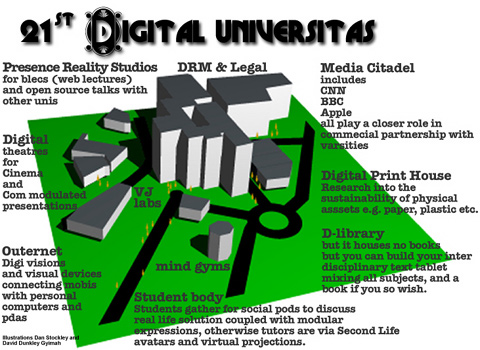
David Dunkley Gyimah writes: It's only fiction so steady on before I start getting hate mail, but this emerging world had me thinking after interviewing the University of Westminster's Vice Chancellor Dr Geoffrey Copland about the future of Unis after I'd been invited to speak about the subject at the forthcoming digital hollywood forum.
What the VC had to say took my breadth away. You'll have to watch it to understand that my active imagination hasn't made up all of the above. The future for Dr Copland is students logging on to their courses via handhelds, devising their own curriculum, education has become open source - anyone and everyone can attend. . . and so on.
In a small way that's almost happening, Blogs and blecs have become an interesting guide for the class of 2006 to discover how their colleagues around the country are doing.
Victoria, James, David, Ruth and Rachel and their contact with Adam Westbrook firstly via blogs and then in person, plus some other interesting stuff they intend to do is the forerunner to open source new transparency.
The virtual bit is my imagination gone silly again. I went into a green room last week and got viewmagazine as the backdrop. What emerged from conversations with the technical manager is that within a couple of months I should be able to walk down a corridor of pages and pull out links while having a live chat with users.
Ahh technology.
"Ping" "Radio 4 . That's all from Sunday with me Roger Bolton. Join me next week on Sunday, untill then goodbye. . .
"I just had the wierdest dream about some future technobable stuff"
There's only so much you can do on a PGDip course, but one area I have given some thought to is Music Journalism.
Today I got to clearing out some junk and trawled through one, then another, then. . . LPs. Yes those black plastic discs with tunes grooved in em.
Gosh despite my penchant for all things techy, my LPs are one vestige of yesterday that I can't shake. I can barely play em. My record players taking leave of of its functioning sense. Yes I could buy a new one, but nostalgia would rather have me admire the things.
Bobby Byrd, Lynn Collins, mostly of all James Brown's stuff from the 60s/70s/80s, Shalamer.... Shalamer ! Oh dear that brings back memories dancing at Soul Train
The heady days of music journalism: NME, The Face, ID, Blues and Souls, Paul Moss, Julie Burchill, Punk, The Smiths, Pogues, Chilli Peppers, Nirvana and you can fill in the rest.
It's not that anything worthy isn't happening at the mo. That's a **** nonsence. It's all relative. My mother would have me believe Bing Crosby turned water to gold. , Yep I'd be as much into Snow Patrol, Razorlight, Beyonce, Music undergrad Nancy Ginindza and at some time I'm looking forward to one of PGDip Journo Ruth Owen's gig. Maybe it's just that I can't go three days without food, sleeping in the same clothes and a bottle of Sam Miguel which lasts me just as much ( I don't really drink) in pursuit of toones, which leaves me bereft of feeling it...
But somehow I feel that living it breathing it ethos of music journo'sm has waned. Although George Skafidas', a 05 Masters student would beg to differ with this site, more than sounds
So how do we make this work and could it? Kienda Hoji - head of commercial music is all for it. His newly created Faculty Records - the only label within a uni is one reason why Music Journalism as a module makes sense. So what do we do next? It's not up to me, but suggestions on a LP cover pushed under my door.
Be careful what you do climbing the media ladder, cuz it could lead to an almighty fall down
Not as many articles this week on viewmag as I would have wanted to, but a busy week and even busier next, when I hope to introduce an aspect of the outernet onto view that had me jumping up and down like a three year old.
Thursday was interesting, the debate about technology and freelancing at the Front Line Club, chaired by CNN's Christiane Amanpour. Hoping to post this soon after some work on it. Name dropped a good friend into the debate, Riz Khan - a keen advocate of digital technology - and now one of the big names at Al Jazeera.
When I got home I emailed him and then what emerged from our emailings to and fro was a story he kept modestly quiet about. We spoke about technology and programme making while editing a programme about the Hajj one evening and he mentioned "Oh there might be an Al Jazeera international".
Might be!@$$%$% It now emerges he started it all... well AJ approached him and he sounded out a few people, got in contact with an old manager friend and the rest is history. Humility... If you've ever met Riz, you'd understand. He'd walk into a room unassuming and beam with an extended arm the words: "hello I'm Riz Khan".
The fact that he was interviewing Bill Gates or some president earlier makes no difference to his attitude and "joe-us".
It is a lesson indeed. As journalists, seen on TV or what have you, we are no different from anyone else. The shop keeper sells essential commodities, we sell information.
But as we walk throough the corridors of this profession, we meet those who believe themselves too worthy of anyone's presence other than similar celebrities. Ah well...
And so off to aerobics again and then back to finish off a chapter on my nameless book. Hello to you if we met at Front Line and a hearty thank you to those that organised it all
Will advances in broadcast technology lead to more and more freelance journalism? In a nutshell this is the debate being held at the Front Line Club today, which honours emerging talent through its Kurt Schork award.
Chaired by CNN’s inveterate broadcaster Christiane Amanpour this question is the low hanging fruit. There will be room to explore deeper questions, but the answer is unequivovcal: yes.
Why? Because the monopoly that consolidated broadcasting, particularly television engineered at its inception has finally been broken.
Historians will note how TV emerged more or less from the bowels of radio, which in turn was heavily linked to engineering firms producing the nuts and bolts of broadcast production and distribution.
It was and still is an incredibly highly politically charged medium, so only few, very few deep-pocketed, politically connected companies could afford to buy their way into the gathering and distribution of the message.
Manufacturing receiving equipment was a cinch; herein is the asynchronous relation in broadcasting that held back johnny-have-a-go.
The Net changes all that. The production of low cost cameras and editing gear changes all that. The ability to travel by air at monstrously low costs compared to the advent of air travel changes the scene; the allure of broadcasting and fame by proxy in journalism alters the mediascape; the deconstruction of media – a more televisual aware public as witnessed through citizen journalism - provides an understanding for changing times
Ironically, the debate comes as I’m emerging from intense contact with newspaper journalists turning to video journalism to up the content game. The BBC [no less than a DG team I'm told] sent a video journalism team to look at the Press Association and the programme I helped them set up.
More on that in a later blog. This programme may not necessarily yield more freelancers but undoubtedly there are increasingly more journalists in the field with the stock to become their own brand.
I have spoken about this in articles on viewmgazine.tv and I note that broadcaster and journalist Andrew Neil said that much at last week’s society of editors meeting.
We now have the tools to do just about anything: radio, TV. Web, . . . quinne media .
And a new generation of technologically fearless, multiskilled, journalists are emerging who will push their own brand if they can’t find work or the working conditions of employers appears Victorian.
There is a greater subtext to the debate by Institute of War and Peace Reporting held on the day when they're honouring Kurt Schork – a highly experienced journalists - and there are many other names that we must pay tribute to.
Comrades who have fallen in action by merely doing their job. More recently Martin Adler – another highly experienced freelancer was short dead in Mogadishu.
The absence of readily accessible broadcast news from some of the world’s most notorious hot spots is one good reason for skilled and unskilled freelancers to make the region their own. If anything it provides a steady stream of stories plus income and sates the appetite of the curious in peeling back the complexities of an area’s politics.
That much led me to South Africa in 1992, armed with a uher and sony recorder to report from among others Katlehong – then the world’s murder capital.
Award winning video journalist Ruud Elmendorp one of the industry’s most skilled journalist started life off as a freelancer 6 years ago reporting from Central Africa. Today , the calibre of his work has led to more clients taking his pieces, but he still freelances, and each time he’s out on a story he must keep his wits about him.
This raises deeper questions of security and safety. If more experienced journalists can find their life in peril, what more those just entering the profession equipped, yes, with modern day broadcasting equipemt – dv camer and alaptop.
Some organsiations provide cover for their bona fide freelance journalists. That's security awareness, insurance, bullet proof vests et al, but for every freelancer in the bossom of a network broadcaster, there are many clamouring to suckle.
The reality is simple. There are more journalists that jobs in are industry – 100,00 grads in total with only 20,000 jobs available in a year according to BBC network’s radio 1 – a station for the 15-35s.
It’s unlikely this number will improve as more centres of journalism set up. And so statistically speaking we can presumably expect more casualties. What can we do?
Does the industry need to get together to address this? That’s just one question that I’d be interested in hearing more about today.
Sitting on a train wifing, my mind drifts away from all things journalistic. C'mon - there is life beyond those borders. Nancy Ginindza - a talented musician comes to mind.
I abs love her music and have used its power to convey visuals from videos I have directed including a vastly downloaded vid on Iraq with photos by award winning Yannis Kontos.
So its simple, please make her famous. Because, well, one way or another she will be. Savour this.
+++
Meanwhile Shirley Thompson, a phenom composer has just reurned from Broadway scoring for Push. You can listen to the themes on her debut CD New Nation Rising which she's kindly let me use to mix with Yannis' reel for his award ceremony. go to viewmagazine.tv
About to post a video of me reporting on London's commercial TV Network. It's a finance and got me thinking about a myriad things.
This week the BBC held out an olive branch to newspaper publishers saying it would accept their footage, presumably alluding more favourably to "local TV"
The deal is this. The BBC with is division of video journalists has spotted a tier lower than regional TV to sell its wares. The same has been made of ITV.
Local TV is set to become a battle ground for eyes and advertising. The latter is something the BBC has no worries over, but that leaves local newspapers apoplectic with rage.
Eyes = advertising. The piece I'm posting says that much. Big sponsors now have music events firmly sowed into the corporate strategy. To have you brand flown across Glastonbury et al guarantees the ad team get the wink of approval from the CEO.
The newspapers have gone on their own offensive. Meanwhile ITN multimedia brand ( a quiet evolution) continues to grow and its online sites - localising their reach - are caching and pushing their assets.
So I'm back to video again. I'll deconstruct this for media students in the context of how video journalism may have approached this later. But meanwhile here goes. There's a bigger story in this.
A month ago I spoke about the erosion of singular disciplines, how the difference between broadcast and print student was soon to vanish. Was I a bit too prescient? The news this week is of a meeting of minds between the NCTJ and BJTC.
"The National Council for the Training of Journalists has said it is to work more closely with the Broadcast Journalism Training Council as the demand for multi-skilled, multi-media journalists increases". according to Hold the Front Page .
I was locked into lecturing at the time so could not attend the monthly BJTC meeting for which I am one of the members to report on this. But I'll be catching up with our secretary Jim latham et al to bring you greater detail.
Make no mistake this is a landmark moment - an irrevocable change to the media in defining what constitutes a newspaper journalist and broadcaster.
If you're a print student reading this. It's now the industry that's changing, not the imagination of those who pass you by in the corridors. Is this good news? You could easily argue course not, but it is change that's taking place.
Casino Royale starts its rounds to flush out the fakes. 007 is the real deal and with a new Bond at the helm you can bet your last hand, movie bosses will be going big on this. So I wanted to know what the real intel chiefs thought. This interview was recorded before Casino Royale was slated but gives a good impression of the life of real 007 agents.
I appreciate EX CIA chief, James Woolsey, for giving me his time in Washington DC.
Meanwhile is it video journalism or not and what makes good vj - the debate apparently was a key issue at the Society of Eds meeting in Glasgow. I couldn't go but here's my 20 second take.
There is vjism by dint of one person holding a camera and then there's vjism that seeks to create a new lingua franca to that which dominates traditional TV. Put simply there are photographers and very good ones and there are photojournalists. One must capture the moment for the front page. The other attempts to contextualise a reportage with an appropriate shot. They're both snappers. There are VJs and Vjs - both do a job. I would like to think man with a movie camera ( geddit) is re-inventing/breaking rules.
I had in mind today to speak to someone I have a lot of respect for after sharing a podium with him in the US last year. Naka Nathaniel works for the New York Times, as a Video Journalist /writer etc and is just about to set off to Dafur.
This time with his correspondent Nicholas D. Kristof, a columnist for The NYT they're providing a piggy back for NBC. Naka and Kristof have been to Dafur a number of times and its mightly encouraging to see that his newspaper continues to bring news of the region to its readers through Naka and Nicholas' efforts.
I started off recording the session with this contraption above. It is state of the art mp3 and if you've ever used a uher before this really is like way beyond anything.
Half way through however and the devices capture card gave up ( hahaha ) I hear you snigger. So we switched to skype and a nifty device called audio capture that allows you to record sound coming out of your mac. The free version only allows ten minutes a pop, but its worth a future investment.
So to the questions.. Naka talks about video journalism and a question being adressed by the Front Line Club about freelance journalism and the future.
Join in the debate nearer the time when I hope to put up a range of views forward for us to discuss.
British Students shunning science screams the headlines. Notwithstanding the brilliant number of scientists in academia and industry, perhaps a more acute bit of navel gazing is required.
My first attempt to continue my science studies- a degree in Chemical Engineering - ended in tragedy. After three weeks on the course at a uni I won't name crammed into a class of 60 plus, with a lecturer who was so monumentally unispiring it was time to leave.
But the real worries was the p**s poor salaries on offer back in the 80s and I doubt its changed much. I'll post a feature piece I made for BBC Reportage, The Brain Drain.
Verdcit: many students, researchers were high tailing to the US where they receive more money and recognition.
Until somebody adresses this and the bias to business qualifications ( media is a belated fad) then the UK will continue to haemorrhage.
Incidently I did complete my degree in Applied Chemistry but by the time I'd got passed my second year, I'd already begun freelancng for BBC radio, realising the sciences and all the additional maths, integration, Newtonian mechanics, organic chemistry was not for me - as a career.
This morning I have just been looking at my notes from Uni on Nucleophilic attacks
Busily putting some flesh on a discussion piece I'm writing for the Press Gazette and the piece more or less wrote itself emerging from my turn of last alpha sleep at 5
It's really annoying and happens quite often. The result you lay awake reading fluidily in your head the words of the article unfold. Go back to bed and you lose any connection with the other world and the crystallisation of your package.
Ah well.
6.00 Mmm I am making mischief. Now let it stew and return again for a stir. Not cricket to reveal its contents, so, er sorry can't say much. No it has nothing to do with D-Notices or offical this or that.
7.00 Quick look inside FTP of Viewmag. Any hope now of a few dark eye winks are kissed good bye. Something is happening with the traffic. It's 3000 up already and I have found some new interest from Taiwan. Hello there if you're reading this. Fat chance me thinks.
8.00 a friend has posted me the most exquisite site to look at http://www.marqmagazine.com/ Yum And now for the fun stuff. Answers on a post card what would you do to enhance it. Kevin drives and tests cars for a living. Don't sniff. Here he has the Aston Martin and then the Jag and then heavens knows what.
I once had him get this amazing car while a freelance at Channel 4 News. We wired the whole thing up courtesy of the ITN Q department and drove around London. I'll tell you what happened next some other time.
9. 00 Surely time for sustsenance. My thoughts cast to PGDip work. Look at the sites. Then MAJI - who are doing tele soon.
9.15 My Mac and I must end our liaison for the morning. there is a life out there, but before I put on my running shoes and get ready fot morning aerobics oh yes I l* o%^o k o86u4 t si887&%%^de and n@@@oti zz Zz Zzzzzzzzzzzzzzzzzzzzz
So if you're an avid BBC Radio 4 Today fan, did you share in the moment of "quick pretend no one's listening" when they attempted to have morse code emerge from the bowels of their studio, only to realise that after a good minute plus, going on for eternity, the beep, beep, dooh, beeeeps was bordering on the Monty Python.
It was a great piece of original radio idea, but i guess the producer forgot to ask how long it takes to transmit a sentence. Answer, for ever.
So as Mr morse code is merrily clicking away, one can only imagine the studio manager and item producer, plus editor screaming " enough" tempting the presenter to try and find a natural break to intervene, which she did on a couple of occasions to no avail.
I bet they had an almighty laugh after the show.
Next week a man attempts to hold his breath for the world record, except the producers didn't realise that's eight minutes, 58 seconds.
" Web video is hard to do, and even harder to do well. Many are dabbling, but if anyone has found a real business model to support quality visual journalism in the multimedia world, let us know"
This from, Jay DeFoore, writing for a well respected photo journal.
So I posted a reply:
Dirck Halstead continues to clear a thorny path for many of us to peer at a future which attempts next generation TV.
My mantra after more than 10 years of professional small video camera use convinces me that video journalism of a kind that redefines television's compositional arrangment for news and docs will emerge from a photojournalistic stanza.
I use a photo from award winning photo journalist Yannis Kontos to instruct would-be videojournalists. "If you can tell or understand how Yannis captures this image" I say, "you're half way there".
Whether we choose to do video journalism is a question. Is it difficult? That needs qualifying. Nothing is ever easy to start off in our trade.
But the newspapers in the UK are having a go and I think I managed to deconstruct enough of it to take the sting away addressing one of the UK's most successful newspaper publishers.
Incidentally it's not the be all business model, but newspapers with VJs in the UK are now selling their footage to broadcasters which includes the BBC. Stranger things could happen.
It was a while coming. In 2000 Viacom UK contacted myself and colleagues to help them fashion a new kind of advertising. XTP would revolutionise the Underground. Our task was to visualise 5 degrees of motion. What?
Simple. On the one hand varying degrees of animation and movement would mean different revenues, but also equally important the implications of a moving ad on the Underground have serious health and safety aspects.
So we experimented with a few ads under the guidance of Viacom UK and came up with five ads pitched at Imagination's HQ. I'll be featuring an article on this on www.viewmagazine.tv with all the ads at the time and how we came to develop them.
The stills here are froma video where we developed the brief of sporting london. Jon Staton, former head of TV at Saatchi and Saatchi could find a helicopter at short notice of you wanted one.
In this case something less adventurous, we hired out some studios and I directed a couple of sports men and women in. We then comped that in After Effects
Gosh 22,000 visitors to www.viewmagazine.tv - and I have the Berlin awards to be thankful for that. I'm going to be posting some more stories from the awards soon. Tomorrow hope to be interviewing Naka Nathaniel about video journalism in expectation of a Front Line Club debate on technology and the future.
One of my closest mates from Medecins sans frontiere has brought over the most strangest looking device. You'll see it tomorrow. It is the future of podcasting and MP3 and looks like a stun gun.
And finally Westmins postgrad journalists are on the verge of something. But this is strictly Chatham House rules so that's all I can say
My family did no wrong, but the question is are we on the national DNA database? For within the realms of science fiction meets science fact we are project beta - the first use of DNA finger printing outside of a criminal case.
The first deployment of this forensic science was a criminal case. The second, and the fist time it was used to prove a custody case Sarbah vs Regina (the state) was my family.
So should this DNA print now exist in the police's vast ID bank. No! Do I know it exists there? No. In any case it shouldn't.
There is a wider debate fashioning and one that I remember from a conference in Leicester a decade plus ago featuring Baroness Warnock et al
You've been Goggled Google surpassing ITV and Channel 4 News. Proof of the reach of the net ( some "@£%!! luddites are still dismissing it). There is a future waiting for us that melds tele, no video vision on the net and myspace + Current.tv is about to come closer to that.
That much I'll be writing about in an open discusion piece for the UK press Gazette in a fortnight's time