Wednesday, November 17, 2021

Inspiring Solutions with Great Stories

Dr. David Dunkley Gyimah

Dr. David Dunkley Gyimah  

10 min read
When journalists decided journalism alone wasn’t enough, it was time build physical solutions, then story them.


“Congratulations, funding for the StoryLab/ Innovation hub has been approved”, said the email from the Research Innovation Fund.

For the last year messages of support and appreciation for a program that bridges storytelling with problem-solving leading to physical solutions have been coming into our inbox.

“Thanks ! Was an amazing experience and would highly recommend the module to anyone coming through”.

“It was an incredible experience from beginning to end. The course is packed with opportunities to develop hard and soft skills on multiple areas and to build a valuable network. Lucky to have been a part of it!”

“Most definitely the best course of my academic career…”

It’s not journalism’s job to save the world, but supposedly report what it believes is important to its audience. That‘s what the profession has carried with it from its 18th century when notable figures like Daniel Defoe wrote the first formative modern account of journalism — the great Storm that battered Britain, before penning his fictional Opus Dei, Robinson Crusoe.

Yet media has no natural borders, particularly evident in the digital era-and- beyond renaissance. If media seems like it’s fixed that’s because the stakeholders and controlling parties like to make it so.

“For many years, people like me perpetuated the myth that unless you were part of the television establishment, you couldn’t make television. Channel One Challenged that”, Stuart Purvis said to me. Purvis, a former CEO of ITN, the UK’s biggest commercial news and factual broadcaster is today one of the UK’s most respected media figures.

Channel One was a platform and a UK social experiment in the 90s which demonstrated command-and-control media production was a sleight of hand. Despite its staff being ridiculed as Robo reporters, and bad imitations of Max Headroom, thirty youngsters became the first Brit professional one-person-television-crews bursting the myth.

A decade later, Screen Gen content producers, remixing, refluxing and fixing in their personal spaces unequivocally tore to shred the myth.

Hence it’s conceivable that if you were to launch Channel One today its new prosumers (call them “Oners”) would be enveloped in innovative work mixing disciplines, using AI, creating new platforms, new business solutions. In fact some of its alumni already have.

SCREEN CREATIVES

Jonny, 21-years of age, is atypical of the Screen Gen as documented in Grown Up digital by Don Tapscott. I’ve watched him up close. He’s my son. At five years of age he first beat me at EA Rugby. Ouch! By his mid-teens he’d amassed a spectrum of platform and Apps.

He’s into Black Panther. That’s his first rig above, and today is ranked high playing Rocket league. His twitch, visual acuity and spatial skills is common place across Screen Gens, the new ONERS. And analogous with a 2004 study of young laparoscopic surgeons , The Impact of Video Games on Training Surgeons in the 21st Century he’s developed a set of unique skills different to his parents. Video gaming is good for your mind says creative expert Steven Johnson. For Jonny it’s his passion.

“What if we decided to use everything we know about game design to fix what’s wrong with reality”, writes Jane McConigal in Reality is Broken. At the UK’s Defence Academy in Shrivenham, Swindon, this is put into practice. Artemis, a $40 game, is used to assess army personnel and MBE elites says Major Tom Mouat MBE to me and the business group I’ve been invited to join.

It’s not gaming and the physical play per se. This can yield strategic thinking that governs prioritising, decision making, etc. but it’s also about de-centralising learning outside technical expertise.

Jonny wants to be a storyteller, combining photography, design, his history, video making, gaming and writing. Our conversations revolve making his passion integral to work. He’s now completing his degree in VFX — an industry with demonstrable creative fluidity in its boundaries.

NEW TECH AS OLD

The ONERS collapsed disciplines questions are cultivated that address real life dramas needing attention: climate change, reeling racism, gaping financial inequality, food security, social turmoils and dogma politics. How can ONERS make an impact in institutional settings? How? By playing a greater role in working collaboratively with their curriculum design and being assisted in engineering THEIR ideas.

Of course journalism is important. Yet, more of the same journalism isn’t the solution says former BBC senior executive Pat Loughrey. I’ve just recently organised one of the journalism’s major calendar events: The Future of Journalism, which brings together more than 200 global scholars and featured Gary Younge as one of our keynotes speaker.

In my lecture series I’ve been interviewing some of the world’s leading international journalists.

The next generation of journalist will have to do better than the current lot and “kick Ass” Sky News Alex Crawford tells me.

But tapping into the ONERS natural skills: connecting, customising and collaborating, just as the real world problems are interdisciplinary and multi-faceted, this at least should be the default for a different storytelling- problem solving in institutional and media entities.

The idea of connecting different disciplines seems anathema or overstretch, yet it wasn’t too long ago in the 1970s when universities upped the industrial production of subject specialisms.

Prof Carolyn Marvin writing in When Old Technologies were New says: “Discussions of electrical and other new forms of communications in the late 19th century begin from specific cultural and class assumptions about what communications ought to be like amongst particular groups of people”.

“These assumptions informed the policies of nineteenth century observers at what these new ideas were supposed to do and legislated the boundaries of intimacy and strangeness of the closing different world they presented to the audiences”.

In the late 90s Human Centred Design Thinking became a feature of Design schools taking a different disciplined approach to their work.

Then consider Finland’s education system, already considered one of the best in the world. It’s switching from subject teaching to what it calls “phenomenon” teaching, that is by topic. Interviewed in the Independent newspaper, Helsinki’s municipal development manager Pasi Silander says “What we need now is a different kind of education to prepare people for working life.”

ANGEL’S TABLE

Six years ago in a TV studio in East London amongst some of the UK’s leading entrepreneurs the idea of a new approach embracing multiple inter-disciplines was being put to the test.

Could you build a program that fused several fields, where MA students engaged in some form of 3-dimensional chess? Each time you made a move, alternative problems present themselves and often they emerge from outside the core practice.

Finding a solution is one thing, seeing several different ways to frame a problem with different solutions is another. In my undergrad Applied (Maths) Chemistry days creating different molecular structures whilst testing its purity and yield continuously invited these question.

For our MA students, the TV studio dubbed the “Angels Table” was their months of work come good. With their mentors they were being prepped on presenting. For the last year they’d been through a cycle of turning ideas into prototypes — each stretching them beyond their limits. Each bringing in various experts to work alongside them.

Institutions look to build critical awareness and creativity amongst its cohorts, but how truly progressive is that if the subjects, as varied as they might be, are still siloed?

I have worked for some of the best branded media in the world e.g. BBC, ABC News, Channel 4 News and loved it. Yet there’s a reason why journalism can often find itself moored to conventions or class and cultural thinking.

One is relatively few institutions teach budding journalists the skillset of psychological warfare and their nemesis awaiting them — the dark side of PR and propaganda e.g. The Mohawk Valley formula. Or how to weaponise words. Otherwise, few popular texts reflect on journalism being dependent on class, culture or that invented word race. Journalism being colour blind is unacceptable.

In 2000, working in Dotcoms in Soho, start-ups such as Justgiving and Re-active it showed just how much cross-knowledge was required to float an idea. Worldwide, the digital renaissance forced new thinking, though this was largely extended to tech and business-based approaches.

Therein were the seeds of 2014’s Digital Story hub. But before I get to that, a fresh experiment was put in place. In 2003 we introduced MA journalism students, much to their chagrin, to HTML/ CSS and design as core module credits.

For one day a week in six weeks of a full term students would build platforms that were as varied and impressive rivalling professional ones. They made it to top spots in SEOs and drew wide praise from industry figures in the BBC and Google to name a few.

CODERS

In The End of College Kevin Carey writes

[students] are highly sensitive to expectations and organisational culture if you give them a lot of work and commensurate support. If you give them free time and an elaborate social infrastructure centred on alcohol exemption they’ll react accordingly.

The operative word was “support”. But if building platforms from web 1.0 forms into dynamic xml mobile sites became the norm, could media students dive into interdisciplinary problem solving and build real world prototype solutions enveloping any number of media, tech and Art — VR, Smart Speakers, Apps, Data and AI?

Moreover, given the size of that task could they also refine a different form of journalism storytelling that would hold audiences attention, whilst also perfecting the pitch and marketing and branding plan? It seemed a tall order, but fortunately some key developments would prove invaluable and prove, yes! It would involve Apple, the Movies, and University curriculum.

If you work in a Uni, you’ve likely noticed a perennial problem. Even when you’ve made the point several times few students read the handbook. Why would they, one student candidly told me, “It’s boring”.

When I asked journalism students if they’d watched the news, few had. But when it came to a movie like The Diving Bell and the Butterfly (2007), 127 hours (2010), Wild (2014) and The 33 (2015), many raised their hands. What these films all had in common was that they were based on true stories, some were even newsworthy.

Yet 16–24 year olds don’t watch the news. Ofcom, the UK’s media regulator, says news consumption amongst this age group at best amounts to 2 mins and rarely on television. What’s wrong?

There’s research that says covering the same old stories is a turn off, and wider choice compete for ONERS eyeballs, but research that has largely escaped the media industry reveals a major inhibitor is the style, form and and manner in which it’s made.

What if journalists used cinema as a trojan horse? Actually what if journalists relearned cinema’s impact in storytelling.

This hypothesis was presented at Apple, SXSW etc., the world videojournalism awards in Berlin. It became my doctorate — a complex interdisciplinary field — in which I came across a select number of international award winning journalists, such as New York Time’s Travis Fox, who used cinema to tell great stories. I made this video.

The third interest to launching the programme was diversity, which in 1990s went by a different name, equal opportunities. In 1999 despite continuing efforts for greater media representation, the media penny finally dropped. Diversity was as much about navigating self-interest, as it was power when it came to expressing agency.

These ideas underpinned the design of an interactive student handbook, a prototype to show students problem-solving. It was hugely popular with faculty and amongst the school secretaries because it was inclusive. It featured success stories from previous cohorts and external links advancing their curiosities. I’m partly credited with unintentionally playing cupid to two students, now friends, whose wedding we attended in Germany.

The whatever-you-want-program was launched supported by industry professionals like Lee Robertson and Stephen Wheatley consistently offering their expertise.

The three pronged approach was to:

  • Address real-world problems and build solutions, cognisant of diversity and inclusion.
  • Perfect how you sell it to multiple varied audiences,
  • Experiment with fresh Story telling formats on various platforms in an array of media.

Nasma turned her Journey, from Syria into an animated game, and getting a taste of being a creative director working with with an agency. Five years on from her TV studio presentation before experts, and her mentor, her project idea is finding new air from research funds .

This brings us to the present. In 2019, I moved to Cardiff University and working with my co-colleague JT we launched Emerging Journalism AKA Story LAB, and forged a relationship with one of Wales’ most progressive companies Tramshed Tech and new tech mentors, Iain, Robin, Chantal, Toby and Oliver.

The ambition is to roll the idea out regionally and then partner with interested universities. The funding is a small step. But then it’s a giant leap to showcase widely what can be achieved.

The LAB is run by Dr David Dunkley Gyimah and Creative Technologist JT.

To find out more how we run the current Lab click below.


Sunday, May 23, 2021

How the News returned to Cinema, rendering 70 years of Television obsolete


 In the 1970s the unthinkable happened. A thriving industry by which the public was informed about the latest news and current affairs was largely proclaimed dead. New media technology, swiftness and style from a relatively new contender, television, made Newsreels unattractive to audiences.

Some years earlier no right thinking Newsreel executive would ever have imagined their days were numbered, even links with a fledgling BBC getting into the TV news market. They (BBC) need us, would have been any riposte to impending doom.

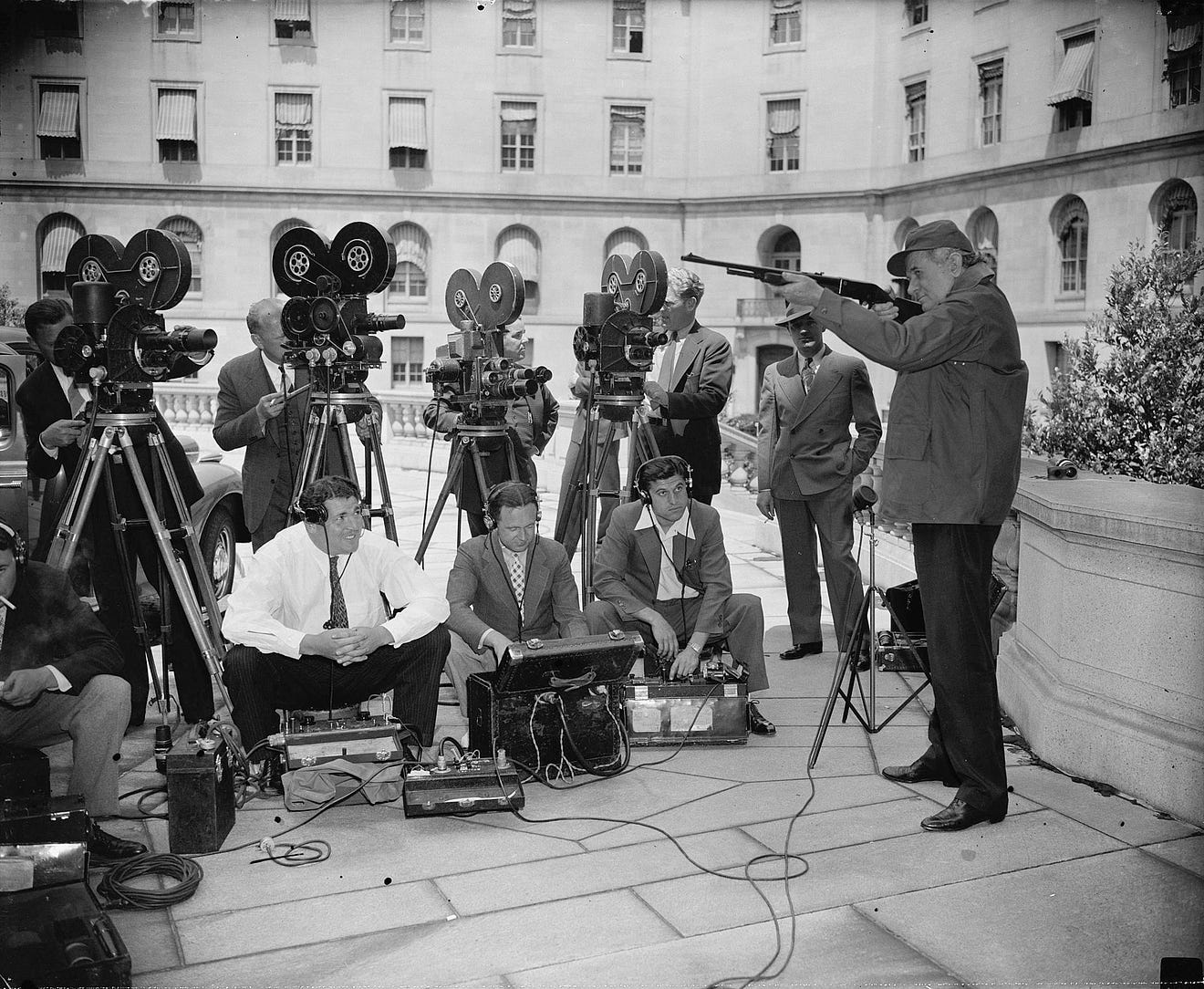
Since 1910 with the first newsreel by the French Pathe called Animated Gazette, and the gaining in popularity in the 1920s, with films from outfits such as British Movietone News, the public were sated by Newsreels.

Wiki — Creative Commons

Features could vary in tone, such as serious news and war coverage in which cameramen used revolutionary small hand cameras, compared to the clunky (Mickey Mouse ears) ones in use in this photo.

The arrival of Black Britons on Windrush was covered by Newsreels, explained here in an excellent piece by Dr Luke McKernan from the British Library.

Then there was the absurd and fashionable and an indifference to news with , jaunty music and jocular mocking narrations, that would earn Newsreels scorn from scholars.

Television News hadn’t been invented in the 1940s, much less refined in the 60s from what is its legacy today. Public arenas designated as cinemas would take to showing five minute features of news from around the world before the main feature. It would be the equivalent of watching, what would now be, a BBC news bulletin before Bond’s Skywalker at a multiplex.

Here’s where the record on history scratches to a stop, and the real relevance of this piece begins, because the shunned newsreel executives from yesteryear may be in for the last laugh. History, does at least have a sense of humour.

No right thinking television news exec would contemplate TV News dying. It’s a multi billion industry, but the writing is writ large on the wall of AI, consumer choice, and new styles.

Just as the threat to Newsreels were technology, style of production, and immediacy, the threat to TV News is the same.

And just as new custodians took over from the old guard, so here too the new contenders will oust an antiquated form of production. This 30 second clip here from a previous senior BBCs News executive sums it up.

I started tracking this phenomena back in the 1990s, when I was part of a UK-wide media social experiment. This piece’s cover photo (thank you David Freeman) signifies the duality in analyses.

Firstly, the experience as a journalist who makes news films and has been doing so since 1994, when as a videojournalist it was unheard off. I’ve since trained thousands of journalist across the world. And before then reporting from Apartheid South Africa for the BBC World Service.

To the executive and academic side of explaining future trends in storytelling, such as here as a keynote speaker to one of the city of London’s dynamic entrepreneurs, The Guild of Entrepreneurs, and News Xchange.


This week I had the opportunity to speak to staff at a TV station in Denmark about the future. The threat to television exists, from amongst others, technology in AI, public boredom with the status quo, but also new platforms in streaming services. News, but not as you know it, in the same way Newsreels were caught napping is about to have a sense of de ja vu.

“A style of delivery that hasn’t changed… cannot be the answer” in the above clip, says Pat Loughrey, so what is?

Ironically the very thing ‘cinema’ discarded in Newsreels is resurfacing with lessons learned. Cinema back in the 1930s meant different things, a venue and style of filmmaking and not necessarily fictional.

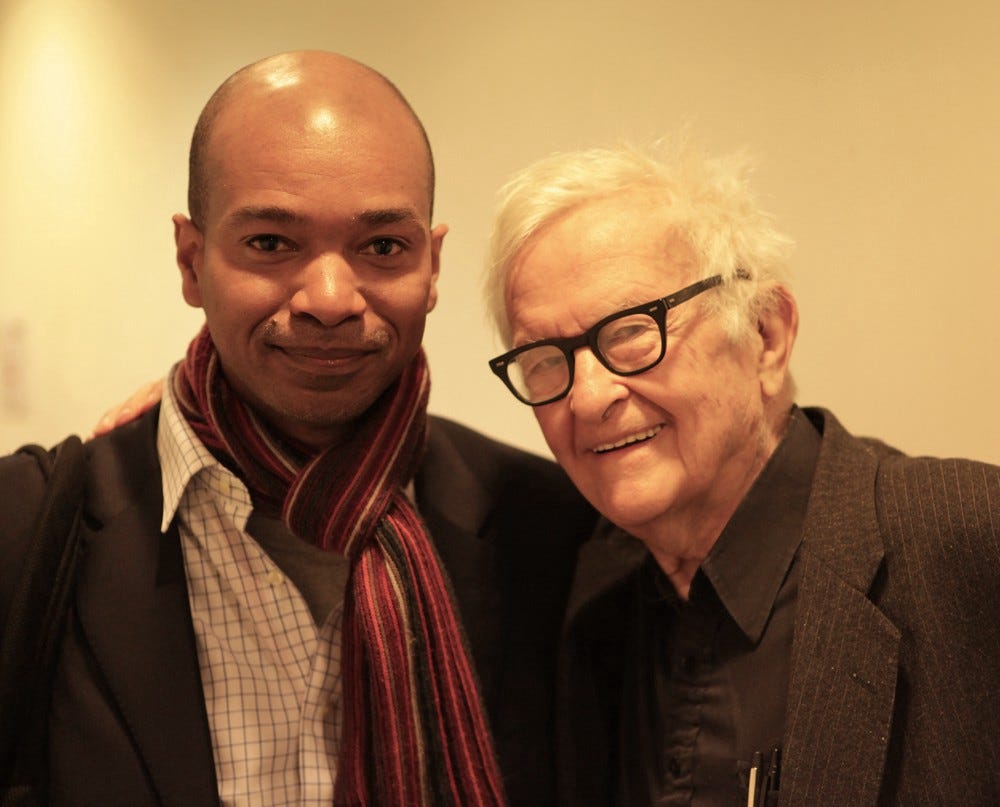
In the 60s one pioneer, Robert Drew with his friends such as Albert Maysles (photographed here at the Sheffield Documentary festival) was transparent about it, giving his way of doing news, a label, “Direct Cinema”.

It survived, albeit in limited form. News executive would be damned if they were going to let a style of filmmaking overturn a business and class model which was gaining ground.

From here to the present lessons have been learned. What will prompt change is happening right now in the shape of new streaming services. Not by taking a style and transposing it on this new form as news executives first did with the Internet. They simply lifted the newspaper onto the web, but by acquiring fresh thinking promulgated by audiences.

At most a decade is the cut off point. It’s easy to sneer. This cutting from 1963 spoke of Mobile phones in the future; something I repeated with a team speaking to the BBC in 2004, when mobiles as they exist then hadn’t surfaced.

The question you might ask yourself, as we have done in our Future Lab, is in the face of change and mergers, such as AT&T’s intended fusion with Disney, what would happen if Netflix or HBO did News?

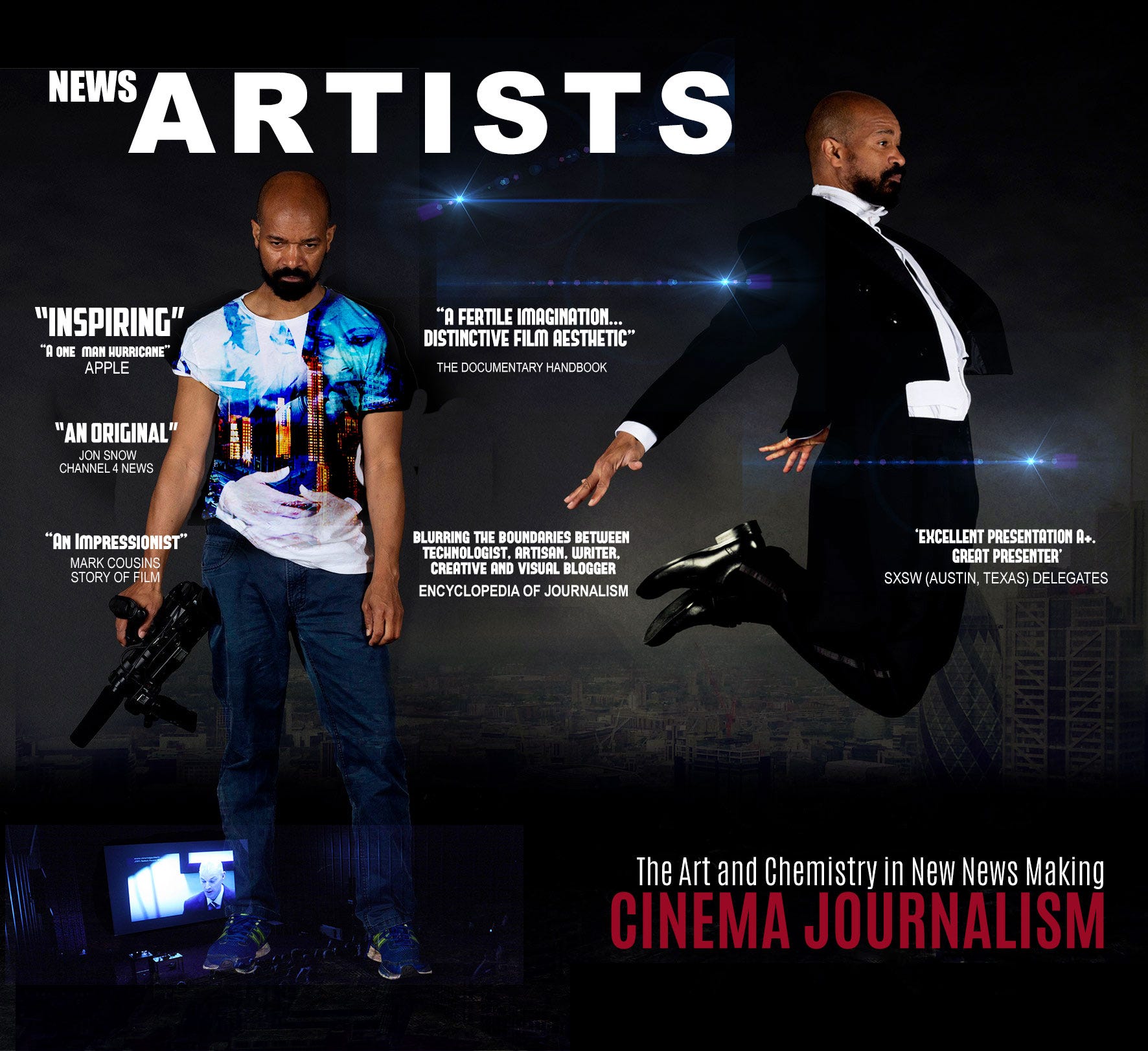
The future of this revolution, much like the industrial one the shaped the multi-billion pound art industry will involve audiences seeking to come into more contact with new news artists. Expressions will be based on what the artists see rather than what they know. And it will fuel a yearning for new content and innovation from audiences, proven by Netflix’s growth over the last 15 years. People easily forget the past in a hurry even when the provider is one of the News behemoths. We know this by the history of Newsreels.

Dr David Dunkley Gyimah has been a journalist for more than thirty years and a technologist with a degree in Chemistry and Maths. He was an artist-in- residence at the Southbank Centre under its artistic director Jude Kelly CBE. He is based at the University of Cardiff. More on his background here

Thursday, May 20, 2021

How to be a global leader in leadership by simply playing games !

 
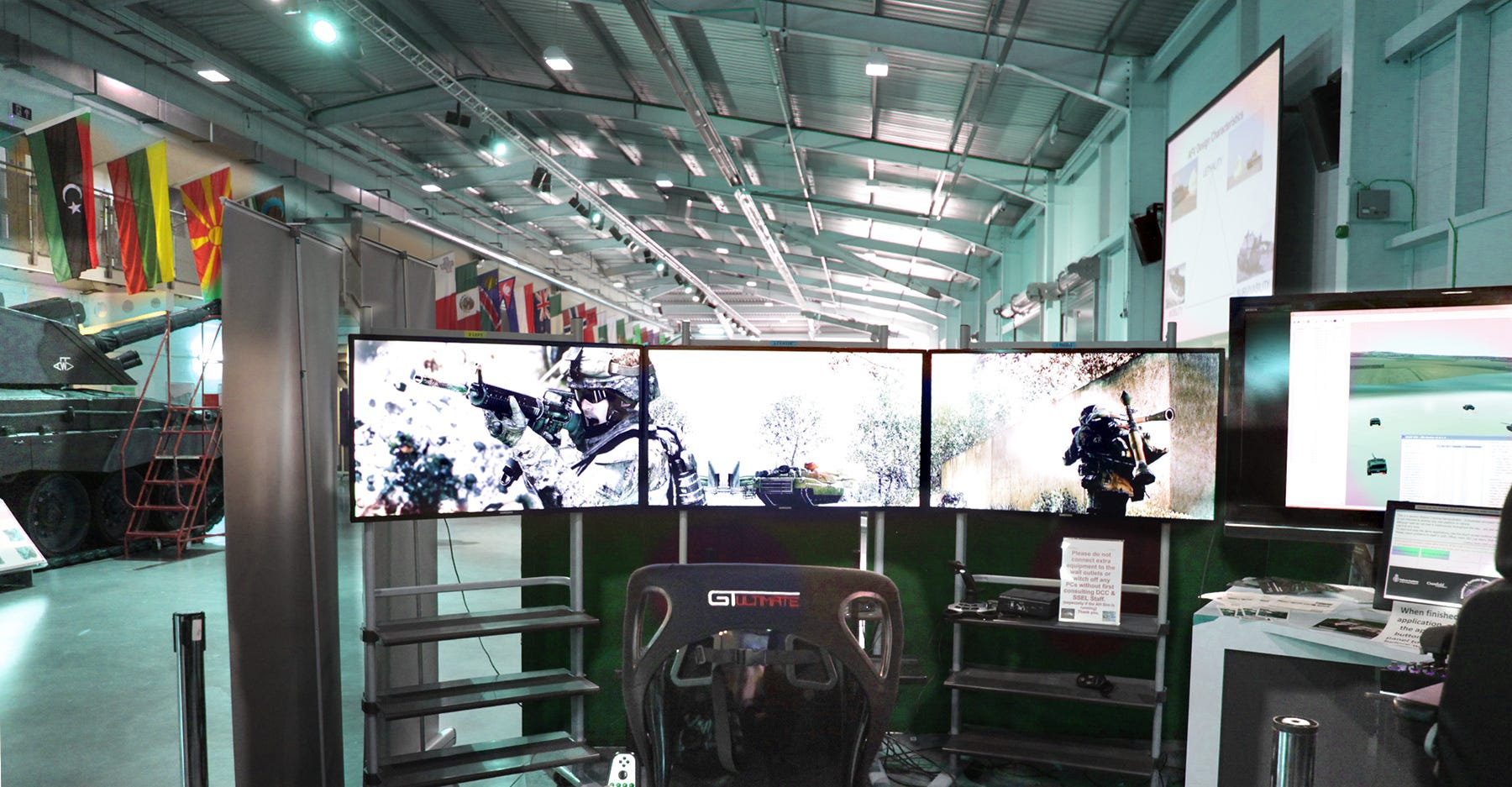
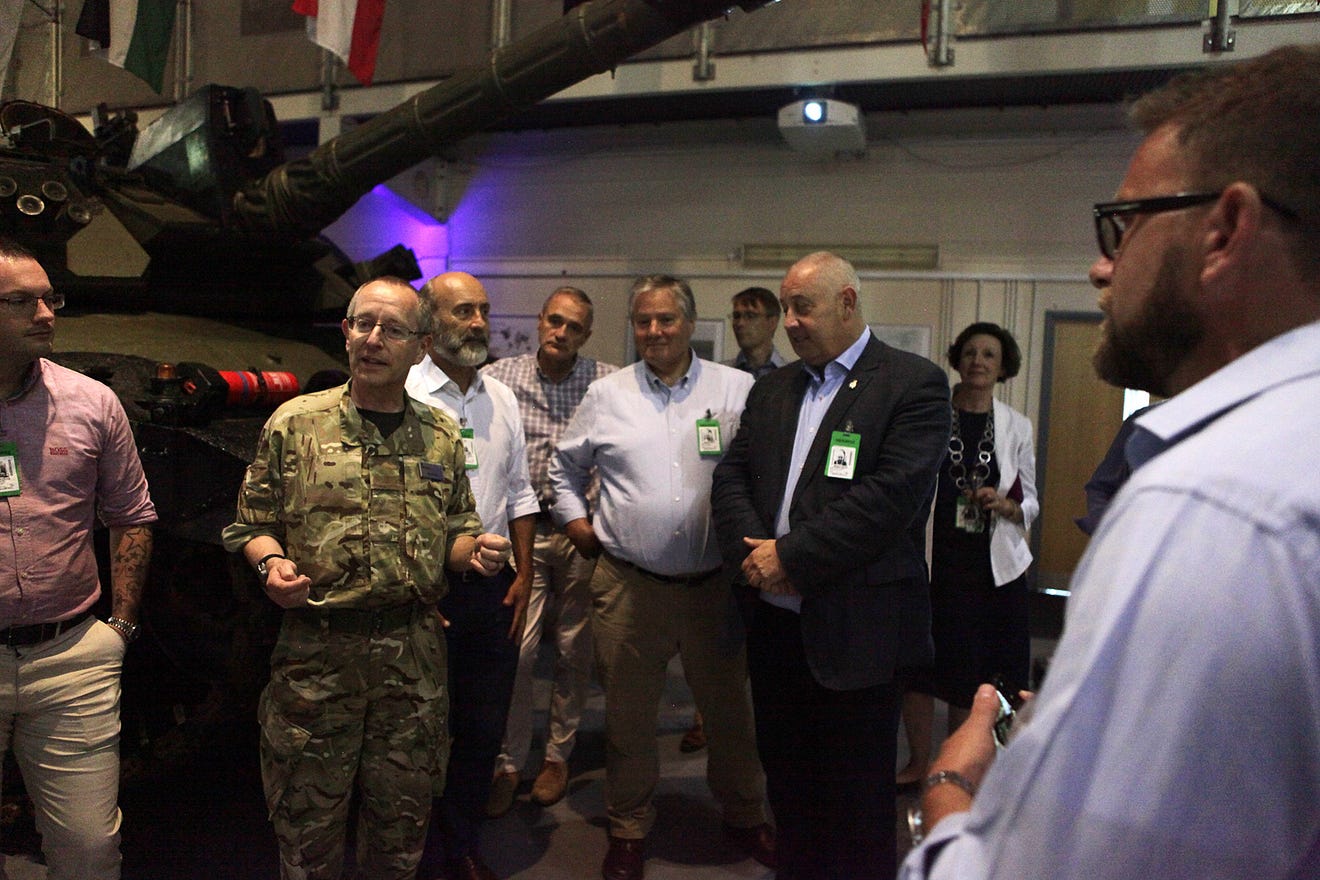
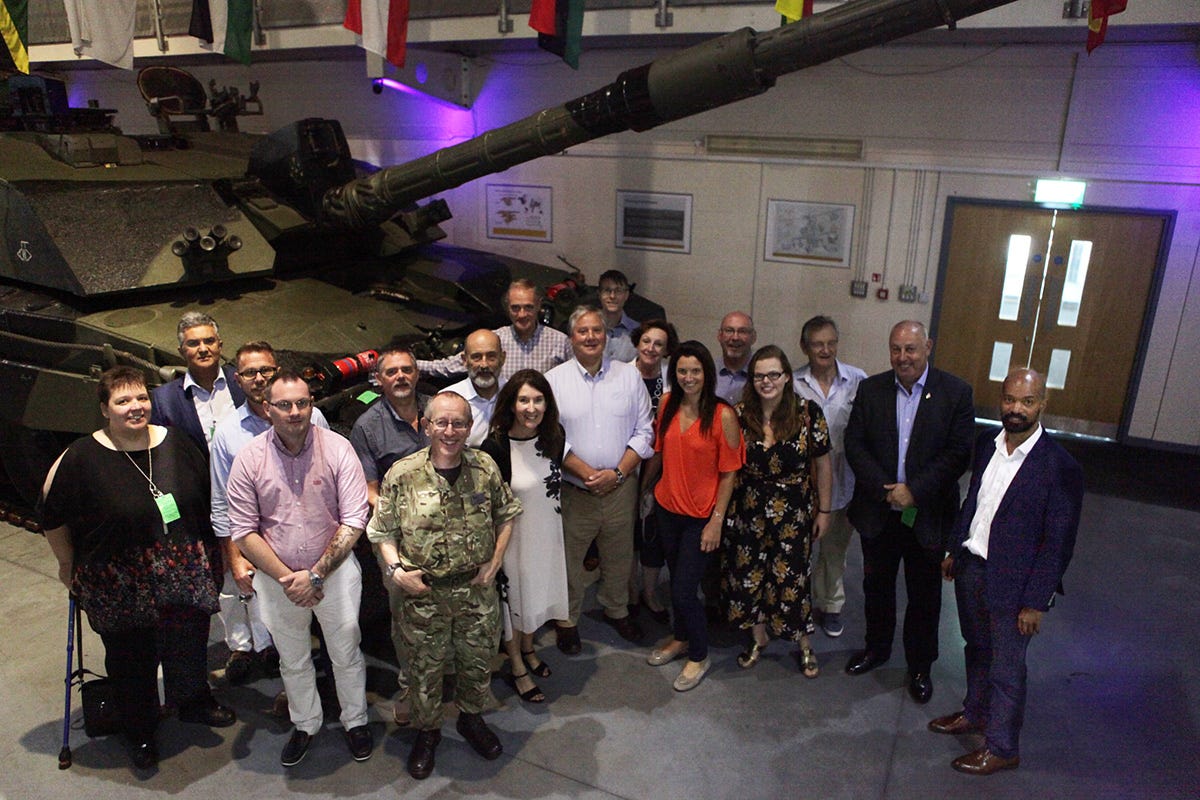
First person shooter games on the Academy’s campus. To the left a £4m Challenger Tank and on both sides lay an assortment of military hardware.

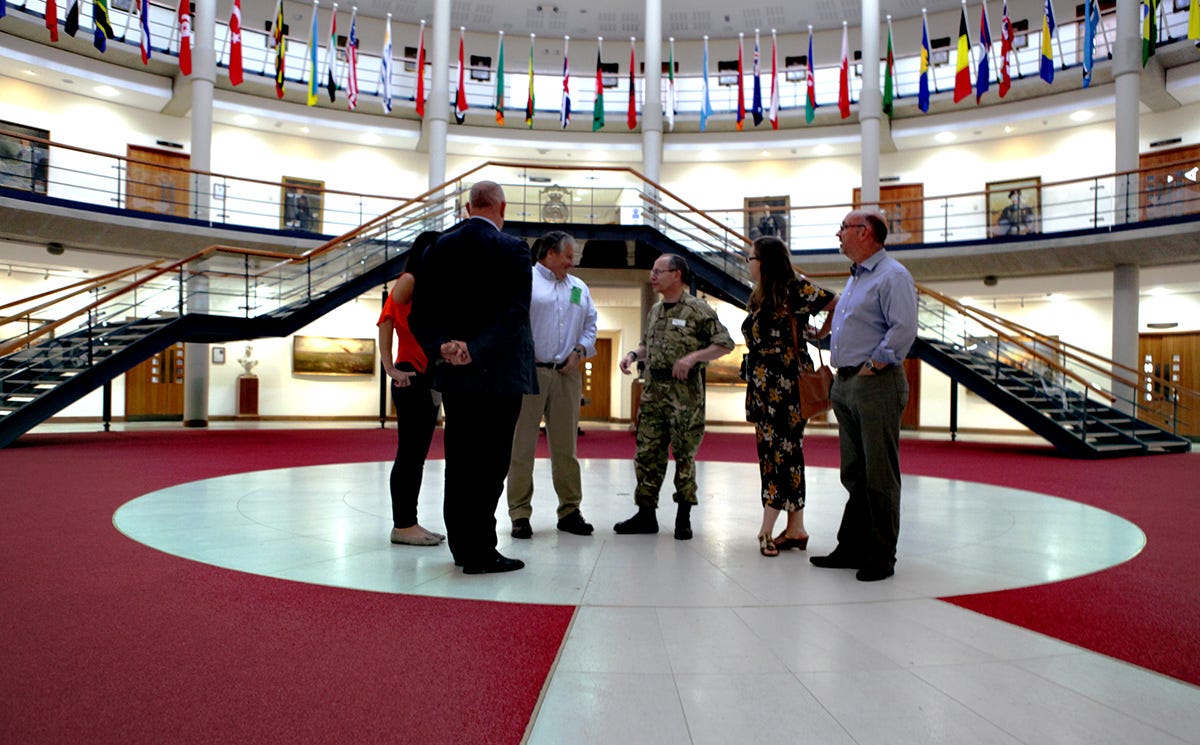
Tucked away in the leafy South West of England, secured from neighbours and behind high security paraphernalia is an academy which, amongst its many offerings, specialises in gaming and simulations.

MBA elite universities,FTSE 100 conferences, Nintendo; few can rival this place where simulations and scenario planing carry consequences that go far beyond exam certificates and commercial imperatives.

On campus, software gizmos and million pound simulators wrestle for attention amid a spectrum of military hardware, such as the £4m Challenger 2 Tank, and rooms called “The JFC Battle Lab Simulation and Synthetic Environment Lab”.

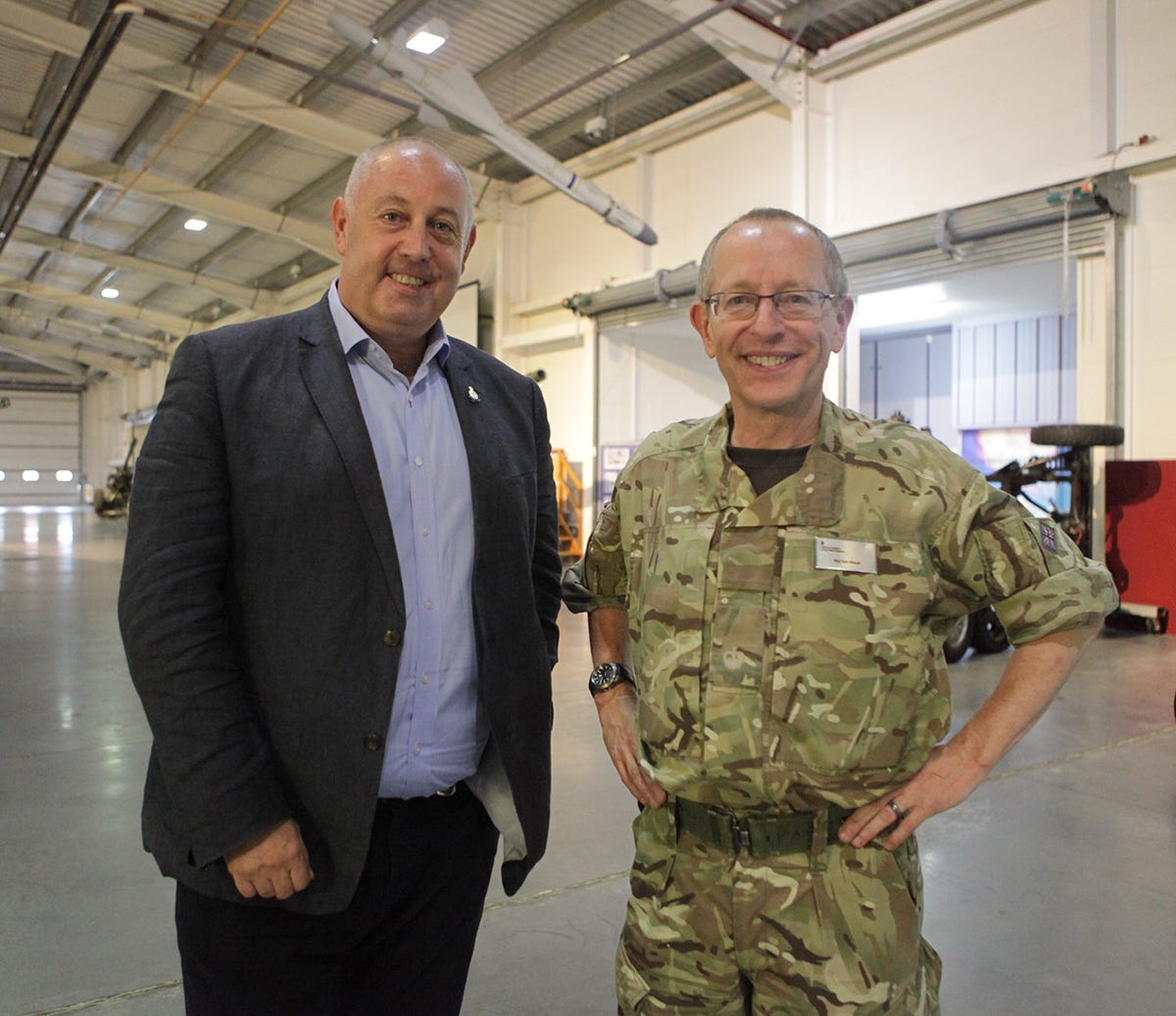
We’re inside the UK’s Defence Academy. It’s where Bond would come if he lived in the real world. Today, Major Tom Mouat MBE a specialist in gaming, modelling and simulation is briefing his visitors the Guild of Entrepreneurs on the importance of gaming.

…to play a game is the quickest way to showing the emperor has no clothes and getting past that group think where the boss goes “so we’re all agreed then” and inside you’re saying “Oh my God”, but no one has said anything so you’re not going to say anything.

As an ice breaker, Guild members, like cohorts entering the academy’s programme, are introduced to a multi-player game. Six people to a team with just about enough instructions to take up a station are given specific tasks: Captain, Helm,Weapon Control, Science, Engineering, and Communication. The objective is to destroy enemy ships and dock with their own stations to replenish fuel.

“Yes! You guessed it” Major Mouat says in a jovial raconteur tone, referencing a popular galactic space franchise, except, this game wasn’t designed by Director JJ Abrahms or the team behind Grand Theft Auto. On the contrary, it looks like a throw back to Atari’s Space Invaders. Our last piece of advice: “If you don’t talk to each other, you’re all going to die”.

At first there’s a momentary stasis of inactivity, and then the room becomes a symphony of different voices.

“Bearing 270 degrees”, says the helm’s steerer.
Load weapons. Weapons armed. Lock.
“Have you fired yet?” asks the captain, “we’re being surrounded”.
Weapons deployed comes the response.
But there’s an immediate problem. Major Maout peering over points out, you’re not far enough from the blast effect of the nuke. You’ve about five seconds and you’re all dead.

Twenty-five minutes on and it’s all over. The value in this game the Major says surpasses many other expensive simulators. “Did you care about the graphics”, he asks. “No”, is the chorus in reply. Artemis cost $40 but it’s the affect it has on players compared with shoot em up games that’s intriguing. Simulation by itself though has no inherent value. How it’s used; the supervisor and support network is what makes all the difference. Major Mouat’s knowledge, a quick search online shows, is highly prized and sought after.

Later we’ll play another game where the Major has now upped the ante, which in psychological language references cognitive loading. Separate teams will come together to solve a larger puzzle.

Different people, have different skills and are suited for different jobs. You find out very quickly who those are when they’re cognitively loaded….We test everyone entering the army, he says.

Cognitive balancing

Two of the most famous psychologists whose work involves cognitive loading and stress testing is the Nobel laureate Daniel Kahneman and his colleague Amos Tversky. Their work captured in the riveting read “The Undoing Project: A Friendship That Changed Our Minds”, by Michael Lewis, and Kahneman’s book Thinking Fast and Slow, shows just how fragile the mind is and how we’re prone to react when under stress.

People are more likely to be selfish studies have shown, or yield to temptations. It’s the reason why when you’re under stress a bar of chocolate become alluring — when you’ve promised yourself you’re on a diet. Further revelations link attention and intelligence. In a test by University of Oregon researchers they found that training attention with children increased their ability to attain their goals and raised their intelligence, and that genes played a part in this, as did parenting techniques in controlling attention and emotions. Are people born leaders?

“You quickly spot potential commanders”, says Major Maout, referring to Artemis “There the ones who end up walking around looking at other’s screens”. And that’s the point with the barest of information about completing a task, what do you do? If you find yourself in a tight spot, do you improvise your way out of it, or give up? And what happens when the problems mount? Where’s your limit to when you might give up?

As a lecturer I frequently witness this when I’d simulate a newsroom strategised around agile and sprint productions. The objective is to see how potential journalists could work with each other, as well as, how adaptive they are to fresh levels of cognitive loads as they accomplished new tasks.


Gaming isn’t what you think

Today’s show is one of a variant cohorts on the academy’s diploma or MSc programmes are likely to encounter. To give it it’s full name war gaming is big business, comes in many forms and dates back millennia. Benjamin Jensen of real clear defence writes,

The popular game chess dates back to ancient India where it was called chaturanga, a Sanskrit name for an epic army. The game, a simulation of war involving warfighting functions and formations of its day, helped rulers and their advisors visualize and describe military problems while practicing new schemes of maneuver.

Jensen documents one of the more prominent advocates of war games General Von Moltke who used maps for gaming to mobilise Prussian forces adapting to new warfare. More recently, the US secretaries of the military departments in a memo voiced concern at “the need to reinvigorate, institutionalize and systemize wargaming across the department”, whilst the China people daily online cited:

China’s armed forces are stepping up combat adverserial training and war games in a bid to make up for diminishing.

The label “War gaming” is itself a misnomer, because it isn’t necessarily about war. It’s about the following from the Major’s powerpoint slide:

It is about practice, an attitude of mind, getting input from everyone, exploring ways to make the other guy fail, an organisation that values innovation, and a clear understanding of “what do we want to achieve?

Scenario planning and simulation envelope one of the more prominent methods in boardrooms, matrix games. Here, minimal rules and players continual test “what if”? What happens when there is no Brexit deal? If Trump turns the rhetoric on Iran, what next? Or a cheese company finds a new pretender eating into its market? Yes, one of the most successful war gamers is a cheese brand, we’re told.

Nato War Games

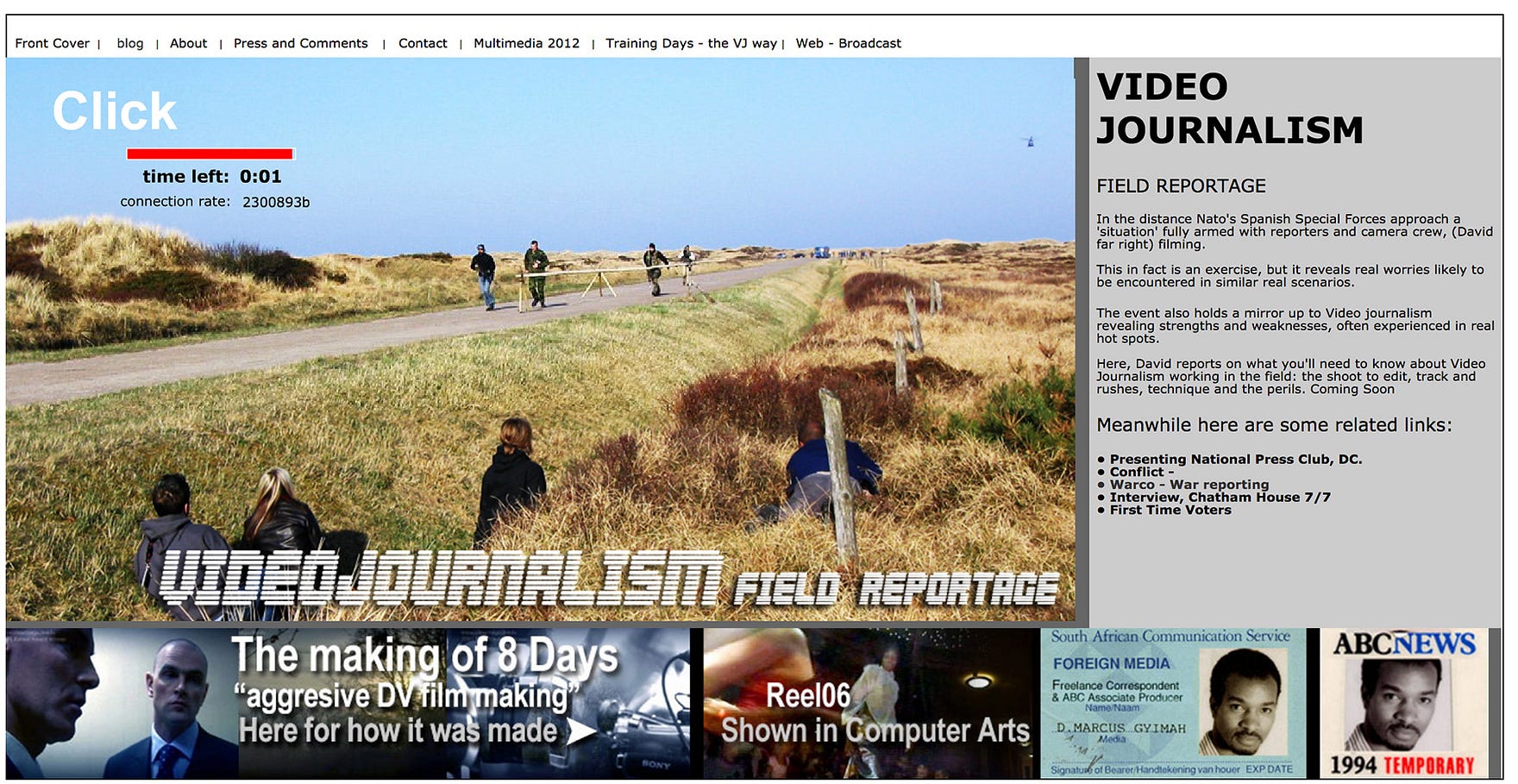
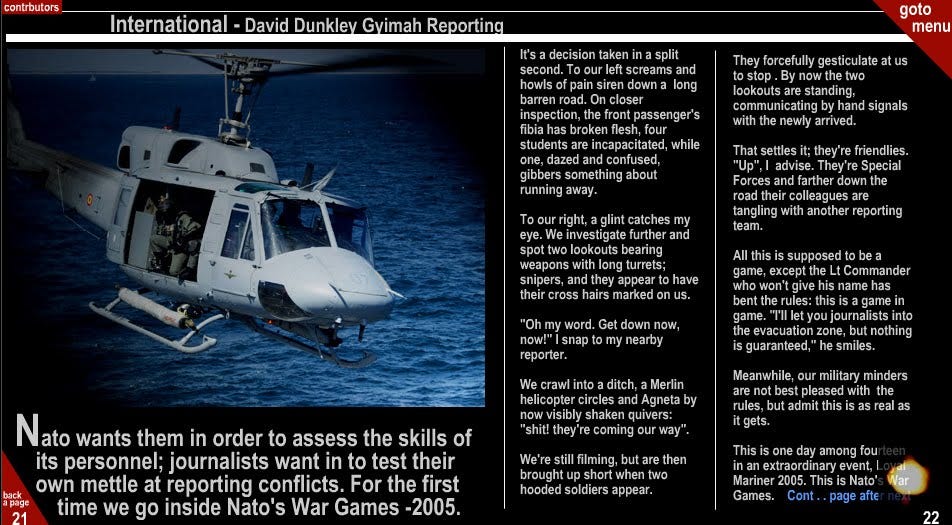
Then there’s full scale gaming. In 2005 joint forces working under Nato launched Loyal Mariner — a war games programme in Northern Europe of some logistical spectacle. As a former conflict reporter, working in South Africa in the early 90s, I was appointed field editor, and as indicated from this archive (above) from my online story platform, viewmagazine, our job was to test army personnel’s handling of a new type of multimedia journalist. One in which the subject couldn’t make a mistake mid flow, and be guaranteed the story wasn’t already being viewed on monitors. The days of, “can I start that again?”, had passed, as one senior commissioned officer discovered.

How real was it? In this short excerpt you can hear how terrified one of the reporters has become when a helicopter circles us in the field.

Back inside the Defence Academy, a third of the day is drawing to a close. There’s more to come, yet so far you get the impression that Guild members have been utterly consumed by the morning events. Some ideas about adding value to the game with the new personnel have been met with approval by the Major. “What do you know?” says one member. Trust entrepreneurs to look for ways of innovating.

Lee Robertson with Major Tom Mouat. Left Guild Members with author on far right.

The author Dr David Dunkley Gyimah heads up the disLAB was a guest of Lee Robertson, the present Master of the Guild of Entrepreneurs at the time of writing.

Innovation- The Art of Planning a Feature — Insider Tips from the Best of British


It’s 7.40 pm and one of the most powerful editors in the UK is standing over me. He’s looking at me squarely and says something that’s ringing in my ears in slow motion as he walks back to his office.

“I’m going to be fired. I’m going to be fired”, I’m thinking.

“You get him, right! You get him”, he says.

How?

On the 6th of BBC TV Centre, Shepherds Bush, is the offices of Newsnight. When you enter it’s humming rhythmically to the sounds of programme making. Chaos, events about the world are being converted efficiently into meaningful stories. I’m in the corner on the left.

A little dorky, wet about the ears, five months out of journalism post grad, I’m a researcher. I’ve been on the programme a couple of months, but now the adrenalin accompanying a big story breaking is causing mild panic and a sense of “I’m out of my bloody depth!”

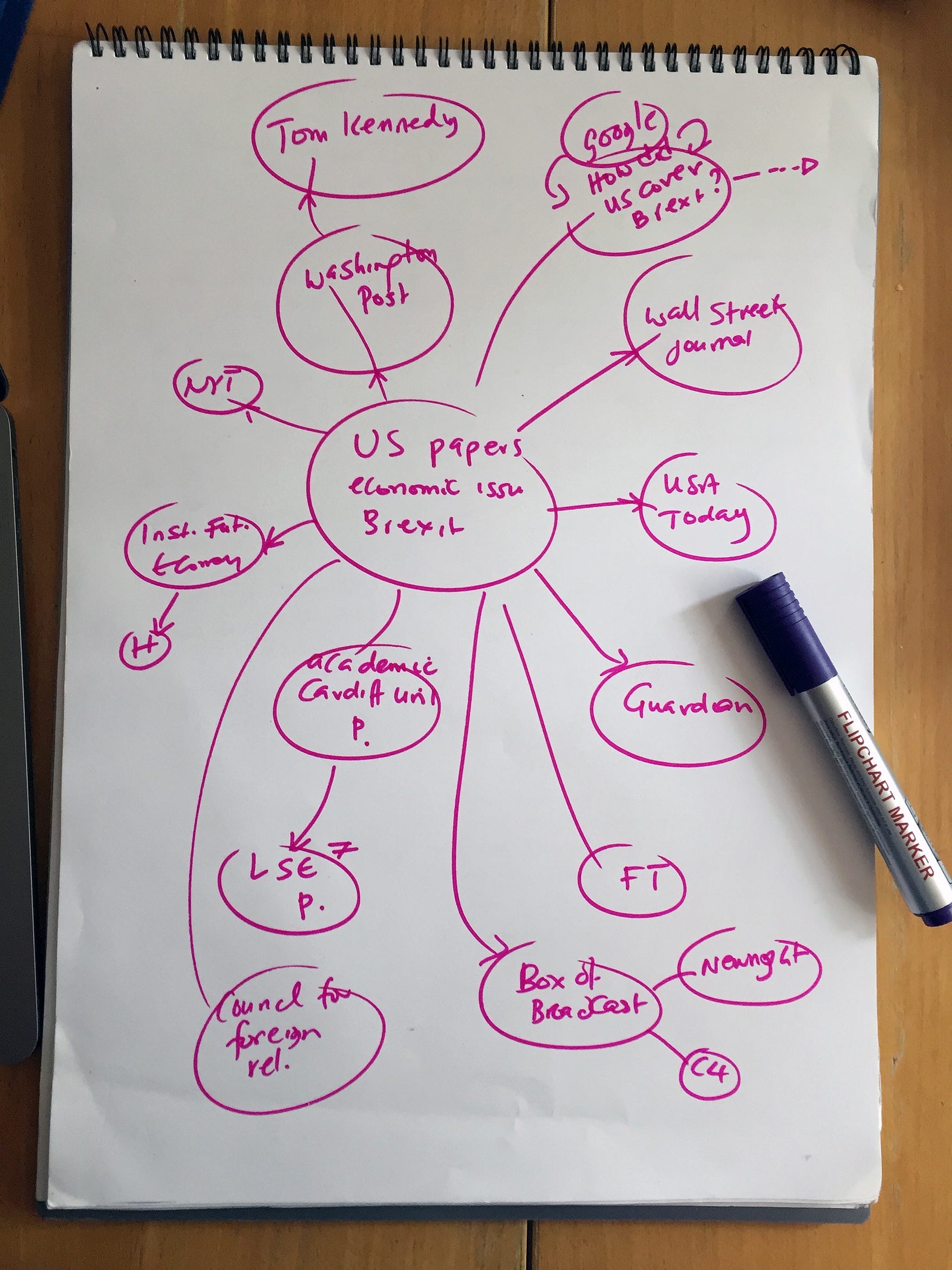
For the last eight hours I’ve been periodically ringing around pulling potential interviewees into a story package and an item on the programme. My desk is strewn with papers and a drawn spider’s web — a mind map.

But there’s one person whom I have called at least four times, and who’s been extremely accommodating as a quasi deep throat — giving me other contacts — but won’t come on the programme himself.

It’s the biggest story going.

On 29 November 1991, after an eleven-week trial at the Leicester Crown Court, Frank Beck, a presumed respected childcare worker, in charge of several children’s homes in Leicester, is sentenced.

He receives one of the most severest life sentences in the UK for sexual as well as physically assaulting more than one hundred children in his care. Beck gets five life-terms and an added twenty-four years for seventeen charges of abuse, including rape.


Researcher’s syndrome

“You get him” I murmur. Editor Tim Gardam is referring to a high ranking official speaking on behalf of the government who will explain how this could have happened.

I place another call except this time my words and tone will change.

“Uh-er, uh-er’ he acknowledges on the phone and then I go serene-slightly sullen- mode, “I’m really sorry but if you don’t come I don’t think I’m going to last another day here”. He listens and says let me see what I can do. I have to speak to a number of people.

This evening, Newsnight is presented by Jeremy Paxman and my presumed-in my-head-friend-at-a-distance pundit makes it onto the programme. Paxman grills him. Paxman does what he does.

I’m certain what I said didn’t change whether he’d come on or not, after all BBC Newsnight is the draw and he, well, is an official. I might cry rivers on the phone and it wouldn’t change a jot, but throughout our earlier conversations they’d been engaging and stimulating. I’d read up enough to have conversations with my pundit demonstrating my knowledge and showed gratitude for his suggestions.

A friend suggested when you’re speaking on the phone, stand up. It allows you to gesticulate, be more expressive and use your diaphragm more. He was one of the best telesales people I knew. His openings followed a rehearsed script.

I sensed a rapport, illusionary or otherwise, with the official. I actually felt he wanted to help this voice at the end of the phone. “Ah hello!” I remember greeting him as I picked him up downstairs in reception. After the show, in the green room, I thanked him profusely. I lived to see another day on one of the UK’s most terrifying, but enjoyable programmes.

Yesterday, I spoke with my Masters students readying themselves for the push to their final project. It appears daunting, more so in times of Covid-19s lockdown.

But lessons I learned from those years back can help today. There was no Internet then to aid research. It was performed via cuttings - looking through realms of newspapers, spotting names and making a spider’s web — a spatial grid of speakers and their relationships.


What did I learn?

№1. Persistence and courteousness. I never went nuclear again. I was embarrassed. But I learned it wasn’t personal. I’d rang up several interviewees that day; the one that seemed like nay impossible, in reality, some of his suggested speakers would have done. But these too were the times when officials couldn’t empty chair an interview because of hubris, as the government does with wanton abandonment today.

№2 If you watch “Homeland”, “Law and Order- Special Victims Unit” or any number of crime flicks, you’ll see their spiders web in play. A central character is connected through a narrative to others in the syndicate. Here’s Mojos top ten detective mind maps

It works equally well too for mapping interviews. We think spatially (right side brain) and its easier for others to see your work and make connections in one fell swoop. There! And the lesson in building a spider’s web of contacts is that it’s shareable and others can add to it.

№3. After I would speak with an interviewee, I would always finish by kindly requesting a recommendation. “Who might I speak to as a matter of interest to get deeper into this story?” It didn’t control my direction, but was a guide track.


Current Affairs Workflow

In our zoom meeting yesterday I illustrated the spider’s web in action, taking one of our MA student’s project. Rachel is looking at how US papers reported Brexit.


Step 1

Here’s my doodle (Fig I) as she shared details. The links are either potential speakers or contacts she’s yet to make. It helped me make some suggestions on top of hers. Consider this: does the map make it easy to see Rachel’s initial research and importantly can you, reading this, help by suggesting other links?

Fig I

At Newsnight, I was struck by how producers could assemble programmes so swiftly and easily. 

Months later though I would have the opportunity to put into practice what I observed when I joined one of the BBC’s most dynamic, fun and feisty programmes, Reportage. Before there was Vice.com, there was Reportage.

The programme brought a new level to research and production, a synthesis of styles from people who’d worked at the creme of news and current affairs and would go on to make huge contributions in television. These included Tony Moss, Jane Knowles, Hardeep Singh Kohli, and Caz Stuart to name a few.

Reportage’s adopted system is one that many programmes, TV docs and current affairs, use. It allowed teams to turn around a 10 minute story in two weeks. That is from the idea, research, previsualisationm,shooting the storry, multiple edits and then going to air.

Later in my career as a producer at Channel 4 News, and creating 7 min plus feature stories and as the reporter/ research BBC Radio 4 Docs, I used the same approach.


Step 2

Let’s imagine I have interviewed Tom Kennedy (from Rachel’s spider’s web. Fig I) who’s a good friend of mine. Tom used to be the Managing Editor for Multimedia at the Washington Post and Newsweek Interactive.

In my interview with Tom I record our exchange, asking his permission before hand and then transcribe the interview. He says several things I find useful.They are illustrated in pink lines (Fig V). But when I listen back to his interview whilst attaching time codes (logging), I’m drawn to quotes that stand out, which I’ve enclosed with blue lines (see fig V below). At Reportage, we’d go, “Whoah that’s a great SOT”. SOT is the same as saying quote. I would share my transcript/ and/ or my quotes with the producer. My producer would be my second eyes, offering a critique (not a criticism).

Whilst I have a skeletal framework where I’d like to take my feature, I’m being influenced by the strength of the strong quotes I’m reading. This is the equivalent of a “close reading” in academia.


Step 3

My next phase is to think of a flow. I have an idea of what each one says. Can I devise a pattern of how to structure them together? Essentially this focuses on continuity editing. This (VII, below) could be an example (in principle I have just made this up but you get the idea).

I start with Tom and then think of pulling in other speakers (using the same script highlight method). Jane( from Atlantico) is followed by P. from LSE and so on. You’re constructing your story world — a way you view the story. In film making outside of Television, often referenced as documentaries, there are an endless array of styles e.g. essay, which you’ll likely be familiar with.

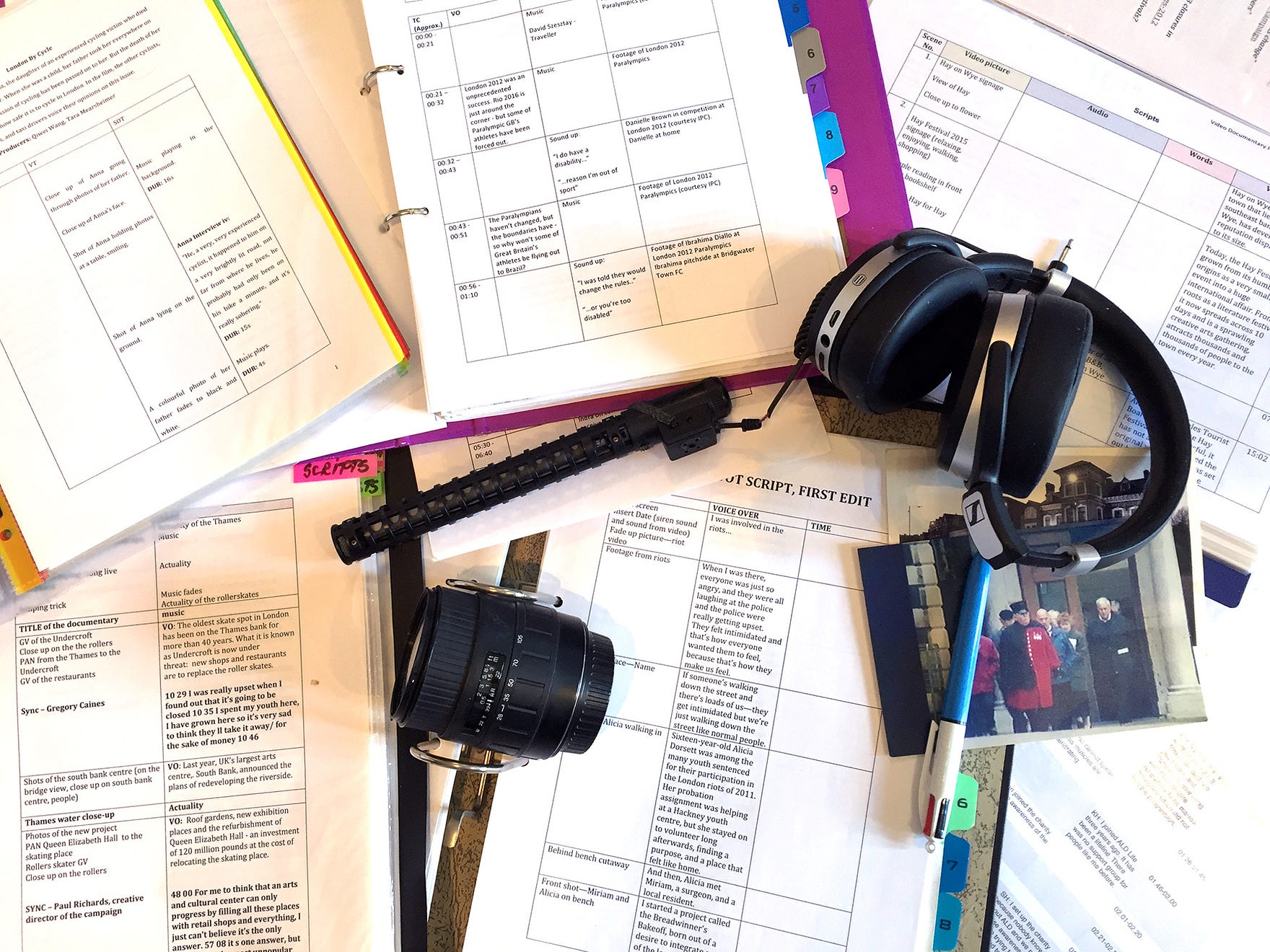
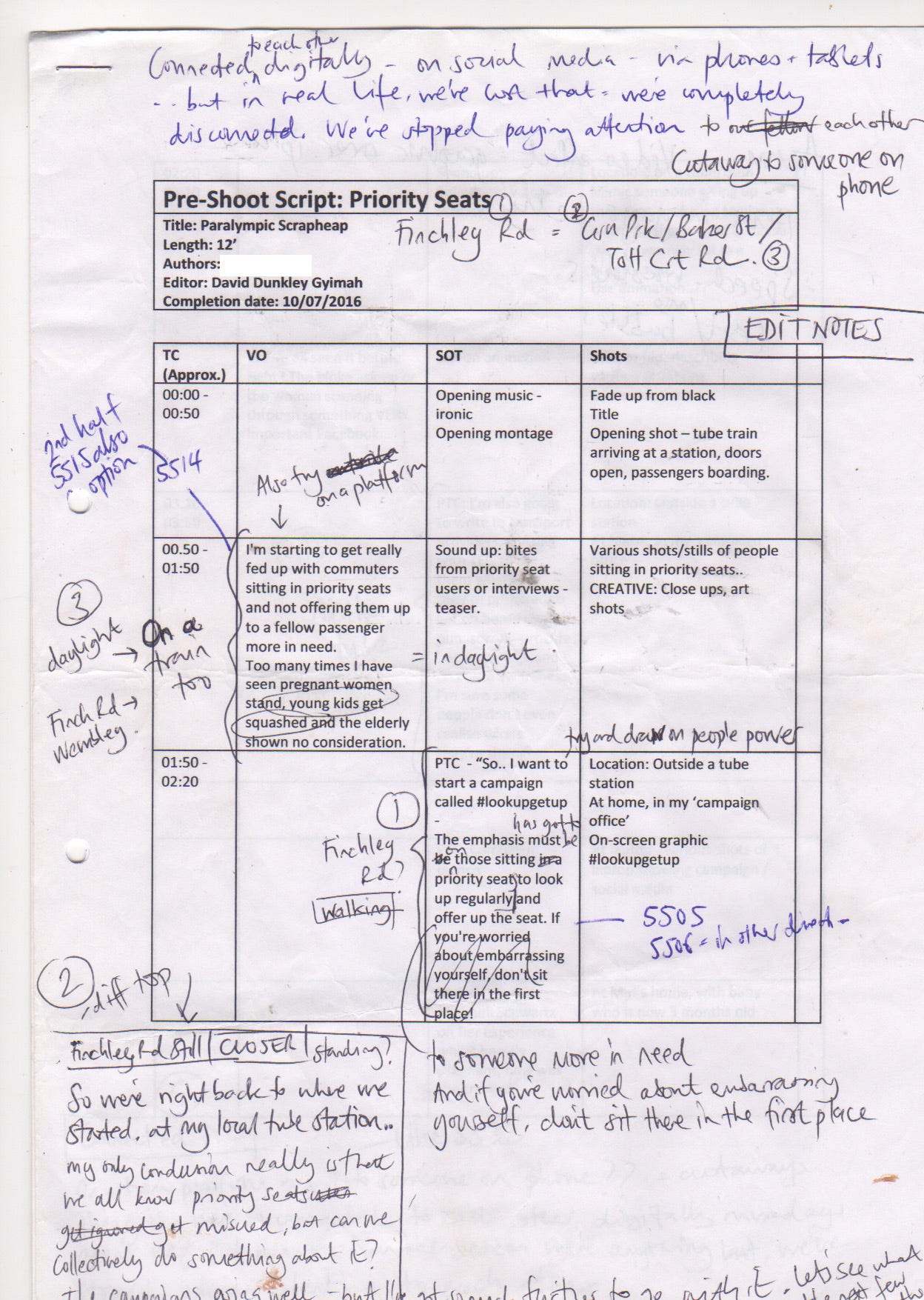
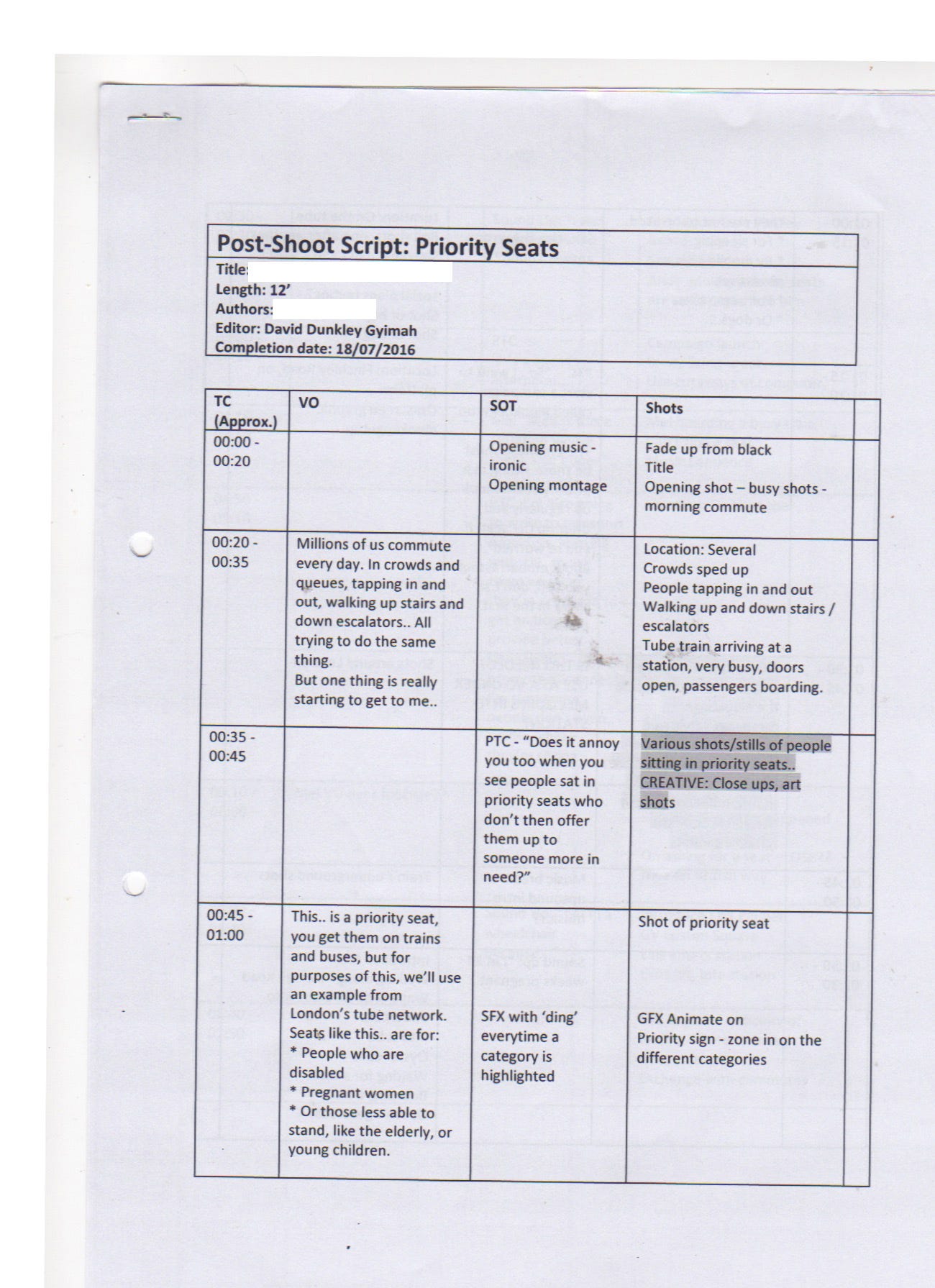
Using the above structure I attempt a pre-shoot script. It’s a script that visualises the film from interviews, location, and related research. Here are examples of pre-scripts of previous students spanning fifteen years.

Preshoot scripts VIII

If you’re creating a documentary/ feature where there’s no need to share your work, then frankly you could go into the field with a loose structure in mind and film to you heart’s content. More often than not, it’s in the edit where the film takes shape.

The architects of Cinéma vérité or correctly referred to as Direct Cinema from the 60s, such as Robert Drew, used this method. Here’s my interview with him.They would film realms and then construct a narrative in the edit. Award winning doc maker and videojournalist Raul uses a loose structure (Fig V) and pre-interviews in the field before deciding what needs shooting. His award winning international is likened to a watching a movie. This is his latest film, The Virus.

Fig IX

Step 4

If you have time constraints and are working in a team, then open transparent planning will help you enormously. This is what we do next.

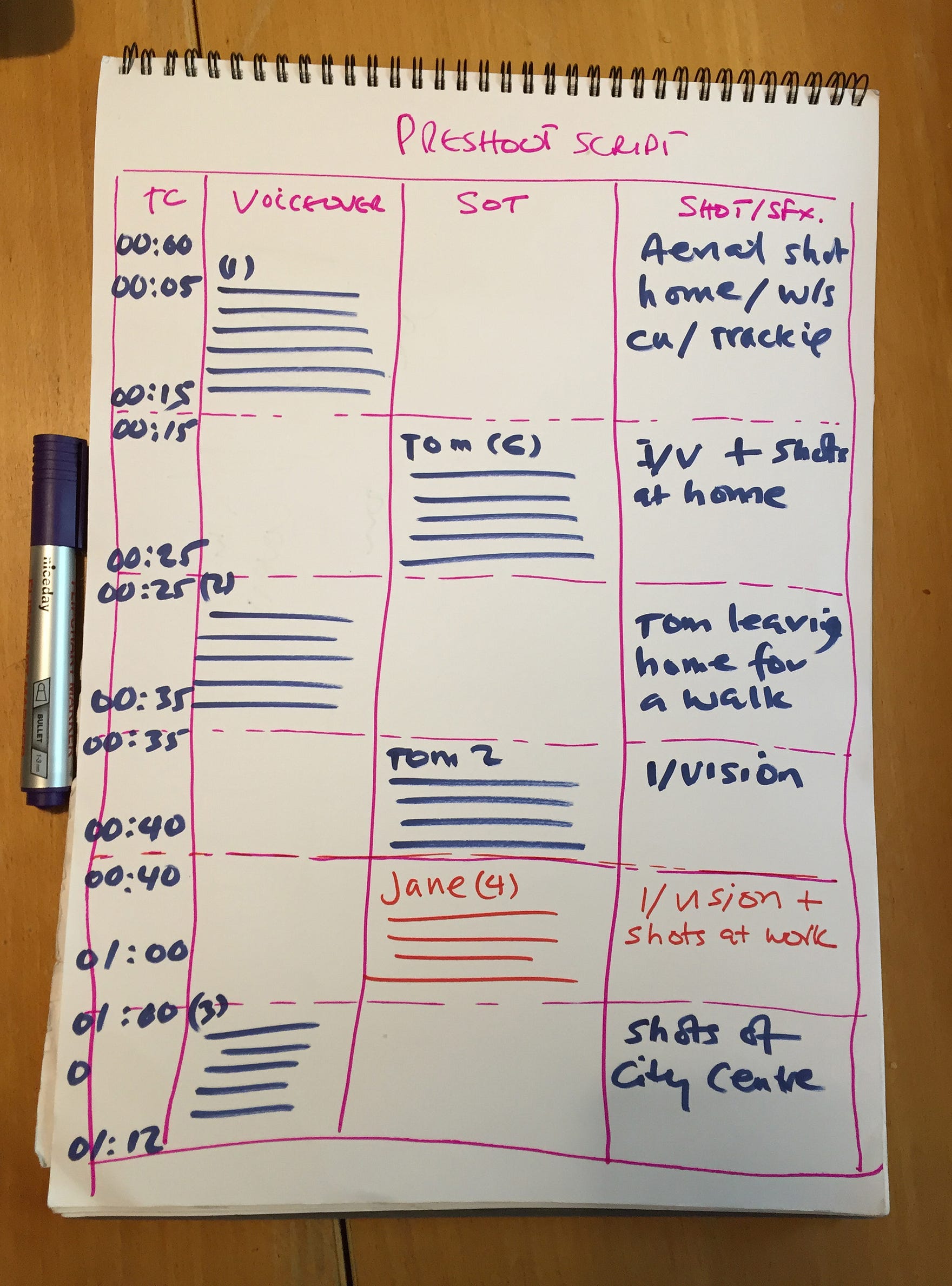
From the structure and the interviews (see examples, fig VIII and XII) attempt to pull quotes into a story structure. We’ll use Tom Kennedy as an example again. Dividing the page into four grids; the columns are interchangeable, I’ll construct a narrative around Tom’s quotes and several others, such as Jane (Atlantic) who I also get to speak to.

Fig X

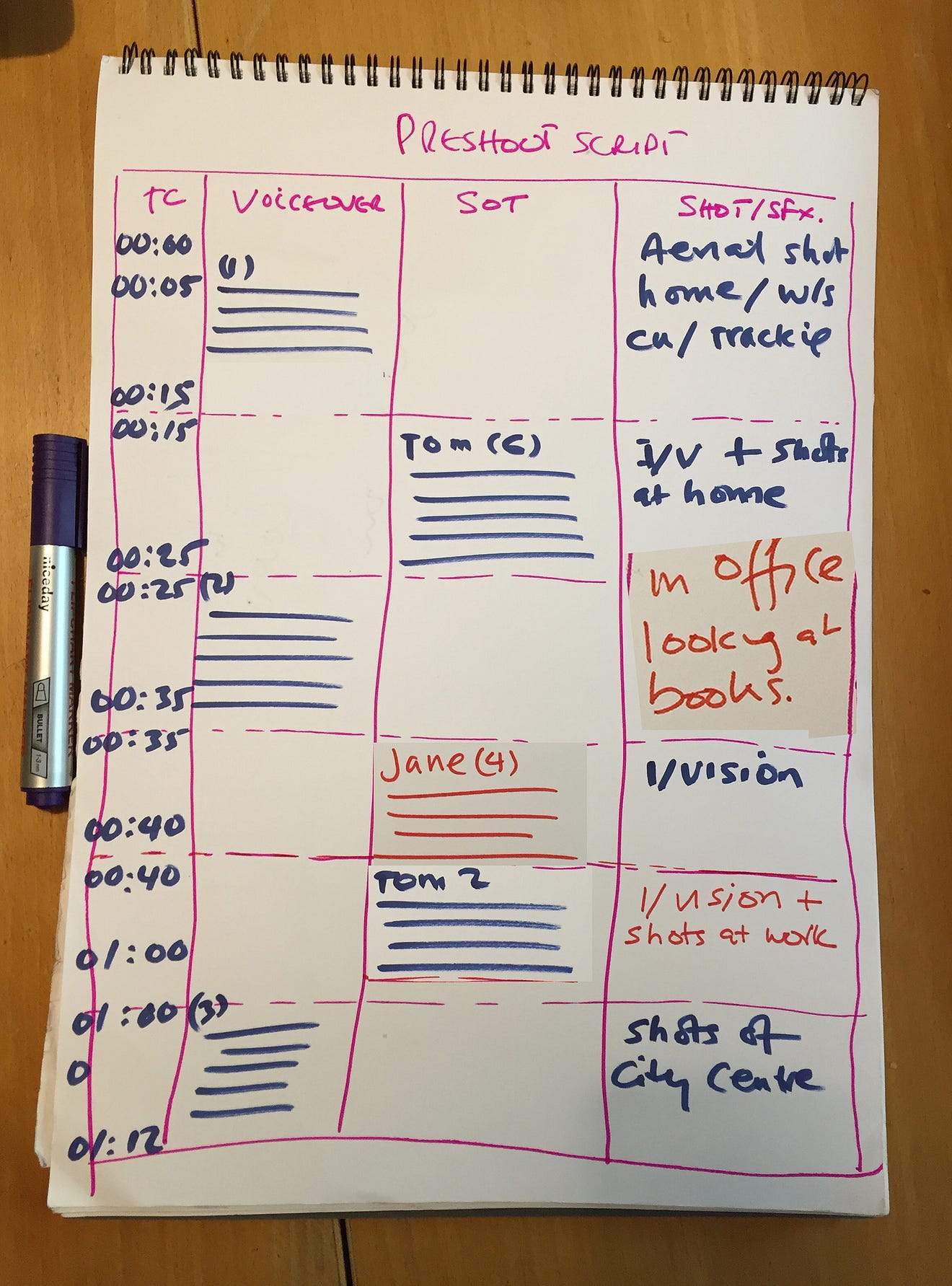
Time codes on your left, followed by Voice Over, SOTs — which is the same as clip — and then shots.

My voice over (represented by blue lines in this case) is scripted and works into the Tom’s (6) quote, lifted from Fig V. I cover that Voice Over with aerial shots.

Tom is interviewed in vision i.e. we see him and then there are overlay shots of him at home. You’ll notice the time code increasing on the left column, each time a voice over or SOT is added.

Voice Over no.2 covers Tom leaving home for a walk. Now the point is we haven’t shot him yet, but that’s what we envisage. That’s the pre-visualisation.

Tom’s (2) SOT from his interview from Fig V is buttressed against an interview we did with Jane ( Atlantico) and that’s followed by another Voice Over covering city shots as we move the story on.

Step 5

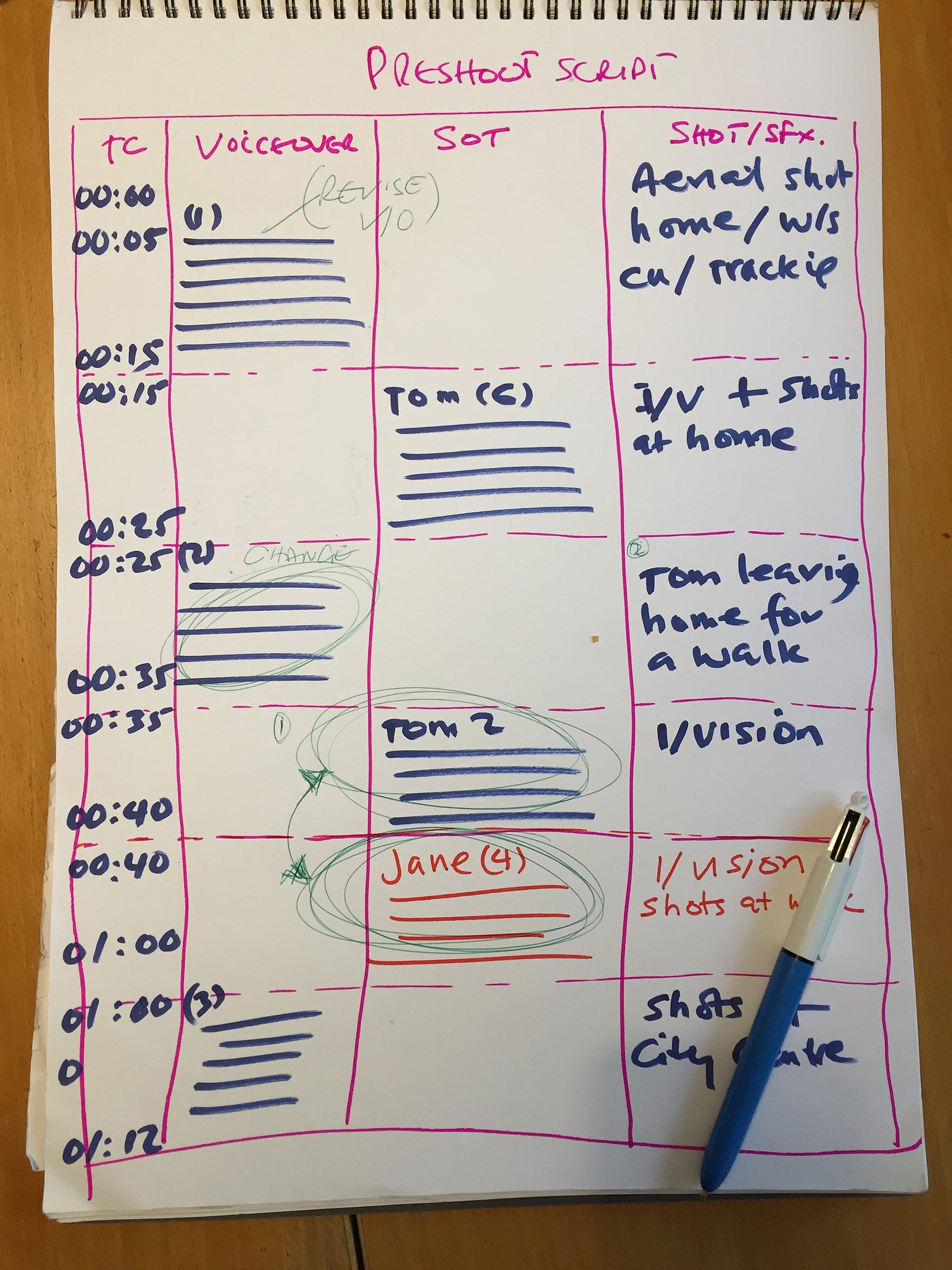
Fig XI

After consulting with your editor or supervisor, you might decide to swap Jane (4) and Tom (2) around for impact. If that happens the Voice Over into Tom 2 and the shots of Tom leaving home for a walk would also have to change. The image above shows this.

We might also see some changes to Voice over 1. These changes aren’t necessary, but more often than not will occur in a pre-script because of new ideas and reflection. In changing SOTs around in the two images above there’s one thing I’ve not changed. Can you spot it?

You can see an example of a pre-shoot script in practice here (Fig XII) from a previous student who took a career break from working at Sky News. She made changes, shot her piece, and made further changes. We met three times in between her pre-shoot and her final edit.

Fig XII

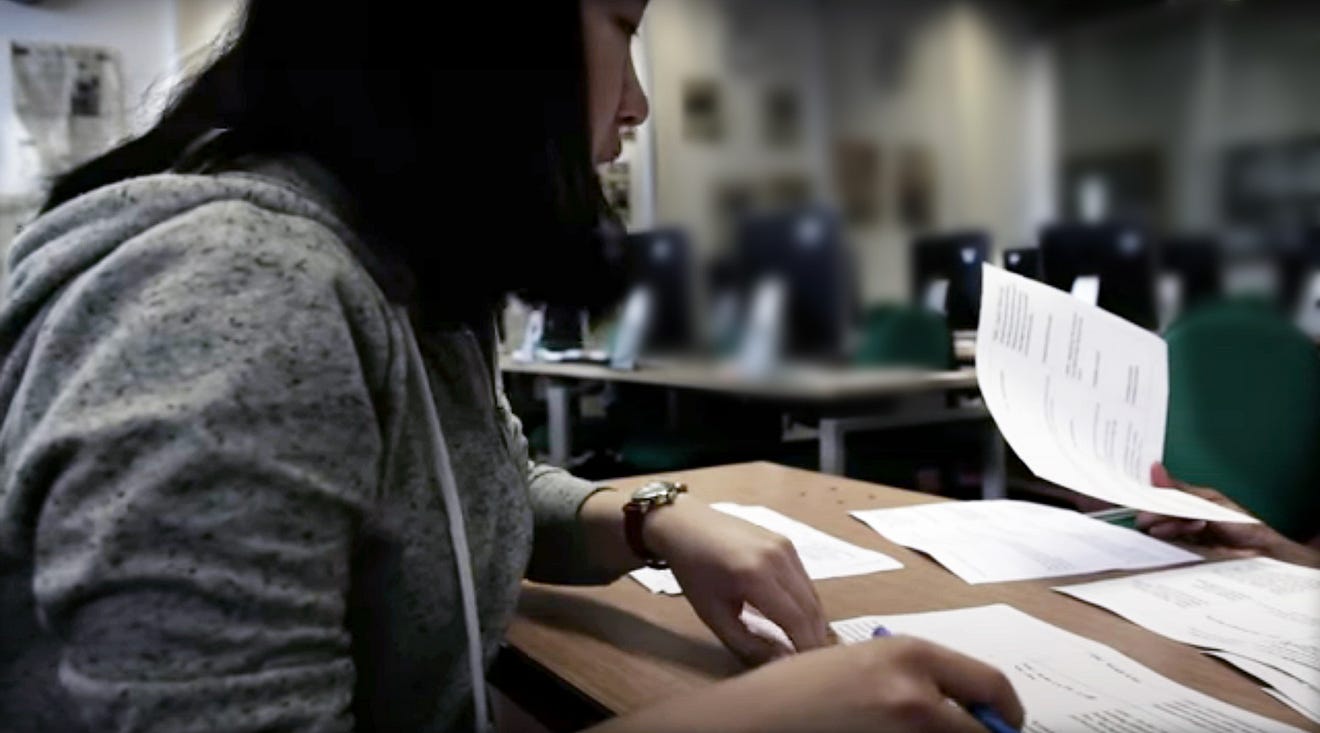
This is Natalie going though script surgery. She’s now a video journalist at the BBC, and Tamer who graduated to become BBC Correspondent, before becoming a reporter and doc maker for Al Jazeera. I made a film of Natalie and colleagues finishing their projects here #Student You.

Fig XIII

That pre-shoot provides a template to film, and replicate. Of course when filming new ideas may arise; somebody might drop out, something entirely new may emerge, but the point is if you’ve done enough preparation so the integrity of your film will hold. You’ll cut down the amount of work done in the edit. That’s how on Reportage, and other programmes like Panorama, a report can be turned around in less than a week.

Side by side, you can see the progression. With revisions to the pre-shoot script, you’re ready to start filming.

On the shoot, there will be changes that will lead to changes to the script, which through the production process becomes the edit script and then the final transcript. So far you’ve prepped the Interviews and the story, and parts of the location. In the next post, I’ll talk about prepping the camera gear to shoot cinematically.

Fig XIV

NB. Marcus Ryder, (@marcusryder) a former Senior executive at the BBC who led Panorama leaves this important tweet, ff by @writersroompublishin.

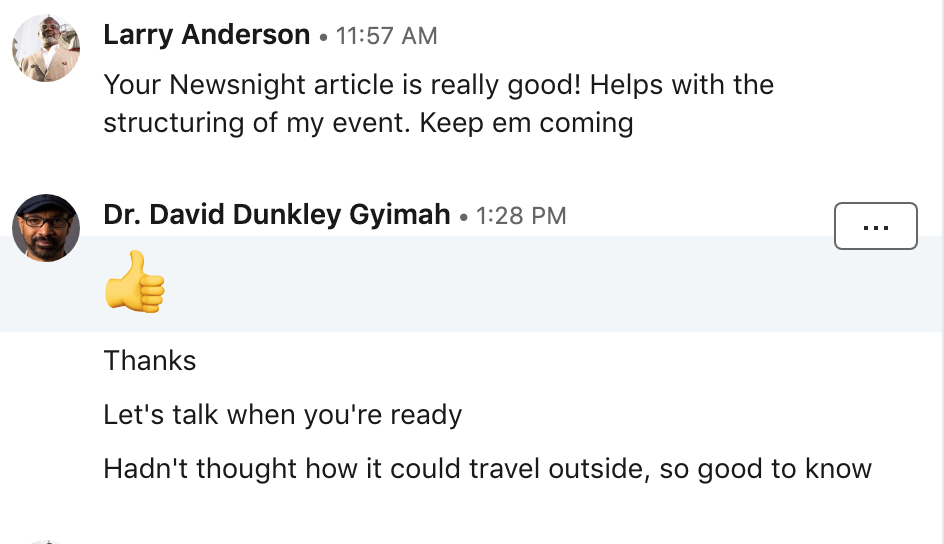
Larry Anderson, a Transformational Change Lead at Nike left this message


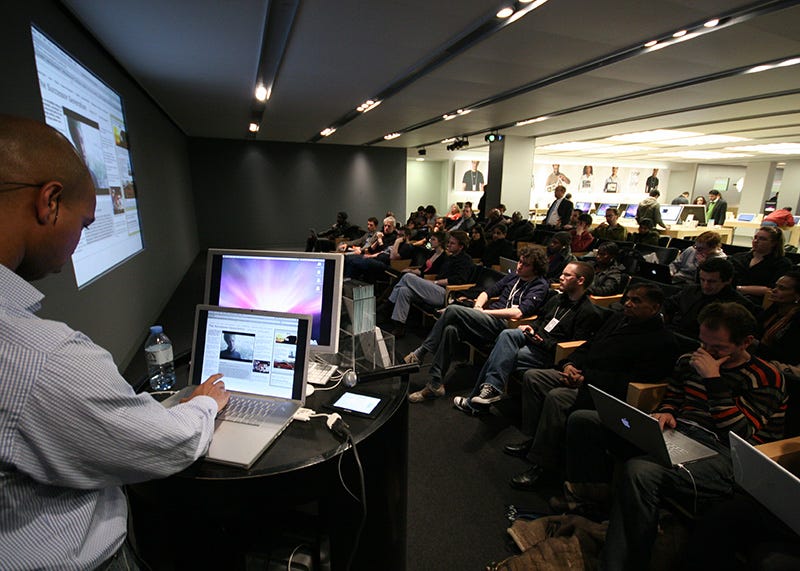
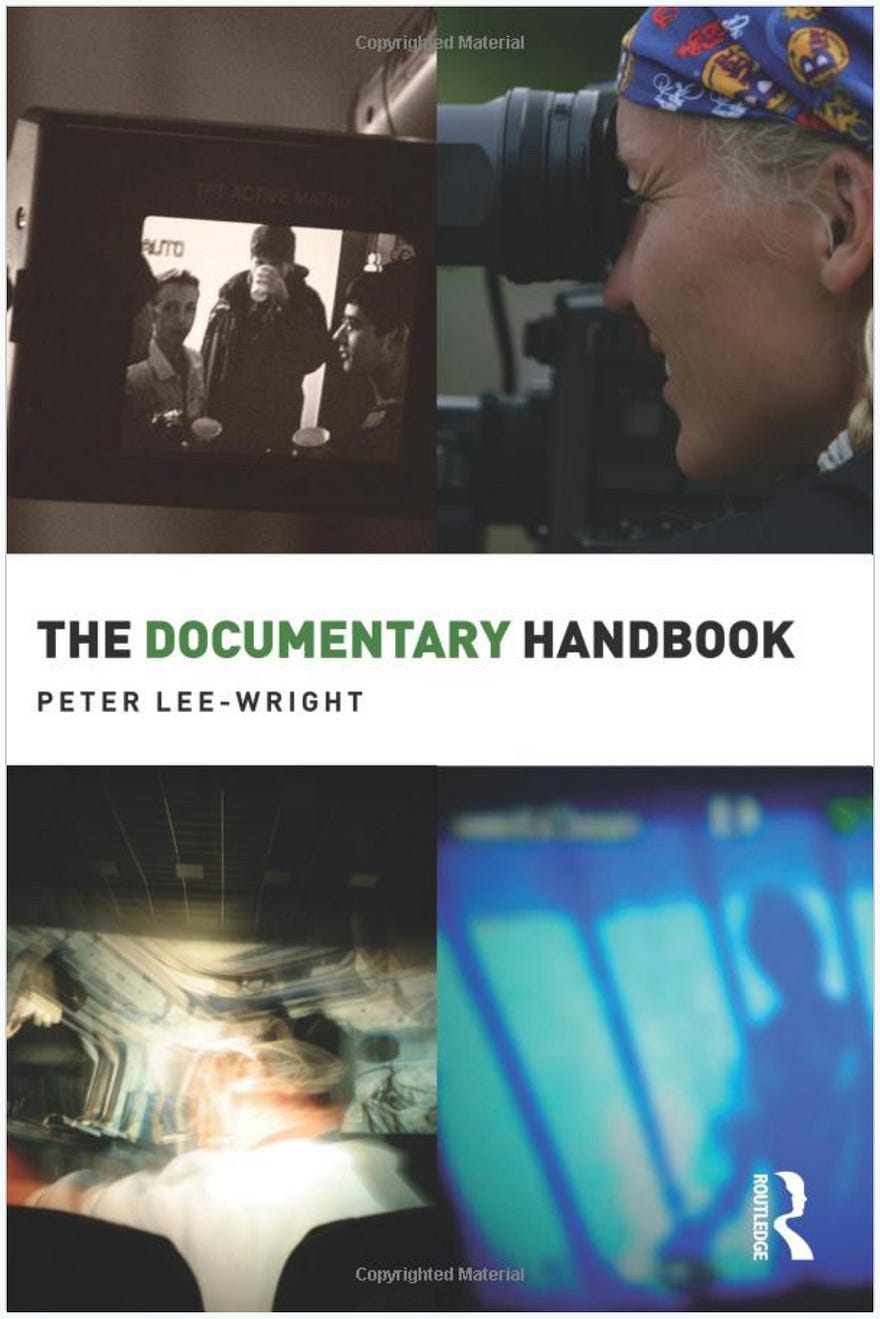
Dr David Dunkley Gyimah, presenting at Apple. His work, as a video journalist is featured in The Documentary Handbook, where he describes his craft as follows:

If you could combine the art of motion graphics and photography, the mis-en-scene and arcing of the cinema, the language of television, the skill of radio with users’ behaviour online, I believe we would be closer to understanding the power of video journalism.(2005)