How does it hold your attention and how does it continue to hold your attention. There was a moment presenting at Apple Store in London, when there was a shift from the audience. A comedian friend told me about this phenomena during his set when that moment comes when the audience mirror the artist, referred to as mirror neuron.
All storytelling involves an intentionality, but sometimes motives can be masked or suppressed because of conventions. Conventions are human generated rules bound within a time and space. But dependent on societal and cultural progress they atrophy, or are questioned (disruptive necessity) for something else to take its place.
Consider then this. News journalism quite often doesn’t cover an event that’s happening in real time. What you see on screen is an attempt to construct a story based on a thinking of events by the storyteller. Where, how and when people are filmed is made invisible in journalism for the convention. It may not have been an issue in the 1950s when TV journalism was coming on stream because there was good faith in the actors — those being filmed were respectful of TV.
How about today? Imagine someone telling you a blatant lie. Have you ever recorded your gaze/ eye movement towards them? Imagine you wanted to question them about it. “John can you come here a second, please?” You’re on the veranda between the coats asking what on earth is going on. The scene becomes quite animated.
Imagine now a scene from a politician named John. He chooses where he’s filmed, actually journalists through convention choose the scene, outside parliament. John’s interviewed some time after the event, so if he’s not in reflective mode has had time to consider his response.
And the framing, by convention, in journalism of John is via the rule of third. The rule of third is in fact NOT a rule in the sense of a fixed command, its a visual choice. The rule of third maintains you place John on the third part of the screen, leaving two thirds of space for where he’s fixed his gaze. It implies John is speaking to someone off camera.
Yet it’s also a shot that invisibly unconsciously yields harmony. Way before TV News was born, in his film Citizen Kane (1941) the director Orson Welles shows a compositional arrangement of the “rule of third” in an interview scene. Western artists discovered that post renaissance. Chinese art found different compositions for balance.
So now consider this. John your politician is lying, yet he’s decided with you on the power of the scene, he’s working a narrative and you’re making him look harmonious by your filming techniques, and the audience will interpret the scene their way aided by the invisible codes used.
There are solutions, and they require a broader discussion, just as the hand cutaway (convention) has been largely laid to rest. There’s no such thing as an innocuous cut away. That much became clear where in a scene many years ago, a corporate was feeding back on a question and then it cuts to the corporate rigorously tugging at his wedding band. Someone in the edit asked innocently does he have marital problems?
So what next? I’ll post news of a form that’s addressing issues like this and is gaining in currency.
Five stories connected: Syrian border, Chicago, Soweto, Spain and Norway. It looks like a scene from Minority Report. You view the story. AI in part generates its own narrative against the author’s preference.
The storyteller explains to its audience — human interaction is valued. A book is generated instantaneously. In 2030, against all logic, but just as history has recycled its form since the 1900s, from scale to miniaturisation, society has fallen in love with scale again and there are enough devices for it to be generated any place, anywhere.
Season greetings and here’s looking forward to a fruitful year. In that vein I wanted to share something, my findings on a form of storytelling that’s happening now. One that I’ve advocated from experience and international research across the world.
It’s taken me several years; the origins started in the early 1990s. This form of storytelling caters for news and journalism, branding stories, business narrative and new documentary. In fact it can be used on anything.
It brings together various styles collapsed around two seemingly well known forms, but the sum of them changes when merged. It creates a different experience for audiences.
I’ve tested this in lectures over the years. Seen many practitioners win awards for their work effectively deploying the techniques and style and have taught journalists from The Financial Times, The Press Association and many people internationally, for example in Russia, China, India and Egypt to name a few.
The template of collision or otherwise hybrid of forms has a history in other disciplines. That is the coming together of the classical and nouveau in artistry and creativity. You’ll find this in the history of architecture, music, painting, and writing.
There are reasons why it’s surfacing now as a disruptive necessity because of how attention has become a commodity. As one BAFTA and Oscar nominated filmmaker friend told me, “How in this morass of media do you make your work more distinctive?”
It is in effect a visual verbal esperanto and it takes account of changing cultures and habits, positivity rather than doom mongering, diversity and inclusion, Gen Z -Baby Boomers, and is largely platform agnostic, yet deploys tech in purposeful ways.
In presentations, as I’ve done previously with TV2 in Denmark and Facebook in India, I’ll tell you of previous reformers and pioneers who extolled its schema. Those filmmakers and artists sowed the seeds and their work today is described as cannons.
I’ll deconstruct how, for instance, news forms were by default formed and have stayed that way from the 1950s — a reason for its audience size. However, all other story templates have mutated. I’ll show how it captures attention, and can be used to take on spin and obfuscation from politicians.
And that a new generation of practitioners would serve audiences far better than the previous. It’ll map my journey first through the BBC e.g. Reportage, Newsnight, to Channel 4 News, before I became a creative director in advertising and then dotcoms, and artist in residence at the Southbank centre.
You’ll find feedback on it here, from well known figures, such as the following and inside books.
1. SXSW:
2. Jon Snow
3. Mark Cousins
4. Featured in the Documentary Handbook by Peter Lee Wright
47winners from Google News Initiative’s 2022 Innovation challenge will now be in their stride with funding up to €150,000 for their project. The official announcement is here.
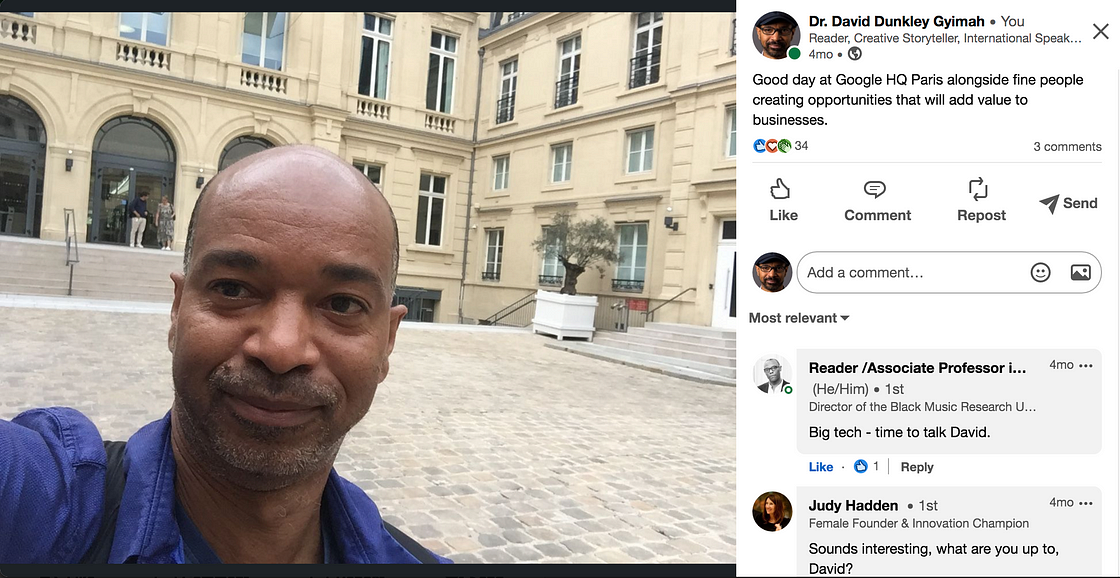
I was honoured to be one of the external assessors invited to join Google’s team. Big shout to Sarah, Ludo, Danielle, Kristen, and Ben for making me feel so welcome.
I’ve been a juror across top flight media, such as The Royal Television Society which picks the UK’s top news journalists and network, amongst others, and have won international awards for my work.
Hence, I could bring this experience to the initiative that attracted 605 applicants from 38 countries. The cache of applications was truly impressive and were eclectic across a spectrum of motivations.
Eligibility for funding fell into the following areas:
that the project was innovative for applicant and users
the impact it would have on society and news ecosystem
the feasibility of the project
how inspiring it was and where owners could “show [a]willingness to share knowledge and to contribute to the improvement of the ecosystem overall”
being able to demonstrate a commitment to diversity, equity and inclusion.
I’ve sampled four successful applicants here.
Les Jours
Imagine being able to establish the connection between say a journalist writing a story and the subjects of the article being written with the aid of a visual map.
Such connections between, not only journalists, but important people featured in a story will give news consumers an insight into how power and influence manifest itself in journalism.
This is what Les Jours intend on building — an interactive easy-to-use playful influence map.
Airwars
One of the difficulties of identifying perpetrators of attacks in wars, based on the munitions used, is producing forensic evidence from the scene of attack using blast debris and crater images.
Airwars is creating a centralised portal providing open-source identification of arms and munitions that can be matched with on the ground pre and post-blasts evidence. The site will be freely open to use by Human rights practitioners, individuals e.g. journalists and groups.
Afrolis
Afropolis in Portugal, is led by a team Portuguese women ( Black and Roma journalists) seeking to create an EU social network of members, and act as a funnel for Portuguese and EU diversity in newsroom.
Their news narratives will envelop nuanced social, economic, and political issues within diverse communities embracing themes seen in the range of mainstream news, but from their agency and perspective. Their mode of delivery will be via podcasts and articles from writers.
L’Humanité
L’Humanité are looking to a model of news which targets a younger audience by the creation of DAO, tokens, and NFTs which feed into web 3. A challenge for all news outfits is engaging with Gen Z+ with stories and agency for the audience to be involved in the selection of topics and its coverage.
You can learn more about the current winners and the application process here on Google’s site.
Aside to the creative and intellectual challenge assessing applications, what was hugely enjoyable and rewarding was witnessing the depth and broad the range of thinking by practitioners across Europe, in either addressing immediate challenges or those peering into the future.
In some ways it took me back to an era of Dotcom I, and the unbridled creativity for the web as a new medium. And it made me recall my own work over the years in innovation in journalism -from working in Soho for a number of start-ups, (including being the editor for Justgiving.com) and then Re-active creating Channel 4 finalists interactive docs, and online web promos for the likes of heavyweight boxing champ Lennox Lewis.
Later, this would merge into work creating Innovative Journalism, profiled by several tech including Apple and more recently using Art, Tech, Journalism and storytelling to help MA students create their own start ups.
If you’re one of the winners of the Google Initiative, Good luck. If you’re looking for an assessor on your project with experience in the aforementioned and diversity, drop me a line Gyimahd [at]Cardiff [dot]ac [dot]uk
About me: I’ve thirty years in the media industry working on top journalism platforms e.g. BBC, media startups and dotcoms, and today balance external work across my main role as an academic. More here
News shapes our views of the world; Cinema does too, but also in a cultural shock way.Jaws left beaches deserted;Super Sized Meshifted eating habits;Lawrence of Arabiamythologised British Intelligence Officer, Thomas Edward Lawrence.
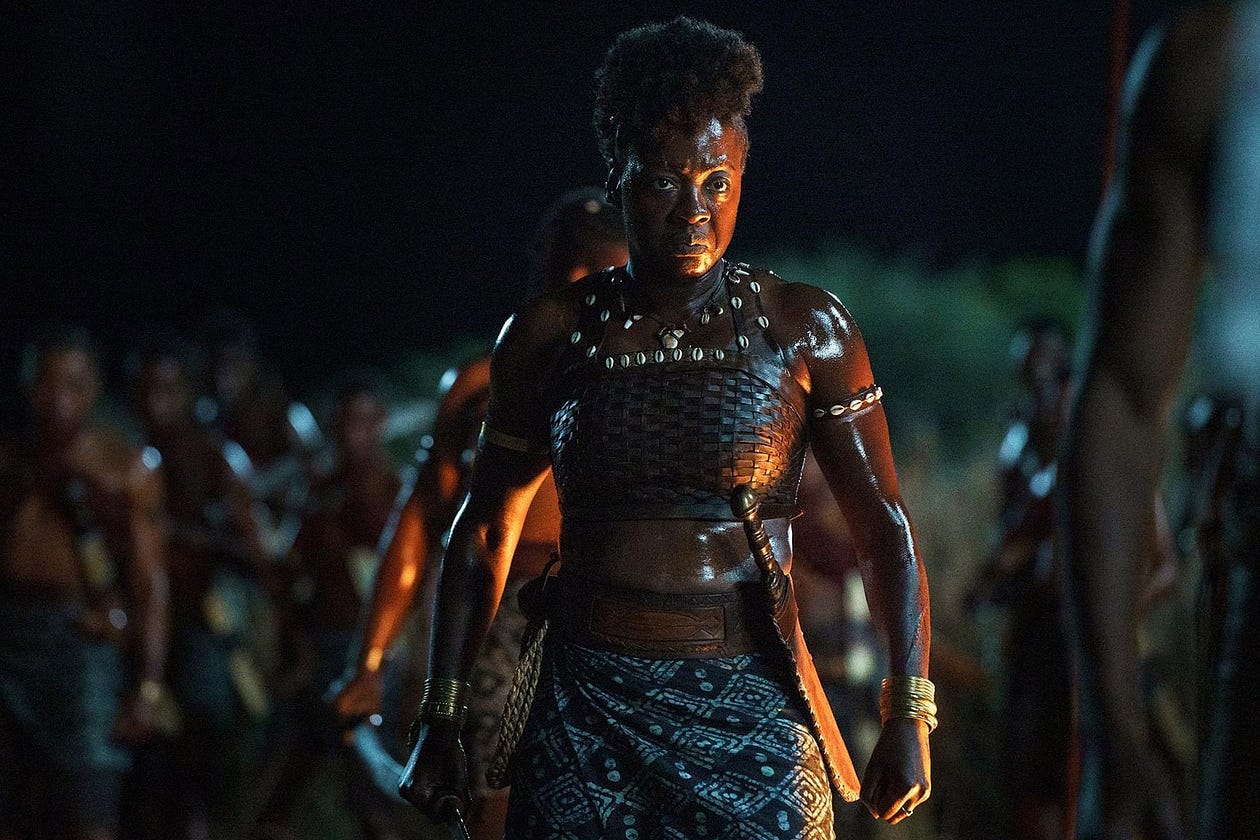
The Woman King (2022) is set to be a game changing movie that will have a global historical and commercial impact in many ways, not least storytelling.
There have been previous Blockbuster films this side of the millennium, such as Black Panther that produced more than a $1billion for the studio. But this is different. The reason is it’s based on a true story and possesses a historical DNA which for centuries, particularly post 17th century, has been erased or maligned.
Take the history of The Congo. Belgium’s King Leopold II’s narrative dominates. He strafed the country — its land and people. In King Leopold’s Ghost by Adam Hochschild the reader is introduced to Nzinga Mbemes Alfonso.
He was a provincial chief whom in 1491 in his early thirties, with his country’s dealings with the Portuguese, steered his people and their interactions with Europeans. He is portrayed as a sophisticated man an abolitionist, learned — he learned to speak Portuguese. And yet his prominence is often overlooked, instead for narratives around the conquering Portuguese and then Belgium.
This is reality untold which in a post-Floyd era is as much about diversity, inclusion and correcting skewed narratives.
The evidence ( was in not always the case) now is there’s an audience that buys into revised ‘real histories’ version of events; helped by images (e.g. Instagram) and films that emphasise Black and brown people’s agency and outlook. This is happening increasingly in decolonising narratives and historical books such as David Olusoga’s Black and British and Peter Frankopan’s A New History of the World. Recently I posted on an African philosopher to rival the canons of enlightenment philosophers
With regard to film, exposing new narratives, furthermore, a globally young audience seeking self identity carries on its heart a purchasing power that even as combined long tail, must be recognised.
Black stars don’t sell
It wasn’t long ago that studios claimed, as relayed in an interview by Denzel Washington, that a Black lead meant they lost sales abroad. Shamefully, Boyega’s Fin character was minimised in the poster in China. Read: Hollywood’s irrational allergy to ‘black’ filmsby Roland Martin, CNN Contributor.
Historical Black heroic characters from Africa haven’t been given the Hollywood platform. Africa as a source of film for Hollywood has played into usual tropes, Out of Africa (1985), The African Queen (1951), The Legend of Tarzan (2016), Zulu (1964)— take your pick really.
The emphasis in this post is about historical based Hollywood films today, because there have been films from Africa, made by Africans. Nigerians have wowed audiences with films like The Wedding Party (2016).
Generally, historical narratives that undo the stereotypical view of Africa can be found in in books such as Hochschild King Leopold’s Ghost and Stamped From the Beginning by American historian Ibram X. Kendi.
In these books we learn how warped narratives from Africa were shaped. Particularly, from the 17th Century. Travel writers such as John Rowlands AKA Henry Stanley Morton, Richard Hakluyt etc. constructed racists myths for their audiences in which the Europeans were the civilisers.
Africans had no culture. It was a dark place, e.g. Conrad’s Heart of Darkness. Britain’s colonial legacy ownership by PM Boris Johnson veers to this when he said of Africa “the problem is not that we were once in charge, but that we are not in charge any more’”.
Real Stories
Based on a true events of the Dahomey women warriors, The Woman King (2022) opens an important window, supported by a digital generation to bypass old tropes. As I write this I’m thinking of the many others cultures e.g. Ashantis, Fantis (Ghana), ManiKongo (Kongo), Dogons in Mali etc with rich histories who fended off Westerners, built complex governing systems and the rest.
As a note of caution, and this is speculative, because of limited knowledge of the film at present ( though it is everything I hoped it would be when I watch it), I imagine a vigorous debate in academia and some press will commence after The Woman King (2022) about inaccuracies and aspects of the Dahomey which might either be minimised, or absent. That includes insights into their religious ceremonies and their own involvement in the slave trade.
This exchange of knowledge can only be beneficial in context and the comparative numbers of participants in the trade. Be mindful too that with “based on true story” genre films they’re not documentaries and hence their expositions can be narrow, focus on singular events and the license for storytelling tread pass fact.
The title itself, an interesting semantic pairing, and draws reflection. I lived in Ghana for almost a decade and attended the King’s college, that is Prempeh College In the Ashanti region of Ghana.
Here, the heroic tales of the Warrior Queen Mother is legendary. Yaa Asantewaa embodies an amazing story fighting off the British and restoring pride, whilst equally feared by her enemies. Her story deserves the Hollywood blockbuster.
In many ways the remarkable nature of the The Woman King (2022) isn’t the story per se, and that’s not to take for granted the filmmakers. The filmmakers take great credit in breaking Hollywood money and pioneering onto the screen a film that sticks a knife into empire stories. The fact is there are many Woman King stories that are part of folklore that would make great features.
Take this that we’re seeking finance to make, The Kings Men. It’s the story of how the King of the Ashanti people built a school with the help of a British reverend that is revered internationally. The college won the World Robotics Championship in 2020. How it came to be in the 1950s as the country stared at independence is the intrigue.
If The Woman King (2022) is to make a cultural impact by creating a window for historical African stories, the question of others films emerging to sustain this, is worth asking. From Cinema to Documentary, here the work of Channel 4 News’ in the Black to Front season where they investigate British looting of Benin Bronze and films by Historian David Olusoga are part of the Tent pole. Similarly, if If you’re a teacher of Black history this film is about to offer you the tesseract for your students.
If you liked the above story, you may like this — The Kings Men, a film in which the King of the Ashanti people Nana Prempeh people created a school which has had a huge legacy on Ghana and globally. Yaa Asantewaa has a direct connection to the school.