Showing posts with label #business #experience #tech #branding #journalism #storytelling #media. Show all posts

Tuesday, July 04, 2023

In the AI world unfolding, how you’ll need your super power to work : diversity as you should know it!

They’re coming for you. Not the AI per se, but the CEOs driving AI. And to ensure you can still make a living you need to find your super power. That much I’ve told several writers recently, some from the BBC.

The CEOs won’t save your job. Their vision is to push the boundaries of tech knowledge, make considerable wealth, achieve Maslow’s highest order in its hierarchy of needs, and maximise shareholder profits. There’s nothing intrinsically wrong in this if you believe in the unfettered machinations of the market. But all is not well, was it ever?

The consequences of so many people losing their jobs, first it was unskilled labour, now the skilled and creatives are realising the heat, would border on incivility in society and a political class literally operating behind defences minimising contact with their electoral shareholders.

So what’s the solution? There is a model that could work, that could stave off complete disruption of work and leisure. It’s been proved to work and it won’t stem from CEOs stopping any AI development until policies are framed.

It’ll require human-ai co-operation and for humans it’ll mean finding your super power. And where might you acquire it from?

Onthe 11th May 1997 in New York City the world’s most formidable chess player Gary Kasparov would do something that shocked the world. He lost a chess tournament to a computer, IBM’s Deep Mind.

The world of AI had taken a major prize. A nascent technology in terms of its prowess today in neural networks and reinforcement learning, it provided an insight into the future.

That future was a year later when in June 1998 in León, Spain, Kasparov fought back. His solution, he explained would make chess players better, make the game more accessible to a wider audience, and would ameliorate technologists. It was a move that de facto set up a blue print for human-ai interaction.

Advanced chess, his design, brought humans and computing power together. It was predicated on his belief that some part of what humans did in chess was better served by computers, tactics. Kasparov could detect gains from individual moves — a feat bestowed on grandmaster chess players seeing the board in several patterned plays. But computers had an Achilles; they were poor at overall strategy — the overall sum of the game.

The game brought a different type of player to chess. By deploying teams these new winners harnessing AI knew how to use it to analyse their games and to find the best moves whilst they focused on the long game — strategy.

Strategy, involves emotions, though some CEOs will say that needs to be removed from the decision making. HBO’s fictional drama Succession, lays it all out. And Moravec’s paradox tells us computers are crap at emotions. Cue Star Trek Data’s emotion chip.

Another simple way of explaining strategy would be for me to decide what I wanted to write in this article and why ( strategy) and have Google Bard write it. But, and this is the but, I may even likely alter the text because it lacks that something, based on mine, or in your case your super power.

Success for chess and its players then? However there’s a catch! What do chess, football, Journalism, and many other professions have in common with each other? Generally they’re based on cognitive patterns in ‘narrow worlds’ that are discernible and can be replicated for solutions. Hence the more experienced you are, generally the better you are at solving these problems.

Narrow worlds point to specific domains which operate under codified guidelines. The term was coined by John McCarthy in his 1956 paper, “Programs with Common Sense” about AI solving domain specific problems..

Problem solving based on “narrow worlds” deploying experienced hands has been the accepted thought process that nominally has served society well. But there’s a false premise lurking in this the world we inhabit today, and with AI in our shadows.

Author with students circa 2006

For the last twenty odd years I’ve been teaching and training cohorts in computational, design and behavioural skills. That was rebooted in 2016 as the Digital Lab, and 2019 when, with a colleague, we launched Emerging Journalism, or as like to call it Applied Storytelling or the LAB.

An observation of students who take that elective tend to have a range of interests, from music, games, art, language and in some cases have n extraordinary super power in which they have an extraordinary gift for visualisation over words. That’s not to say they can’t or won’t write — some have gone on to become editors of national newspapers.

Yixiang, was a formidable concert player. She hid that from us, but there was a different quality to her work which when I questioned she revealed this. She’s now a senior financial journalist.

It’s more how they’re able to express themselves and see the world differently. My job at the lab is to enhance that, and my colleague and I do so by collapsing several, oft unrelated disciplines that impact thinking.

Almost all students come to the lecture with an idea and by our third lab start to turn on themselves and express their super power. How to solve a problem first guided by some expression, but by not being conventional. In fact the key statement is diversity.

No, wait, wait! For that brief moment, you might have thought “oh yeah right, I see!” Diversity here envelops culture, thought, hobbies, your life outlook, approach to problems.

Your super power is based on diversity of being and thought et al. The more different you are, and aren’t we all different, the more your super power for problem solving comes into play. In fact, the definition of the word super power is really your uniqu power. Super power is to think diversely.

Another observation from years of interactions, teaching and training is how diversity of thought within a homogenous group is different from that in a heterogenous group. It’s the unpredictable vs the crowd solution. And that’s not say the crowd solution isn’t right; of course it is and will be. But the expressive collective approach from the unknown is a super power, and one that AI will struggle to capture.

So how do you get there? Self nurturing. The students I first see already posses what philosopher Isaiah Berlin called Fox qualities. These are individuals that delve into many things. They realise the procedural and come to assess conceptual frameworks for dealing with issues.

Journalism isn’t writing, it’s problem solving and in an AI rich world, that added quality for the next gen is to harness the many discursive approaches emerging. In our lab for journalists we refer to them as Applied Storytellers for the application of a host of solutions towards creativity.

In many ways this approach makes sense. The problems that have beset us from old have relied on tried and tested, formats from another generation, a chess board in which the play is determinable from set patterns.

We tacitly and expressively know some of these approaches don’t work. Our attempts at addressing them have been swiped by old hands we deign know best. But these problems are still there. They are wicked problems that require innovative approaches, not for the sake of them, but now, this time, what AI will do.

To make a big thing of it, there needs to be a bigger discussion across disciplines and institutions. This is what my students say of the programme we run below. I’d like to have that massive discussion.

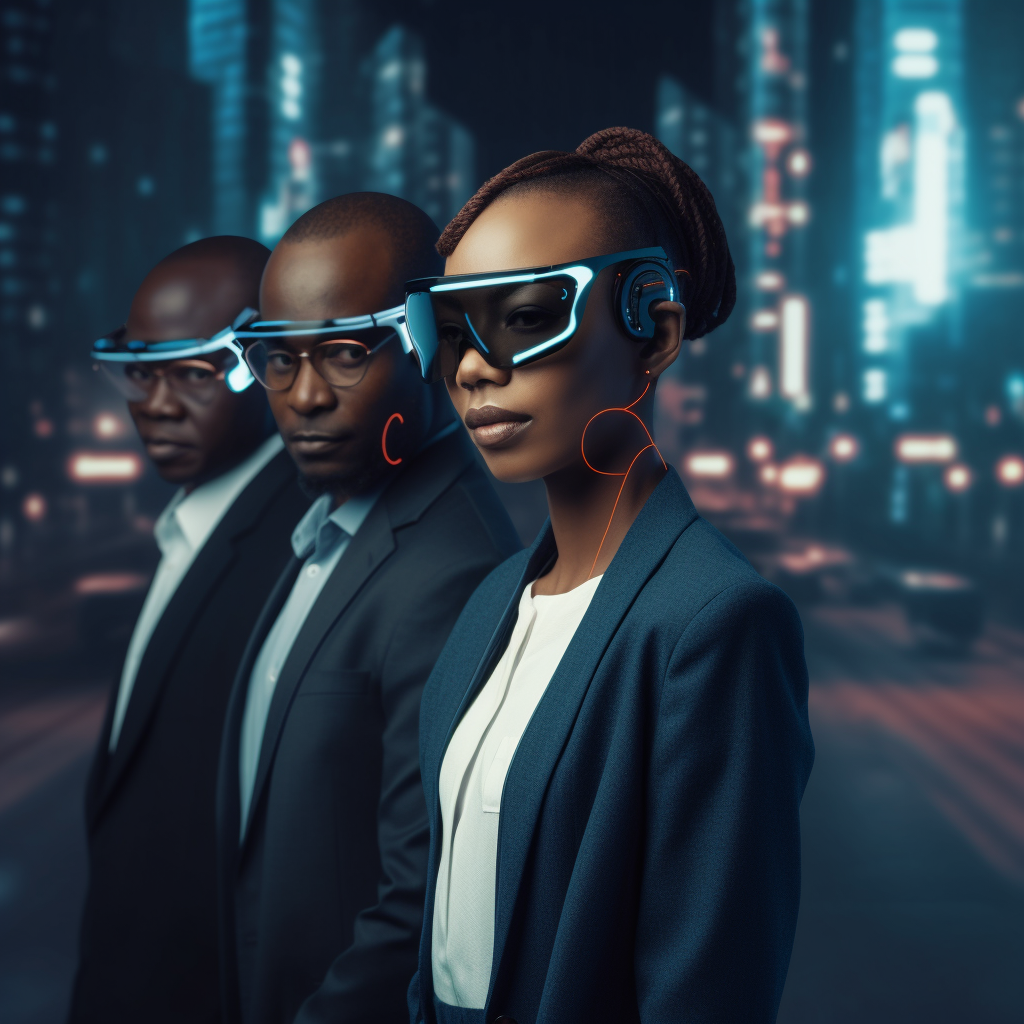
NB: If you’re a TV network we’ve devised an international game that we think is pretty amazing. It’s not unlike the reality game Physical: 100 and one I was involved in as editor for Nato’s War Games. Most images in this article were AI generated.

—

Here’s my scoping of my super power = diverse thinking. I’m British and Ghanaian. I grew up in Ghana, attended Prempeh College (Ashanti King Prempeh II’s college), I graduated in Applied Chemistry at Leicester, studied modules in Global Finance at LSE, then became a journalist.

I became an artist, and artist in residence at the Southbank Centre, hired by Jude Kelly CBE. My PhD from Dublin covers cognition and storytelling. I read several books a year. I’ve travelled and taught in Russia, China, India, Egypt, Ghana, South Africa, Canada, US, across the UK and Europe.

A lecturer at uni who worked in the health system and had knowledge of the ff said I had dyslexia, for the way I processed information. True or not, it’s never been a weight. You can read more about my background here 

Saturday, March 18, 2023

You desperately want to make it in journalism. My first piece that framed my career, with advice on Diversity and Inclusion.


his is it, I thought clutching my tape recorder about to board a plane to a country that by all television and radio news’ accounts was gripped by a civil war. Soweto, the country’s symbolic centre for racial justice was a place of rebellion and lawlessness — an enclave of South Africa which was a no-go zone.

It’s the winter of 92, I’m broken. I’ve sent various letters to media employers. Nothing! I’ve just finished a stint on the BBC’s flagship programme Newsnight, and am now freelance presenting/ producing on the BBC’s London radio. That seems to stand for nothing. ‘Second jobs are always the toughest’ a senior exec says to me. There’s another short term contract in the offing Def II BBC Reportage. But as I ponder my future, I know there’s no way I can survive this.

I started to become interested in the media years back, and in the late 80s as an Applied Chemistry undergrad started to freelance at BBC Radio Leicester. It boasted talent like Charlotte Smith (Now Farming Today), Ian Pannel (now ABC News senior correspondent) , Iain Carter (BBC Golf Correspondent) and Julian Worricker (BBC Presenter).

South Africa had interested me then. Five years on weary of any prospects in the UK I’m going on my own adventure. What I know of South Africa through the media is grim, but I believe that I can add my voice. My perspectives, lived experience (I schooled in Ghana witnessing first hand Rawlings’ coup), my interests should have some currency.

The last twenty minutes of the flight to Johannesburg the pilot welcomes me into the cockpit to record a running commentary. I see no explosions or fires from the air and when I land I’m greeted by someone I’ve never met but spoken to from weeks of letter writing. There is no Internet in 1992. How did people survive? They did. Alan Swerdlow will turn out to be an extraordinary human being.

And then over a period of two months exposed to different communities, people, the ongoings outside the BBC, CNN, ABC News et al news agenda, I feel I need to stay, But first return to the UK, complete my last short contract and head back.

Below is that account of my first assignment; my first ever feature piece and one that would appear in the BBC’s magazine Arial. It would bring me lots of attention, some welcome, some not.

But there was so much I wanted to write about: Soweto, and the fact it sits in the bosom of Johannesburg. The remnants of Apartheid dismantling, the wealth in the township glimpsing my first 850i BMW. How people are coping with high unemployment and the pending end of Apartheid. And then young people, graduates, like me whose thoughts were rarely given air time.

South Africa has a majority Black population and yet few networks had any reporting staff who were Black on the ground. It will get worse with the elections in two years time. The intersectionality of stories between Blacks and Whites had little interest for outside networks unless tension to the point of violence was a headliner, or that Mandela was seeking accords with leaders.

It made me aware of the hegemonic story in news; professionalism as a gold standard indeed but who tells the story matters; their everything does. But journalism I will soon learn is about power. As a freelancer I would brush against several scrapes, be treated in different ways if I opened my mouth, or spoke one of my Ghanaian languages. Otherwise my physical features threw up conundrums. I would months ahead report how Afrikaaner farmers got angry with me accusing me, a Brit, of being responsible for concentration camps in South Africa, after they dropped their scepticism that there were Black people in the UK.

Sometimes it’s just that, the calling. Journalism is what you want to do. You believe your voice matters and you’re prepared to take the journey. Twenty years into the future as an academic (still in love with storytelling) , I will find myself on the Syrian border, Ufa in Russia, Chongqing, Beirut and many more countries training, video-making and writing on social-political issues, and in many of those places what I see on the news has barely shaft of bearing on the complexities on the ground.

I recognise that my advice to young journalists wanting to climb up journalism by finding a hot spot needs to be tempered; but the zeal to drive deeper connections with editors who pledge to diversity and inclusion, whilst doing your own thing must not wane. Back in the 90s there was no diversity and inclusion. It was all in the gift of editors; still is by what we see.

Next year will be thirty years since South Africa’s momentous change. There’s so much to discuss, but will it be a predominately White male lens ? My reporting, listened to by Chatham House executives would earn me an invitation to join the institute - thirty years on I’m still a member.

This then below is my account. It would shape me thereafter. Make me realise how storytelling is not neutral. It would lead to some extraordinary breaks in unexpected areas: BBC Radio Four commissioning a documentary of first time voters that I would research and present, various reports for BBC African Service and World Service features. Meeting Mandela and reporting live on his inauguration for the Caribbean service, but above all that the next person I meet, I’ll tell them if I could do it, so absolutely can you.

After South Africa I would become one of the UK’s first NUJ videojournalists. There will be more break throughs and trouble ahead but that’s not a next time.

Full text below transcribed below.


Transcribed Audio here

Full text below here

xcitement and a flash of nervousness with me as we coast along the road from Johannesburg to Soweto. Twenty minutes later, the excitement will be replaced by fear.

Easing into Soweto police flag our car down twice. We pull over, but both times the car speeds off.

A wrong turning by Zosha, my friend and driver, brings us to a dead-end. While she is reversing and armoured personnel carrier used by the police, known as a Caspir, comes into view with a mob of youngsters in its wake.

No news footage or articles can prepare you for the menacing presence and overbearing size of these vehicles. On our way again a second Caspir edges in front of us creeping along at 20 mph. One of the occupants mumbles into his mouthpiece, whilst the other clutching a machine gun exchanges steely glasses with me.

His curiosity, I discover later, is pardonable. Zosha who is white and middle-aged, has the expression of a lost tourist and I, Black and wearing a military-style jacket am whispering into a half-concealed lapel mike.

Had I followed my instincts we would have turned back and I would have missed out on making some of the most interesting and rewarding friendships in Soweto, and for that matter South Africa.

It is my first trip to South Africa brought about by my interest in the country and triggered by what I learned working on Black London at BBC GLR. I am here to record a radio documentary for a program that examines the ‘successor generation’ — South Africans Black and white, between the ages of 18 and 35, who overnight are the beneficiaries of the ‘new South Africa’.

A country freed from its past emerging from the effects of isolation with new clothes, a new act and presumably receptive world audience .

My contact, Alan Swerdlow, who has now become a good friend works at the South African broadcasting Corporation — ‘not a good place to forge relationships’, friends in London had cautioned. But with him, my microphone became an extension on more than 70 lips, each telling different intriguing stories which all shared a similar theme: the new South Africa? We’re hoping for the best (democracy) and fearing the worst (civil war)

Thembakezi, who lives in Soweto and is a PhD chemistry student at Johannesburg Witwatersrand university is hopeful that being black will not deny have a good job.

A young Afrikaner and a practice in attorney in Cape Town was having none of it: ‘The new South Africa, what-ever that is, spells trouble.’

Hopping between the major cities, I find people warm and receptive. They in turn use me as a barometer for world opinion. ‘So what do you think about our country?’ is the standard question. ‘Interesting’, is my loaded response. Pushed further, ‘The weather is wonderful and the people have been nice to me’.

Pushed even further, ‘The more I learn, the more I understand, the more I understand, the more complex things become’.

It is also point of hilarity for some who discover, not only can I not speak any local languages, but I’m not American, and, although a radio journalist, do not work for the World Service.

What I find difficult to rationalise as many others do, is the violence on the streets. I spend a day in Durban with a field worker and researcher for the Human Rights Commission in Natal.

She discloses disturbing facts about what she comes across while investigating human rights abuses. The most telling is how easy it is to buy guns — an AK-47 for as little as R40 (£8) on the black market — and how teenagers ,as young as thirteen, are taking guns to school and in some cases threatening teachers.

The previous owner of her home he died in a bomb blast. The device had been delivered to the doorstep as a computer. Somehow, even with the iron bars barricading the windows — they are called burglar bars — are little comfort to me as I try to sleep.

After 40 hours recording and travelling 4000 km across the country my impression is that there is a long haul ahead. But I prefer to focus on the positive: more black people appear to be in positions of power across a range of industries; black and white performers and artists are committed to working together publicly — unheard of three years ago; and there’s generally a sense of expectation from South Africans that 1993 will be a good year.

Christmas day finds me once more in Soweto. We kick off with church, and again I am overwhelmed by feeling of exhilaration mixed with unease. Twenty minutes on, the thrill of staying in Soweto for a week, ‘shebeen crawling’ ( the Sowetan equivalent of pub crawling), gives way to anxiety. I cannot sing any hymns; they are in Zulu. A little girl observing my out-of-sync lip movements, breaks into a huge grin.

From Videojournalism, Cinema Journalism to AI Applied Storytelling: Everything, everywhere - each of us is many.


There are multiple versions of you, living multiple lives. Each one of those defines you. Some are recognised, some not! They have to wait the turn. But sometimes you can’t wait.

Kung-Fu, metaverse-jumping, laundry-owning mother sorting out her taxes and winning an Oscar appears to signal a change in viewing habits from the global arbiters of film excellence.

Oscar winner “Everything, everywhere all at once” has its mitochondria in ‘Inception’, ‘Scott Pilgrim vs. the World’, and Shaolin King Fu flicks of the 70s. But how on the metaverse earth does it impact factual storytelling and news?

News and factual videos passing as news-worthy is atrophying. By 2033 it’s highly unlikely what you’re seeing on your screens will be what you’re used to now.

Firstly, it’s the discrediting; the mask dropped last week from Fox News — Dominion case when it emerged Fox anchors and their boss Rupert Murdoch knowingly said one thing on air supporting the President whilst mocking and venemously slating him in private.

News is an entertainment set, a conduit to rile constituents to keep filling the slot machines for doubled-down alternative reality.

The much loved BBC and its impartiality debacle with its highest paid sports presenters Gary Lineker courted enough controversy for the news to damaging. In a decades time we might still be talking about that moment. Today, the BBC continues to look the other way with a Chairman who is a Tory donor and supporter.

Secondly, analyse carefully over a stretch of time style of news making and something subtle is happening. News is a social construct of its time. It looks, feels and behaves in accord with its era and whilst its storytelling form hasn’t changed much, its style is.

Based on global research I led across Europe and several countries like Russia, Syria and India this style leans towards, something the audience interprets as like cinema. This isn’t to deride news output as fictionalised, as the pioneer Robert Drew used Direct Cinema to bring meaning to audiences. This new approach using cinema frameworks, cinematography and essayistic voice expressions appears to build on Drew’s form which was shunted from news.

Research over six years and different practitioners, from solo video, mobile journalists to broadcast journalism teams reveals how several are using a form, at the lab and viewmagazine’s platform we refer to as cinema journalism.


The methodology for achieving this data has been replicated in different countries e.g. Russia, Norway etc and was recently part of a Facebook accelerator programme in India and keynote address shared with Danish Broadcaster TV2 — a summit of its staff. TV2 Editor-in-Chief Marie-Louise von Holstein called the talk “Exciting and Inspiring”.

The trend forward and super forecasting places video storytelling in a new state in which Cinema as an expression of shot, framing, voicing, sequencing, lighting etc are being purposely deployed to derive deeper sense-making. Thus there are ways of telling stories you can call immersive that doesn’t require a headset.

Thirdly, last summer whilst working/ consulting for Google on their innovation fund it provided me the most extraordinary evidence of innovation across Europe’s brightest companies and the future.

One that had caught my attention from my own previous work was the revelation of social connections between journalists and their subjects using AI, which could help understand motives between a journalist and their source. One we’re working on, involves ensuring fact-checking isn’t compromised.

Applied Storytelling


These findings have led to developments in new disciplines such as Applied Storytelling which is an interdisciplinary methodology collapsing specialist subjects in storytelling into one system, amplified by the delivery of artefacts e.g. apps and AI.

In 2015 we launched the Dislab that I led at the university of Westminster, and subsequently the Story Lab at Cardiff University we’re leading the training of Applied Storytellers. These are cohorts we develop as multi-hyphenates delivering artefacts, based on applied sciences.

The history of interdisciplinary work dates back far beyond the renaissance with individuals being named polymaths. Divisions of labour however in the 20th century became the norm, as did specialisms. As early as 1990s, whilst general reporting encouraged cross thinking, cross discipline, such as bi-media, were shunned. It took the BBC until 2000 to recognise solo videojournalists. Anything beyond that has been a bridge too far for one person and hived off back into disciplines, though the BBC’s labs under Robert Mckenzie encouraged ‘thinking across the way’.

Over the years our approach and research has yield research several results about future media. From 2004 working with the BBC heading up a team of researchers we proposed how mobile video would become ubiquitous. This video captured the beginnings of the mobile revolution amongst broadcasters.

In 2007 featured on Apple’s site we forecast how broadband would enable people to self broadcast into public spaces, whilst launching the first programmes for UK print journalists to become videojournalists. One of my first keynotes in Norway examined programme making on the web, and how broadcasters could use it as a second screen.

Videojournalism by David Dunkley Gyimah

And from 2015 onwards deploying an integrated approach in storytelling we examined how culture and inclusivity is integral to story form, which in tech VR applications could be used to confront unpredictable scenarios.

Podcasts’ popularity captured below principally at 2007 on iTunes to comparisons with radio and documentaries years back has shown up trends to be able to forecast the future.


From our soundscape-podcast design 180991 featuring unique archive there’s every likelihood that podcasts will enter more visual and meta (VR) platforms. The history of media tends to favour deeping engagement with media by inviting greater multi-sensory touch points. Also that branded podcasts will coalesce curatorialy around each other creating unique points for innovation and collaboration.

This year we’re on the cusp of launching a unique global project and I’m looking forward to sharing ideas with independent international group of journalists looking to blend Applied Storytelling with Journalism.

Perhaps the most striking innovations to emerge with the pace of tech stea, rolling ahead will be a social recognition: of all the identities you believe you are how they might all be recognised.