The use of Generative AI in education seems alarmist, even dangerous, but is it? And what might you make of this glimpse of its future in Star Trek in the 1960s. Trekers knew this all along.
Finding answers, compound and complex ones will be the shift. For too long learning has sought to attach singular or dominant responses to answers. If you've done hacks or ran labs you'll know from systems thinking that simple is ne'er the outcome. Simplicity maybe?
So watch in this scene how Cpt. Kirk arrives at a solution. He's in charge of strategy prompting the Computer (AI). The AI returns answers. Kirk's cognition is in finding the next response to move towards his end goal. This approach mirrors Gary Kasparov playing Centaur Chess ( Advance Chess (1998) with AI).
Knowing the answer is one thing. Knowing how to get to a cogent answer is another. This will be helpful in delineating between simple to complex problems - and about time too.
Furthermore, the problem-solution needn't be stated. The finder arrives at the end goal by a series of logical propositions and deductive questions
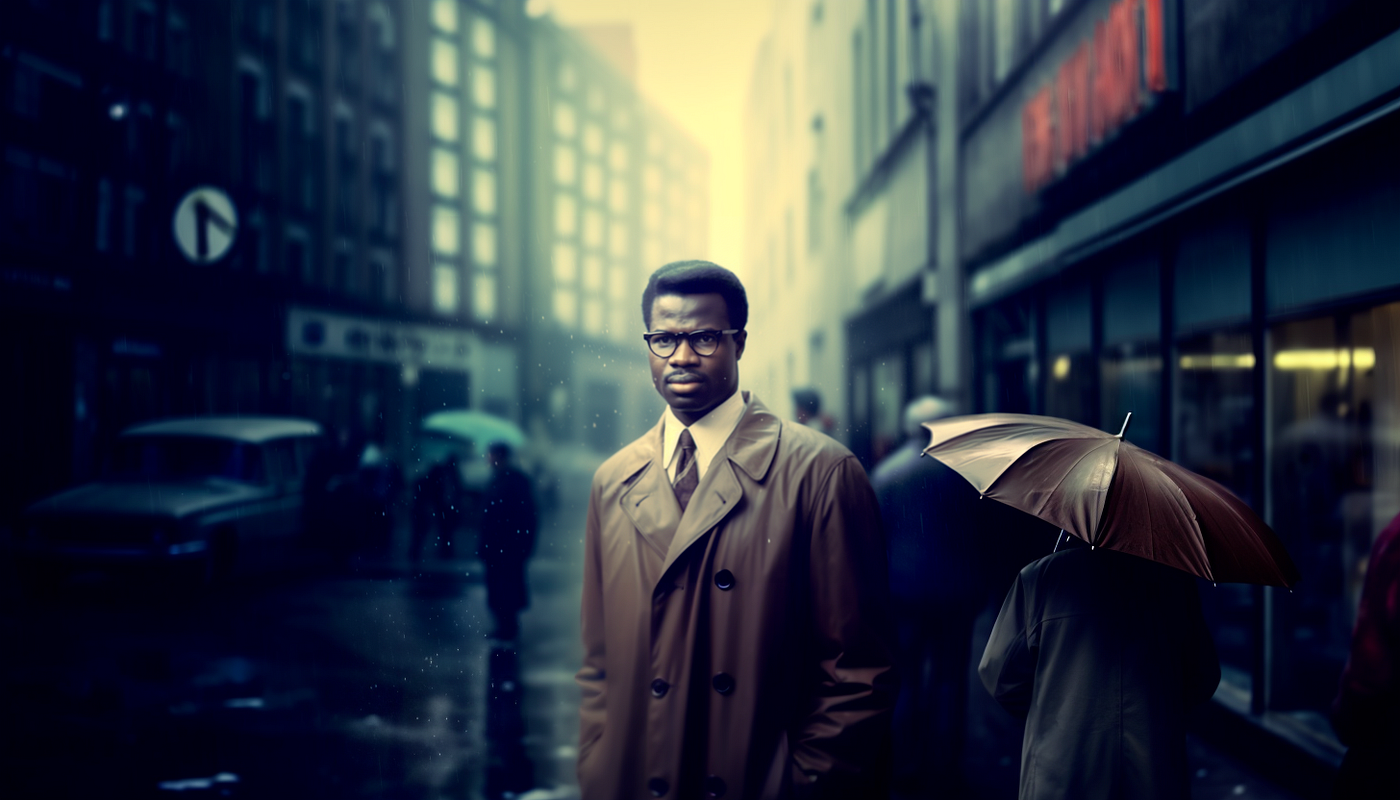
Astory about a young police officer who travels to the UK in the 1950s from West Africa seeking a new life shows a future of AI evolving filmmaking. And it will particularly benefit communities.
AI was used to recreate half of the visual scenes from researched documents.
The officer Edward Gyimah was 25 years-of-age when he travelled to Britain in 1955 on a government scholarship from what was then called the Gold Coast. The Gold Coast would become Ghana in 1957 — the first African country to achieve independence from Britain.
The story called “Chairman — The Ghanaian”, is just one of the lesser well known narratives of 1000s of West Africans who made Britain their home in the 1900s. Chairman is a term of respect used in Ghana to address a senior figure.
“Chairman — The Ghanaian” is the story of my father. I’ve been finding material (a suitcase of letters, photos and his passports) 17 years since he passed away which paints a vivid picture of his trials and travels.
The photos prompted quite a reaction on social media when I posted resulting in people posting photos of their parents too. Several people, such as Marcus Ryder MBE, Henry Bonsu and Jo Holmes left comments.
The issue I had, which is commonplace is, there was limited archive to expand on his story. But the use of Generative AI has solved that problem. The promo below is a first iteration, and already I can see new improvements and new apps I could use. By 2027, I can’t imagine where we’ll be.
Journalism and AI
I’ve been a journalist for more than thirty years and have worked for outfits such as Channel 4 News, BBC Newsnight and ABC News. And also as a technologist and artist I’ve been involved in several media innovations. The angle I come at with AI is largely different from dominant views. Some of the innovations I’ve championed include:
Cinema and video journalism — a study and work showing how a new breed of journalists, some from the BBC, use cinema’s langue to tell stories
Mobile journalism and VR — creating a mobile film Bass Culture, a 500k Arts and Humanities Council project, which was shown on the big screen at Regents cinema where the Lumieres brothers screened their films
Creating platforms that have appeared on Apple’s website — creating one of the first video magazine platforms in 2004 before YouTube which would win a Knight Batten Awards
Innovation tends to be accompanied by apocryphal stories and the “industry-is-dead” themes. So what of AI? What’s so different ?
The impact of the industrial revolution on artisans provides a framing for the future. Not unlike painters who were the news people of their day reconstructing scenes from memory, Gen AI for many practitioners fulfils the same function.
Critics speak about the ethics, and that can’t be ignored, but there were ethics that were overcome with the generation of art, and photography in the 1800s. It resulted in the introduction of broadly agreeable standards. The same will happen with Gen AI.
Industrial manufacturing markedly reduced the work of carpenters, carvers and metallurgists, but in time there was a premium for having worked produced by experts.
The promo I’ve produced using AI takes the viewer through my father’s ups and downs, and his eventual return to Ghana with us, his children. His motives for coming to the UK, abandoning a career in the police force was to study and return to Ghana. His life mirrored scores of Africans coming to the UK on scholarships. He would return home almost 20 years after his arrival.
Whilst Africans have been in Britain since the 1600s. According to one of the foremost authorities on African history, Professor Hakim Adi author of West Africans in Britain 1900–1960, after 1945 there was a fundamental change which saw the number of West African students, including women, in Britain increase. Professor Adi writes:
By 1945 this figure had risen to over a thousand, about two thirds of whom came from Africa, the vast majority of these West African (mostly from Nigeria and the Gold Coast)… by 1948, divide over 1000 west African students in the country.
Today, Black Africans outnumber Black Caribbeans in the UK. The 2021 census says of England and Wales was 59.6 million:
2.4 million people (4.0%) were from black ethnic groups — 1.5 million of those identified with the black African ethnic group (2.5%), and 0.6 million with the black Caribbean ethnic group (1.0%)
In constructing the promo, amazingly I was able to create photos of dad from AI that my close family did not realise were AI generated. Whilst the impact of AI will be colossal, and will reshape the industry it won’t based on forecasting lead to AI media utterly usurping actual media and people.
They’ll be a secondary workforce burgeoning just as we’ve witnessed with multimedia, but mainstream has not disappeared, anymore than actors will. And if you’re a Trekker, seriously there’s the future writ large in front of us all.
Chairman was one of a number of ideas I took to Ghana in April and was taken to meet the former President of Ghana John Kufuor and several CEOs by one of Ghana’s leading academics Prof Kofi Asare Opoku.
The President took a keen interest in the work and requested I continue to probe.
One of my main aims is to teach a new generation of its efficacy and where it could help in media. Its hugely important that its adoption is wide and absorbed particularly by students from the Global South, where technology and media access has historically been challenging and led to deep chasms in the knowledge economy.
AI will accelerate a new information horizon and its vital data and industry participation towards shaping existing biases, that will be baked into the future alone, are addressed. But what are the odds of this? Media as a business is forever gazing at its bottomline navel, looking to new ways to up its profits. AI is its Sapphire.
Yet by itself is AI is a tool, it’s not sentient yet to think by its own, so it’s the thinking process towards creativity which has huge currency. Systems thinking, design thinking and cinema journalism are a few of the methodologies used to enhance this future filmmaking form.
To that end, I’m in talks with a number of people, academic outfits and bodies, and look forward to inviting AI storytellers, practitioners and academics, to the University of Cardiff where I’m based. We’ll share and publish work. More recently I’m honoured to have been invited to join the Pan African Heritage Museum in Ghana as a member of its academic and curatorial Council. AI storytelling will have much to say in Museums.
I’d like to thank Prof Prof Kofi Asare Opoku, Professor Pash Obeng, and Senior Kojo Yankah founder of the Pan African Heritage Museum for their ongoing suport.
I’m a reader/ Associate Professor at Cardiff University with a specialism in innovation and Story Labs. You can contact me here Gyimahd@Cardiff.ac.uk For more click here
It’s a sprawling magnum of emotionally fuelled storytelling. Transcendental in its ambition, non linear and complementarity in its delivery.
Nolan’s Oppenheimer (2023) thematically plays on his movie heritage which is diverse, yet moored in the art of memory. Is that not the way for all great filmmakers, the continentals such as Bresson, Godard, Jean and Renoir, then Wells whose Citizen Kane is also an example of synchronicity?
I’ll return to memory in a moment. For there’s something else his vision for this film mimics, captured in the essence of the science that his characters are seeped in — Quantum physics and complementarity.
In life, Niel Bohrs in 1926 acting on Einstein’s 1905 proposal of the duality of light, formally cracks its. Light is both particle and wave. Ergo the world, or even the movie world, is both inner consciousness and outer feelings.
The idea that events are happenings collapsed together around multiple interactions of chained causes and affects — is Quantum, and also synchronicity (see Junger). Synchronicity — things that seem meaningless knit together into some coherent form.
In more hyper flexed kinetic cinema it’s “Everything Everywhere All at Once (2002), and Iñárritu’s Babel (2006).
I was a chemistry and maths graduate approaching the 1990s — not a good one, before I became a journalist, filmmaker and artist in residence at one of the UK’s prestigious centres, The Southbank Centre.
I had a weakness in deciphering inorganic reactions; I loved Organic and can still see on the board the nucleophilic attack of Nitrogen on its benzene molecule leading to Tri-Nitro-Toluene (TNT). But I had no hope for where my chem career would take me , and hence in my second year of Uni lost my hunger for science’s abstruse approach and its delivery and became fascinated in radio and the science history of innovators. My MA radio dissertation was on DNA and its new breakthroughs interviewing Baroness Warnock, before I got a job at the BBC.
I’ve a sweet tooth for science movies. The brilliance of Oppenheimer, fiction as it is, was bringing together physicists and players in dialogue: Bohr, Einstein, Teller, Strauss, and Oppenheimer.
It’s not entirely original. Playing on BBC I-player at the moment is Sam Waterston’s Oppenheimer; a 1980s seven-part mini series. There are parallels with Nolan’s script, yet Nolan’s visuality, the intensity of repartee dialogue creates an edge — as if there wasn’t one already.
There are many piquant moments and it’s widely reported that Nolan held fast to the Pulitzer Prize-winning bio by Kai Bird and Martin Sherwin’s American Prometheus: The Triumph and Tragedy of J. Robert Oppenheimer
Nolan also, its reported acknowledges cinematic license, much like Oliver Stone altered some scenes on his epic Nixon.
That conversation between Einstein and Oppenheimer which becomes a homing pigeon; the need for Einstein to run calculations to validate the world would not end on the explosion of the A-bomb, never happened. It was Nobel Prize winner Arthur Compton who directed the Manhattan Project’s University of Chicago that got the call. Einstein was just a better film figure for this dramatic arc Nolan told TheNew York Times.
Oppenheimer as a nod to quantum physics, for what some scientists see as a poor choice of words, means a particle can exist in different places. It’s explored cinematically by different expositions in varying time space happening at once: various hearings, a love tryst, and the science narrative towards to creating Trinity (the bomb). What then knits it together for its denouement is memory.
Nolan’s giant jigsaw puzzle of a film, much like in some ways his Tesseract in Interstellar (2014) culminates in different time frames falling neatly together. It’s the Rosebud moment from Citizen Kane.
This post isn’t an article about the film per se rather the idea expressed in Tenet (2020) as “Just feel it”. So what’s the quantum lit fuse?
Filmmakers have perfected the art of borrowing. “They watch each other’s work and learn how to tackle scenes that have gone before” writes Mark Cousins in his erudite “A Story of Film”. I’ve written about Nolan’s films in the past and what it offers. Tenet,Dunkirk, and Interstellar.
In training the UK’s first newspaper journalists to become video journalists in 2005 I created a feature news piece influenced by the kinetic movement of the camera inspired by Paul Greengrass’s work.
I’ve built a career in news and journalism which has had a problem with memory. If the very nature of news is what’s new, then arguably during its inception you could point to current affairs and documentary to perform the function of remembering. Admittedly there’s only so much you can do with 2 minutes. But these structures in journalism are constructs that suited television journalism at its birth, but in the world today are inadequate.
Professor Catherine Loveday, a psychologist and regular contributor to the BBC talked to me about memory and journalism. Here’s an excerpt:
Loveday: A news story is a shorter piece of information. It may be something that doesn’t engage you as much and so you don’t pay too much attention to it. More importantly it hasn’t necessarily got a narrative that runs through it. So you don’t invest in the story psychologically or immerse yourself the same way you would a film in which you’re relating to the characters integrating it with your own knowledge base and experience.
Dunkley Gyimah: So how does that happen?
Loveday: So one of the things is how deeply you process something. The second is how engaging it is. The third, which is related is how much attention you pay it. The forth is the different kind of formats that the same sort of information is presented to, so if there’s any kind of repetition. So for example in a film you might have music in it and the music might allow you to engage emotionally more with what’s going on.
So it’s employing more than one sense, so visual sense and auditory sense. I know this happens with documentary, as well as with the news but not to the same extent. Those are some of the things that make film memorable…There are some formats that are more memorable than other. ’There’s a bit of discrepancy around this but we tend to remember visually more easily than auditory stuff.
Dunkley Gyimah: Because?
Loveday: Memory tends to be more visual, using more visual areas of the brain. If I ask you to remember something from last week or ten years ago, fifteen years ago, it tend to be visual. The other thing with narrative is that we are primed as human beings to remember stuff as narrative. We try and reconstruct our life and our kind of world as narrative, and we need to do that to in order to place ourselves in context in the rest of our lives.
Memory is at the heart of how people function. Yet it’s often rendered obsolete in journalism. You can gaslight, and all but believe there’s no consequences, that obscenely, “Black people benefited from slavery because it taught useful skills”, and that’s it!
Nolan’s gift to me, like I said we all take and modify something from auters is to reimagine how in a world of 2030, even now, how our memories will serve us in media in a world where we’re reliant on AI.
If the media did not already exist of an event, if the past is strafed with representation harms that are caked into AI what then? The Interdisciplinary school in London made a video in which it asked Gen AI text to image about how Barbie would look in territories like Sudan and South America. It’s worth a look.
How can I take Nolan’s thoughts to create a piece of work, which becomes immersive and triggers engagement?
How does Nolan prompt me as a filmmaker, artists and educator?
This is one example: a two minute project promo featuring the story of my father, a policeman in the Gold Coast in the 1950s, who came to Britain to advance his career. We’re unravelling several interesting story arcs, but we’re bereft of archive. What though if relying on memory we could build these scenes in Gen AI?
I suspect 2023 is going to be strange year. Visibly, a number of things are being nakedly exposed, even atrophying before our very eyes. Things like politics and its governing system, behaviours that upend equitable actions, and so on.
Yes they’ve been apparent, but we’re increasingly aware of the urgency to do something. What replaces pre-2020 is still in incubation, if not fully formed. It was a bit like this around 2004–2006 with ideas. The first wave 1989–2001 set up a correction for the next jump, and to now 2023?
Except that the last two innovation jumps, whilst opening up new communities have tended to veer towards the notion of capitalism at any costs. What happens next has many already acutely aware of the ills of the past. What happens next, particularly in the engine growth of new economies isn’t to replicate templates elsewhere.
The word “integrated” gets used a lot, because generally work and lifestyles are still seen as actioned as independent silos. It’s that division of labour thing necessary for its time concerning productivity. For instance work until recently was primarily office-based. It was felt if you weren’t in an office, you wouldn’t be so productive, but increasingly, meetings or work is taking place from the home and a balance for output has been found.
Journalism, which I know a bit about over the thirty years is an area that requires an integrated overhaul, but with what? And hasn’t it already been through change? And should it be called Journalism, any longer? Why is journalism important?
it’s a main conveyer belt for knowledge, but its achilles is its set form in which its guard rails can be found struggling against the status quo. Rightly bound by facts, but losing the sense at how it fashions a story so people take positive steps from being informed, taking action for the right reasons, taking action towards bettering society and cultures. AI, behavioural science and Applied storytelling have a role here integrated as one.
There was an out and out model of journalism as news that appeared to work before methods were found to undermine it. A model to inform people in the next wave that fails to integrate behavioural psychology, with applied storytelling, tech and art will only serve to provide what we’re already doing.
Some years back, I wrote about the journalism interfaces that would establish for readers connections in stories. That’s doable now.
In the 1600s the word “Nice” meant to be Ignorant or stupid. Words change, disciplines too. By 2030 I hope the word storyteller or journalist is someone who performs multiple functions from different domains in building things that solve problems, whether that be stories or otherwise.
How does it hold your attention and how does it continue to hold your attention. There was a moment presenting at Apple Store in London, when there was a shift from the audience. A comedian friend told me about this phenomena during his set when that moment comes when the audience mirror the artist, referred to as mirror neuron.
All storytelling involves an intentionality, but sometimes motives can be masked or suppressed because of conventions. Conventions are human generated rules bound within a time and space. But dependent on societal and cultural progress they atrophy, or are questioned (disruptive necessity) for something else to take its place.
Consider then this. News journalism quite often doesn’t cover an event that’s happening in real time. What you see on screen is an attempt to construct a story based on a thinking of events by the storyteller. Where, how and when people are filmed is made invisible in journalism for the convention. It may not have been an issue in the 1950s when TV journalism was coming on stream because there was good faith in the actors — those being filmed were respectful of TV.
How about today? Imagine someone telling you a blatant lie. Have you ever recorded your gaze/ eye movement towards them? Imagine you wanted to question them about it. “John can you come here a second, please?” You’re on the veranda between the coats asking what on earth is going on. The scene becomes quite animated.
Imagine now a scene from a politician named John. He chooses where he’s filmed, actually journalists through convention choose the scene, outside parliament. John’s interviewed some time after the event, so if he’s not in reflective mode has had time to consider his response.
And the framing, by convention, in journalism of John is via the rule of third. The rule of third is in fact NOT a rule in the sense of a fixed command, its a visual choice. The rule of third maintains you place John on the third part of the screen, leaving two thirds of space for where he’s fixed his gaze. It implies John is speaking to someone off camera.
Yet it’s also a shot that invisibly unconsciously yields harmony. Way before TV News was born, in his film Citizen Kane (1941) the director Orson Welles shows a compositional arrangement of the “rule of third” in an interview scene. Western artists discovered that post renaissance. Chinese art found different compositions for balance.
So now consider this. John your politician is lying, yet he’s decided with you on the power of the scene, he’s working a narrative and you’re making him look harmonious by your filming techniques, and the audience will interpret the scene their way aided by the invisible codes used.
There are solutions, and they require a broader discussion, just as the hand cutaway (convention) has been largely laid to rest. There’s no such thing as an innocuous cut away. That much became clear where in a scene many years ago, a corporate was feeding back on a question and then it cuts to the corporate rigorously tugging at his wedding band. Someone in the edit asked innocently does he have marital problems?
So what next? I’ll post news of a form that’s addressing issues like this and is gaining in currency.
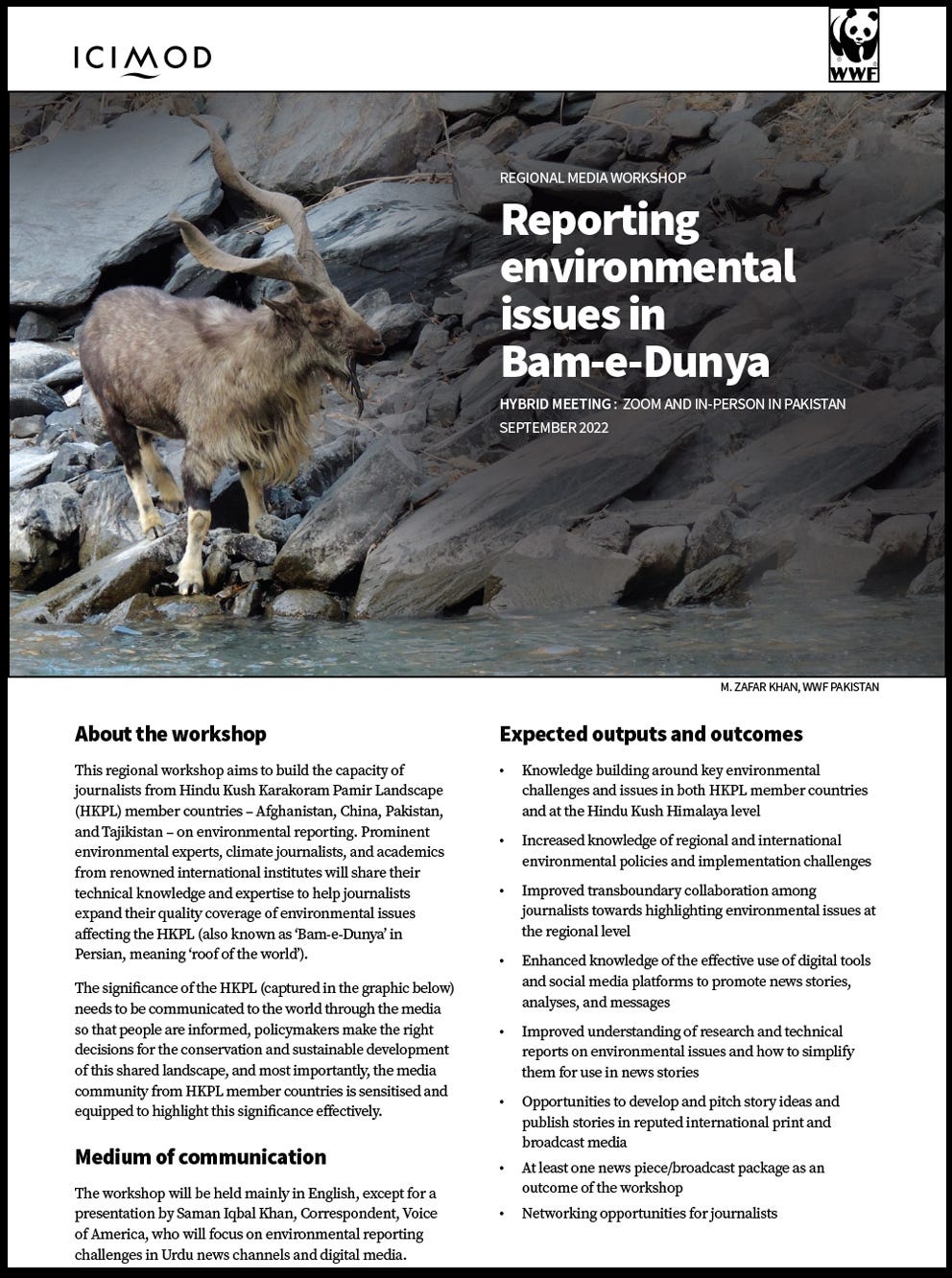
“H”ow can climate stories be improved?” was one message. “How can stories reach more people?”, was another. These were fundamental questions. Was I about to pitch too high?
This last week Pakistan has been devastated by floods submerging a third of land, causing 1300 deaths, 33 million people affected (which is almost half the British population in size), and untold human misery. Human-made changes to the climate, experts say is a contributory factor. Unusual catastrophes across the globe this year have left their mark too.
However, blink and you’d have missed its damning, humanitarian and ongoing affect on television news. For environmental officials, experts and ministers gathering for a months in planning the last few weeks are a reminder, if anyone needed it, of the impact of a fragile ecosystem convulsing. Speakers included: Wolfgang Blau, Co-Founder of the Oxford Climate Journalism Network, Leo Hickman, Editor of Carbon Brief (former editor, The Guardian) and Dean Emeritus, Professor Adil Najam from Boston University.
Meeting Online, as well as in-person, the organisers pre-determined focus is one of the most striking, life-supporting, and picturesque regions of the world — the Bam-e-Dunya. It means ‘roof of the world’, a vista of six of the world’s impressive mountains, supporting a spectrum of habitats. Ironic, as the roof of the world is collapsing and those below slowly atrophying.
Valiantly, an award winning journalist and one of the organisers Abubakar, has made it his mission, through deep dive research and report, to expose the region’s life, traversing, amongst others, the famous Khyber Pass that connects Pakistan and Afghanistan to interview mountain women.
CLIMATE OF NEWS
The swell of global cataclysms thus far may not yield enough empathy your end to make a radical change to behaviour and to halt a diseased climate. The reasons are plentiful.
If anything it’s occurring in a space with which you may have little emotional connection. If you do catch a glimpse of human sacrifice and ruins, it’s transient. There’s another calamity, perhaps not of this scale, but enough like a game of musical chairs to occupy your thoughts. Carl Sagan, a noted scientist, nailed it back in 1987 with his observation. No one cares because it’s not going to affect them. It’ll be their children or grandchildren.
For my hosts across the Net, I have a solution, of sorts, in this complex web of solutions in applied storytelling. There are two ways, by no means exclusive to each other, of looking at this. Let the conscientious thinking policy makers do their work setting rules and influencing governmental behaviour or get the ecosystem of communications; in this case I’m focusing on News and journalism, and its impact on consumers, to do your bidding for you.
Why News? It shapes your understanding of the world. But there’s a snag, if you’re relying on News, that requires untangling. Mainstream TV News won’t have the answers for you in addressing viewers enough that may motivate behavioural change, even if you get precious moments of coverage.
The reason is simple. It’s TV News’ detachment that sits at the core of its impartiality and guides its output. This from The Power of News by the influential media historian Michael Schudson.
Increasingly journalists take a distanced, even ironic stance toward political life- in fact they are en-joined to do so by both the tenets of their professionalism and the cynical culture of the newsroom.
TV News, through the presumed lens of its audience, sees climate change as “boring”, too complex to resolve into story arcs and too remote. Otherwise a whole 30 minute programme would be dedicated to it: “Dear Viewers. This is a special news programme about Pakistan”. It’s issue led, and if a story of the scale of Pakistan does emerge there’s a debilitating sense amongst gate keepers of ‘how-do-you-tell-the-story’ without, wait for it, putting off their viewers.
David’s slides
LANDING A STORY
Itmay have caught your attention that to illustrate a global climate crisis I’ve used a polar bear. I’ll come back to this. Another reason that TV News will likely fail to capture how the story could be told is the lack of representation in western and global north newsrooms.
Take the BBC, there’s no person of colour at the helm of its domestic TV News output that more likely will be emotionally, psychologically and culturally tethered to a story of this nature. This doesn’t necessarily mean impractically hiring every national for a potential disaster zone to be an editor, because a consultative editorial advisory group, comprising wide representation would suffice.
I remain intrigued why stories about human suffering are always confide to day shots. What happens when the lights fade? What happens when in Pakistan you’re five feet in water with children and there’s no light? I remember, flash floods in Ghana, not on the scale of Pakistan, but at night, the suffering intensified.
For the neuroscientists and psychologists amongst you, the quest is how do you tell an empathetic story that motivates people into action. Again, modern mainstream News isn’t your answer, but there’s a hint towards solutions.
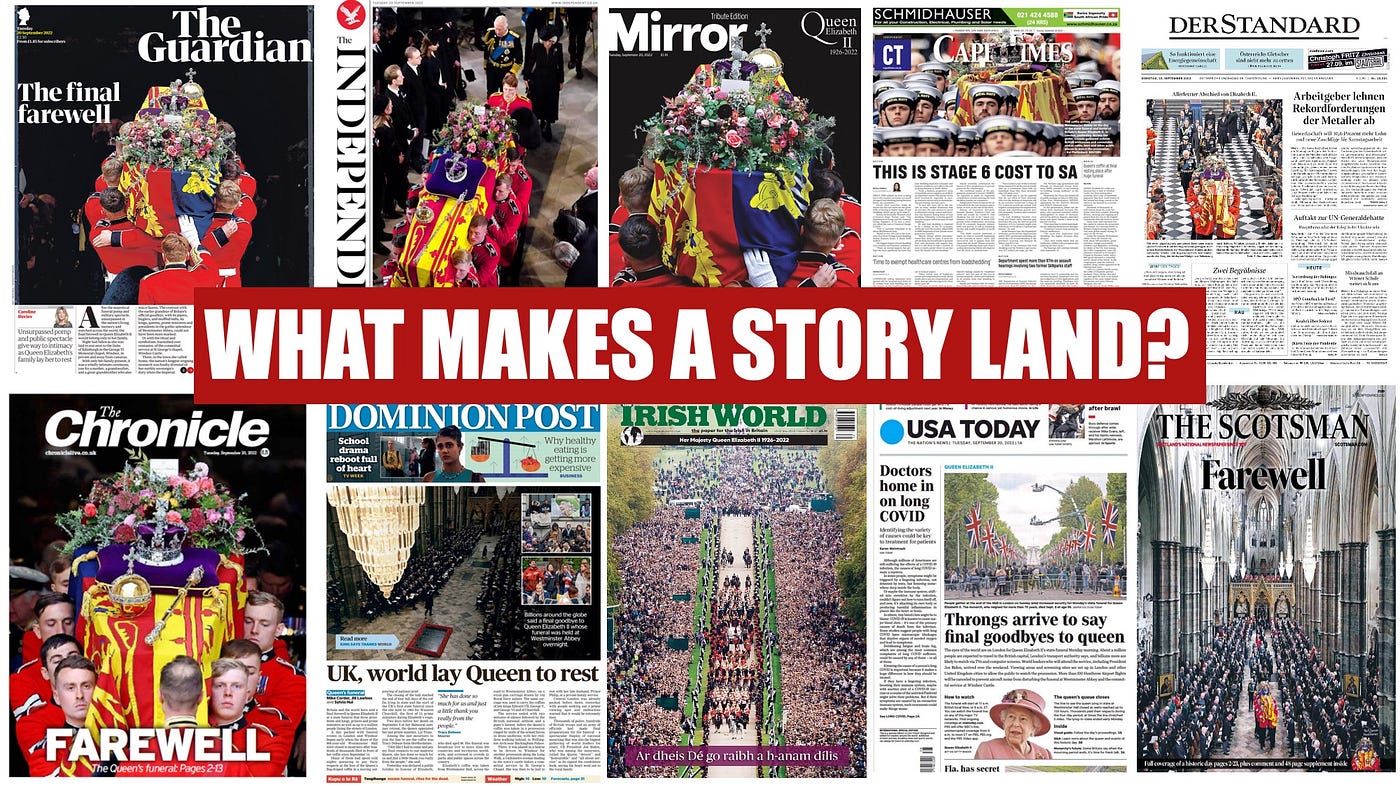
The passing of the Queen provides an illustrative canvas. There are countless reasons why the death of her majesty would make global news. I’ve worked in newsrooms in the BBC, Channel 4, WTN and so on, enough to know the answers, or most of them. She was the Queen. Celebrity sells too.
But a look at some of the front covers from around the world reveals something interesting. The pageant was an organisational feat of pomp and circumstance and some images dominated front covers. This is no accident for the organisers and the media who know an arresting image when they see one. What makes a story land? Powerful Images that coherently tell a story, often where few words are required. It’s not always a given; it’s a cognitive puzzle.
Whilst researching for my keynote, I tried in vain to find free copyright images or video like the ones below from The Guardian and The Atlantic. Nothing! The use of a Polar Bear from Unsplash was to make that point. If you want your Human interest stories to travel, make pictures like the below available for public use, and social media share. This brings me to a set of solutions I provided in my address. But before then, more on the power and reach of international stories done well.
How did a report about famine and deaths in Ethiopia in 1984 spur on a rock singer to put together concerts, Live Aid, that would motivate generations into action? Why did a 30-minute report Kony 2012 about an outlaw in Uganda (East Africa) Joseph Kony garner so much attention? Today it stands at more than 130m views. How on earth did a fictional film, a Korean story “Parasite” about domestic workers out on their luck become an Oscar winner? It’s how they’re told.
Television News is one of our biggest influencers; its currency is information, but that doesn’t necessarily translate into action on the consumer’s part. In any case, the argument is that’s not TV News job. That’s PR! But that’s not entirely the case either.
Coupled with this complex matrix for telling a story that seems far removed from viewers’ consciousness is the growing impact of climate state craft practitioners working to suffocate meaningful reportage. My next slide I shared.
They can’t be ignored, however there is a solution to story craft that is journalistic, not PR, and cuts through to viewers.
In the past 20 years plus through global research which would form the basis of my PhD, and coupled with my experience at making programmes, I identified a new breed of storyteller that embraces a different storytelling ethos.
Let me first provide context. You may be aware of something called Cinema Verite or Direct Cinema that emerged in the 1960s as a style of news and doc making that radicalised factual and news narrative. The figure behind it was the late Robert Drew.
It’s no exaggeration to say what Drew and his colleagues did was to fundamentally change the way viewers would come to watch and interpret news films. If you’re a seasoned documentary maker or news person, your understanding may be that this style was designed for documentaries. No! Drew in our conversation was emphatic. It was to recreate a style of news, but they news folks didn’t get it, he told me.
That’s the parallel example for where we are now.
THE APPLIED NEWS STORYTELLERS
In the 1990s-2000s a professional class of news makers would realise, just as Drew had done in the 1960, that by changing news gathering tools, approaches and methods something happened. Left to their experimental space, and unencumbered by Journalism’s detachment and the rest, this new breed of journalists intentionally or unknowingly approached a story like a film director/cinematographer cum photojournalist.
The research showed that some videojournalists and some mainstream reporters were being influenced by wider storytelling models observed in cinema, not for its fictionalisation, but how story forms worked.
If this sound strange, this is what Drew realised and hence the word “Cinema Verite” was coined. He uncovered a cinema style of filmmaking for its time. Forty years on from his find, when I spoke to Drew (made into a short shown at Apple) he was confident the myriad of new storytelling styles was on the horizon. He wasn’t wrong.
Solo and small mainstream teams of journalists and camera operator were reaching beyond information as the driver, and making sense of the story by asking the question, “how can I make you feel how I felt?” Each frame mattered. There was no such thing as GVs; general vision shots to which TV news is attached.
For the coterie I’ve spoken to across the world, there’s a fundamental break with the detachment model TV News promotes, and whilst this new breed of storytellers demonstrated what they could do, they still generally held firm to the qualities that frame TV journalism and would go on to win award after award.
They include Raul Gallego Abellan, which Sky’s Award winning reporter Thomas Moore would comment upon below.
Another exemplar is Travis Fox, whom I provided a content analysis to his news filmmaking below. I’ve had to warn Chinese students when I’ve showed them the full Travis Fox film.
So to the questions asked at the top of this piece. How do you get people interested in climate change against the inertia of TV News management and the statecraft of disinformation? It is at first a complex chicane to navigate, but here are some solutions that should help garner viewership.
How can stories reach more people
Work with the top news agencies who have the infrastructure in story workflow. You may have access and contextual knowledge of the region for co-creation.
The MSF effect. This global humanitarian outfit regularly allows professional media and photographic crews like Magnum to accompany them into disaster zones and makes their media available to use.
SuperSize me, Kony 2012, An inconvenient Truth reveal patterns for how to make stories with an impact. Tell longitudinal stories over a lengthy period of time. If I were an editor I’d pay for a solo videojournalist to go and live and document for the next year to six months, and connect them to different geographical spaces.
The future is Web 3 and decentralising. Those images found on the Guardian and The Atlantic, hold an insight into bringing in young audiences via NFTs and DAOs.
The TikTok effect. This is the platform for innovators and now the not-so-young viewers get their news. It’s where you can experiment and find traction CNN’s Max Foster told me. TV News note, the trajectory for viewers will only decline further if you can’t find new ways of engaging audience.
Super collaborations. Co-create with others involved in the story. Just as you see with the Queens front covers, co-ordinate and share output so it creates a news cluster, which will also be picked up by social media.
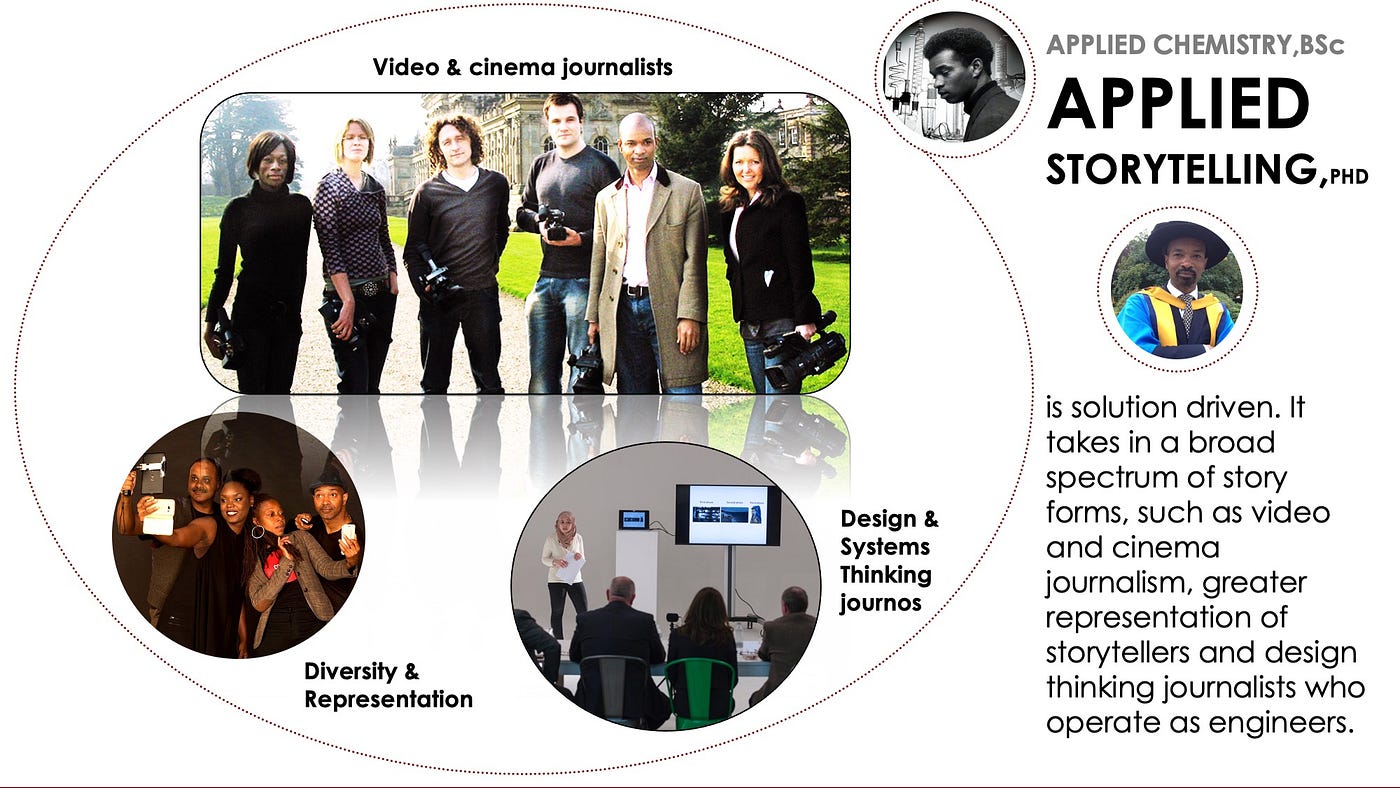
I explained in my talk, there are other factors. We run a digital storytelling lab which combines the videojournalism/ cinema journalism ethos described, with design and system thinking journalists and diversity and representation are key components to the art and science of storytelling.
That science falls under Applied Storytelling. My degree was in Applied Chemistry which provides parallels to seeking solutions.
I explained I have form in innovation and hence am confident that any co-creating alliances will have an impact.
At an international level, there are too many projects to name, but some that feed into the sense of reporting on stories that thread big movements include working alongside Nato to train journalists in risk assessment and the likes, and reporting from Apartheid South Africa in the early 90s for the BBC World Service. This summer I worked on Google’s European News Innovation Initiative as a reviewer, and before then, moderated and worked on a UN conference on the Ocean. This is the head of comms’ feedback.
The way forward is mired with levels of difficulty. It involve training new storytellers, revising language ( I’ve tried not to use the word “Climate Change”) and involves exemplary reporting on one hand and fighting disinformation on the other.
There remains a big hole in this advance that could bring greater attention to some of the world’s most pressing problems, and that is places and seats of learning working in alliances with media makers and the public, in a way that has yet to be realised.
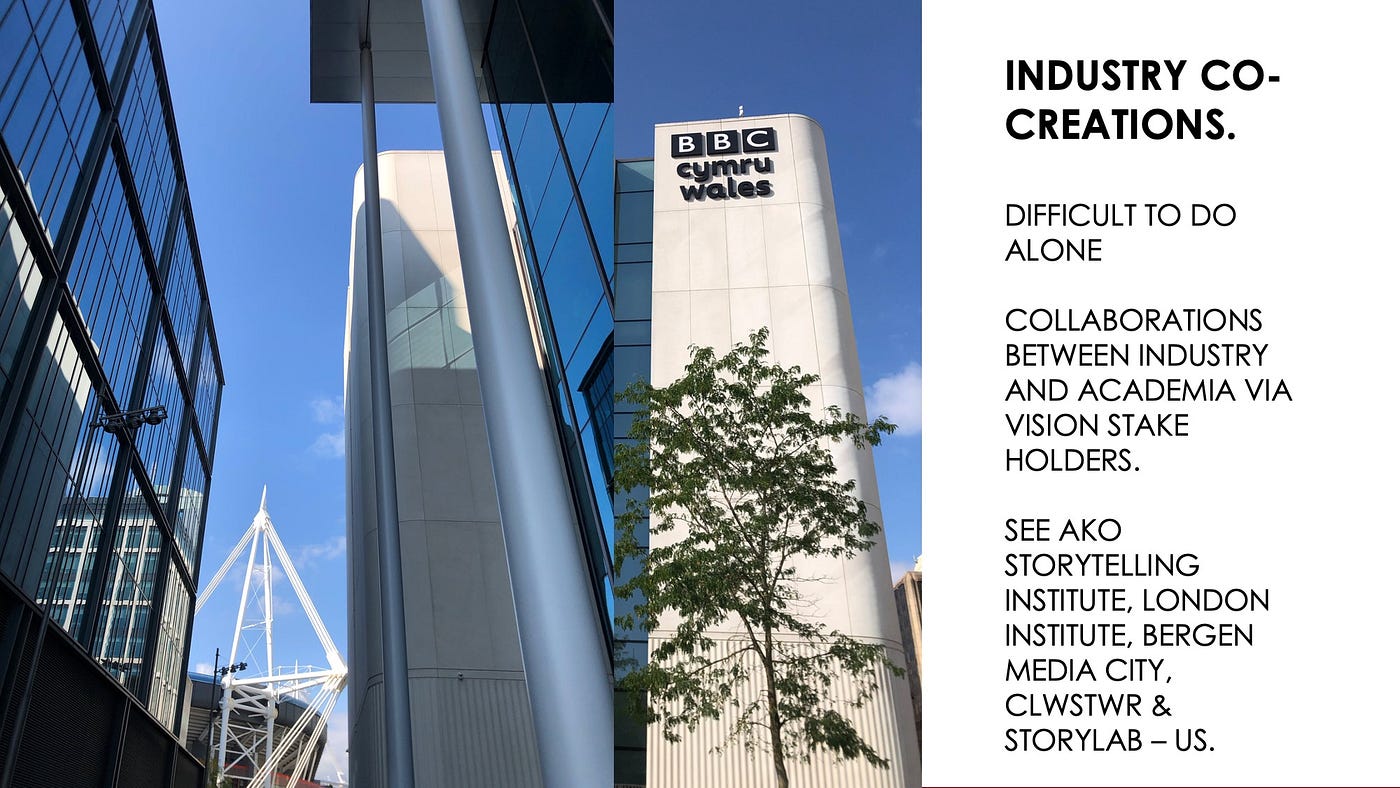
Some are forging these bonds, Media.Cymru, The AKO storytelling Institute, Bergen Media City, and the London Institute. Collectively there needs to be a more amplified concerted effort, embracing people and organisations on the sharp edge of the issue.
Perhaps then, in these approaches Dorothy in Arkansas will come to feel the chaos theory of events; the monsoon butterfly that flaps its wings half away across the globe which will be felt emotionally, proving she has more in common with global events than previously thought.
Dr David Dunkley Gyimah has been described as one of the UK’s leading videojournalists. More on his work in innovation here and background here. More to follow.