Showing posts with label video. Show all posts

Saturday, February 16, 2019

The Netflix of television journalism how it lived, failed and its ideas live on.Pt III


The frenzy during its launch both excited and terrified the media. A bunch of twenty somethings were about to be unleashed and they possessed something of the dark arts of television.
They could do just about everything that needed done by specialist in news gathering. Today, no question they would be data genies, SM specialists and television-journo-scientists.
It wasn’t about what journalism was as whatever they required outside of it to give it a boost, both in the storytelling and blurring the lines of disciplines.
Backed by tens of millions of pounds and one of the UK’s most respected media moguls, Sir David English, who adopted a hands off approach, every mogul from around the world worth their salt would visit the station to see them, and the equipment at work.
Before YouTube was conceptualised, the station ran a programing schedule controlled from a PC which automatically cued the news like a Juke box. IThey were also the first in Europe to transmit live on the web.
This is the story, you’ve never heard. It’s not alone, as you may be able to recount innovations you know of that should be heard, but this is one of them — Innovation at its zeitgeist. And how the idea lived, died with the closure of the station, and its legacy lives on. That legacy has a currency for television today and the role universities could play.
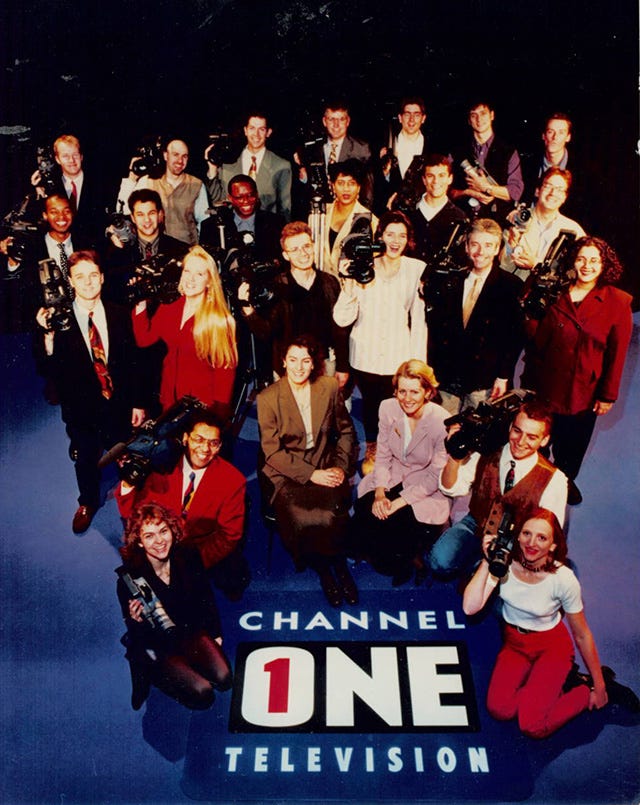
I’m David. I was one of the group (2nd row, 1st left picture) — chosen with thirty journalists from three thousand candidates. Before that I worked on one of the BBC’s most innovative current affairs programmes, BBC Reportage,in Apartheid South Africa eventually reporting Mandela’s inauguration and then working for Channel 4 News and Jon Snow.
In 2005 I became the first Brit to win the coveted Knight Batten Award for Innovation in Journalism, and have lectured (as a visiting professor) and taught innovation around the world e.g. Russia, China, and Africa and presented at places like Apple.
In my last post, I spoke about how television journalism generally rarely led in innovations in tech, which was exploited outside. It was very good at adapting external ideas — from cameras, studio settings, satellite transmissions and latterly in online and its use of video players alongside social media. These usually occurred after lengthy considerations. Yet in 1994 — a group of executives stuck their neck out and did something.
Unlike any other news outlet in British television you can mention today, out of the stations thirty journalists, those from Black, Asian or ethnic backgrounds, or that were women was above the average of any mainstream outfit then and today. The stories came from their communities and viewers. It wasn’t uncommon to be walking down the road and have a van driver shout “Oya Channel One”.
They innovated within the story, the way they told the story, and the range the range of stories. Its journalists abandoned the industry’s style by mixing up genres to cinema — the very thing 40 years ago that was abandoned ( see Pt II).
Dimitri Doganis (2nd back row, 2nd from right above photo) was one of the youngest journalists. Today, he’s an Oscar nominated, BAFTA winning filmmaker who founded RAW TV and talks about innovation at Channel One.

I reserve the greatest sense of innovation for the fact this little known outfit Channel One pioneered videojournalism, selfies, multiple storytelling and reality programming.
A decade later that experience and craft skill would lead to me winning the Knight Batten Award for Innovation in Journalism, International Videojournalism Award and other labels.
Many of the gang of thirty continue to make an impact on the industry in one shape or another: Marcel Theroux (back row, 3rd right) makes exemplary documentaries (as does his brother Louis); Rav Vadgama @TVRav ( not in the picture) is the videojournalist/ cameraman/ producer/ director who brings stories with correspondents to Good Morning Britain, Sacha Van Straten @svanstraten to my right is doing amazing things in technology with education, and Rachel Ellison (front row, Left kneeling) is an MBE, having worked in Afghanistan.

That experience combined with my background too as an Applied Chemist, a passion for art (I was an artist in residence at the London Southbank Centre) and deep interest in culture and politics, led to the creation of a media lab, where we (students myself and colleagues) could interrogate media in ways it rarely does.
Generally making sense of media in education and media largely revolves around cognitivism and semiotics — a culturalised system. One is about common sense, the other learned values. But it’s missing something that we introduced into the lab. An insight into what’s happening in our brain during storytelling.
How do words and images shape our behaviour at a cellular level and why are teenagers less interested in say news? Combining cognitivism, behavioural theory, parts of neuroscience, entrepreneurialism and psychology, we enter a new approach to media and one that I believe every training and teaching centre should adopt, and how educating the public could insulate them from “dead cats and squirrels” and spin.
Did you know that even before social media arrived, youngsters would feel restless or watch television for hours, whilst doing their homework, and that as a parent you’d tell them umpeenth times about making up their room?
Generally their lack of interest to character driven films above plots is also a symptom. In her book Inventing Ourselves Professor Sarah-Jayne Blakemore provides some answers. New knowledge in neuroscience shows the prefrontal cortex — the front part of the brain where decision and executive functions take place is still growing — up until around 25 years.
Professor Paul J. Zak’s work includes hacking Oxytocin — a hormone associated with social bonding. He’s been working to understand how stories motivate and says:
...by developing tension during the narrative. If the story is able to create that tension then it is likely that attentive viewers/listeners will come to share the emotions of the characters in it, and after it ends, likely to continue mimicking the feelings and behaviors of those characters.
Whilst a paper I delivered on Memory which included talking to a former colleague of mine Professor Catherine Loveday narrative she says:
A news story is a shorter piece of information. It may be something that doesn’t engage you as much and so you don’t pay too much attention to it. More importantly it hasn’t necessarily got a narrative that runs through it. So you don’t invest in the story psychologically or immerse yourself the same way you would a film in which you’re relating to the characters integrating it with your own knowledge base and experience.
It’s perhaps early days for factual storytellers and news, but fictional storytellers have been aware of the psychology and neuroscience for a while. Perhaps it’s about time all journalism students should as well.
You can read here part I and II


Author Dr David Dunkley Gyimah is a winner of the Knight Batten Award for Innovation in Journalism, and National Union of Students Teaching Award. He’s a former BBC Newsnight, Channel 4 News and BBC World Service Journalist, whose work is featured in several academic books

Friday, May 13, 2016

Cinema is a future of journalism, but in 2025 of course you knew that already.

Journalism using video is in a crisis. Cinema — that’s the future. You see an alternative: Snapchat, Vine, Instagram etc.

I’m not disagreeing with you for now, but they are smaller elements towards a human need for deeper expressive narratives. I did say future.

 You’re dismissive, I know. You wanted to read about the next iteration of tech enveloping 3D, even 4D virtual environments, or even presence reality — holo deck images created in your home. You can find these in several of my previous posts.
No, at this very moment, perhaps you’ve decided you need not read any further because you’ve never heard anything so absurd. Bear with me, as it’s possible you’re exhibiting what psychologists refer to as an illusion of explanatory depth.
It is so obvious to you that cinema has nothing to do with journalism, because you implicitly know this, because aside from everything else, you know cinema is the stuff of fiction and Captain America Civil War.
Here’s a conundrum. Is it so obvious that everything you know is down to experience or constructed from experience? Course it is! Yet this wasn’t the case before the 1700s, when philosopher John Locke proposed this.
Perhaps that’s too far back. Is it really obvious that you could be made to electrocute someone to death on the say so of a man in a white coat? That was the Milligram experiment in the 1960s.
And how about this for only just over a decade ago, was it really obvious that video embedded in web sites, surrounded by audio and text was the future. N00o it wasn’t. But your hindsight bias is working overdrive now to, perhaps, suggest it was.
On a personal note, I wouldn’t consider it obvious that if you create work that attracts the attention of your peers, alongside a group of people you’re invited to meet the future King of Britain, Prince Charles.
I digress. Yes that’s a surreal one. Where was I?

Here’s a citation from one of the US most coveted innovation labs,
the Knight Batten Awards and what they said about a prototype video site I built before the days of YouTube.
Entrants to the awards included: Newsweek, Time, MSNBC, and BBC.Viewmagazine.TV was a site I built from scratch. Ninety percent of the articles, the videos, the podcasts, the interactive media, the photography was created by me.
Then I set about designing and creating the pages - some of which are below. They included a range of story forms, such as these from the future of mobile, new photos of Bob Marley, a tie-up between Brixton and the Bronx, Jay-Z at my university. 
The judges pooled from some of the US’ finest media organisations said:
This interactive magazine foreshadows the future with its use of hip new story forms and hight video-centric web tools.
So how do I justify Cinema? And how do you use tech to support this, and what do I mean by cinema, and what kind? It’s based on worldwide research and a doctorate programme, please Click here for part 2
 

Sunday, November 02, 2014

The Art of a New International VideoJournalism - A Brit, US Social Scientist, and Syrian Talent


EPILOGUE
By 3 O'clock in the afternoon, it dawned on me the magnitude of the story. We're holed up in a hotel near the Turkish-Syrian border. That's me standing on the bed.
Young Syrian journalists in the room, fifteen in all, have taken huge risks to cross over. Their stories are powerful, yet untold, and international businesses regularly lift or take parts of their report with no remuneration.
We're trying something called cinema journalism - an artistic form of news making. The story really starts here, almost thirty years ago... Five minutes of the film can be viewed below...

Nineteen eight-seven
Looking across the auditorium at some of the US’ most respected educators, Donald Schön presented a simple yet powerful tale he had recounted several times.
Its impact was no less emphatic for professionals who were not educators, such as designers, health workers, and for that matter journalists.
You’re riding a bike and you begin to fall to the left. How do you quickly regain your composure?
Turn Right
Turn Left
I don’t know
It’s an irrelevant question
The answer, the MIT social scientist said was to turn into the left. It has to do with the bike, which acts like a gyroscope, re-finding its centre of gravity. Racing car drivers braking around a bend at 200kph know this. But what about those who might say turn the other way? In practice, Schön continued you don’t fall off so what’s going on.
Often, we might know what to do, without necessarily being able to put this into words. This phenomenon Schön called reflection-in-action.
Doctors will sometimes detect an illness, not based on a clinical diagnosis but a hunch. Designers make use of reflection-in-action to ponder a new design, like the Stata Center in MIT, Cambridge, Massachusetts, when the concept appears impossible, and journalism?
Well, swathes of journalists have creatively thought through the process of compiling a report against a deadline when the odds have been stacked against them — but there’s a catch.
Schön’s address poked at education on the one hand and the professions on the other. There is an enslavement to the packaging of knowledge in academia he said, and the rigid modular form students are taught does not give rise to what he called reflection-in-action, or reflection-on-action. One is an ongoing process, the other occurs over time.
Here, students should have the artistic freedom to experiment, to develop new forms, to ‘make it up’ within a framework and assess their work thereafter. The idea caught on with many US educators doubling as action researchers who incorporated Schön’s teaching into their classes.
But arguably and generally television journalism has been in stasis.
A case in point, students undertaking television journalism or documentary will often work through how to create news and documentaries based on a rationale of the way things ARE done.
Not by what could be done, which is in stark contrast to visual or graphic designers who employ wide discursive methods to reach their goal.
News, we’re told, requires the use of one camera. You can’t use music, and the narrative has to be ‘he said, she said’ assuming total knowledge from the journalist. Often, it’s worth asking the lecturer or practitioner why?
Schön called this condition technical rationality. In one of several books,The Reflective Practitioner, published four years earlier from his 1987 AGM talk to the American Educational Research Association, Schön elaborated.
Technical rationality confines many professions to be rooted in a scientific norm of practice, what’s called positivism where data is derived from logical and mathematical reasoning.
It leaves little room for much needed artistry in experiments that would expand knowledge in ways that are unpredictable. A popular way to look at the two systems, postivism and reflection-in-action based on artistic methods, is the Apollo 13 near disaster.
If it was logic that got the crew nearly to the moon, it was lengthy periods of reflection-in-action, tearing up the rule book, shown in the film by Gary Sinese’s character that got them safely back to earth.

Gary Sinise in Apollo 13 Copyright: © 1995 Universal Pictures

The Reflective Practitioner 
has since become one of the most cited and talked about books for researchers talking about their practice.
Whilst journalism is not included in Schön’s book, the similarities are clear. The way television journalism is, and delivered by experts, has been fixed for the last fifty years. It’s based on a positivism, so issues such as objectivity, balance, trust are thrust before student journalists by professionals as absolutes.
New Journalism
In 2001 when Bill Kovach and Tom Rosenstiel published Elements of Journalism, a book synthesised from several industry meetings from conversations started at the Harvard Faculty club in 1997, issues such as objectivity were finally being jettisoned.
Kovach and Rosenstiel listed ten essentials of journalism, writing that:
Some readers may think items are missing here. Where is fairness? Where is balance? As we researched journalism’s past and looked to its future, it became clear that a number of famililar abd even useful ideas associated with news were to vague to rise to the level of essential principles of journalism. Fairness, for instance, is subjective a concept that it offered little guidance in how to operate.
While Schön is not, and neither am I, criticising the many hard-working educators and journalists who ply their craft, Schön’s reflection-in-action advocates change, not as a cosmetic procedure, but to advance our knowledge and profession. He states:
Our systems need to maintain their identity, and their ability to support the self-identity of those who belong to them, but they must at the same time be capable of transforming themselves.
Television news is a Porche, often presented in a Skoda body. It embraces a language system that is so vast, so rich in expression, but has confined itself to a scientific norm of practices.
The camera needs to be placed here — inevitably leading to the rule of thirds. The reporter’s job is to voice-over bits of the film where an interviewee isn’t speaking, and a report needs to be 1.20’.
All of these have specific reasons for how and why they were brilliant at the time and why they would work when NBC news pioneer Frank Reuven popularised the news package.
If reportage is the skill and knowledge of articulating complex issues to an audience, then even in these video-utopian times there is still a vast terrain that videojournalism is reluctant to enter.
The artistry derived from experimenting and peeling back from technical rationality lies within a journalism that embraces Schön’s reflection-in-action. Sadly, such artistry is not taught.
Call it an artistic form of videojournalism or even a hybrid form of cinema — which this author has spoken about at the International Festival of Journalism in Perugia, Apple stores in London, and CUNYs Reinvent TV in New York, in which Jeff Jarvis and Hal Straus convened a gathering of twenty professionals to examine the future of TV.
That Syrian film mentioned earlier...


Young British Artists
In the UK an attempt at a new journalism happened twenty years ago to this day with the UK’s first officially recognised videojournalists.
Thirty British youngsters, many of whom were picked because they had never worked in television, were trained by the father of videojournalism Michael Rosenblum in an intensive three month regime.
The group made a serious stab at reworking television journalism though as yet there’s little evidence of their reflection-in-action being adopted by UK journalism.
I was one of them and over the years have become more familiar with reflective practice. But here’s the catch mentioned earlier. You can reflect, but you can’t affect change unless
a) You’re willing to step out of the conventions that so powerfully hold you

b) You are in possession or are seeking to find this non conventional solution.
In my case I have looked to cinema and art for these, which would lead to incredible journey’s, such as becoming an artist-in-resident at the UK’s illustrious Southbank Centre, or travelling to near the Syrian border to make a film.
Channel One folded after four years but its legacy amongst the founding staff lives on. The history of Channel One and its practitioners is due for publication next year from my PhD.

The company folded after four years but its legacy amongst the founding staff lives on. The history of Channel One and its practitioners is due for publication next year from my PhD.
Today, social networks and the impact of the Net have finally forced institutional journalism to rethink its practices. They’ve been dragged here screaming.
But the field, at least in video, is still wide open. When Adam Westbrook, part of a new generation of videojournalists and writers enquires about new artistic forms on the Net, he invokes a spirit of journalism, a reflection-in-action, that I believe became conscious amongst audiences 20 years ago and is now, finally heading to critical exposure.
www.viewmagazine.tv
David is a Knight Batten Winner in Innovation in Journalism and an international award-winning videojournalist. His journalism career spans 27 years working for outfits such as Channel 4 News, ABC News and Newsnight. His PhD looks at the future of videojournalism.

Thursday, May 03, 2012

Young people don't get audiences say BBC: I made this video, but who's it for?

Nice video but who's it for?

And that's when you shake your head with incredulity. Who's it for? What a stupid question.

It has has everything: shallow depth-of-field, interesting characters, a good script and a Terrence Malikesque score, and you're asking who it's for.

Is this a media snob thing?  Because if you produce your video with its depth-of-field, good script and Terrence Malikesque script , so long as you like it, who the bakedbeans cares.

The BBC Academy does of course, and it's why in a summit with UK universities it was keen to get across the following points.

1. Graduates wanting to join the corporation just don't understand what the audience wants
2. Graduates today just aren't curious enough to push themselves to make interesting programmes.
3. They need to be more innovative.
It's a likely salvo sent across the lecture rooms of many media courses, because try as you may unless you're planning a mass lobotomy you're never quite understand audiences . But do they have a point?

The BBC has a sizable audience research lab, but I can't remember ever having a debate with an editor over a commission in what the audience wants. I know that conversation happens, but I do remember well the mantra in Channel 4 News. What will the audience be talking about down the pub!

This non-audience talk could be for two reasons. That firstly I brilliantly already knew the audience's needs - which is hardly likely. Or secondly, the editors were so in tune with the audience they're sort of a public barometer- very likely.

Metube


Trouble is the selfish gene of modern programme makers is common place.

When Wired's Chris Anderson revealed empirical anecdotes for a phenomenon called the Long Tail, it legitimised our need to be self-satisfying.

Because, it suggested whatever you do, however bad it is, you'll always find an audience.  And never mind if the audience is three in the UK, you'll find another two in Bojomburu and before you know it you'er the people's choice.

But the ideas behind audiencing - thinking about serving others - though can get pain stakingly scientific is as prized an issue for today's budding film makers as Social Networking is.

There are some basic things audiencing tells you. Firstly that your use of language, its tone and construct target particular groups. Here's where it gets interesting.

Television sorts out audiences according to class demographics, which it equates to set viewing times so A= upper class; b1= upper middle class; b2 lower middle class and c1, c2 working class and so on, and these groups watch television at set times.

But that's not so PC for you, because you're web based where time and demographics are all but immaterial (the BBC's iplayer jumped by a million user it said yesterday), and your concept of categorisation is by a number of methods e.g. geekydom, youth, trendyness, disposal income.

But there's something else audiencing can help you with. Take this passage from Annette Hill's Reality TV.
"In the UK, the rise of reality TV was connected with the success of American tabloid TV and the demise of documentary television.... The BBC's interest in popular factual programming was a response to political pressure from the Conservative government in the 1980s and early 1990s".
What you're getting here is a sense of how programme styles change, which means once you lock into the study of audiences you get a good idea of what the audience want, which now means you can go about crafting your programme in the knowledge that you're in the zeitgeist.

So you can be as selfish as you want and still net an audience whilst exercising your social conscious too.

Wednesday, February 15, 2012

Lucky Wall Street Journalists with Grammy's Adele.. but filming her?


You have to envy the few Wall Street Journalists who managed an audience with the Grammy's darling Adele.

In an intimate setting the august US newspaper gave the Brit the floor to perform "Someone Like You" from her record breaking album 21.

For many of us Adele could perform in pitch black and we'd still coo, reach back into ourselves and think "blimey her story!". Yes I know it's called radio. So the idea of me posting about Wall Street's video is in essence a moot point.

Yet for the journos in the audience, the experience they got, which can't be replicated exactly with video, is worth a thought or two.

So what's wrong with the video?  Take a few minutes...

She's telling her story. Her story is writ large on her face and hands.  I wager those in the audience would have been transfixed on her, her face and hands - extraordinary expressive.

But we, viewing, rarely see this. The big closeup, ironically captured photographically on the above video's poster frame, is rarely seen. The pained look, the eyes, her eyes... Her poetics of expression. Then there's Ben her pianist who seeks anonymity, but whose fingers dance across the keys. He too is telling, and reflecting Adele's story.

So watching this video you're loving Adele and thanking quite rightly Wall Street, but I'm also telling those I work with, the new generation of visualists that they still have much to offer, as the Street, hasn't quite cracked it.

Is the print generation still getting to grips with the differing concepts capturing the representation of the event versus its affective state?

It will nail it one day, but for now if you can produce exemplar work, people will come to your site.

How do you produce exemplar work? If you're studying etc. watch what others have done and attempt to understand the art of visual storytelling. Deleuze, a philosopher talked about the affectivity of the close up, much admired by Hollywood studios on Dietrich et al

And there can be no bigger star at the moment than Adele.

Think Sinead Oconnor's "Nothing compares to you".. No! I didn't say film the whole thing in close up.  But watch how Adele's  own video is made. Because the video maker is an artist abstraction is key, but the close up still features.

You can read David's work with the Financial Times and Chicago Tribune training them in the art of videojournalism on Viewmagazine.tv

Sunday, February 20, 2011

Videojournalism: Experience-based techniques for problem solving and learning Video

David presents his emerging philosophy on video and videojournalism at the SMARTlab

In this post David gives a brief account of his workings with video and ideas about an emerging philosophy using Videojournalism
                                          -----------

SMARTlab - a multi-disciplnary research lab and PhD programme has moved into one of the most respected research institutions in academia - University College Dublin.  

For the outfit's February on-campus week, the physical change in environment was the more obvious sign of change. Barely into the week and UCD's heritage as a research centre also became evident.

Some thirty cohorts that range from music and dance experts to NASA researchers and virtual world specialists and then me - a videojournalist- have made the transition from the University of East London to Dublin.

Now into my third year of a part-time doctorate programme, I delivered my latest research into video, videojournalism and communications.

The methodology - a favourite word for researchers describes and examines the route and rules taken to produce knowledge. In my case it draws on heuristics, experiential learning and my interpretation of the landscape using interviews and film I've been collating since 1994.

Heruristics in its simplest term refers to how a problem or solution is obtained by using experience-based techniques. The principle is the more you've worked in a given area, the more you're likely to find a solution. This works for tennis players, chefs to those in the media.

I call it the bicycle syndrome. Learning to ride a bike involves going through a process of trial and error - something that can be forgotten in training students. In acting or the creative arts, you provide the framework and allow students to make things up.

At some point on a bike, you're most likely fall off, but then you get back on. This scenario continues until the day when probably cycling down hill you learn to keep your balance.


Interpretations- there's no such thing as objectivity
My interpretation of events are rooted in this italicised statement below - one of my presentation slides. Here's what I said about my world of video at the Batten Awards, the national press club in 2005. Ideas are cultural as well as temporal so they change over time.
Viewmagazine in 2005
"My work as practice-based PhD will take everything on viewmagazine.tv, relevant and will be housed on a site called videojournalism.co.uk Including work with the SouthBank, Apple, experience as a broadcaster and videojournalist over 24 years with training in China, Cairo, Chicago. The training of 300 journalists over five years from the Press Association, and my lecturing work".


Video as a creative medium
There have been various critical transitions within video and or film as a medium for communications and these matter a lot if you're looking to posit new ideas.

The 90s saw the beginning of the DVCam revolution. At the time I was working in news e.g. Channel 4 News and for independent A/V - audio visual outfits and commercial outfits e.g. John Staton Productions - ex head of TV at Saatchis.

It was also the era for a burgeoning web professionals and creatives, where designers such as 
Razorfish showed the potential of the web and the Attik - the duo from Huddersfield, who have also since built a global agency.

The  Attik's Noise series: philosophies of design which I still refer to is a must to understand an emerging visual aesthetic. e.g. NoiseFour.

For the first time, these creatives made me aware that an individual or group could do everything. I mean everything: Design: encode: brand: film: news: sell.

This is a notion news has great difficulty resolving still, more so in the analogue world - pre-digital when the artifact of making news was distinguished by that great specialised cooperate labour: the Ford System.

News involves technical and creative solutions. However, there's a strict division of labour, which is a legacy of practicalities and unquestioning adoption of media forms from the 1930s. In the 1950s during TV news' conception, the equipment was big and unwieldy and the influence of the unions gave rise to a conveyor belt system.
To television, the very idea of a polymath was heresay, absurbed as that may sound. You did news and news alone. If you dared to anything you were labelled multi-skilled.

The closest I saw this at work in network broadcasting was in 1991 when Jerry Timmins - now head of the Africa service at the BBC World Service - was working at BBC Newsnight. It was my first TV research job and Timmins wooed everyone with his ability to produce, direct, and report on the BBC's flagship news analysis programme.

Video as a creative medium in the 80s
The 80s signalled the change ahead in video. Super VHS and hi-8 were creeping onto the market, but super 8mm film and 16mm had a strong presence.

New languages within a cacophony of media were being strengthened; new ideas spilled over from the 60s that had become a feature of the 70s were being challenged as new political systems e.g. Thatcherism, were shaping up. 


Video as a creative medium in 2000s
The winds of change that have radicalised many features today e.g. working habits, distribution, media forms have DNA's with strands that go way back.

Again this matters because it affects the quality of debates, and helps others to interrogate alternative sources of innovation.

Take Abel Glance - a polymath film maker, whose original Napoleon (1927) could easily have been the template for multiple award winning series 24's frame system. Catherine Spaeth's blog provides an insight into the effect of
Glance's framed system referred to as trytich

Tryptich framing from 1927-2000
The significance of this as with a plethora of media issues is reconfiguring them to suit a new semiotic - media language  - and some of the most exciting media thinkers tell us for instance spatial forms will become the dominant ideology of film in the 21st century.

It's these collisions of the old and new that are exciting; they are interdisciplinary: design meets video, and seek to decompose old orders such as the division of labour.

What methods of research based on our past, backed by in depth reading facilitate is a comprehension of trends and how knowledge of a subject is produced.

The practice is often supported by an emerging theory; the theory made to fit to cystalise what we have as evidence. A crucial theme thus becomes how media as it is seen, or taught today is in need of a variable shake-ups.

Ultimately, that is the goal, that besides producing areas of interest, inspiration or debate, that these leads to new areas of teaching.

That's what I believe the SMARTlab is about, as much as any research, which I'll share some more over the lifespan of this blog.