Showing posts with label storytellers. Show all posts

Tuesday, July 04, 2023

Lies, Damn Lies, Ai and damn Truths- How TV News could overcome its lack of trust. It’s an AI and political move.


In less than a decade television news will be transformed. The screen you’re used to viewing on national networks will be transformed, not because executives sought to, but AI forced them to.

These are just some of our stories bringing together great young minds and experts in a platform being realised from an Innovation fund.

Arguably, one of the most tendentious aspects of television news are interviews and false hoods or lies promulgated by interviewees and presenters. The motive often lies in the idea that fact checking will take a while and a lie will transfer half way around the world, before, if anything it’s corrected.

How often might you have caught yourself screaming answers at a screen, or criticising a presenter because they missed the obvious follow up?

What then if online displays not only indicated either the likelihood of a falsehood by providing evidence in real time? This could be done now from our own ideation. Its use will be a political one first before it breaks into the norm. Another aspect that will have currency is establishing for viewers the relationship between journalists and their interviewees, providing watchers with information on the notion of objectivity.

Last year I was one Google’s reviewers for their EU Innovation news fund. One of the awardees was developing what I refer to as “social indexing”. The app reveals connections between the journalist and subject. I’m looking forward to catching up with their work in the future, as we look to our developments which will be documented in a forthcoming new platform.

All this comes at a time when trust is journalism is diminished and television news often appears powerless at addressing in real time skewed or propagated false narratives. That said TV News still tends to rank higher in trust levels above newspapers.

The problem with television News at present is embodied in the Icarus paradox in which the success of its process or product can be viewed as the reason for continuing with the status quo. Icarus’s success in flying also blindsided him to dangers ahead mapped out by author Danny Miller in a book of the same name.

From 2006 viewmagazine.tv reporting from New York and Miami — Can you trust the Media

Trust in journalism has been on a downward spiral for a while. In 2006, the figure was put at 44 percent of Americans. CBS’ 60 minutes and Dan Rather’s broadcast, dubbed Rathergate, and a September 2004 Gallup Poll illustrated how the American people took a dim view of the 4th estate.

Former New York Times writer Jayson Blair’s actions may have already sullied public opinion. Yet in each case of recognising Trust, the answer appears to be, as reported in Niemann labs’ Journalism faces a crisis in trust. Journalists fall into two very different camps for how to fix it a new form of journalism or ways to up trust levels.

These haven’t worked because it’s not just journalists that are at fault. The solution then is to make visible in real time actions via on-screen displays.

Imagine this exchange?

Presenter: Are hospital waiting lists coming down
Interviewee: yes
AI Index (AIIN) ( in real time with sources e.g. NHS England) Hospital waiting lists are
Presenter. [Interviewee] as you can see here on AIIN ( Ayan) this is the true figure. Would you care to correct what you said.

Presenter: You quoted a figure before. AIIN’s showing that figure was used by a health lobby, and that not only is there a social connection between you and that lobby, but a personal one. Your brother-in-law works there.

In the 1990s Bloomberg Business introduced a matrix on-air visual schema providing real time economic data for viewers. Deploying systems thinking applied across the product and process, we see how we can use AI (product) in a model that addresses the current problems with television’s transmission. It’s been sometime in the making when I presented to educationists and school children across the UK the concept.

Some notes on my work.

In 2005 I advocated from building a model online video hyperlinking reported within The Economist. This would help into drilling deeper into narratives. In 2006 I built a theoretical prototype Outernet (profiled on Apple Inc’s Pro front page here) , saying in years to come we’s be streaming from homes.

In 2006 in this article for the Press Gazette I further stated that different storylines could be placed online in “Acres of innovation — so what can video do for you?” No network was doing this at the time.

Over the years I’ve won various awards including the Knight Batten Award for Innovation in Journalism ( the first Brit to do so) and have lectured around the world including being picked as the 2018 Asper visiting professor of Journalism at the University of British Columbia.

I’m an Associate Professor/ Reader at the University of Cardiff where I run a programme in innovation and AI and have had a career in journalism working for top flight news outfits.

You can read more of my work as an news producer and innovator here

If you subscribe you’ll be the first to hear about out our new platform design © 16 Storeys which delves into the future by bringing together exciting young and expert practitioners across a range of disciplines.

In it I’ll be showing AI for news making and film making (such as this below), and the global MasterClass I’m set to deliver to documentary and filmmakers. I’ll explain why I believe it will greatly aid minorities.

If you’re in news, into AI, or a tech funder do drop me an email Gyimahd(at)Cardiff.ac.uk
Dr David Dunkley Gyimah
Associate Professor in Innovation in journalism and tech

Sunday, October 13, 2019

Training in foreign news reporting in the digital noisy age.

O
ana couldn’t believe her misfortune whilst setting up in one of the world’s hot zones, Ukraine’s Maidan Square. It’s quiet now. Five months earlier it was under siege; a battle zone between government security forces and protestors against president Ukrainian PresidentViktor Yanukovych,
She’d checked and doubled checked everything before she left London; equipment, risk assessment, pre-shoot research script, but now one of her contacts had bailed on her.
When you’re on your own and a chunk of your programme idea falls away your options are either to can the idea or improvise to save it whilst evaluating the risks. Great improvisation comes from a canny instinct and understanding craft skills. You can’t make up what you don’t know proficiently. Today tech calls that agile production.
Back in London, Oana’s grafting would earn her report high praise. Rare footage taken by a videojournalist she acquired provided unseen knowledge behind the bloody protest. She graduated from her Masters and duly found work at the BBC and made a number of special reports from Poland. Her desire was always to work for the international arm of a network and become a foreign reporter. Somewhere in the world, I know she’s doing just that.

The Foreign News Reporter Paradox

By definition reporting from a foreign land makes you a foreign news reporter particularly in the digital age where everyone is a potential broadcaster and no one needs to vet your skills. In his promo, multi-award winning mojo Yusuf Omar explains:
I wanted to be a foreign correspondent in Syria and they said I was too young. I wanted to tell stories across Africa and they said it was too dangerous…
Thus Omar did what legions before him would do, he went it alone reporting for his citizen journalism outfit. The big or brand named publishers may have alluded him, but he probably gives that short shrift now as he travels the world delivering workshops on journalism with a mobile phone, as well as acquiring celebrity status.
In practise, and by convention (if you listen to convention) becoming a foreign reporter, or to use its much less loaded word, “international reporter” for a named publisher calls on an expert understanding and analysis of a country’s socio-politics, or at least how to source it.
Being around the block enough for industry figures to have a measure of your ethics and professional standards which will be tested. Meanwhile you sport unkempt grey hairs suggesting you have skin in the game and sharp elbows — a firm desirable. Being an international reporter is not for the meek. You may taking the OCEANs test find you’re not cut out for its rough and tumble.
Viewed as the plumb of plumb jobs, with all its romanticised travel, daring-dos and hotel hopping, it’s small wonder scores of reporters want a crack at it. In reality writes Tony Grant editor of BBC Radio 4’s flag ship programme, From our own correspondent, it’s far from it.
The job involves a great deal of hanging around, often late at night or early on the morning, waiting for people to arrive at airports or to emerge from hospitals or courts clutching statement.
After stints at BBC Newsnight, and reporting on BBC 2’s Reportage in the early 1990s, I too felt the itch. Naturally, after several rejections I became aware no one was going to hire a Chemistry and Maths grad with a penchant for African politics. Hence, I made my own way to one of the world’s trouble news spots, South Africa, and slowly but methodically listened and learned.

Eventually I would be reporting for the BBC World Service, its African and Caribbean Service and BBC Radio 4 documentaries. By the time I’d left South Africa filing my last report covering President Mandela’s inauguration the Head of Studies at Chatham House, Professor Jack Spence would invite me to become one of its youngest full members. Twenty-five years later, I’m still a member.

Skills and Knowledge
What I learned becoming an international reporter has been put into practice countless times helping a new generation and whilst age is not a defining quality, craft skills and embedded knowledge of a subject do matter.
Tamer, written about here in 2007, had come from Gaza to gain an MA in journalism. With the course barely over, he told me he was going for a job as Gaza correspondent for the soon-to-be launched BBC Arabic service.
There were two major skillsets he’d learned. Here’s what you do I advised. At the age of 24-years Tamer returned the next day to break the news. “Mr David I’m now the BBC’s correspondent from Gaza”. He beat a field of experienced practitioners. He did it.
Today those technical skillsets have changed in a new digital era, but the underlying principles and artistic skills remains in tact.

This is the storyverse, which you’ll want to master. It correlates with the workflow of storytelling, digital tools and pre-visualising how to proceed in the digital noise age where disinformation is rife.


What you see and how you interpret events is framed by your cognitive thinking — the black box; your approach and dissemination of knowledge. Skills can be easily acquired. A few classes mastering camera work, or shooting on mobile is enough to get you up and running, the knowledge of how framing and camera movement affects the audience takes longer.
There are competing interests, but one of the first things is to develop an idea of your audience’s persona. A butcher sells meat, a lawyer legal services, as a journalist you sell stories. Buzzfeed and Vice magazine’s case studies are informative and worth studying. There are several ways to build a likely audience’s profile, perhaps from surveys. In the digital noise era which I’ll explain in a future post, I’ll show how you can get even more granular.
Next in competing interests are ideas. Creative ideas and problem solving, two highly ranked characteristics in the World Economic Forum’s 2020 data, have a direct impact on your audience’s needs.
When I landed in South Africa for the first time and each time I travel on a story I ask to be taken to a popular coffee shop or pub, where you can hold a decent conversation. I usually take a curio which can easily start off a conversation. In South Africa, as a genuine Rugby fan, I’d wear an England shirt. The sight of a black man, wearing England colours would often spark incredulity before the archetypal question. “Are there black people in England?” or “Why are you here?”
The next thing was to analyse nupes and trend extrapolate their output; a pattern soon emerges about what the region’s main newspaper or digital publishers produce for their audiences. This can be significant but also requires caution. If Buzzfeed or Vice followed the popular signage they would not have been successful as they are. There’s a swathe of untapped readers that publishers are vying for.
The third for this post is style and form for your audience. Over the last two decades several branches of journalism have emerged, each of them a reaction to a deficiency in the market. I’d like to think, amongst them there are very few that are platform agnostic and deal with story structure.


For dye-in-the-wool videojournalists that would be cinema journalism — a craft that subsumes all other forms in its quest to tell stories. A crude analogy to imagine is its fictional form. Films like The Big Short, Scott Pilgrim vs. the World, and The Kingdom (below) are three different movies that incorporate styles in seen in data, Tik-Tok and motion graphics. The Kingdom’s opening sequence is still one of the best journalistic stories told, which can be achieved using after affects. You can find more about videojournalism and cinema journalism in my medium posts and this short film here .


Saturday, February 16, 2019

The Netflix of television journalism how it lived, failed and its ideas live on.Pt III


The frenzy during its launch both excited and terrified the media. A bunch of twenty somethings were about to be unleashed and they possessed something of the dark arts of television.
They could do just about everything that needed done by specialist in news gathering. Today, no question they would be data genies, SM specialists and television-journo-scientists.
It wasn’t about what journalism was as whatever they required outside of it to give it a boost, both in the storytelling and blurring the lines of disciplines.
Backed by tens of millions of pounds and one of the UK’s most respected media moguls, Sir David English, who adopted a hands off approach, every mogul from around the world worth their salt would visit the station to see them, and the equipment at work.
Before YouTube was conceptualised, the station ran a programing schedule controlled from a PC which automatically cued the news like a Juke box. IThey were also the first in Europe to transmit live on the web.
This is the story, you’ve never heard. It’s not alone, as you may be able to recount innovations you know of that should be heard, but this is one of them — Innovation at its zeitgeist. And how the idea lived, died with the closure of the station, and its legacy lives on. That legacy has a currency for television today and the role universities could play.
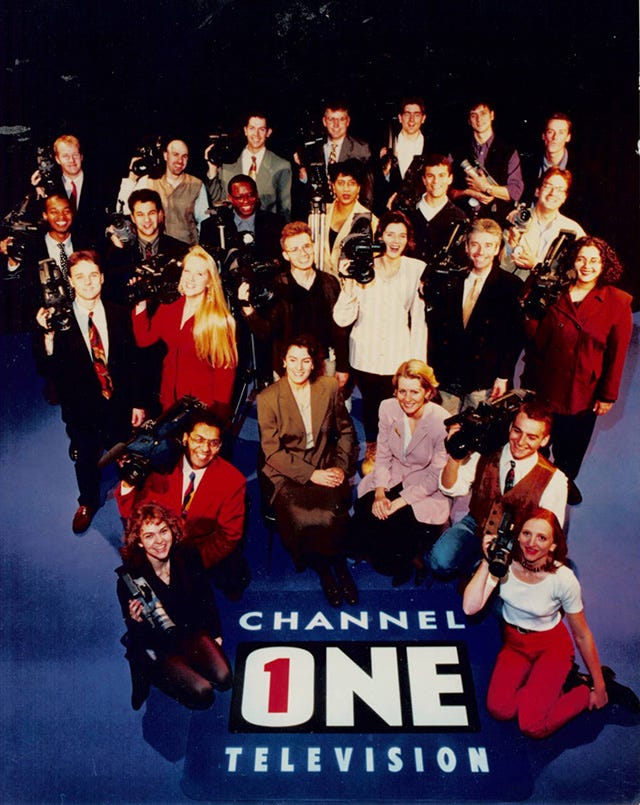
I’m David. I was one of the group (2nd row, 1st left picture) — chosen with thirty journalists from three thousand candidates. Before that I worked on one of the BBC’s most innovative current affairs programmes, BBC Reportage,in Apartheid South Africa eventually reporting Mandela’s inauguration and then working for Channel 4 News and Jon Snow.
In 2005 I became the first Brit to win the coveted Knight Batten Award for Innovation in Journalism, and have lectured (as a visiting professor) and taught innovation around the world e.g. Russia, China, and Africa and presented at places like Apple.
In my last post, I spoke about how television journalism generally rarely led in innovations in tech, which was exploited outside. It was very good at adapting external ideas — from cameras, studio settings, satellite transmissions and latterly in online and its use of video players alongside social media. These usually occurred after lengthy considerations. Yet in 1994 — a group of executives stuck their neck out and did something.
Unlike any other news outlet in British television you can mention today, out of the stations thirty journalists, those from Black, Asian or ethnic backgrounds, or that were women was above the average of any mainstream outfit then and today. The stories came from their communities and viewers. It wasn’t uncommon to be walking down the road and have a van driver shout “Oya Channel One”.
They innovated within the story, the way they told the story, and the range the range of stories. Its journalists abandoned the industry’s style by mixing up genres to cinema — the very thing 40 years ago that was abandoned ( see Pt II).
Dimitri Doganis (2nd back row, 2nd from right above photo) was one of the youngest journalists. Today, he’s an Oscar nominated, BAFTA winning filmmaker who founded RAW TV and talks about innovation at Channel One.

I reserve the greatest sense of innovation for the fact this little known outfit Channel One pioneered videojournalism, selfies, multiple storytelling and reality programming.
A decade later that experience and craft skill would lead to me winning the Knight Batten Award for Innovation in Journalism, International Videojournalism Award and other labels.
Many of the gang of thirty continue to make an impact on the industry in one shape or another: Marcel Theroux (back row, 3rd right) makes exemplary documentaries (as does his brother Louis); Rav Vadgama @TVRav ( not in the picture) is the videojournalist/ cameraman/ producer/ director who brings stories with correspondents to Good Morning Britain, Sacha Van Straten @svanstraten to my right is doing amazing things in technology with education, and Rachel Ellison (front row, Left kneeling) is an MBE, having worked in Afghanistan.

That experience combined with my background too as an Applied Chemist, a passion for art (I was an artist in residence at the London Southbank Centre) and deep interest in culture and politics, led to the creation of a media lab, where we (students myself and colleagues) could interrogate media in ways it rarely does.
Generally making sense of media in education and media largely revolves around cognitivism and semiotics — a culturalised system. One is about common sense, the other learned values. But it’s missing something that we introduced into the lab. An insight into what’s happening in our brain during storytelling.
How do words and images shape our behaviour at a cellular level and why are teenagers less interested in say news? Combining cognitivism, behavioural theory, parts of neuroscience, entrepreneurialism and psychology, we enter a new approach to media and one that I believe every training and teaching centre should adopt, and how educating the public could insulate them from “dead cats and squirrels” and spin.
Did you know that even before social media arrived, youngsters would feel restless or watch television for hours, whilst doing their homework, and that as a parent you’d tell them umpeenth times about making up their room?
Generally their lack of interest to character driven films above plots is also a symptom. In her book Inventing Ourselves Professor Sarah-Jayne Blakemore provides some answers. New knowledge in neuroscience shows the prefrontal cortex — the front part of the brain where decision and executive functions take place is still growing — up until around 25 years.
Professor Paul J. Zak’s work includes hacking Oxytocin — a hormone associated with social bonding. He’s been working to understand how stories motivate and says:
...by developing tension during the narrative. If the story is able to create that tension then it is likely that attentive viewers/listeners will come to share the emotions of the characters in it, and after it ends, likely to continue mimicking the feelings and behaviors of those characters.
Whilst a paper I delivered on Memory which included talking to a former colleague of mine Professor Catherine Loveday narrative she says:
A news story is a shorter piece of information. It may be something that doesn’t engage you as much and so you don’t pay too much attention to it. More importantly it hasn’t necessarily got a narrative that runs through it. So you don’t invest in the story psychologically or immerse yourself the same way you would a film in which you’re relating to the characters integrating it with your own knowledge base and experience.
It’s perhaps early days for factual storytellers and news, but fictional storytellers have been aware of the psychology and neuroscience for a while. Perhaps it’s about time all journalism students should as well.
You can read here part I and II


Author Dr David Dunkley Gyimah is a winner of the Knight Batten Award for Innovation in Journalism, and National Union of Students Teaching Award. He’s a former BBC Newsnight, Channel 4 News and BBC World Service Journalist, whose work is featured in several academic books