Showing posts with label film. Show all posts

Tuesday, August 15, 2023

CHAIRMAN — Kickstarting AI Community films


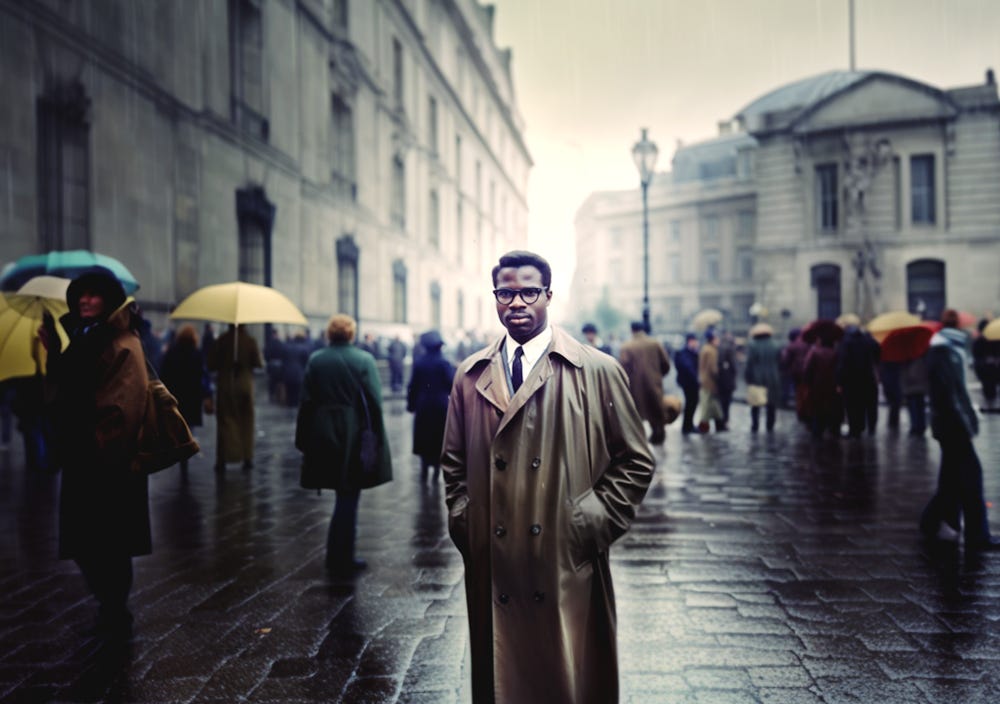
AI Generated image of The Chairman

Prologue: An article underpinning specific and underdiscussed use of AI and new story styles particularly for specific audiences — by Dr David Dunkley Gyimah.

They’re a great band with an international touring reputation playing to huge audiences in Japan, Australasia, India, and across Africa and their single, “Sunshine Day” was a banger reaching number 17 on the UK Singles Chart.

Yet years back the mighty Osibisa played in a small town (some twenty miles) from Ghana’s second capital Kumasi called Asokore. The venue, a smallish dance-bar that could house less than 100 people, in what was at the time the only storeyed residential building in the town.

Clearly I’d forgotten this when my sisters sent me this whatsapp of the passing of band member Vico Mensah.

Osibisa played a set that went deep into the morning as punters in their torso-hung bell bottoms , Kente-skirts and platform shoes or charlie wote (sandals) raucously drank Star beer, and kept neighbours 200 metre either side awake. Having Osibisa play was the equivalent of Maze or Cameo playing in a small pub in London.

FAM

Our father, ever ambitious, ne’er afraid, and the music lover he was staged many groups like Osibisa. Others he tried to hire like Fela Kuti eluded him. Some twenty years later I would interview Kuti on BBC Black London that I co-hosted. I wondered what dad would have thought?

Mr Edward Yaw Gyimah was one of the “ones” in 1955 before Ghana, then called The Gold Coast, attained independence. He was a copper — a policeman dedicated to his job, earning a scholarship from Prime Minister Kwame Nkrumah’s newish government to travel abroad and acquire new skills from its soon-to-be ex-colonial ruler, Britain. Like many he found his way to the UK with his unique Gold Coast passport as a British subject.

Air travel by then was already established. Several ships too like the MV Accra made the journey between Accra and London. No news reel crew captured the arrival of Ghanaians who arrived first as a trickle.

Courtesy of the Daily Graphic

The eminent historian Professor Hakim Adi writes in West Africans in Britain 1900–1960 how most of the West Africans travelling to the UK were mostly from Nigeria and the Gold Coast. West African student numbers gradually increased to a thousand in the UK in 1948. More recently (2021), the national census shows there are more Black Africans in the UK than Caribbeans; 1.5 million compared with 0.6 respectfully.

In the UK father abandoned the idea of building on his police credentials. He took up a business diploma and some. Yet his potential was never fully realised in the UK. When later with mum they started a family, the absence of extended networks took its toll. This photo, of my sister and I looking our Sunday best bookended a day out before we would end up with a series of foster parents.

HOME

Seventies Ghana was not the fulfilment of its Independence legacy. There seem to be one coup attempt after another, but father had enough of the UK. It was time to head back home.

And that journey was accompanied by his children two sisters, a brother and myself. In Ghana, his fortunes seem to change; music venues, the serious potential for heading a political party and presidential run, CEO offerings, and then a slew of business ventures — some more successful than others. And then Rawling’s government ceasing all his assets.

Father seemed to be building on the moniker he’d attracted amongst Ghanaians in South London. A sort or quasi abusia panin — someone who appeared to have all the answers. If you’re Ghanaian and have a problem, go see Edward was the refrain within the community, particularly for new arrivals.

His endeavours epitomised that Ghanaian can-do. A brief post yielded a stream of contributions from social media with users sharing thoughts and powerful stories about their parents and the difficulties in telling their stories.

MY NAME

That’s how we came to frame his promo when first released — The Ghanaian. Some later screen testing though revealed insights into the title’s social cognitive awareness.

This isn’ t unusual. Take The Irishman (2019). It was originally called I Heard You Paint Houses. And Rachel Boynton’s spell binding documentary Big Menabout the oil finds off Ghana and the politics that followed was originally called Power, Money, Greed & Oil when first aired on BBC’s Storyville.

There are many reasons why film titles change. Big Men perhaps would not have conveyed the semiotic heft that the film delivers to a non- African audience. Big Men, is a familiar term for West Africans. Similarly, whilst the label “Ghanaian” may yield any number of visual cues, to West African and Ghanaians, “Chairman’ carries a particular connotation or respect, without necessary a portfolio. Hence Chairman: The Ghanaian is the title we’ve adopted.

The real creative work though lies in the approach using AI to create media much like a painter would conceive of reality using brushes.

And there’s a bigger takeaway from this project that is emerging. Whilst AI has attracted frightening headline, some legit, it truly stands as a piece of technology which mastered closes the gap between heavily resourced knowledge acquisition cum trade craft and creative talent bereft of resources. AI in Communities is an initiative that examines this bringing together industry, academia and individual talent.

Over the years media creating the first digital international co-production between Ghana and South Africa, the Outernet expressed at Apple Inc, a breakthrough video platform, exhibitions, to mobile phone films shown in cinema like Bass Culture— charting reggae music’s contribution the UK — demonstrate a penchant for innovation being at heart of co-creations at @viewmagazine

made using an IPhone screened at the Regent street cinema

But AI stands to be hugely beneficial for communities, with the caveat of getting it right. The work into the bouquet of projects ahead serves to underline how the future offers promising openings for future storytellers — from artistic impressionism and storyboards to actual scenes in a film.

ideas behind Chairman- The Ghanaian

Not quite on the scale of Hollywood, but a training and leveraging platform to facilitate more people who’ve historically found it difficult to gain resources for their films.

Half of this film’s material is AI generated

Dr David Dunkley Gyimah is a Reader/ Associate Professor of Innovation at Cardiff University. He’s a former broadcast journalist and producer and artist in residence at the Southbank Centre. More on background here

Wednesday, August 09, 2023

AI will do for filmmaking what Synths did for Music. Liberate creativity!


Created using Gen AI

Creating media using AI will be a boon for creatives, particularly for marginalised, disadvantaged or people unable to meet modern production resources and costs.

Currently and rightly so there’s increasing controversy over the use of AI in the creative industries. For instance the use of faux images and music, copyright and where truth lies. These are being tested.

And yet that does not remove the thinking that AI will be hugely beneficial for some groups, who engage in its practices. It will not as some experts put it entirely replace human endeavour, but enhance creative thinking.

Hence if there is a meme to go forward with it “People with AI skills will replace people without it”.

For creativity, a near enough analogy would be youngsters in their bedrooms in the 80s and 90s generating music from synthesisers, instead of hiring a full ensemble of musicians.

In 1985 Brit Paul Hardcastle released his international smash hit 19 about the age of soldiers fighting in Vietnam.

Today Hardcastle would merely create his track via prompts in Gen AI tools.

19, and the many synths sounds that followed did not obliterate the music industry and that analogy can be assigned to film making. The original process will not disappear. We’ll go to Fatboy slim concerts and Glastonbury. We’ll watch AI generated films, and traditionally made ones.

Yesterday I watched Oppenheimer (2023). Great film. And this line I’ve modified summarises where we’re heading - “the genius of using AI will not replace the wisdom of filmmaking”.

There will be standards to sort out, and just as in previous tech jumps that will sort itself out.

This here is a sample of work, in the guise of personal essay documentary I’m working on. I thank readers and watchers for their feedback. Half of the images are AI generated.

Part Created Using Gen AI

“Oppenheimer” and the lit fuse for engaging filmmakers and news making.


It’s a sprawling magnum of emotionally fuelled storytelling. Transcendental in its ambition, non linear and complementarity in its delivery.

Nolan’s Oppenheimer (2023) thematically plays on his movie heritage which is diverse, yet moored in the art of memory. Is that not the way for all great filmmakers, the continentals such as Bresson, Godard, Jean and Renoir, then Wells whose Citizen Kane is also an example of synchronicity?

I’ll return to memory in a moment. For there’s something else his vision for this film mimics, captured in the essence of the science that his characters are seeped in — Quantum physics and complementarity.

In life, Niel Bohrs in 1926 acting on Einstein’s 1905 proposal of the duality of light, formally cracks its. Light is both particle and wave. Ergo the world, or even the movie world, is both inner consciousness and outer feelings.

The idea that events are happenings collapsed together around multiple interactions of chained causes and affects — is Quantum, and also synchronicity (see Junger). Synchronicity — things that seem meaningless knit together into some coherent form.

In more hyper flexed kinetic cinema it’s “Everything Everywhere All at Once (2002), and Iñárritu’s Babel (2006).

I was a chemistry and maths graduate approaching the 1990s — not a good one, before I became a journalist, filmmaker and artist in residence at one of the UK’s prestigious centres, The Southbank Centre.

I had a weakness in deciphering inorganic reactions; I loved Organic and can still see on the board the nucleophilic attack of Nitrogen on its benzene molecule leading to Tri-Nitro-Toluene (TNT). But I had no hope for where my chem career would take me , and hence in my second year of Uni lost my hunger for science’s abstruse approach and its delivery and became fascinated in radio and the science history of innovators. My MA radio dissertation was on DNA and its new breakthroughs interviewing Baroness Warnock, before I got a job at the BBC.

I’ve a sweet tooth for science movies. The brilliance of Oppenheimer, fiction as it is, was bringing together physicists and players in dialogue: Bohr, Einstein, Teller, Strauss, and Oppenheimer.

It’s not entirely original. Playing on BBC I-player at the moment is Sam Waterston’s Oppenheimer; a 1980s seven-part mini series. There are parallels with Nolan’s script, yet Nolan’s visuality, the intensity of repartee dialogue creates an edge — as if there wasn’t one already.

There are many piquant moments and it’s widely reported that Nolan held fast to the Pulitzer Prize-winning bio by Kai Bird and Martin Sherwin’s American Prometheus: The Triumph and Tragedy of J. Robert Oppenheimer

Nolan also, its reported acknowledges cinematic license, much like Oliver Stone altered some scenes on his epic Nixon.

That conversation between Einstein and Oppenheimer which becomes a homing pigeon; the need for Einstein to run calculations to validate the world would not end on the explosion of the A-bomb, never happened. It was Nobel Prize winner Arthur Compton who directed the Manhattan Project’s University of Chicago that got the call. Einstein was just a better film figure for this dramatic arc Nolan told The New York Times.

Oppenheimer as a nod to quantum physics, for what some scientists see as a poor choice of words, means a particle can exist in different places. It’s explored cinematically by different expositions in varying time space happening at once: various hearings, a love tryst, and the science narrative towards to creating Trinity (the bomb). What then knits it together for its denouement is memory.

Nolan’s giant jigsaw puzzle of a film, much like in some ways his Tesseract in Interstellar (2014) culminates in different time frames falling neatly together. It’s the Rosebud moment from Citizen Kane.

This post isn’t an article about the film per se rather the idea expressed in Tenet (2020) as “Just feel it”. So what’s the quantum lit fuse?

Filmmakers have perfected the art of borrowing. “They watch each other’s work and learn how to tackle scenes that have gone before” writes Mark Cousins in his erudite “A Story of Film”. I’ve written about Nolan’s films in the past and what it offers. Tenet, Dunkirk, and Interstellar.

In training the UK’s first newspaper journalists to become video journalists in 2005 I created a feature news piece influenced by the kinetic movement of the camera inspired by Paul Greengrass’s work.

I’ve built a career in news and journalism which has had a problem with memory. If the very nature of news is what’s new, then arguably during its inception you could point to current affairs and documentary to perform the function of remembering. Admittedly there’s only so much you can do with 2 minutes. But these structures in journalism are constructs that suited television journalism at its birth, but in the world today are inadequate.

Professor Catherine Loveday, a psychologist and regular contributor to the BBC talked to me about memory and journalism. Here’s an excerpt:

Loveday: A news story is a shorter piece of information. It may be something that doesn’t engage you as much and so you don’t pay too much attention to it. More importantly it hasn’t necessarily got a narrative that runs through it. So you don’t invest in the story psychologically or immerse yourself the same way you would a film in which you’re relating to the characters integrating it with your own knowledge base and experience.

Dunkley Gyimah: So how does that happen?

Loveday: So one of the things is how deeply you process something. The second is how engaging it is. The third, which is related is how much attention you pay it. The forth is the different kind of formats that the same sort of information is presented to, so if there’s any kind of repetition. So for example in a film you might have music in it and the music might allow you to engage emotionally more with what’s going on.

So it’s employing more than one sense, so visual sense and auditory sense. I know this happens with documentary, as well as with the news but not to the same extent. Those are some of the things that make film memorable…There are some formats that are more memorable than other. ’There’s a bit of discrepancy around this but we tend to remember visually more easily than auditory stuff.

Dunkley Gyimah: Because?

Loveday: Memory tends to be more visual, using more visual areas of the brain. If I ask you to remember something from last week or ten years ago, fifteen years ago, it tend to be visual. The other thing with narrative is that we are primed as human beings to remember stuff as narrative. We try and reconstruct our life and our kind of world as narrative, and we need to do that to in order to place ourselves in context in the rest of our lives.

Memory is at the heart of how people function. Yet it’s often rendered obsolete in journalism. You can gaslight, and all but believe there’s no consequences, that obscenely, “Black people benefited from slavery because it taught useful skills”, and that’s it!

Nolan’s gift to me, like I said we all take and modify something from auters is to reimagine how in a world of 2030, even now, how our memories will serve us in media in a world where we’re reliant on AI.

If the media did not already exist of an event, if the past is strafed with representation harms that are caked into AI what then? The Interdisciplinary school in London made a video in which it asked Gen AI text to image about how Barbie would look in territories like Sudan and South America. It’s worth a look.

How can I take Nolan’s thoughts to create a piece of work, which becomes immersive and triggers engagement?

How does Nolan prompt me as a filmmaker, artists and educator?

This is one example: a two minute project promo featuring the story of my father, a policeman in the Gold Coast in the 1950s, who came to Britain to advance his career. We’re unravelling several interesting story arcs, but we’re bereft of archive. What though if relying on memory we could build these scenes in Gen AI?

Saturday, May 07, 2016

How using new tech e.g. VR can recreate memories that correct a flawed past.

 It’s an idea so powerful, like a virus it keeps growing. Its currency is its ability to recreate our mental landscape, impregnate us with concepts that affect our senses in ways that it becomes knowledge.
Furthermore, this industry at work builds our internal world into a fortress of new ideologies — a place within us where personalities are shaped and our reality is framed. Our memories.
This sounds like a sequence from Nolan’s blockbuster movie Inception. The farther we burrow into the subconscious, we bypass ideas, complex ideas and then the basement level where memories reside ready to be retrieved.
But instead of a movie, albeit created from a philosophical theme, could the reality of building fresh repurposed memories reside in our growing penchant for the come-back media phenomenon, Virtual Reality.
In our present state of collective reality promulgated by traditional Real-flawed Reality media, ideas like the following  have transcending into a cultural norm: wealth is necessary towards happiness; unlimited capitalism a sign of virtuousness and virility; love thy neighbour, so long as they look and sound like you; and fear mongering is the much needed condition to sow a better future. It’s dystopia, yet it’s become acceptable.
John Locke saw the importance of memories. An English philosopher whose vision was how to break from the abstraction and dogma of religion and defy following authorities for the sake of it, he cast his thoughts to what our senses and experience could deliver. Memories shape us. They are our link to perceptions.
Ask any ten year old in the US whether an African American can become President of the USA, and you’ll be ridiculed. A decade ago and other ten year olds without any concomitant memories and narrative from their parents would be equally forthright, with a different message. Today, a London politician who is a Moslem just laid down a new tarmac for deep-core perceptions. Yes, any faith can become a London mayor.
Three hundred years on, Locke, also a founding father of democracy might be taken aback to find how our collective memories in the Western world have been harvested and water-boarded by a virulent elite media. If you keep on doing what you’re doing, you’ll keep on getting what you got. Austerity is good, or is it?
Virtual reality, as a newish mass media, could facilitate new realities, yield hyper realities even, to address what’s before us. The New York Times, reports the Niemann Lab, sees VR films as regular content for the future. Several mass media organisations are due to follow as VR finally cashes in on its contemporary fame. But that’s the problem. There’s little evidence, the content required to mediate current memories, to build new knowledge will be any different from the status quo.
Today, our recalibrated memories of wars leaves us ignorant to its legacies. Former US President Ronald Reagan in Oliver Stone’s Untold History of the US, asks the nation to forget about Vietnam.
In the late 1950s, following a combination of mass movements of African Americans into urban spaces and the ‘Kennedy Administration [had given] giving voice to the poor, among which blacks were disproportionately represented’, poor African American’s became the media symbol of poverty. Unknowingly or otherwise, new memories were laid down to cohere food stamp recipients as overwhelmingly black, when US stats have shown otherwise.
DC Marvel promulgated a persuasive virtual reality back in the days when tens of thousands of boys and girls growing up were drawn into its make-believe enterprise of super heroes.
In this virtual escapist world, bullying was answered with a thwack and a Spiderman one-liner, racial injustices were dealt a triumphant blow from the Black Panther a revered figure who by coincidence reflected the name of a real-life political movement. Storm caused a hurricane to restore humanity, and a disabled man using echo sound location cleared the streets of maladroit citizens.
It took me to my late early teens to know it was impossible to scale buildings, yet the narratives and their allegories, those memories, are still with me. If the mass media, guilty of performing its own collective inception is to be corrected by new millennial media how might VR help? First to take advantage of its newness, then as Michael Bodekaer points out in his TED talk on VR to educate the future. To recreate worlds.
Ironically, in choosing a slide to highlight the scientists of the future, Bodekaer’s fumbles presenting a smiling cluster of graduates, where diversity does not figure in the photo.  But then that's his reality. A later slide on teachers corrects this.
Then it requires films and personal with subject matter that goes beyond the boundaries of naturalised memes we see drudgingly across screens.
If the memories of your past appear contentious, or even distorted, throwing more personnel at the problem, won’t necessarily tip the scales back. The BBC is hurriedly trying to address a diversity imbalance. It could do well to review its content as well.
Does Africa deserve generally to be presented as a unitary mass and mooching on the West for integrity, as seen in international news? Africa IS a country someone wrote tongue-in-cheek. Several years ago, a magazine inverted the relationship between the developing world and developed to dramatic effects.
Then VRs distinctive quality requires consideration to an essence of a new cinema. How so? The art of the moving image uncontroversially resides in cinema — an eclectic assortment of styles and forms designed for audiences to be informed, affected, and often moved to react.
In his groundbreaking book The Language of New Media, author Lev Manovich presciently references an emergent new form as a return to spatial cinema. Similarly in a tome being considered by publishers I detail how millennial factual image makers and journalists are re-learning the lost art of non-fictional cinema. In effect we’re coming full circle, the birth of a new media and realignment of a populist one. This time, the hope should be of creating  truer memories.
follow @viewmagazine
If you liked this article, please share so as others may participate, feedback or critique its premise. This is part of a wider paper I'm developing to present at a symposium with a film. Dr David Dunkley Gyimah writes about digital and media. The image in the headline is of his actual DNA. Gyimah holds a distinct feature in science. He and his family were the first in the world to have DNA genetic sequencing performed on their DNA in 1985.