Creating media using AI will be a boon for creatives, particularly for marginalised, disadvantaged or people unable to meet modern production resources and costs.
Currently and rightly so there’s increasing controversy over the use of AI in the creative industries. For instance the use of faux images and music, copyright and where truth lies. These are being tested.
And yet that does not remove the thinking that AI will be hugely beneficial for some groups, who engage in its practices. It will not as some experts put it entirely replace human endeavour, but enhance creative thinking.
Hence if there is a meme to go forward with it “People with AI skills will replace people without it”.
For creativity, a near enough analogy would be youngsters in their bedrooms in the 80s and 90s generating music from synthesisers, instead of hiring a full ensemble of musicians.
In 1985 Brit Paul Hardcastle released his international smash hit 19 about the age of soldiers fighting in Vietnam.
Today Hardcastle would merely create his track via prompts in Gen AI tools.
19, and the many synths sounds that followed did not obliterate the music industry and that analogy can be assigned to film making. The original process will not disappear. We’ll go to Fatboy slim concerts and Glastonbury. We’ll watch AI generated films, and traditionally made ones.
Yesterday I watched Oppenheimer (2023). Great film. And this line I’ve modified summarises where we’re heading - “the genius of using AI will not replace the wisdom of filmmaking”.
There will be standards to sort out, and just as in previous tech jumps that will sort itself out.
This here is a sample of work, in the guise of personal essay documentary I’m working on. I thank readers and watchers for their feedback. Half of the images are AI generated.
News shapes our views of the world; Cinema does too, but also in a cultural shock way.Jaws left beaches deserted;Super Sized Meshifted eating habits;Lawrence of Arabiamythologised British Intelligence Officer, Thomas Edward Lawrence.
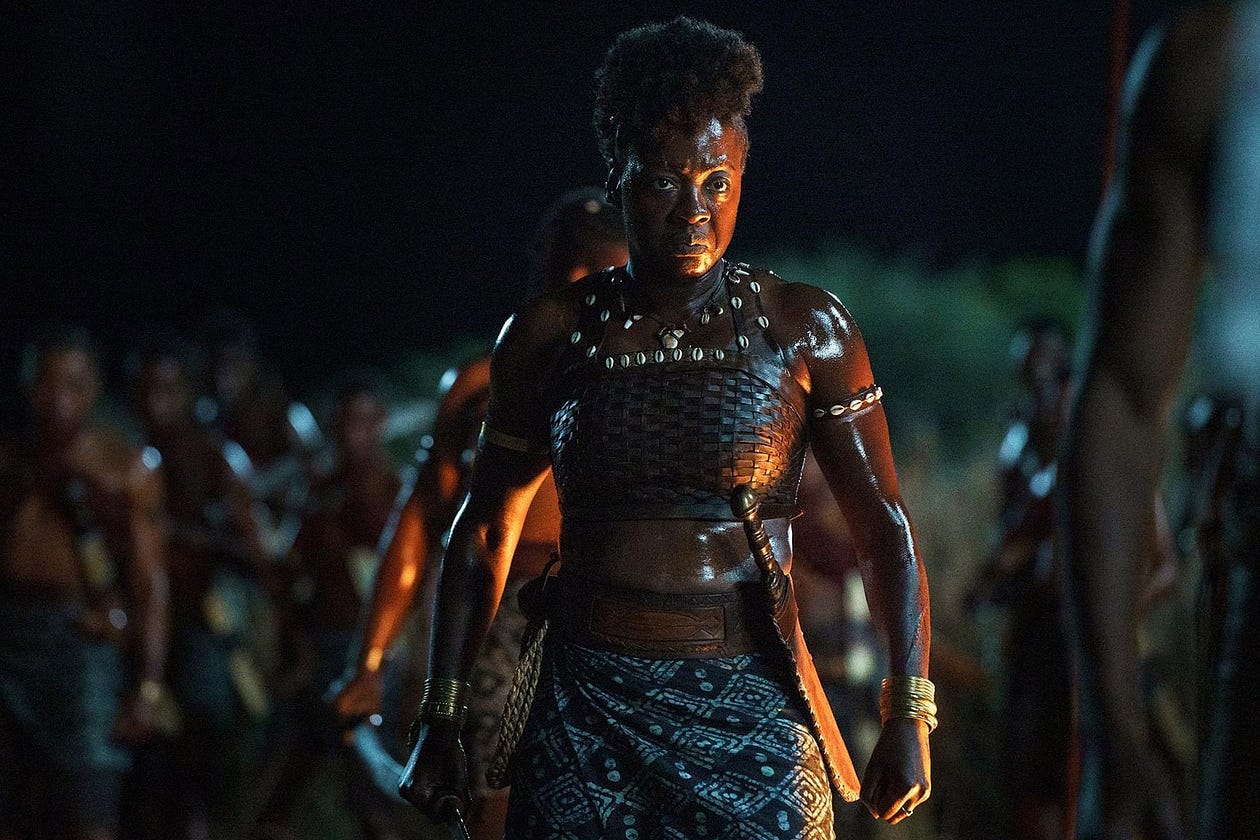
The Woman King (2022) is set to be a game changing movie that will have a global historical and commercial impact in many ways, not least storytelling.
There have been previous Blockbuster films this side of the millennium, such as Black Panther that produced more than a $1billion for the studio. But this is different. The reason is it’s based on a true story and possesses a historical DNA which for centuries, particularly post 17th century, has been erased or maligned.
Take the history of The Congo. Belgium’s King Leopold II’s narrative dominates. He strafed the country — its land and people. In King Leopold’s Ghost by Adam Hochschild the reader is introduced to Nzinga Mbemes Alfonso.
He was a provincial chief whom in 1491 in his early thirties, with his country’s dealings with the Portuguese, steered his people and their interactions with Europeans. He is portrayed as a sophisticated man an abolitionist, learned — he learned to speak Portuguese. And yet his prominence is often overlooked, instead for narratives around the conquering Portuguese and then Belgium.
This is reality untold which in a post-Floyd era is as much about diversity, inclusion and correcting skewed narratives.
The evidence ( was in not always the case) now is there’s an audience that buys into revised ‘real histories’ version of events; helped by images (e.g. Instagram) and films that emphasise Black and brown people’s agency and outlook. This is happening increasingly in decolonising narratives and historical books such as David Olusoga’s Black and British and Peter Frankopan’s A New History of the World. Recently I posted on an African philosopher to rival the canons of enlightenment philosophers
With regard to film, exposing new narratives, furthermore, a globally young audience seeking self identity carries on its heart a purchasing power that even as combined long tail, must be recognised.
Black stars don’t sell
It wasn’t long ago that studios claimed, as relayed in an interview by Denzel Washington, that a Black lead meant they lost sales abroad. Shamefully, Boyega’s Fin character was minimised in the poster in China. Read: Hollywood’s irrational allergy to ‘black’ filmsby Roland Martin, CNN Contributor.
Historical Black heroic characters from Africa haven’t been given the Hollywood platform. Africa as a source of film for Hollywood has played into usual tropes, Out of Africa (1985), The African Queen (1951), The Legend of Tarzan (2016), Zulu (1964)— take your pick really.
The emphasis in this post is about historical based Hollywood films today, because there have been films from Africa, made by Africans. Nigerians have wowed audiences with films like The Wedding Party (2016).
Generally, historical narratives that undo the stereotypical view of Africa can be found in in books such as Hochschild King Leopold’s Ghost and Stamped From the Beginning by American historian Ibram X. Kendi.
In these books we learn how warped narratives from Africa were shaped. Particularly, from the 17th Century. Travel writers such as John Rowlands AKA Henry Stanley Morton, Richard Hakluyt etc. constructed racists myths for their audiences in which the Europeans were the civilisers.
Africans had no culture. It was a dark place, e.g. Conrad’s Heart of Darkness. Britain’s colonial legacy ownership by PM Boris Johnson veers to this when he said of Africa “the problem is not that we were once in charge, but that we are not in charge any more’”.
Real Stories
Based on a true events of the Dahomey women warriors, The Woman King (2022) opens an important window, supported by a digital generation to bypass old tropes. As I write this I’m thinking of the many others cultures e.g. Ashantis, Fantis (Ghana), ManiKongo (Kongo), Dogons in Mali etc with rich histories who fended off Westerners, built complex governing systems and the rest.
As a note of caution, and this is speculative, because of limited knowledge of the film at present ( though it is everything I hoped it would be when I watch it), I imagine a vigorous debate in academia and some press will commence after The Woman King (2022) about inaccuracies and aspects of the Dahomey which might either be minimised, or absent. That includes insights into their religious ceremonies and their own involvement in the slave trade.
This exchange of knowledge can only be beneficial in context and the comparative numbers of participants in the trade. Be mindful too that with “based on true story” genre films they’re not documentaries and hence their expositions can be narrow, focus on singular events and the license for storytelling tread pass fact.
The title itself, an interesting semantic pairing, and draws reflection. I lived in Ghana for almost a decade and attended the King’s college, that is Prempeh College In the Ashanti region of Ghana.
Here, the heroic tales of the Warrior Queen Mother is legendary. Yaa Asantewaa embodies an amazing story fighting off the British and restoring pride, whilst equally feared by her enemies. Her story deserves the Hollywood blockbuster.
In many ways the remarkable nature of the The Woman King (2022) isn’t the story per se, and that’s not to take for granted the filmmakers. The filmmakers take great credit in breaking Hollywood money and pioneering onto the screen a film that sticks a knife into empire stories. The fact is there are many Woman King stories that are part of folklore that would make great features.
Take this that we’re seeking finance to make, The Kings Men. It’s the story of how the King of the Ashanti people built a school with the help of a British reverend that is revered internationally. The college won the World Robotics Championship in 2020. How it came to be in the 1950s as the country stared at independence is the intrigue.
If The Woman King (2022) is to make a cultural impact by creating a window for historical African stories, the question of others films emerging to sustain this, is worth asking. From Cinema to Documentary, here the work of Channel 4 News’ in the Black to Front season where they investigate British looting of Benin Bronze and films by Historian David Olusoga are part of the Tent pole. Similarly, if If you’re a teacher of Black history this film is about to offer you the tesseract for your students.
If you liked the above story, you may like this — The Kings Men, a film in which the King of the Ashanti people Nana Prempeh people created a school which has had a huge legacy on Ghana and globally. Yaa Asantewaa has a direct connection to the school.
High above London's skyline, the 25th floor to be precise, gripped by the city's awesome vista and intended sighting of London's Olympic emporium to the East, a group of us sit in an invited circle.
Jude Kelly, Chair of Arts Culture and Education Committee London 2012, with Baroness Lola Young are holding a series of think sessions.
For two hours or so, ideas ebb and flow from a venerable list of publicly known figures looking to provide entropy to London's 2012 Olympic bid.
Wouldn't it be cool I thought if 2012 devised a Sims game; build your own London Olympic Village? Goldie weighs in: "yeah yeah".
This is the first of three meet ups before London hears its ecstatic news.
Months later, moment of decision upon us, a meeting at East London University where Radio 1 DJ Nihal, of Nihal and Bobby fame talks fusion and what London means for the games.
Nihal:British, Asian, Tottenham-lovng, Radio- enthusiast, Essex-boy, presses, a potent point shared amongst 3rd generation Asians and Brits: diversity.
Classical Composer, Shirley Thompson ( Pictured) typifies cultural leanings of a British Diversity.
You only have to listen to a sprawling composition: "New Nation Rising"* - which I'll repost on Viewmagazine.tv to see the mesh of differences and what it yields.
*This is a shell site I created for Shirley for some new designers to remake, so it's incomplete.
For London 2012 at the meetings I attended, culture took centre stage. That's London! Games yep, but you'll come away with, to borrow South Africa's phrase: "The feeling of a world in one country"
Like the kerbillions I too watched the Olympic closing today and thought...
I thought back to those gatherings and pondered.
It's going to be frenetic from here after China's "How do you like me now?"
I'm still bursting with ideas, but you imagine with the microscopic interests it might be out of range for we-media people.