Sunday, November 03, 2013

How digital erodes what make you different


 In the library, between the methodical drone of thesis editing, "Oooh  look there's another stray comma". and reflecting on the next lecture, which has something to do with SEO, I reached for a magazine.

Uni libraries are good for that. I have passed on taking subscriptions, as I tended not to get through the magazines I subscribed to. Time magazine, for all its worthiness, was the worse. Pristine copies would gather dust in the hall way at home.

A quick flick through the New Statesmen became a stimulating distraction. New Statesmen, a political left leaning magazine, is enjoying a purple patch. And its latest edition illustrates perhaps why that is.

Comedian and Actor Russell Brand's guest editing turned out to be a masterly stroke of risk-taking. His interview with the coruscating BBC interviewer Jeremy Paxman, ( I am still scarred from being one of his researchers eons ago) was illuminating and a good piece of television. [ Fight ! Fight fight].

Paul Mason, formerly of Newsnight, now the Digital Editor on the other side,  C 4 News, likened it to a mutually aided symmetrical skewering contest. Brand got one up on Paxman, who also dug the knife in rather systematically.

And, if you want to see how journalism truly benefits from cultural baggage, witness the gesticulating finger jabbing of the presenter (Paxman) akin to a lovers tiff: "You're so selfish, you bastard", or headmasterish command "go-and-stand-in-the-corner "syndrome.

As Mason said, they both had a go. Paxman, on a more supine programme (Graham Norton) later in the week, let go of his feisty daschund persona to reveal that he believed Brand was correct to bang on about people being tired of politicians.

At that moment, along Tory hallways across the land, you could hear the thud of a door closing as Tory person (A) got into their Aston Martin to drive 50 metres to Tory person (B) to confirm, what they'd always maintained, and that is journalists are biased.

Of course they are! Who isn't. Except they are, what's that phrase I heard this morning on Radio 4? Yes, secular! That means many a journalists Jon Snow, Paxman, Humphreys and the late Charles Wheeler can be as cranky or disagreeable as they like, based on their own prejudice, but in a studio they make every attempt to be fair and honest.

I have been banging on my own mantra, which piquantly described journalism as a cultural construct courtesy of the writings of American academic Michael Schudson [read Deuze]. 


Being different
It seems rather controversial when I say this, and it is perhaps understandable, albeit erroneous. If you consider how Willem Defoe's  (of Robinson Crusoe fame)  separated himself from the creative writings of his peers, it becomes a little clearer.

He was after the stated facts. Getting to the truth or pulling together the facts is the bedrock of journalism and journalism putatively does so based on its parity with the judiciary.  A pound of flesh, is a pound of flesh Mr Shylock.

Brand's rhetoric and Paxman's interventions open up a secondary debate alongside abject discrimination amongst the disenfranchised young and the getting-rich-and-fuck-anyone-else gentry.

Sigh! Blimey, it's taken me this many paragraphs to get to the point. The point? Digital has no more redefined the media landscape than Barney makes children scared.

It's an odd thing to say. I'm an ardent digitalist. Without it, viewmagazine. tv and the bits and bobs I have focused upon would never have left my study room.

But the perspective from where I sit ( Yeah who cares ?) seems patently clear.

In the 80s and 90s, I was campaigning (banging on) about the inequities of media. To get a job in the big five as the broadcast media were back then, there was no room for culture to be displayed on your arm.

It was a frustrating period. I was into South Africa, science, and youth culture. The period was  made enjoyable by periods in broadcast media where as an individual ( Channel One TV) you were encouraged to pull from your cultural moorings to talk about the things that bothered you.

If traditional media successfully showed that media was done, one way and one way only. A big fat wrong! Then digital media was going to expose this, because of the methodologies of doing things differently.

The method includes the  process, so yes Twitter offers a new digital media outlet, but the sociology of journalism had remained the same. Nothing has changed. Today you hear less about what it means to be young and unemployed, or being black and being discriminated against or being a woman and being harassed.

Yes you can read/ see it somewhere in the pit less vaults of a Youtube or or some website off the digital landscape, but the brilliance of an alternative media impacting upon the heavyweights and thus changing the way we do business has not happened.

Thatcher's legacy has been more powerful than anyone could ever have managed. In her prime with social networks available, what would she have made of them? Cynically her phrase there is no such thing as society, would apply. There's no such thing as social networks. If so what have they done? What have they changed?

It's nothing more than self-interested individuals fleetingly flirting with others. Digital has failed us. Of course this is all relative. If you've never had the attention Twitter gives you, technology is all the rage.

However, if the point of technology is to make our livelihoods remakarbly better,  (Naively it never has e.g. Nuclear) then it's done it for the few. Russell Brand's inevitable revolution looks like a shoe-in.

Yes there have been movements, along the lines of either tacitly or intentionally calling themselves social networks, but as yet that seismic thing to change the status quo has yet to truly happen.

More so within journalism, where we still believe culture doesn't matter. And that diversity is a badge you wear to show how many different friends you have from  spain or say, Ghana.

 We need more stimulus from the external voices that shape our politics and for digital to be more than a gateway to more of the same. Brand's revolution-in-waiting is as much about politics as it is about information, less ordained, more explosive emerging. When?

At this rate we may have to wait for a  new movement  e.g. quantum,  to take form. I'm holding my
breath.

Here's ten things digital could have changed, but hasn't.

1. We're still interested in those self-interested subjects e.g. fame, celeb, meism. If anything digital expands conditions for all of us to be self-centred.

2. We've hardly invented a different journalism, and if we have its popularity is along the lines of Hogwarts and big foots. Sighted once in a while,  mythical ever so often, and trammelled where there are green shoots into oblivion

3. Digital: the have and nots of traditionalism have no become the haves and have-nots of the new system.

4. The view of the world is hegemonically based around a corpus of opinion. Thank Goodness Kenya's tech society is punching about its weight.

5.  When was the last time you went to a tech meeting and the diversity of people e.g Women and people of colour blew you away. Nah ! Thought so. I was at one two weeks ago. No comment!

6. Digital has become so corrosive as to discombobulate cultures. We all seek solace in a hashtag culture that erodes rather than strengthens. Somehow too digital has become a Western come-to-product.  If you've nothing to say, even though you might have bombs raining down on you. Shut up, as we listen to an ageing Joe 90 give us a peak.

7. Have we become less experimental now? Was 2000-2005 the last of the chaotic experiments, with big ambitions to change the world. Because now everything looks so well defined as to embolden complacency and erectile dysfunction set in because, guess what. There's no rush anymore, and yes you get this thing digital.

8. Most of the conferences and water holes of the digital spark of the 2000-2005 have folded. Others have been taken over by the multi-companies. Yes I read Clue Train  Manifesto when it first came out too.

9. Digital makes us less empathetic. You notice this in tertiary education. The availability of everything renders little emotional premium attached to the pursuit of that something. It's almost as if there's been a technological revolution, but not a social - digital one.

10. Explore what you can do for others, not what you can do for yourself. Otherwise proclaim yourself an absolutist. Alas there's no problem in doing so, but stop calling yourself digital social networker.


David teaching videojournalism at the Chicago SunTimes

David Dunkley Gyimah is a university lecturer and teaches digital journalism

Saturday, October 26, 2013

Russell Brand takes on BBC's heavyweight presenter Jeremy Paxman

Engaging interview with Russell Brand and the BBC's heavyweight presenter Jeremy Paxman. Briliant Television.

Tuesday, October 22, 2013

How to get your PhD and avoid the PhD struggle

My supervisor Deveril who has been behind me helping me to shape a new understanding of videojournalism and news has written a post about how to get a PhD. I thought I would share it with you. You can read my response below.

Dr Deveril

Getting the thesis supervision right – avoiding PhD struggle

It is a sad ‘fact’, based on what I’ve seen over the years, that many PhD researchers are not receiving the kind of supervision they need. Writing a thesis is only part of a wider set of processes of research, but it is one that needs to be handled carefully so as to ensure the researcher doesn’t crack under the strain.
From being misdirected to being neglected by a supervisor, a researcher can be wrongly led by their most important ally in the PhD struggle — but why is it often characterised as a ‘struggle’? It doesn’t have to be. It can be treated as any other long term project and be planned and managed and made enjoyable. It will still present challenges to most — as it should — but fun intellectual challenges rather than those born out of frustration and hopelessness.
I think I have helped a number of PhD researchers to realise their thesis through simple steps such as ‘milestoning’ their writing, critical debates around ideas, engaging with their ideas and helping them to focus their research question. Additionally, I enjoy close-reading, and teasing out issues in the writing process that create blocks.
From fixing grammar to expanding on pertinent ideas, the role of a supervisor and reviewer of the writing should be that of a constant guide — from beginning to end of the research and writing. And often it is early on that the problems develop, only to become large-scale obstacles later on.
I advise the laying of firm foundations — or if further on in the process, the stripping back and re-laying of the foundations to the process. Identifying the issues and fixing them so that the researcher can realise their potential can occur at any stage, but fostering good habits and following best practice is important, the sooner the better.
Working with media, cross-disciplinary artists
I have worked with researchers in the media, cross-disciplinary artists, performance experts, and designers. Each one is different. Each has different needs. I treat each person individually, and talk with them as much as possible about their requirements, their difficulties and their preferences.
I like to become as engaged in the work as possible, and act as a close observer of their activities. Recent Internet tools such as Google Drive are great for allowing a concerted effort and on-the-spot commenting and fixing of minor errors — thereby saving, potentially on hours of tedium later on.
A thesis is a researcher’s own work, but it often comes out of a collaborative or group process; it depends on the support networks built around it; the communities the researcher is part of. Having someone who is with you each step of the way, or someone who can engage with you at crucial times, is often a missing part of the process.
Please contact me:
@DrDeveril If you feel that I might be of some help, contact me. Each case is considered according to a number of criteria, and discussions would need to be had before any work was carried out. Of course, I can make no guarantees of PhD success, but I can help with certain things like getting your writing back on track, tidying up arguments and structure, and scheduling your writing.

Sunday, October 13, 2013

Videojournalism: the revolution in media influencing academia. On assignment near Syria's border.


In this video, something happens at 1.27, but you need the contexts of the earlier footage, so be patient,

The girl singing survived, you see her ushered into a safe place as her caretaker calls her name.

The caretaker is a videojournalist, an activist documenting the atrocities in his country. Two years ago circumstances led him to pick up a camera. For the next 7 days, I share a space with him and fifteen other so called "activists", in one of the most rewarding and emotional projects I have been involve with for a while.


End of prologue. 
 ++++++++++++

"Non-emergency personnel and family members" were ordered to leave Beirut and given permission to leave Adana, near Turkey's border with Syria.


This news reported on Reuters couldn't be any worse. No S**t a friend said. In 8 hours time I was heading into the very region, Adana, where Americans officials were being ordered out of.

Was I scared? 

Apprehensive, Yes! Enough to talk about a likely exit plan, if things were to go Pete Tong [wrong] , as we the Brits say.

Last time I had butterflies like this was traveling to Tunisia, Beirut, Cairo and in the 90s South Africa. What's new? Except there was no whiff of air strikes or rogue chemicals in the air.

There are lecturers I know and respect who make it a habit to stay in touch with their craft e.g. Bill Gentiles a figurehead in the world of backpack journalism.

Not by design, more by default, but firstly, the need to stay in touch with the field I'm in is an anti-bored pill. Secondly, it furnishes me with my narrative for storytelling I like to tell. These story-forms derive from a fascination in what experts call the world without theory: Bakhtin's Carnival.
Beirut Videojournalism

I train enthusiasts to become videojournalists, but to paraphrase Mr Cobbs " I specialise in a very specific type of security  videojournalism". I apologise if that sounds arrogant. It's not meant to be.

This videojournalism has been the subject of a six year PhD, [historical and qualitative] which through the selfless help of  Rosensblum, Drew, Turness - NBC first woman president of News -  and several other people.e.g.  contemporary videojournalists such as Adam Westbrook. The thesis should  be evaluated soon.


videojournalism study

The working-in-the-field also, many performance lecturers believe has benefits for their students.
What I do constitutes experiential knowledge. Lectures become hermeneutical. Practice is informed by theory, and the process of curating information becomes wrapped in that most basic of perceptions.

You know the story of the politician expressing a point evoking Mary with one child agreeing that raising taxes puts her 100 UKP in the red each month. Well yes, merely saying that gives you scope to imagine Mary and hear her predicament, even when she's not real.

In performance lecturing, based on actual events, the narrative of teaching journalism, say expressing SEO, ethics or how to keep a low profile, is a story in itself.

A brief visual history of videojournalism from david dunkley gyimah on Vimeo.

Did I tell you the time, I had to Q and A with Nelson Mandela at a press conference and I was terrified out of my wits, and then met him at a foreign correspondence do? South Africa 94.  Or being asked to film for Heavy weight Boxer Lennox Lewis and his camp as he fought Tyson?  Memphis, 2002. Or  back in February explaining cinema journalism to the Arab media summit? Cairo, 2013.

Experiential notes on a page - that mobile narrative.


The story of what happened in the week in Adana is extraordinary.  A series of lectures, exchange of knowledge, seven stories that we  (Marwan, Fires, myself ] had to shape - some of which constitute war crimes of a nature that would make you physically sick.  


 Marwan, from the think tank Menapolis presses a point over verification
The video at the top.. dramatic, terrifying.. their stories deserve a proscenium, where we can learn more about them in ways that are affective Presence reality?

Imagine going to see a film at the cinema, and then seconds after the film finishes the general manager tells the audience to hang on, because we now have a personal skype interview with the participants in the story.

Otherwise imagine I create a story that leads imperceptibly into their stories, and everything from the technology to the social issues become dialogical.


David discusses the philosophy of the 100 videojournalists and specialised videojournalism equipment

Or what about a lecture in which the wisdom of crowds is also the narrative. This is the domain of Touch cast which I explained in my previous post. 

These are methods to bring journallism straight into the lecture room in a more visceral way, but also to pump it out again as both narrative and eipitome [ notes in a lecture]. See my post yesterday on the BBC's secret weapon and popular post, the theory of new videojournalism

It requires a new collaboration - a pragmatism to lecturing emerging from the interplay of the professional practice and theoretician. The two have always been bedfellows, yet academia post 70s has invariably delineated the two. In his wonderful articles Bordwell expressed this in a related way why don't academics and critics get along.

This merge will also spawn a new type of university, one which corresponds to the demands on the one had of emerging technologies, but also as part of its core values thinks up the next generation of practices, not as a theoretical exercise, but by creation.

This new proscenium will see a heurestics of emerging media as key, utilising apps that bring journalism in the field right into lectures. I'm excited by this.


End


Thanks to Marwan and the team from Menapolis

Viewmagazine.tv is about to undergo an overhaul to reflect what academics refer to as an autoethnographic study, where I use myself as the narrative to express the changes to journalism and communications, such as shift media and videohyperlinking - my most recent post.


David Dunkley Gyimah is a Knight Batten winner for innovation in journaism, an international award winning videojournalist and Channel 4 Digital finalist, among other awards. His PhD research reevaluates videojournalism repositioning a new understanding of the form. David is a senior lecturer in online ( social) and videojournalism. he is a juror for the RTS awards.

Friday, October 11, 2013

The BBC's secret weapon - The future of Television. I have seen it. I call it Media shift

Touchcast strengthens second screen viewing 

By David Dunkley Gyimah. Connect with him on Google 

The future of Television, where multimedia has been pensioned off.  Medium specificity is no more. And instead  media shift - fragmentary media mimics our psychological understanding of narrative, in a diffused medium on one platform. Confused already?

It works. I have seen it and by the time you finish reading this you will too.

Simply put,  what if you could bring the Net, Cinema, motion graphics, the photo play all together?

On the one hand we're recycling the famous Plato's Cave illustration of simulating Cinema before it became the cinema, you and I know.


For film scholar Robert Stam it is Bakhtin's carnival, "an anti classical aesthetic that rejects formal harmony and unity in favour of the asymmetrical, the heterogeneous, the oxymoronic, the miscegenated".

We are in a super post modernism era. The future has folded back onto the past. It's the 1920s again, everything is possible before theory, process and the battery hen farm approach usurped our dialogical thinking.

I blame the institutions, which have spawned institutional ideological  thinking. There was a time when something meant something without an authority having to validate or remediate it.

So what is about to happen next should make you gasp because it is the institution that is helping to change our thinking. Focault called it Discursive Formation "[ institutional discourses with the nominative power to produce that which they speak of"]  Read Scannell's Media and Communication.

So if you're a disruptive individual there's room for you to score big.


Inside the BBC's think tank
It is a non-descript building removed from its new state-of-the-art fanciful buildings in central London. Tucked away on the fifth floor is the BBC's version of the Earthscope project.

It is here where a select group of people have been tasked with seeing the future of television; the BBC's own RnD.

David  Dunkley Gyimah at the BBC
And see they have. The BBC has had many firsts; more recently, the iPlayer which has turned into an unparallelled success.

But what is about to happen will turn our concept of television viewing upside down. It's a fairly bold statement and not a day goes by without someone proclaiming this or that is the future of television.

For some it's the fidelity of 4K television, talked up by this year's blockbuster movie The Hobbit. It's so real you can smell it.  Other experts  more presciently point to the future in this Guardian newspaper op ed.

I have been an avid prospector myself, winning a Knight Batten award for Innovation in Journalism and being one of the jurors for innovative media on the UK's highest television journalism awards.

Occaasionally, I get the opportunity to sneak at something e.g.  


So I hope I come with a bit of  knowledge of this area.

London Live
Across London, an equally exciting project is gripping media land - the launch next year of London's 2nd 24- hour television news station.

Truth! Someone from #Londonlive should send a spy into the BBC. The idea of linear television will continue to work with narrative, but how we access the narrative and its own 'cause and effect' causality is about to be disrupted.

In fact it already has, we just haven't been paying too much attention.

The BBC yesterday did two things to signal its intent; the rnot-so-new Director General Tony Hall provided an internal key speech for the BBC's vision and where next?. The BBC also showcased internally to staff, this new television, and the oohs and aahs flowed.

There own pilots which I have seen, I won't divulge, but I can talk about my work, which resulted in Charley, one of the futurologists from Touchcast spearheading the BBC project.


Spatial filmmaking


In 2001 A friend introduced me to the writings of  Lev Manovich and his ground breaking book, The Language of New Media.

We had an idea. What if media really became spatial as opposed to linear? That idea dovetailed with one of the mega projects at that time. I was asked to be a videojoutnalist for the Lennox Lewis camp as he was fighting Tyson for the undisputed heavyweight crown.

Myself and a colleague took a different approach to looking at the sport of boxing, from a grass root level and the result was this circular film called The Family. It had a beginning, but no middle and and end.

For Manovich, this approach was no big revelation. One of the UK's most exciting cinema scholars, Mark Cousins calls its schema plus variation.

What Manovich revealed was the template for filmmaking before it was Hollywoodised. Spatial cinema already existed in the the Zoetrope and Napoleon's triptych, so this new thing we stumbled upon was a variation on that spatial theme.

That idea went further to conceptiualise the Internet, outside called the Outernet, which  was first featured on Apple's website in 2006.


In 2006 I gave it a fairly obvious name: video hyperlinking. The Economist picked up on it in this article. The Economist wrote:
.. at viewmagazine.tv, a website that is experimenting with hypervideo, the term “drilling” is used to describe the ability to click on a talking head during a sound bite to summon an entire interview. 
What the BBC has achieved, which is only the tip of the futuretv-berg is video hyperlinking of varying sorts.  This is a visual manifest that you control, one that provides endless possibilities. It's like television in its nascent stage so it would appear we're still thinking linear.

But I have it on good faith that we'll soon be experimenting with the Touchcast on viewmagazine.tv. IT can't come soon enough.

 
Solo - a film about videojournalism from david dunkley gyimah on Vimeo.

Now here's the big reveal. Imagine everything you read here, you had control of on a platforms which collapsed video around my tweets, blogs, external links, links within links and that you could influence the direction, even add to the narrative.  That's touchcast.

Davd Dunkley Gyimah is the creator of viewmagazine.tv. To contact him email David (at) viewmagazine.tv (dot ) TV.

I'll demo my Phd thesis into the future of videojournalism. Read more about David Dunkley Gyimah's career

The launch of London's newest station, London Live and the ghost of Channel One


"Details have been revealed of London’s first dedicated 24-hour television channel, London Live, which will go on air in the Spring of next year". 

This opening paragraph from the Independent newspaper proclaims the arrival of London's own television station, and one that has been long overdue.  

£15 million is to be spent on this digital frontier, bolstered by the Evening Standard providing huge resources to furnish the stations news,  and a daring programme schedule which includes short films according to Broadcast.

At this point, you should be hearing the record scratch to a halt. No fault of London Live. We've been here before.

Cue, 1997  at the UK's gathering for the TV industry, a former BBC director turned managing director told the television industry audience how new television Channels must be different to succeed.

Aston managed a TV station called  Channel One TV. It was London's first 24-hour television station launched in 1994. The station spent £12 million a year - not far off from London Live.

And like London Live, it sought to rely on a newspaper for help. Have you guessed who? Yes The Evening Standard. Except back then in 1994, the Evening standard was owned by Associated.

Like London live, Channel One too had bold dreams. London Live will use video journalists (apply here),  Channel One Television pioneered videojournalism. It was the first 24-hour television station to use videojournalists in the UK.
Author working at Channel One TV 

Channel One folded in 1998. It lasted four years. Its demise is attributable to several reasons, including the lack of cable's penetration, which the managers were relying on.

But there were other pressing issues, which my six years PhD research interviewing management and staff has revealed.

The money ball of Channel One was how videojournalism reduced the spend per storytelling to a fraction of the cost the BBC and ITV would pay. This you might presume would show in the difference between the quality of programming.

You'd be partly right, but from Aston's speech to the Financial Times New Media and Broadcasting Conference there was a twist to this assumption. Aston stated:


In November 1995 the cable industry commissioned RSMB Television Research to undertake the first major survey of broadband cable television households and it found that Channel One is The Most Popular Cable TV Channel in London. 
Channel One is Number One in the ratings according to TV watchdogs, the ITC. In results announced in September 1996, researchers for the Independent Television Commission found that 97% of people surveyed liked it, with many expressing "surprise" about "the high quality values and quality of presentation."

There was something the station was doing, a risk in the way not only programmes were made, but in the styles they adopted. 

In today's digital disneyland of TV stations and the web, launching a station in London is going to require a strategy which will have to predicated on what next, rather than what now.

Formal television being launched now is in danger of sinking those millions, which is why the BBC  is adopting touchcast ( see my insider report here), but more importantly that a prescient attitude to 21st generation programming is considered.

It's a heady mix. It's not YouTube and it'll be hard pressed to beat a BBC rejuvenating itself with #BBCwherenext.

So what's in store for London live? They are presently hiring, according to the Guardian newspaper.

Next week. More on launching a station...

David Dunkley Gyimah is completing his PhD which looks at Channel One TV and the future of television. He is a senior lecturer at Westminster University and a practising videojournalist who is completing his most recent story travelling to Southern Turkey 3 hours from the Syrian Border. David is an RTS juror, artist-in-residence at the Southbank centre and a former Newsnight, Channel 4 News and ABC News journalist. He has won various awards including the prestigious Knight Batten in the US and trained the FT, Chicago SunTimes and Press Assocation. You can find out more about ho here at Viewmagazine.tv


Saturday, October 05, 2013

The science of story telling - where Business often fails with video


The wine is flowing, the foie grass was perfect. The convenor clinks her champagne flute. Time for the presentation... and this video here on shared values is ...

No one's watching.  What do you mean, that video was made by a professional company.

Yes, I said and they charged you a whack, and probably eat a full breakfast each morning while looking at the share price rise. { conversation with a friend staging a conference on shared values in London).

Ir's a terminal disease for Business. In the 80s and 90s when CEOs were finally being dragged to appear on business articles, the grammar was so impenetrable you needed a style guide to interpret what the CEO was trying to say.

With the, video-is-easy to make syndrome around us, even the best of the best are showing how little they understand the medium. The knowledge in this video is worthy. Teams will be pressed to watch it and no sagely.

Hey Diana, so what do you think?

Well put Dan!

Diana ( fictional person I have made up ) that wasn't the point. Tell me, if between spending your last 15 bucks on a meal because you're hungry and paying to watch this, you'd opt for the latter, then your point sticks.

Compelling video can do that to you, but it's not just about the content. Everything we negotiate is about style and some form of affective state, film can put us into.

The video is well lit. The topic important, the interviewees sanguine and the production values lifted from how-to-do-a-documentary book. The alchemy here is the equivalent of being at a function and being asked to watch this.

I choose obviously not to watch it, if I don't like it, But I happen to be a big HBR fan and this is painful.  Sell the best of business, surely that should mean understanding the business of communications

Redefining the value chain, positive social impact, .... I blame the producer

Thursday, October 03, 2013

Ground breaking six-year Videojournalism study from knight Batten Winner overturns myths and points to future


David Dunkley Gyimah, winner of the prestigious (US) Knight Batten global award for Innovation in Journalism (www.viewmagazine.tv),  and the International Videojournalism Award, has completed a six year study into Videojournalism.

The study constitutes his PhD thesis he submits in January 2013 and is one of the most thorough examinations of the form pointing to its future.


David, a technologist and one of the UK's first official videojournalists uncovers a number of widely held current beliefs that are are shown to be flawed. He unearths the rationale behind the misapprehension of the form now adopted by newspaper and broadcasters and maps out its future based on rigorous research.


A news and current affairs journalist for more than twenty five years working for leading outlets such as BBC Newsnight, Channel 4 News and ABC News, David co-launched the UK's Press Association programme and has trained journalists
 from the FT, Chicago SunTimes and Annahar newspaper in Lebanon about videojournalism.

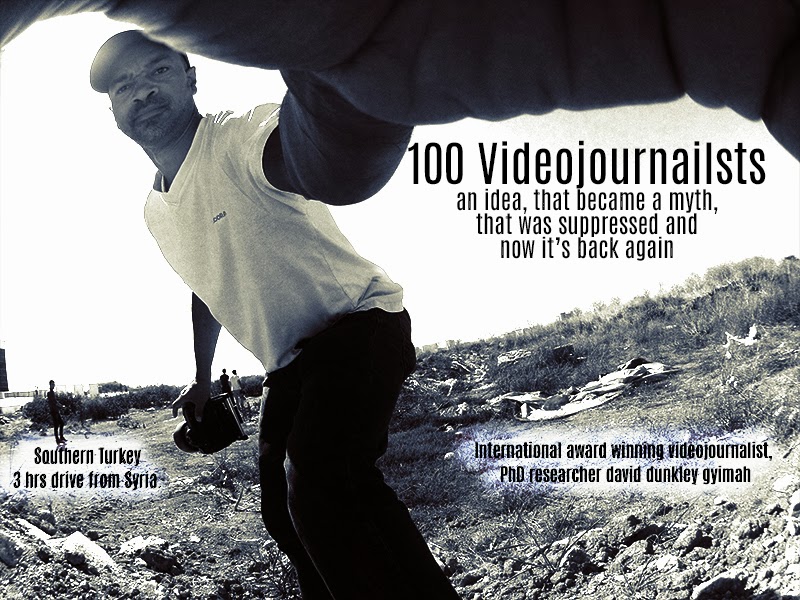
According to David, traces of the original form and style are only now only re-emerging as the movement he calls the "100 videojournalists"and it's not significantly because of the Internet. The name  '100 videojournalists' derives from the first 100 to become disciplined in the forms original philosophy. 


Beyond the 100 Videojournalists

100 videojournalists

The thesis is an historical and analytical study and involves  methods collating data and research about videojournalism. These include  ethnographic work across several countries and  Mass Communication.

The latter is a critical evaluation of videojournalism, based on David's background. He was one of  the UK's first official videojournalists in1994 and has been on the web since 1996 forecasting the likes of embedded video, video-hyperlinking and the Outernet. He's contributed to many conferences, such as Restoring the Trust in San Antonio and the ONA, where he spoke about the theory behind videojournalism.

Says David, this PhD has been a torturous labour of love and it's not finished yet. It still needs to be vivaed, but if the rhetoric works then it undoes the conventions of what generally is known about videojournalism and offers a new discourse for anyone entering the field.

David with Video storyteller Scott Rensberger
He adds: I interviewed five different groups amounting to 100 leading media experts and Videojournalists around the world, such as Deborah Turness, now  NBC's new president of news; Robert Drew founder of Cinema Verite in the 1960s and talent such as Scott Rensberger, whom with similar talent confirm my assumptions.

There are aspects of videojournalism that did not interest me, such as the conflict of videojournalism adopted into newsrooms ( every new technology has a conflict) and the perceived forms that mark a difference between what some experts call newspaper videojournalism and television videojournalism. These are red herrings. I wasn't interested in that, but something more pragmatic and hermeneutic.

If you were to be learn about its findings, how could you make a difference? So the thesis addresses pedagogy, but also practical schemas.

Practice-based Research


The research has taken David six years and to countries like China, Southern Turkey near the Syrian border, and South Africa.  David started his career as a videojournalist at Channel One Television in London before taking the form to a number of outlets. In 1997 African state broadcasters Ghana Television and South Africa's state broadcaster used videojournalism to produce a series of programmes about each other.

David is currently a  senior lecturer at the University of Westminster,  a judge for the UK's RTS Awards (UK EMMYS), artist-in-residence at the London Southbank Centre and advisor for a number of academic and commercial-led companies.

For more details email David at David (at) viewmagazine ( dot) TV.

Saturday, September 28, 2013

The 100 videojournalists - one of the most comprehensive research to date about the least understood form


They go by the name of the 100 Videojournalists. They existed as a unconnected collective, like Zavattini's filmmakers, Robert Drew's Cinema Veriteist of the French's Dziga Vertov group.

Each generation throws up its radicalists, who strive to show they have seen a greater horizon, and that previous formalists or cinephiles were flawed in some way.

The Internet claims to be THE harbinger for change, but it is really only the latest-to-arrive medium to provide the radicalists with a chance to do what they do best.  Before that it was cable, letters, telephone, community boards etc.

Our intelligence is only equipped for the norms and then shocks of its time, which is why some of the best brains still proclaim the 1960s as far more radical than the 2000s. It's a matter of relativity and conscious load bearing. That is how much we can take.

What separated the 100 videojournalists, however were some fundamentals, which would upturn some of the most venerable paradigms in film and the art of learning.

McLuhan said the medium is the message. He was right then, but the 100 videojournalists could prove rhetorically that this was now flawed and this would be before the Net. Many of us state content is king, but when everyone has the content is that still the case?

Imagine this. You travel for the first time to Russia, then Spain, China, Burma then South Africa. You're with a friend. All you know is English, and you're very proficient. But each time you get of the airport you encounter a problem.

Someone speaks to you in their native tongue. You can only guess what they's saying, but your friend each times rises to the occasion conversing with locals solving problems.

In communications and the landscape of video journalism, the art is the equivalent to knowing all those different international languages. The one traditional media is proficient at is English. And their proficiency is such that they've exported this form to others and maintain a tight grip. It's the one they understand.

The philosophy of the 100 videojournalists was to comprehend all the other international languages and reverse engineer its theory.  Film is cited as language like, and learning film requires not only a flexible mind, but a radical one.

The 100 videojournalists lasted less than a decade. It took that long for traditionalists to understand and rebuild a narrative to discard it. Today it's become a practice-based theory, meaning it can be taught.

Some of my Masters students will recognise traces of it in lectures, that our reception to problem solving, whether that's making an film, writing a letter, solving a maths problem, is tangible, if we're equipped with the diversity of knowledge-approaches.

Some months ago, I interviewed one of the figures the world owes a debt to, the great Robert Drew who pioneered Cinema Verite. It was one of the most enlightening interviews I have ever had, but I left also understanding how the 100 videojournalists could pick flaws in some of his very eloquent arguments.

In the coming weeks I'll divulge more of the 100 videojournalist philosophy and how you can truly comprehend its potential

David in Southern Turley, couple of hours drive from Syrian border

David Dunkley Gyimah is an award winning videojournalist who is completing a Six year doctorate study into video making, videojournalism and our cognitive  behaviour to the form. He has taught groups around the world, and most recemtly was training activists in Southern Turkey, a couple of hours from the Syrian border. find out more from Viewmagazine.tv


and

The 100

but there was something about them.