|
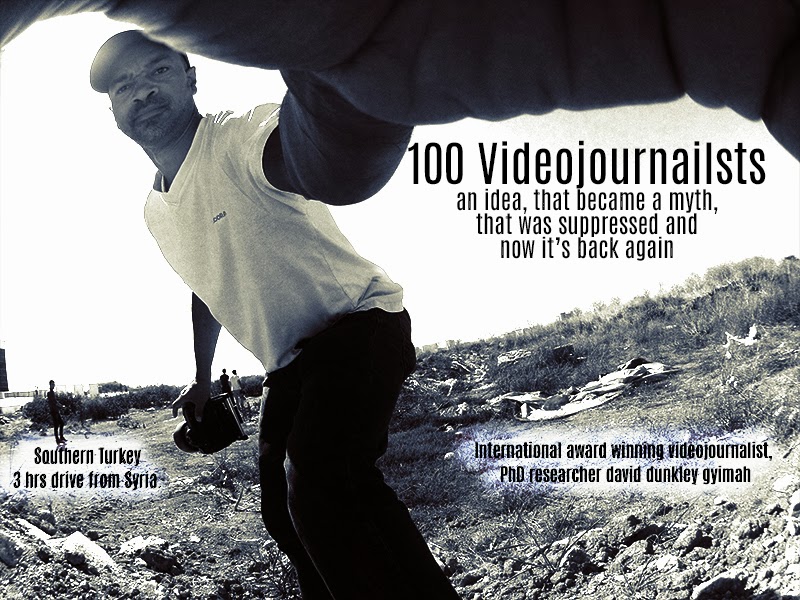
| David presents his emerging philosophy on video and videojournalism at the SMARTlab |
In this post David gives a brief account of his workings with video and ideas about an emerging philosophy using Videojournalism -----------
SMARTlab - a multi-disciplnary research lab and PhD programme has moved into one of the most respected research institutions in academia - University College Dublin.
For the outfit's February on-campus week, the physical change in environment was the more obvious sign of change. Barely into the week and UCD's heritage as a research centre also became evident.
Some thirty cohorts that range from music and dance experts to NASA researchers and virtual world specialists and then me - a videojournalist- have made the transition from the University of East London to Dublin.
Now into my third year of a part-time doctorate programme, I delivered my latest research into video, videojournalism and communications.
The methodology - a favourite word for researchers describes and examines the route and rules taken to produce knowledge. In my case it draws on heuristics, experiential learning and my interpretation of the landscape using interviews and film I've been collating since 1994.
Heruristics in its simplest term refers to how a problem or solution is obtained by using experience-based techniques. The principle is the more you've worked in a given area, the more you're likely to find a solution. This works for tennis players, chefs to those in the media.
I call it the bicycle syndrome. Learning to ride a bike involves going through a process of trial and error - something that can be forgotten in training students. In acting or the creative arts, you provide the framework and allow students to make things up.
At some point on a bike, you're most likely fall off, but then you get back on. This scenario continues until the day when probably cycling down hill you learn to keep your balance.
Interpretations- there's no such thing as objectivity
 |
| Viewmagazine in 2005 |
"My work as practice-based PhD will take everything on viewmagazine.tv, relevant and will be housed on a site called videojournalism.co.uk Including work with the SouthBank, Apple, experience as a broadcaster and videojournalist over 24 years with training in China, Cairo, Chicago. The training of 300 journalists over five years from the Press Association, and my lecturing work".
Video as a creative medium
There have been various critical transitions within video and or film as a medium for communications and these matter a lot if you're looking to posit new ideas.
The 90s saw the beginning of the DVCam revolution. At the time I was working in news e.g. Channel 4 News and for independent A/V - audio visual outfits and commercial outfits e.g. John Staton Productions - ex head of TV at Saatchis.
It was also the era for a burgeoning web professionals and creatives, where designers such as Razorfish showed the potential of the web and the Attik - the duo from Huddersfield, who have also since built a global agency.
The Attik's Noise series: philosophies of design which I still refer to is a must to understand an emerging visual aesthetic. e.g. NoiseFour.
For the first time, these creatives made me aware that an individual or group could do everything. I mean everything: Design: encode: brand: film: news: sell.
This is a notion news has great difficulty resolving still, more so in the analogue world - pre-digital when the artifact of making news was distinguished by that great specialised cooperate labour: the Ford System.
News involves technical and creative solutions. However, there's a strict division of labour, which is a legacy of practicalities and unquestioning adoption of media forms from the 1930s. In the 1950s during TV news' conception, the equipment was big and unwieldy and the influence of the unions gave rise to a conveyor belt system.
To television, the very idea of a polymath was heresay, absurbed as that may sound. You did news and news alone. If you dared to anything you were labelled multi-skilled.
The closest I saw this at work in network broadcasting was in 1991 when Jerry Timmins - now head of the Africa service at the BBC World Service - was working at BBC Newsnight. It was my first TV research job and Timmins wooed everyone with his ability to produce, direct, and report on the BBC's flagship news analysis programme.
Video as a creative medium in the 80s
The 80s signalled the change ahead in video. Super VHS and hi-8 were creeping onto the market, but super 8mm film and 16mm had a strong presence.
New languages within a cacophony of media were being strengthened; new ideas spilled over from the 60s that had become a feature of the 70s were being challenged as new political systems e.g. Thatcherism, were shaping up.
Video as a creative medium in 2000s
The winds of change that have radicalised many features today e.g. working habits, distribution, media forms have DNA's with strands that go way back.
Again this matters because it affects the quality of debates, and helps others to interrogate alternative sources of innovation.
Take Abel Glance - a polymath film maker, whose original Napoleon (1927) could easily have been the template for multiple award winning series 24's frame system. Catherine Spaeth's blog provides an insight into the effect of Glance's framed system referred to as trytich
 |
| Tryptich framing from 1927-2000 |
The significance of this as with a plethora of media issues is reconfiguring them to suit a new semiotic - media language - and some of the most exciting media thinkers tell us for instance spatial forms will become the dominant ideology of film in the 21st century.
It's these collisions of the old and new that are exciting; they are interdisciplinary: design meets video, and seek to decompose old orders such as the division of labour.
What methods of research based on our past, backed by in depth reading facilitate is a comprehension of trends and how knowledge of a subject is produced.
The practice is often supported by an emerging theory; the theory made to fit to cystalise what we have as evidence. A crucial theme thus becomes how media as it is seen, or taught today is in need of a variable shake-ups.
Ultimately, that is the goal, that besides producing areas of interest, inspiration or debate, that these leads to new areas of teaching.
That's what I believe the SMARTlab is about, as much as any research, which I'll share some more over the lifespan of this blog.