Monday, October 25, 2010

The political aesthetic of scale and the ambitious - how makes an impact.


As you read this, your campaign is turning south. Launched amid a flurry of board meeting and plenaries, the team had every reason why it would work.

It was checked, doubled checked and even straw poll of reasoning thrown in.

Then there was the tiresome debate about how no one watches videos more than 3 minutes long and that without the obligatory social buttons sowed on, it didn’t stand a chance.

So why is it floundering?

Because it’s failed to catch the mood of the politics of scale, of ambition, of sensation which is now part of the zeitgeist likely to  make any visitor ponder: “what!”

Go Big and Prosper
The politics of scale is not a new phenomenon. It's practiced all the while on television e.g. the Olympics, or even reality shows such Undercover Boss USA, where a CEO masquerades as a new employee at his own company to assess what's wrong.

Simply, these programmes beg us to be in awe in disbelief. 

And now with the fashion for social networks it's now gaining firmer traction.

At its heart is an ambitious idea enough to scare mere mortals away. By dint of its presence, it leads to an aesthetic of scale debunking the myth it’s not about size. It is, but you’de be mindful to understand its first basic premise.

It must be affective – whether as a website,  more so as a film – which is not just about representation but a processural experience.

The groups who stand to excel the aesthetics of scale are broadcaster, NGOs and commercial outfits with ready access to audiences and inhouse talent who should be thinking big.

Far from being the big society, this is is about thinking big to get to the small. You’ve seen it in the following works:


New Aesthetics of Scale
My own experience with scale stems from video shows made in South Africa and Ghana, and Nato's programme.
The South Africa show in 1997 used small DVcams, leading an interntional team of African broadcasters to report on each other in what you might call intranet broadcasting - between 2 nations.

That sense of ambition has since returned with a project I'm talking to the BBC about, as well as a programme concept with a fellow Phd colleague.

So what are the ingredients for scale?

  • An original idea
  • Involves many people as contributors or participants
  • It yields the exclamation.. "are you mad?" when you tell friends
  • It involves a methodology you've not encountered
  • It often takes a long time to accomplish and resources beyond your means, so you need to have a co-partner

Thursday, October 21, 2010

How good do you think you are and how do you know?


Here's a thought? How good do you think you are at what you do?

It's one of those squirmish questions human resource often inflict on unsuspecting candidates, who must then straddle a line between deprecation and the avoidance of arrogance.

That is, if you are good.

But spare a thought for those whom you might say are not very good at what they do.

John Cleese sums it up as follows - the same cognitive skills that allow you to know you're good at something, can also illustrate how poor you are at recognising how bad you are.

It's long winded, but put simply. If you're bad at something, often you lack the skills to understand how bad you really are. You see it all the time at open competitions, say the X-factor.

Cleese got me thinking more deeply though, because often the act of knowing something boils down to the science of knowledge and how to learn.  This is captured exquisitely in Don Schon's the Reflective Practitioner.

The philosophy of knowing
In Don's book he takes us on a journey of how we learn and how we might qualify that learning process.

Do something, fail, and do it again, reflecting on where you went wrong.  As such, even acts considered futile by others may have merit.

I demonstrated this when I showed a group of students an object and asked what it was. It was an apple, but how could they prove that.

They needed by negation or what Don refers to as hypothetical testing disprove it was anything other than the object in question. They needed to traverse a reflective journey articulating and discarding thoughts.

I often in my first video classes give a camera to clients asking them to go out and shoot. Many students return often embarrassed or disgruntled that they were not given instructions.

I point out there is no formality in what to do. Were I to abandon them at that point, then their fears would be justified, but I then begin to explore their natural ability, untainted learning, around the exercise.

Some will demonstrate natural talent; others will in despair do very little crippled by the fear of not knowing and not wanting to explore.

Which experimenter are you?
Schon devises his experimenters into the following
  • Exploratory experimenters
  • move testing experimenters
  • Hypothetical testers
  • and my own interpretation non-testers occupy these realms.
Explorers are what I call jumpers;. They'll take the leap into the unknown with often little guidance, backed by their own fierce temperament.  Move-testers need to see the next link in the chain. If it's not obvious they'll not move.

You meet them in Chess all the time, when you literally have to pull their finger.

Hypotheticals scratch an itch. They've thought about any number of tangible outcomes and will eliminate by active thinking what to do. Non-testers lack the spirit to move in an alien environment.

Child Psychologist Dr Desmond Morris' extensive work with children - the subject of a BBC programme gave some clues. Some toddlers in an experiment were quite at ease playing with foreign objects; others would stand by non-committed.

Perhaps it is preprogrammed, explaining why those who aren't as good at what they do often have no idea about this. But it does help if you're in a safe environment where you can explore your concerns.

This is something that I try and foster in my work. Creativity craves safe environments to work without fear before you let the genie loose.

Providing a safe place and getting people to work together, whilst encouraging the first three aforementioned often helps bring along the non-committed. It's a complex process of behaviour, but often it works. Age, background, self esteem all play a part.


Daring exploits
In 1992 with little more than a piece of paper and a scribbled name I travelled to South Africa for the first time. I was met at the airport by someone I had swapped a letter with. Yes, no emails and mobiles during those days.

It was a huge risk, but he met me and is still a firm friendship today. The fact it turned out he was one of South Africa's up and coming theatre directors adds another layer.

In this world of continual change, the tools- this onslaught online - is only part of the key to innovation. Steven Covey, author of the galactical best seller The 7 habits of highly effective people, provides an insight into interdependency.

It was true back when his book launched to become a best seller then as it is now.

Often it's not the subject that stymies us, but the process of how we acquire and process knowledge that needs greater critical thinking.

And here in a world being levelled by consensus whilst we have the opportunity for collective thoughts - a good thing- we must also be mindful of not losing idiosyncrasies and a sense of inddifference to consensus.  That's not the same as not knowing, more the explorer at their best.

We need more explorers.

Britain's swingeing cuts to an elephant in the Chancellor's room

Is it me. Or am I missing something.

Britain today announced cuts to to its house keeping budget that might no longer allow for the moniker "Britain - one of the best places to live".

Then again, given what's going on in France with its riots n all, things haven't got as bad as they seem.

The French are protesting over the hike in the pension age from 60 to 62 years of age. In the UK it's going from 60 to 66 years of age. There should be opprobrium from the Brits.

Early days though in terms of a potential pending strife -as the unions in televised interviews are calling for resistance.

But a couple of things irk me in a manner which has me stamping trampoline-fashion on-the-spot.

Maligned Bankers
Am I misinformed in understanding that a major part of the fault of the UK's debilitating predicament was caused by maligned bankers.

That up until the collapse of Lehman's brothers, Britain's budget was fairly in good shape.

So why after the cataclysmic event that have led to Britain PLC being saddled with huge debts doesn't anyone, namely politicians from the labour bench force this argument.

Rather, we're led to believe that the previous government was reckless with the state's finances over its 13 year run.

The evidence is that the Tories broadly supported Labour's budget strategy up until Lehman's crash, but the tory-lition continue to land punches over Labour's recklessness.

So what would have happened if the banks were allowed to sink?

The former PM, Gordon Brown is absent from this much needed redress now.

And so while this open sore needed penicillin, the medicine instead has been to severe the foot and then waterboard the vunerable. I can't imagine how many rogue banker are chuckling over a a prized bottle of wine, singing "happy days, happy days".

Can anything be so perverse?  Frankly why not skim of more bonuses.

If you're planning a hols to the UK, better do it quickly, next couple of months appear to be very uncertain.

Saturday, October 16, 2010

Wednesday, October 13, 2010

Sixty Nine Days - the movie of the Chilean miners

As films go this was truly epic - Sixty Nine Days.

A worldwide phenomenon played out on the small screen years earlier (that would be today) on live TV.

Thirty three miners, also a good a Hollywood title, though not with the same resonance as www.sixtyninedays-the-movie.com emerging from the depths of entombment,  delivered by awe-engineering cesarean.

As we wept, Hollywood moguls mixed their emotions. After all they too are human. But it would not have escaped them that here was a film to be made on par, if not more ambitious than Apollo 11, or The Titanic.

And like both  seafaring (really) tragedies, here was a movie whose outcome everyone knew, but had more than enough drama to sustain two hours.

So, with the dust barely shaken of their boots, Hollywood is now in a behind-the-scenes bidding war.

Which studio will emerge triumphant for the rights, which will no doubt have trans media written all over it: book rights, merchandise ( those dark shades) etc.

Which director will be tasked to helm this soon-to-be global brand?

Will it be an ensemble piece, that's 33 characters?  Or will it be character-driven to feature the perceived stars, such as Mario Sepulveda  (Super Mario) and of course the 19 year old, who'll attract the teen vote.

And then it could get messy; a story needs tensions and wrong doings. Cue miners' infidelity, wives and girl friends fighting for the attention of their man, and cynically you could say financial dues.

Movie Journalism
But here's where this story takes a u-turn, because in discussing a movie about one of the most epic factual stories of our times, this should be a narrative penned and produced by journalism.

If journalism bereft of a definitive pathway of the future, but willing to experiment, had it in itself, it would necessarily reclaim what was once within its stable.

The schism dates back to the early 1900s when Lumiere's and George Melies slugged it out for ownership of fact and fiction. The Lumiere's doubtful of their novel equipment failed to press ther case. Vision became at best documentary. 

In the 50s as Television news took over from Newsreels,which dallianced quite wrongly with fictionalised narrative, it too baulked. Such was the clamour for truth, that anything but was derided - even the great Grierson - father of documentaries - and his staged reenactments.


And therein lies an intriguing issue.  It may be that television doesn't have the infra structure to produce and distribute cinema films. It may be that they don't have epic directors, though that's questionable. 


But frankly, TV news doesn't do fiction.  And furthermore it won't discriminate between fiction - as in made up for commercial reasons, and fiction crystallising a story based around fact, but pushing fictional content. Docu-dramas are one facet of that. The motif "based on a true story", another.


However, last year the BBC showed its hand, with 10 days to War. A brilliantly conceived story of the run up to the Iraq War, in which I was one of eleven jurors at the prestigious Royal Television Society, which voted it to take the coveted Innovations in Journalism Award.

In next weeks Special viewmagazine, I'll be looking to bring you an interview with the BBC Editor who conceived this and the strategy which enabled him to posit the programmes into Newsnight.

It's a dangerous road to go down the editor admits, but if you're experienced enough -as the Newsnight team were the results can be highly rewarding.


Viewmagazine.tv Magazine download on Web Journalism, where next?

 Viewmagazine.tv - special report

Next week, a special report from Viewmagazine.tv looking at some of the contested and talked about issues within journalism. 

Written as quick reads, for travels-digests to work or otherwise, it'll include material intended for a book publication.

Created to stimulate and provoke further, the contents draw on my experience straddling traditional e.g. BBC and new journalism e.g. Outernet  over the last 24 years, and the Net's propensity for open endedness. In otherwords, this is envisaged as a hyperlinked open magazine.

The latter, a brief developed as part of my Artist in Residency a the London Southbank Centre.

As the author, some of articles lean on research drawn from PhD research studies, though written up in journalistic prose, and is part of a visual presentation planned for Apple's Theatre in London later this year.

Also in mind, a collaboration which one of best brand news makers, whom I'm in talks with. The magazine looks at:

  • Videohyperlinking explores an inevitability of future video transactions.
  • Training Days asks whether processing to ensure the wheels on your news production turns over is enough?
  • The triumphant and gradual ( at the time of writing) rescue of the Chilean miners is a story journalism should tell. But it will be left to Hollywood and fictional cinema to retell this epic story. Why?
  • And the new philosophy for videojournalism. TV news of 1955 is creaking around the lens, so why should videojournalism ape its methodologies, rather than seek to define its own
  • And can't pay, won't pay, but then who pays? Why can't every journo, pro or amateur, enjoy the spoils?

Sunday, October 10, 2010

Why Videojournalism is a haptic craft akin to gaming


There appears no conscious thought. It's as if the gamer and game are attached playing as one - best exemplified in the film "Gamer" where Simon (Logan Lerman) literally plays Kable through hand gestures.

Elsewhere in Malls with Wii and X-box displays kids can be observed (though we marvel no more- we did with Pacman) to be in tune with their console.

Their console has become a haptic device. Sensory touch and feel is as good as manipulating the game without a device, which is why Gamer offers a unique perspective.

The gamer involves a number of receptors: proprioreception ~coordinated move cognition; Somatosensory ~ consoles shaking affecting the sensoriums ; occularcentrism ~ primacy of sight et al.

At some stage of the gaming level, the gamer ceases to be intimidated by instructions and technical efficacy.

Crudely "it's about the game baby!". Cause and effect; anticipation and intuition, which incidentally Philosopher Henri Bergson in The Creative Mind calls a mode of reflection, far different from intellect, take over.

Videojournalism's Gaming

The similarities in Videojournalism could not be more stark. Where the camera remodels itself as haptic vision - what you see down the lens informs you in story mode form.

You switch screens and perspective from the real (external scene) to the virtual (lens) offering a different point of view.

The frame in itself cedes your birthright of objectifying scenes through a 180 degree plane; 40 degrees when you're focusing - how you normally see things.

Cause and effect often override the news cameras sense for data stasis.- except principally where the action is unfolding - what I call event-driven awareness - when the news camera follows the event.

Ordinarily the cameraman sets ups for the scene or limited scenes and holds.

The documentary maker liquefies the scene - asking what immediately comes next, and next, and next... The fictional film maker has preplanned, rendering his or her task no less complicated, for other reasons.

The experienced videojournalist does the same, with one exception, she or he is driven also by authorship via narration, as well as visualisation. It's as if you're playing two games inflicted as one: narration and visuals.

What's more they're attempting this in a shallow lapse of time. Turnaround mimics the game. Intuition and compressed refexivity play a larger role.

At a creative fight club it took us around 9 minutes to film, cut, and upload an interview which was 3 minutes. Here's one example from work in Macedonia with a senior BBC figure.


Results - How to create a multiple angle interview in 3 mins from david dunkley gyimah on Vimeo.
 [ You can click here to see this was constructed here]

The TV industry of the 1990s understood fully the differing senses of visuals and narration enough to attempt to eviscerate videojournalism's ontology. It couldn't work and wouldn't work, because you could not possibly do sound and visuals at the same time.

We never referred them to Gamers, that through training and beyond the technical feat of mastery kinaesthesia was very possible.

Haptic and Cause and Effect though prescribe a narrow gate towards delineating videojournalism.

And if at this stage this rather sounds obscure, then through out the many posts on this blog I have failed to elucidate what I believe videojournalism is and more pertinent what it could be, which is shaping through post TV debates.

Videojournalism is not a bolt on, though it's had every attempt at being one to existing media, yet it emerges from the DV film maker et al with a caveat of filming substance of news value.

That word "news value" is a worthy signifier in an age when the Internet has shown ( we always knew it existed) the plurality of events constituting  news, your news, subjective news, was important.

Moment videojournalism


Charlie Bit Me has tremendous value; his dad enacted a methodology of videojournalism. But before you discard this thought as a "what?". There was no construct involved; a combination of haphastance and the fondness of memories reveals the "moment"  - which is not replicable.

The "moment" which has come to equate a substantial portion of Youtube's form prefigures the alternative more complex form of the construct. That is where do you go next for build a narrative from the scene yet keep interest?  On the other side of the fence, the Gaming programmers figured this out -but that's for another post.

The question that should concern us looking to become proficient videojournalists is how we transcend the normal to the normative? Partially the answer lies in gaming culture.


David Dunkley Gyimah is a practising videojournalist and senior university lecturer and trainer, and PhD candidate at the SMARTlab investigating future media. He has 23 years of media experience and has spoke widely around the world on videojournalism , online and future media. He publishes viewmagazine.tv, and is available for talks and commissions

Friday, October 08, 2010

Great stories, Good stories and then some - Videojournalism

David in China with one of the prominent tech firms

I've had my head down on various projects and soon hope to modify a manifesto for future collaborative work. 

Meanwhile I have been reflecting on this title Great stories, Good stories and then some - Videojournalism - which I was going to call something like Puddles in the Sky.

Henri Bergson said affection and memory make perception impure - that we give over to familiarity. This is a well trodden path for philosophers, exploited by modern day marketeers and generally people a generation ahead of you.

When the Rolling Stones  circa 60s were carving out their careers, teenagers were warned by their parents to steer clear of their medium and message.  When a film generally wins an Oscar it's because it conforms to affection and memory.

This is not a criticism of the film maker. Gosh we all wish we were that good.
The nature of good stories
There are great stories, good stories and then some - and their rewards are not always ratified.

Great stories - have it all. Plot, characters, richness, scores. Good stories all but got there but played to familiarity a little too much.

But then there's the some. The some is not the haplesss mediocre ones that got away, but the ones that break convention, that seek ingenuity by taking risks, that rarely have antecedents and sear a hole in your consciousness.

There's something about it. But you find it difficult to explain. You might try any number of film discourses and probably succeed, but in truth you're being taxed of a new vocabulary.

There are great stories and then some.  The great stories have a familiarity, the and some challenge you. Things are done that little bit differently. We attempt sometimes to explain away this disembodiment - ie you can't be asked, as Art.

And that in its eventuality may be so. Next week I'm presenting to a panel on this.. and some..and my focus is videojournalism ~ expressions that challenge a given form in the relationship of author and his work and his work with the audience.

How in ways we can look to embracing haptic vision as it exists in other new media forms into video factual story.

I'll expand more during the week

Saturday, October 02, 2010

New modes of storytelling

Viewmagazine.tv
Couple of weeks ago in a post I spoke about getting in touch with me concerning my quest and passion to explore the modularities of storytelling.

I had an interesting chat with Giordano who's doing some work in Haiti. He's been on the ground and has built up admirable knowledge about the area and issues.

The extent of that talk should remain confidential as it will, but there are broad principles that need addressing, and are in many quarters.

They include
  • Parachute Journalism
  • Partisan Journalism
  • anniversary journalism 
  • And Agenda-fuelled journalism

The latter of these sits in with a methodology of audiencing, the network and editorial values.

The editor chooses when to cover an issue, based around his or her knowledge of the audience's appetite. These are tried and tested methods, often referred to as gate-keeping, which external outfits in today's citizen journalism try and crowbar in their stories, issues etc.

A lot of editors I speak to acknowledge we operate a 19th century model of journalism, even 18th century if you think back to the Addison and Steeles, and we're yet to find a new construct.

This week I had a lengthy talk with the BBCs journalism college and in weeks to come hopefully we'll be able to announce a couple of things that attempt to lance some of those perennial boils of journalism in an artistic and practical manner.

My Background
In reflecting on my own past, I would like to think I have something to offer here. Those reason are both inclusion and being an outsider.

Being black is a statement; I am black, but it comes with a degree of eye-tracking working in the media. In 1987, as a science graduate, you could say I needed my head examined.  I had no contacts, no inside patron, but was fortunate enough to convince others to give me a chance.

So even though I went from one outfit to another e.g BBC, Channel 4, ABC News, South Africa, Ghana, Channel One and so on, I tended to think of myself as an outsider, but with a knowledge how the media operates.

That isn't to say main stream media has the 'knowledge' sown up, but that to prod and find cracks, we must be aware of how they work, as a practitioner and also from an academic point of view- where possible.

I'm continuing in a round of interviews which continue to reinforce my area of expertise sometimes, and also shed light on new areas. Often I have been fascinated by interviewing senior figures, only for them to turn the tables on me and ask what I think.


Multi modal storytelling
There is no one prescriptive method for telling stories.

In many ways the multiple approach we adopt through citizen journalism harks back to an era   pre-equitone - that prose of storytelling from an author as refined by 17th century Addison and Steele and given prominence by Marshall McLuhan.

We find our own accommodations by mimicking others, or borrowing their means. But knowledge does count. It provides Terra ferma to deconstruct these things that appear new, but in many ways have their own antecedents.

To the wire newsmen, twitter is a refinement of the early telegraph and telling a story before the line cut, or in Twitter's case you passed your word count.

Social media yields comparisons with pamphleteering - again in the early days of newspapers, when the princely sum of a few schillings forced people to share their Daily Courants and to talk about its impact in the pub, before the newspaper cryer would appear.

New knowledge and collaborative work comes from sharing, so I'm happy to talk, so please do email.

David

Friday, October 01, 2010

Time Lapse by Mike Flores


Timelapse Montage from Mike Flores on Vimeo.

Great Time Lapse, made also by the locations. Always adds that something to viscerality

Friday, September 24, 2010

The ultimate programme maker - videojournalist.. but..

 
Speaking at Apple stores , where I'm going back in a couple months time 

Recent news addition. On Thursday 14th October I visited the HQ of Google in the UK and had a personal presentation from Peter Barron, head of PR for Europe on the future of news. I'll be posting that soon and it has a marked impact on the post below


 My conversation with a senior executive at ITN, the UK's biggest commercial news outfit went like this:

Me: So the guy seated over there is a videojournalist?
Exec: "Oh no (with mild look of horror) he's much more than that.

The title of this post seems a trite on the side of hyperbole, but as an academic, there's something of the law of diminishing returns here and what might amount to an erosion of the role of videojournalism, at least to its UK pioneers.

I have been writing and practising videojournalism since 1994, at a time when the name was obscure, but revelatory enough to prompt the query.

What are you?

For the school of Videojournalism 1994 hired by Associated Newspapers, Videojournalism was the ubiquitous, versatile media practice. Not the fact that they did everything within the news concept, that breakthrough had limited gasp appeal. it was the ability to traverse different programming genre: news, series, docs, motion graphics, drama.

News was just one strand, its own fixed semiotic and then to the other scale - a six part series as slick as any BBC series made by a sizeable team.

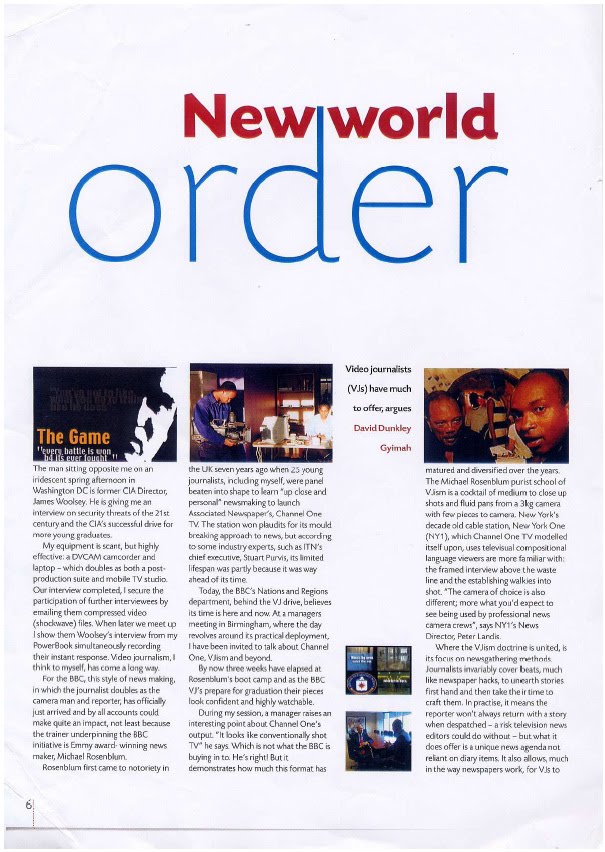
Article on a New world order on Videojournalism for Sony Mag, written in 2000


What the experts say
Suart Purvis, ITN's former Chief Executive says it all. He was at the RTS, the US equivalent of the EMMY's, as the stalwarts of Channel One were showing what they could do. His head, Michael Plantin then looked over to Stuart and asked why ITV wasn't doing this (referring to the programmes) and how they were being made.

This point is worth emphasising: videojournalism, at least increasingly to some of the pioneers was a way to make anything. The cable station allowed them so, their training gave them that experience. This is something Michael Rosenblum knows all too well.

Fast forward to 2010 and the videojournalist ( the law of diminishing returns) has become a defined form. You work in News? As a newspaper it defines you, but something's about to explode - albeit over the coming years.


Filming you, filming me. The Making of 8 Days with the UK's  first regional newspapers to adopt videojournalism in 2005, who I trained.

It's not videojournalism's fault. The title came before the art form could stamp and crystallise its identity. If I call you an artist, you could work in any genre of the arts. If I call you a videojournalist, you're more than likely working in the field of news.

That's what the ITN exec had identified, that's what I have been writing about for 15 years. Thus far we haven't found the title that illustrates that grand polymath versatility. No correction! it's been found, but the form has sped along.

Shooting Moby in DC. Circa 1989. I'm using the VX1000  one of the first DVcams, which didn't quite meet TV transmission standards.
 
Remarkably and perhaps surprisingly, this is what faced some of the pioneers of television with labels that did not cater for them, so they lifted all the definitions from Hollywood: producer, director and so on.

Over the years, I have occupied several positions within television, new (back then) media and digital media - from creative director of an ad agency run by a former head of TV at Saatchi and Saatchi, to long formats, to conceptualising with teams whole sale programmes and related media.

I could be called any number of titles, but the legacy of Channel One and what that meant remains like an old shoe.

We can't say we shouldn't get hung up on titles, because it's what often defines you, but the sad short history of videojournalism is its misappropriation - at least to a Channel One crew of the 90s.

I may from now on call myself producer, creative director, designer, director, editor, but then what's wrong with videojournalist?

As Purvis said to me... You're a story teller!

Thursday, September 23, 2010

See It Now! Video journalism is dying. Long live video journalism Response

See It Now! Video journalism is dying. Long live video journalism By Jill Drew is a must read essay delving into the spine of Videojournalism and evoking memories of Murrow in its title.

Featured on Columbia Journalism Review, it reads:

As the video begins, no announcer welcomes you, no headline scrolls across the computer screen. There is no need for either. You know where you are from the logic of the images. The camera lingers on the anticipatory expressions on people’s faces at Barack Obama’s inauguration; it holds steady as endless streams of people slowly fill the National Mall. Natural sound builds the excitement. Click here for the piece

The piece over six pages strips into an ontology of videojournalism; its pending death and survival - peering over its vast landscape. I hope to come back to more specifics in the piece later on.

If I have a criticism, which I can see a legitimacy, it is that it takes an American-centric view of videojournalism, thus overlooking insightful work from the Europeans e.g. Germans, Norwegians, French and Brits e.g. Frontline Club

But that may be seen a s gripe on my part and it's nay impossible to frame a subject as vast as this to cater for readers of all international hues. What about the Chinese and the Asians? It's an admirable piece and practitioners across the big pond must perhaps write their own story.

However this was my response posted to @CBR after a day of working towards an epistemology of videojournalism projects

------------------------------------------------------------
Drew, Leacock et al were massive pioneers, fundamental in shaping a visual medium and a methodology, as were Rouch, Marker et al in Europe. You could even look to the work of Eisenstein whom instigated cinema verite (kino). All had a passion, all searched for an aesthetic.

Videojournalism's Achille is in part its search for a home. Shooting a camera, making a news film was never quite as revolutionary as it was made to seem. Jessica Borthwicke in 1914 would further prove that when at 24 with a Newman camera and a few days training she left London to film the Crimean war.

What's dogged film all the while and thus attracted stern critique is the search for an aesthetic. History informs us these have arisen through a number of supervening moments.

But videojournalism's supervening time, at least as a creative aesthetic construct has often been junked in favour of a replication of a status quo inured by saving costs and multiskilling.

It's finding one now; small pockets.

If you'll pardon me. In 2005 when I was awarded a Batten Award, this was the precise question within videojournalism that taxed me then and still does today.

The judges commented on viewmagazine.tv (the site and video I produced) as

“This interactive magazine foreshadows the future with its use of hip new story forms and highly video-centric Web tools".
2005 Batten Advisory Board Judges

That future then, is now upon us at present, but the aesthetic and philosophy has moved on. There's a fresh media ascendancy, albeit limited at the moment that resides in the collocation of photography and video, animation, and less a reliance on television and at times the classic video obs docs lingua franca.

Hence the bril work of Travis Fox, Angela Grant, Brian Storm et al.
I've had the opportunity in many cases of talking to them personally or on the dog and bone (Gosh these air fares are killing me).

Your post is prescient as I have just returned from interviewing some of the UK's leading television/media figures about this,, such as Stuart Purvis who was Editor-in-Chief and then Chief Executive of ITN from 1995-2003.

One little unknown story, which I'm pursuing acknowledges the contribution of a UK cable outfit in 1994 solely dedicated to videojournalism called Channel One. I'll post what Stuart says on Youtube and my blog.

But Channel One 1994, which I was part of accepted in its early days (tutored by a young Michael Rosenblum)the need for a newish aesthetic.

What's more none of the videojournalists were constrained by a paradigm or semiotic of news production. We made programmes - a Zero or Z principle of media production. Nothing was wasted, it all unfurled together.

We were informed, at least I was, by a run of programmes on BBC e.g. Reportage and Def II. Stuff today we might take for granted, but led to great late night debates and films.

And today many of those former videojournalists work in the industry and their work has attracted huge acclaim e.g. Dimitri Doganis Raw TV .

The videojournalism ( that poor word) I see is one that is maturing but beyond its traditional stables, driven by, yet not wedded to exclusively a cinema aesthetic, a motion graphic derivative, a visual verite, a narratology which will do for it, what blogs did for news copy. A time when we'll video hyperlink pieces and drill further into aspects of design and video and how they work.

There's still work to be done, but articles like yours Jill become, or should become a camp fire to explore the contemporary, antecedents, and what ifs.

Videojournalsm is dead;the flag might flying half mast, but the stool is never vacant. Long Live Videojournalism

Ta Loads
David

David entered broadcasting working for the likes of the BBC and Channel 4 in 1987. He is a Senior Lecturer at the University of Westminster and PhD candidate at SMARTlab examining the Outernet. He's an Artist in Residence at London's SouthBank Centre and is still a videojournalist and trainer

Tuesday, September 21, 2010

BBC My story - great idea & stories, but the film making?

The BBC's My Story - amazing stories, but the semiotic even from the above picture suggest we still can't hear what you have to say, without a celebrity. User Social Network debunked.

I have just watched the BBC's My Story and curiously am upset.

The idea is well thought out in a way of bridging television - a social enabler - that is it brings people together, with the new new thing, participatory social networks.

In the latter case, this was illustrated by its central premise that everyone has a story to tell, so send yours in, which people did in their droves, 100os in fact.

From that judges of the highest calibre of literature and reportage e.g. Fergal Keane, whose reports from Rwanda and South Africa still resonate today, combed through and chose an eventual winner whose prize was nothing short of miraculous.

Following today's showing the winner will have her story published tomorrow. That's ambition. You can, as te BBC says, download that story for free, which I have just done for an Uncoventional Love by Adeline Harris.

Adeline's story is as amazing as the other three profiled in the show.

She fell in love with a clergyman, Father Kelly, many decades ago. Couched in the words of the show's presenter the relationship did not go to the next level. But he cared for Adeline through trials and tribulations.

They lived together for two years. Then she fell pregnant to another man and had a baby and still he cared for her. Up until Adeline married her lover and they had another child when Father Kelly would shun her. He has since passed away and Adeline is still married to the same man many years on.

This is an epic story, no less emotional wringing than the other two on display: a woman who falls in love with a lifer and campaigns for his release, having questioned the original conviction. They are now living happily on the outside.

And a woman whom through the power of the Internet, most likely Facebook returns the affection of her first love 40ish years ago and despite being happily married leaves everything to reacquaint herself with him, and leaves her happily married husband beached.

Middle England must have been harrumphing like mad at the moral message of this story as somehow through the presentational skills of the host Christine Brinkley we get an unequivocal great love story, rather than someone who's also been, well ghastly.

What her husband she'd been leaving with in her retirement must have felt? But this was about stories, so yes, the clash of morals itself is fibre for the viewer.

The show's flaw
So why was I, and I imagine I'm in a minority, mildly irritated? Because the films they showed did not do the stories the justice they duly deserved.

TV has its failing in its often tired aesthetic, exacerbated media historian critics might point to the time 35mm gave way to 16mm and then beta cameras took over.

So what you got was the most cinematic quests reduced to the style of a TV news package. The narrative, their story is strong, the visualisation however is enough to mutter all sorts of things.

For instance more often than not, a camera is used to record the subject's narrative in one take, and then sequenced shots cut back and forth, with V/O from the presenter. There are enough cliched shots e.g. looking on yonder, to fill the Directors Book of Film Cliches.

The colours are harsh and any subtlety of lighting to reflect these incredible stories had been sacrificed for capturing the oral narrative -the news narrative.

Reading the download, the book is everything I suspected. It's cinematic, expansive, rich in description, textured - just as a book should be. But if the producers treated the book, just as they had the visual story, there's no reason why you wouldn't expect a newspaper article.

And perhaps a good one, as there is nothing intrinsically wrong with that, if that's what was intended, but I suspect it wasn't. This was a different semiotic.

You could argue on the pin of a needle whether the show needed a presenter, but there's something about epic stories that don't need the embellishment of a strong personality narrator.

TV goes social network is inevitable, as realised through the litany of reality shows, but TV realising sometimes cinema offers a richer experience is something still being wrestled with - and that's a shame.

Ultimately just as the book is a download, their self-contained stories should be as well potentially cinema at its best.

For inspirtion, if you haven't seen Last Minutes with Oden, up for a Vimeo Awards , now's your chance. TV could still learn a bit or two.

Last Minutes with ODEN from phos pictures on Vimeo.

Monday, September 20, 2010

Producing analytical videojournalism to evoke response - social

Presenting in Norway at Innovations Lab

Back in 1991 is when it happened.


In an industry where blogs, social participatory networks, new journalism, had at least another 15 years to fully gestate, as a minority in many ways working in the media, I often thought about "if".

What if the sort of programmes, BBC TV's flagship news programme, where I would gain my break could be replicated elsewhere and for anyone. How empowering and enabling that would be.

Newsnight was replete with bright sparks (it still is) - Oxbridge grads. The producers have this talent, an ability to take an idea, and communicate it analytically to their 900,000 audience - largely decision makers.

The ideas arise from critically assessing an issue, a thought, and producing theatre that captures the imagination and provokes a response.

In a previous post I spoke about participatory social media videoprogrammes. Newsnight's programmes invariably fulfill one facet of this, though yes I can see areas to do more.

I mention this programme and indeed other analytical programmes I would work on such as Channel 4 News and The Politics Show, because I would think then, as much as I think now of the power of unification: the best of TV, design and digital media.

If we can converge combined crafts, pass on such analytical skills, if we can hotwire this to the best of today's digital communications, there's a strong proposition.

This is not merely about superfiical reportage, that involves "observe and report" on an unfolding an event - which can often drive the narrative. It's deeper, its value system creates knowledge that many access to provide individual solutions. It interrogates business models, lifestyles, motives.

Take Oxfam and various charities, e.g. Mumsnet, decision to invite bloggers onto international aid trips. A role once usually reserved for journalists.

Mumsnet's political and economical footprint is key, given its constituents. But think about an analytical end product that not just explored the trip, but strategically underpinned the scope and challenges for Oxfam, Mumsnet and various related agencies.


This model gives an idea of strategy and ownership
( click to enlarge)


Journalism Educator and blogger Jeff Jarvis asked in his highly acclaimed book "What would Google do?", to inform a different strategic approach to the new media industry. I say what would an IM Videojournalist (with an analytical crafts background) do?


This front cover, above, is a chapter for a book which features an image from "8 Days", which was the recipient of an international award in Berlin. The film was claimed by three agencies after wards because of its outcomes: The Police, The UK Press Association, and International VJ Awards for its representation of a different form of videojournalism.

This notion also has a strong outcome also for a increased transparency for multinationals as a strategy for accountability from reading this expansive piece on Crisis and PR disasters in the Evening Standard. More on that in latter post.


Looking to the future.

When I was awarded a US Knight Batten Award for Innovations in Journalism, the judges commented:

"“This interactive magazine foreshadows the future with its use of hip new story forms and highly video-centric Web tools.”Batten Advisory Board Judges

This quarterly netcasting magazine integrates ISP broadcasting and print magazine information produced by individual backpack journalists (“solo-jo’s”) from England, the United States and South Africa".

At the ceremony I had to point out that the work was largely mine; I was too embarrassed to own up to creating it single handedly, but today the future of the past is now the present.

And now that we've passed video making's acceptability, the next phase is a more rigorous, emboldened analytical aesthetic and principles, which I tend to discuss in Viewmag- the Outernet (this blog).

In fact Viewmagazine's real treatise was to combine creative designer and videojournalist. Create the video and build the branded sites. You can see quite a few on Viewmagazine.tv


Video news journalism which doubles as a corporate video

A video I made more recently interviewing the Director of Chatham House (formerly The Royal Institute of International Affairs) by default appeared to meet those requirements.

The Director is seen robustly explaining a topical issues of international affairs within the framework of integrated multimedia videojournalism. So the video has as much interest for the organisation, which led to a meeting with its communications team, as it did for me showing what can be done.

Consulting at the FT, working with one of their talented producers Rob, one of the proposition we worked on was to produce the definitive Budget programme. We accomplished a very credible package on the day at a first attempt after 2 weeks IMVJ training.

And next month I return to Cairo and Nile TV to work with a new generation of journalists, who are tech savvy and also embracing this evolving epistemology for video communications.

David training a new generation of journalists from Cairo, Nile TV - national broadcaster

Why am I talking about all this now. Because last week I interviewed the editor of the UK's most successful commercial news company, ITN and in the course of the interview she spoke about, and I acknowledged, that the digital revolution had not yet stolen all their clothes.

That whilst everyone's doing video, not nearly as many are doing analytical video as a critically- led aesthetic and the irony is in a climate of uncertainties, we need more information to challenge a raft of issues.

If you remember the Thatcher era and confluence of domestic and international issues, when commentators spoke about the erosion of values, and that Thatcher would say there is no such thing as society, programme makers had something to challenge.

Rough political climates, make for good foundations for incisive programmes ( video making). If in the yester years we prevaricated or even protested, today the options are a more potent one.

Invitations to speak and share
That's that then I thought which is why I intend to turn my attention or return to this in a very practical craft either as a series of workshops or conferences talks, starting with an invitation to return to Apple Stores in London.

There as elsewhere I'll talk engage and reveal some of the specific work flow methodologies which can be used to strengthen beyond unitary videojournalism.

So this is also an invitation. If you'd like to know more, I'd be delighted to hear from you, otherwise click on Apple Profile or my website viewmagazine.tv . My email is david@viewmagazine.tv. I can't tell you how much I look forward to that.


Sunday, September 19, 2010

WOW - Women of the world festival -what's your contribution?

Jude Kelly OBE, Artistic Director of the Southbank Centre chairs
Women of the Word (WOW) ideas session.


The conversation then turned to films and Kathryn Bigelow's Oscar and its impact for women in film, outside of Tinsle town

No doubt that question has been asked in academic papers, film magazines and industry committee meetings ad nausea.

However, in Central London, The Southbank Centre level 5 room, films about women or by women has a resonating pathos of its own.

Sholay (a film with men, made by men, so it won't count) or Seetha and Geetha, another personal favorite of mine and Screen writer Foye Banjo may attract a matured audience, but how do you get 16-18 year old noted Choreographer Sita?

Sandwich the works of new women film makers amongst traditional works was one solution, evoking the programming of cinema Newsreel producers of the 50s.

And to rally interest from potential attendees at grass and arboreal roots level, the selling powers of the door-to-door Avon ladies is an idea well worth considering said Jude Kelly chairing these talks.

Film, was just one of many themes in discussion at this ideas session.

The meetings was captured with a unique artistic
method called Visual Minutes


Women of the World
The over-arching occasion was to posit ideas for a festival, Women of the World, acronymically presented as WOW. This, session six of seven, yielded a festivals of ideas as broad and eclectic as previous ones said Jude, Artistic Director of The Southbank Centre.

They included Candice, a pioneering black woman - one of the first Assistant Directors in the US' film industry; and the youngest woman in the UK to gain a pilot's license. She won't forgive me if I name her.

Meanwhile, fellow Artist in Residence and dancer/choreographer Gauri Sharma Tripathi spoke of her daughter's long pony tail - a matter that draws attention in her birthplace in India and manifests as a protest between femininity and male religious dogma.

Poet Lemn Sissay pointed to an observation how the term Mother Earth, Gaia has become redundant since the mascularisation of green issues into climate change.

The word "Mother", which evokes deference to many, curiously in the theatre can be used to diffuse a character's identity. All the cast will have names, bar one said Jude.

Jo Glanville, Editor of Index on Censorship, looked at representation and gender-standing.

The previous evening she'd welcomed into the country Iranian singer, Mahsa Vahdat - a quite magnificent singer said Jo, but did we know that because of her sex she cannot sing solo on stage in Iran. The authorities forbid it. Her performances here will no doubt attract attention from the law makers back home.

She spoke of sexuality and notions of beauty in Lebanon from a show of camped up transsexuals, and presented an intriguing story of Belsen.

When a consignment of lipstick and sanitary towels found its way to the concentration camp, the oppressors would not know what to make of a mass spectacle of women, haggard, despairing of their plight but momentarily emboldened by the power of a beauty stick.

They dressed their lips, and placed sanitary towels Dallasesque on their shoulders - poise and femininity - in the face of excruciating circumstances.

The extremities of sexuality provided that putative subject, which to many dare not speak its name: Porn.

If a festival was to look at celebration, a Ying, it would be a travesty (my words) but an interpretation of Jude's position, if it failed to look at Porn.

A frame work? Those who have found it problematic could be invited to a showing: see and tell, as opposed to those who may have heard and told.

Planning stage for WOW
The vision is a grand one, to celebrate, visit, critique, experience, append the contribution of women.

My own interest is quite simple. My work has been catalysed by women. My mother's support kept me strong when I was placed in boarding school in Ghana - a round robin trip of some 3000 miles which mum would undertake as much as possible for eight years.

And a recognition by figures I presume who might have observed a quickening for me to do something creative, when the same sex was indifferent.

There is also the small matter of being conscious of a parallel struggle - a supervening movement. In the 80s just as women in the media were forcing the agenda for change, ethnicity and diversity also found a voice, a co-joined struggle at times, though the ethnic discourse would falter in comparison.

And finally the doctrine. Take this video from a friend, now a TED fellow explaining how the the male domination of cell biology (DNA) has failed to give oxygen to an alternative view; that the cytoplasm ( female) holds equally the key to life.

Preview to SCi Fi London - Rachel Armstrong @viewmagazine.tv from david dunkley gyimah on Vimeo.


Women in the World is scheduled for next year. I'll keep you posted.

Viewmagazine.tv below -David's multiple award winning videojournalism site for innovative storytelling

Saturday, September 18, 2010

China's new Shanghai - a Manhattan skyline and economy- Chongqing


Chongqing Report - by David Dunkley Gyimah

It's the scale of it. Chongqing little known by many; the big cities are Shanghai Beijing etc, is making a bold off-the-radar move for hegemony.

It might be construed the wrong way to suggest it is a Manhattan, but this only serves to give you a mind map of its scale, which it looks to dwarf.

Recession? What Recession. In Chongqing - a city with a population of 32 million, compared to London's 14 million or there abouts is defying many odds.

With my camera I captured a slice of this. This report stemmed from a university programme in which four academics, including me, were invited to Chongqing to share our practices.

With two days to go for my second lecture, I had an idea, why don't I take a novice reporter, a student who was just starting her communications career and in the time I had put together a report to show how flexible videojournalism is.

The report is in Mandarin. Thanks to everyone, Prof Liu et al and Melody, the reporter, and Tracy for finding the tech company.

Images from the shoot


Participatory social videojournalism - a guide to


If you were one of the many millions who watched "Live 8" you would have witnessed a a very powerful psychological theme at play: using video for participatory social media.

An act would come on to woo a jubilant audience, followed by a film which would reduce you to tears, and then a presenter who would extol you the viewer to do something, that is donate money.

Yesterday, cutting a film I made on one of the UK's most talented directors for his generation, Rob Chiu I was reminded when Rob mentioned the brief for his film.

It was to bring the audience, young people, into a baleful despairing emotional state and then the organisation "I Care Revolution" could act on this - give them options how to feel better.

Live8". Again, the audience, a group of people, feels compelled to participate.

Rob Chiu's - The Making of Fear/Love


What is participatory media?
Often when reading about participatory media, I'm drawn to that well known saying by Justice Potter Stewart on pornography, "I know it when I see it".

Oh My News & fellow Knight Batten Award Winners Global Voices are often quoted as great examples of project alpha in participatory media, usurping the monastery pyramidal structure of news' one - to many, rather than many - to - many undertaken by non-professionals ( the whole basis of the Net ( Information routing Groups)

There have been a great many blogs e.g. Paul Bradshaws, Howard Rheingold and Alfred Hermida, et al. But I wanted to take this post to concentrate on film and videojournalism.


Three fundamentals of Social, Participatory video-media
There are, for me, three fundamental levels of participatory which are at play.

1. The first and more obvious emerges from the distribution of the end product- the video, via any number of platforms and the ability to share that product.

ie You Tube, Twitter, Delicious, Facebook, and any number of social-distributive platforms facilitating the sharing process

2. The second involves the making of the product e.g. video, in which many participate towards the eventuality - if as a finite product, for this argument we call it that. Eric Whitacre's Virtual Choir - 'Lux Aurumque' is a robust example of a story, that's formed from the coming together of many.

Here Eric composes a score whose contributors he never meets - at least on the recording of the score.

3. The third aspect of a participatory form of storytelling and perhaps the one I have spent more time pondering occurs at a phenomenological level, that the structure and composition of the story has built in nodes for participation.

Live8 a model for greater participation
Lets go back to the Live 8 example, where built into the film is a cue or cues for the audience to do something, more explicit perhaps than implicit. The most powerful being to give money.

Actually the film never asks you to do that. Watch an Oxfam or Christian Aid ad on TV and it's explicit to the point, that it suffocates the film's narrative.

Often by default a powerful report induces the audience to act. Whenever the BBC is dealing with a controversial issue within one of its soaps or a documentary on a medical condition, it's aware of the repercussions enough to conclude with an end title saying: If you've been affected by this programme, please call our helpline".

That is participatory, and necessary, but still based on top down 20th model.

The very idea of building reportage that acts as a catalyst for participation, undoes the narrative we've become used to in news. Firstly news reporting inherently seeks closure and is driven by often unimodal narratives.

Also by its very nature in which it was set up, it reports without acting on after wards.

Take this video I shot in 2005 from then Masters students and third along listen to what Daniel Kofi, from Ghana has to say, in that the media should be responsible for not just reporting but changing attitudes.

I'm pretty certain that if this was shown to you around that time, you'd think Daniel was highly naive, but now?


A New Narrative
Breaking into that narrative has its challenges in the modernistic presumed free flow of the article, though the use of hyperlinks circumvents that - and we've got used to breaking out of the text.

Video, not so yet I would argue at a mainstream news level.

Structurally there are actions we could undertake and the introduction of videohyperlinking (see the Economist article which mentioned my work on video hyperlinking) will be a game-changer of participation and narrative exposition when it finally breaks.

But for the meantime, thinking through participation structurally within the report calls on a re-orientation of narrative closure and the question remains whether it would work for all reportage, though why not is my answer.

The Pope's visit presented a number of participatory nodal points from the BBC's reportage with Alan Little. One such example, a woman complaining there were no giant sized screens to watch the pope. Cue: geostat message where they can be found.

At a pedagogical level it requires a new methodology and even work flow within the gathering and dissemination of new, particularly online, which I alluded to in previous posts about Trans media and cuts to the very heart of a debate explaining what is news.

More of this in the coming weeks.

I'll finish though with a reminder of this tussle between new modes of reporting as embodied in the debate between public ( Citizen participatory journalism) and professional programme makers.

Famed Poet and literary critic T.S. Elliot giving evidence to the Pilkington Committee on the Future of Broadcasting (1962) said:
"Those who aim to give the public what the public wants begin by underestimating the public taste, they end by debauching it"
That in response to a widespread view from the 1930s from the likes of literary and social conservative critic F.R Leavis who saw standards being maintained only by the actions of an elite minority.

Yesterday I was reminded again by a modern editor how broadcasting and the media is conservative in its nature.

end

Recommended link