It was designed to repel teenagers gathering outside shop fronts.
The mosquito emitted a high frequency noise only audible to teenagers.
However shop owners had not anticipated the black lash and the civil rights implications some youth groups would raise.
But then some youngster got wise and transformed the noise into a ring tone.
And the ring tone is not only a device to thwart teachers but also keep one step ahead of parents and the police.
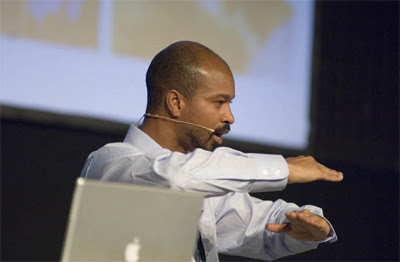
Just one of the things discussed in a session today on sound crafting at the Smart Lab which included a fascinating talk around sound war fare and sonic water cannons.
The latter sees how you can send a stream of narrow audible sound, even subliminal messages so unless you're standing in an exact particular spot, you'll hear nowt.
Tomorrow we'll be down at the Dana centre, part of the science museum, looking at citizen film makers.
They'll be speakers on avatar-characters, collaborative film making and mobile phone features.
The questions have been asked before, but we've moved on a bit, so could this new discourse in film ever challenge the status quo.
How much is this new quantum in film making innovation over substance and is it only the preserve of niche audiences?
Wednesday, October 22, 2008


Creating an Ad aired on CNN International and some
It's Phd away week, where thirty or so of us, all with different fields of interest gather. More on that and what may be of interest with its terms and frames of interest.
Today I interviewed a prominent expert in child development and play who had some fascinating things to say translated across journalism.
Tomorrow at my presentation to colleagues I aim to illustrate how size, speed, content and aesthetic may well matter on the web regarding video stories and video journalism.
Later in the week I'll post a 30 sec spot, one of a few, aired on CNN International. The story behind the story was being rung up by a client who had paid for airtime but had nothing to show and wanted to know if I could create an ad in less than a day.
Tuesday, October 21, 2008
Training Matters -redux
In this I outline why journalism training has never been more pressing in today's climate.
I was a speaker at this year's 15th World Editors Forum of the World Association of Newspapers in June in which I spoke about training to hundreds of editors. This is a redux of an earlier article.
***********
In the twenty years I have been a journalist working across various disciplines, five of which I have combined as a senior lecturer, few issues rank higher within the space I ocuppy as training, whether it's in the lecture hall or newsroom.
In those twenty years I have been fortunate enough to work with, train with, or train scores of journalists.
Some of my earliest international memories include working in South Africa in 1993 alongside the International Federation of Journalists, the Media Workers Association of South Africa and South African Union of Journalists creating a Training the Trainer programme.

South Africa Report for BBC Radio 4, the only non- South African documentary played on South Africa's public service radio during the historic 94 election.
The need for training was something South Africa's institutions readily embraced for a post apartheid regime.
More recently I have consulted for a number of newspapers in the UK, including the Press Association and FT.
What's clear amongst many editors and proprietors is the need for training -not just as an away day exercise to bond staff, and that is necessary - but as a means of keeping the working environment fully active: to enrich the iron in the blood.
The motive is not just to be on top of the game, but in front of it.
What's media scape like?
How can we strategically stay ahead of the game?
how can we respond to the the changing needs of journalism?
TRAINING DAYS
I am perhaps one of the thousands of fortunate journalists to have experienced some of the best training around during my newsroom years.
The BBC's Training Unit, which does not exist in the form it was in the 80s and 90s, saw its fair share of me for voice training and various journalism practices.
I once even served as a guinea pig for broadcast managers to interview an ethnic minority and assess whether their interviewing style needed changing or whether I was simply hopeless. I had worked for some of the biggest outfits, but not via interviews with personnel, but by managers seeing my work and calling me up.
BBC Radio Leicester, the first local radio station in the UK, where I started my career was where I received some of my best training under station manager Leo Devine, now a senior BBC figure.
And I was reminded of that culture of training recently when a broadcaster approached me at the Royal Festival Hall and reminded me that I trained him in 1988.

Training, is either the thing that dare not speak its name of our career, quite unsexy in one guise, or a fall back position, a safety net that ensures a broadcasting outfit could maintain its professional status quo by bringing up staff to the water mark of best standards.
Without playing down challenges in that era and the commitment from those that could afford this expense, there appears some startling differences between then and now.
It was no genius on my part that when I graduated from journalism college , Falmouth, following years of the sciences and a degree in Applied Chemistry, I landed a couple of prime jobs.
Serendipity played a part- right place right time - but truthfully I'd been maxed to the head with training.
And truth, as a former chemist more used to writing chemical symbols than essays, oh I needed training.
*******
BACK TO THE FUTURE - TRAINING

National Press Club report here featuring Adrian Holavaty - a VJ report back then we more or less knew journalism and any scenario planning of trend extrapolation provided a fairly comfort zone ahead. What's the worse that could happen?
Oh we're launching a 24 hour news show, which requires multiple feeds from the journalist.
Difficult and daunting YES, but in the broader sense of the word it was still journalism you understood.
Today, no such luck, the seams of a profession are being picked and rewoven into a new, some say exciting, others believe a shapeless tapestry.
Added to the normative variables of journalism e.g. storytelling, ethics and writing, we're witnessing new parameters - which in many cases we might argue have nothing to do with the profession.
It begs questions, many ones, wider ones.
What, if we can afford to train our journalists, should we train them with?
Scary!
Where do we start?
ALL THINGS GREAT AND TRAINING

Now it's expected, within foremost the emerging generation and to an increasing extent those already in the profession to be the passport to keeping their career going.
We're in the evolving era of jack of all trades and masters of them all.
We will still need specialists, journalists who have no need to master these things, but the trend suggest a collapsing of interdisciplines into one.
It's a Niagara Falls chasm of a leap from the days I remember at the BBC when friends where being asked to become bi-media.
From bi to sex and counting; soon you'll be dec skilled - that's 10 separate disciplines.
CONTEMPORARY BREAK THROUGHS

In 2005 working with the first regional journalists to attend the Press Association's (PA's) Videojournalism training session we proved that print journalists could indeed learn TV.
And if you're long enough in the tooth to remember the BBC's excellent journalists training schemes where 12 cohorts become the chosen ones across the nation, you'll be no stranger to the mantra surrounding the once mystic art of TV making.
The feeling was: "If you haven't got a double first from. . . you're ahead of me here, you're not coming in".
Now print journalists shoot, cut, edit, voice their reports and we're training them to do it swiftly and produce appropriate visuals for their chosen platform.
Video online can either using one person be video journalism for television of video journalism for video journalism - the creative gonzo form.
And along the way of what I refer to as blank paper syndrome, there have been noticeable success.
One that tickles me after taking a call from one of PAs early training adopters was from the Liverpool echo - David how much can I charge for news footage?
The Echo made a nice tidy sum that day selling their story to the BBC and commercial broadcasters.
MANY MEDIA OFFERINGS

But those that can are having a go and making good on their online ventures.
However one of the biggest tasks besetting training, a sort of pot-noodle of a word, is not necessarily the technical and theoretical skills we need to learn, but the paradigm and creative bent that is required to comprehend changes; changes which don't look like slowing down.
Contemporary attitudes, re-engineering our approach, mixing technology with the traditional, thinking spatially rather than linear ( see post for Journalism.co.uk), writing for human eyes and artificial one e.g. robots are just some of features we're having to wrestle with.
Has training ever been more crucial?
Well no not really, this is all relative; each by gone era will trumpet the importance of training
But that doesn't diminish the profoundness of training, here and now.
Is it crucial now?
Absolutely.
In fact I'm thinking of tagging on RnD to the word training, which often still evokes thoughts of Open University lecturers looking like fallen rock stars wearing hush puppies.
RnD because in the current climate training is not, or should not be about ensuring staff are kept up with good practices but prepped for disruptive forces and how to seize initiatives.
I use an old image illusion to make a point that if you can't see it, it doesn't mean it's not there.
Or as I have said in the Video journalism manifesto, if it hasn't happened it awaits to be done.
Go to the web young journalist said Anthony Moor, editor of OrlandoSentinel.com on a posting that oozed passion and foresight. ( I apologise it does reference me as well)
For examples of if it hasn't happened it waits to be done you can look to the British media's relation with videojournalism.
After Channel One, the BBC would take up the reigns of this new media form as a viable asset, seven years on from C1s beginnings and in between that period no one would dare try for its lack of a broadcaster's endorsement.
WHY DOES TRAINING MATTER?
Why does training matter?
It doesn't if you're not interested; you'll get by.
By why it matters otherwise is it is the engine that drives our progress: the swan syndrome, looking elegant on top but webbing furiously.
Here and now, it provides us an in, to what might come.
There are many of us, you who believe the tower fans of change are yet to gather force; the net at a standard 16mb plus will drive a medium of unimaginable power e.g. live net broadcasting, IPTV.
As I write this I have been made privy to software in the making (I'm under an NDC) that when it comes off will completely and utterly change the landscape.
There's work to be done; present forms are evolving, new ones are emerging.
Journalists are having to think like graphic designers, motion graphic artists, action scripters, SEO analysts and as they slay one form, within the core disciplines the experts are raising their anti.
Cubism turns to futurism and then constructivism emerges.
Online, the foundations of what we once did might still be sound, but the style is (meta)morphosing.. futurism to a new futurism.
The flash documentary I made with my colleague in 2000, runners up in Channel 4's Unleash the Talent, I believe still holds, but it's old hat; we've moved on.
WHY TRAINING MATTERS MORE

Training matters because it's about progress, not the fag end of budgetary expenses.
Three years ago a colleague and I conceived an online learning tool for journalists built in Flash.
Last year the BBC acquired its intellectual engine, and us as consultants to make its own version to launch its flagship Journalism College training.
Why does training matter?
Because there is no certainty for those who remain complacent.
Big companies can and most likely will conceivably go to the wall if they don't change.
Doing nothing now is no longer an option - hoping this thing called the web will blow away.
We (more so in developed countries) occupy one big mother board so if you're not innovating, someone else will and your CEO will have no excuse to shareholders when that tech company down the road launches the next big journalistic tool that you should have had.
 Brrrrr Final Cut Pro!
It matters, in a bizarre twist of fortunes because large swathes of university grads are leaving the nest with fabulous skills - that much we know from within the BJTC - but there are cases where some fail to find homes that can use their new skills.
I see the timetunnel of Channel One looming in which of the hundreds of VJs - some very good , some er, perhaps needing more journalism training made choices to move elsewhere as the market did not support VJs
Today only a few have survived from the days of Channel One.

£$%^&*@@! No!
But what the present generation know, what they can do is so awesome that it leaves managers bereft of ideas what to do with them.
In a recent posting I say tongue in cheek go hire a teenager for Christmas.
NEW JOURNALISTS

Students get a chance in a lifetime to be in a make believe war zone environment as Nato forces battle each other, setting up their own game theory scenarios and letting these new journalists loose to report.
Students by then will know how to shoot video and stills, pod, sat. back to base, get an idea of rank and procedures on board anything from a destroyer to rapid boats.
Training matters because without it we become anemic, we atrophy, we become bored at what we're presented with and if not industrious we fall behind our competitors whom today are world wide.
To coin an old phrase demo or die, train or be slain.
The choice is yours.

I was a speaker at this year's 15th World Editors Forum of the World Association of Newspapers in June in which I spoke about training to hundreds of editors. This is a redux of an earlier article.
***********
In the twenty years I have been a journalist working across various disciplines, five of which I have combined as a senior lecturer, few issues rank higher within the space I ocuppy as training, whether it's in the lecture hall or newsroom.
In those twenty years I have been fortunate enough to work with, train with, or train scores of journalists.
Some of my earliest international memories include working in South Africa in 1993 alongside the International Federation of Journalists, the Media Workers Association of South Africa and South African Union of Journalists creating a Training the Trainer programme.

Soon after arriving from South Africa on his first trip in 1992 David wrote this Dispatches for the BBC's In house newspaper, which would catch the attention of a number of South African media institutions.
The need for training was something South Africa's institutions readily embraced for a post apartheid regime.
More recently I have consulted for a number of newspapers in the UK, including the Press Association and FT.
What's clear amongst many editors and proprietors is the need for training -not just as an away day exercise to bond staff, and that is necessary - but as a means of keeping the working environment fully active: to enrich the iron in the blood.
The motive is not just to be on top of the game, but in front of it.
TRAINING DAYS
I am perhaps one of the thousands of fortunate journalists to have experienced some of the best training around during my newsroom years.
The BBC's Training Unit, which does not exist in the form it was in the 80s and 90s, saw its fair share of me for voice training and various journalism practices.
I once even served as a guinea pig for broadcast managers to interview an ethnic minority and assess whether their interviewing style needed changing or whether I was simply hopeless. I had worked for some of the biggest outfits, but not via interviews with personnel, but by managers seeing my work and calling me up.
BBC Radio Leicester, the first local radio station in the UK, where I started my career was where I received some of my best training under station manager Leo Devine, now a senior BBC figure.
And I was reminded of that culture of training recently when a broadcaster approached me at the Royal Festival Hall and reminded me that I trained him in 1988.

David in an edit suit in the days of physically cutting tape recorded on a Uher
Other than that, like most news rooms you just got on with it - de facto training on the job - for which I have also had some tremendous experiences working on the likes of Reportage and Newsnight.Training, is either the thing that dare not speak its name of our career, quite unsexy in one guise, or a fall back position, a safety net that ensures a broadcasting outfit could maintain its professional status quo by bringing up staff to the water mark of best standards.
Without playing down challenges in that era and the commitment from those that could afford this expense, there appears some startling differences between then and now.
It was no genius on my part that when I graduated from journalism college , Falmouth, following years of the sciences and a degree in Applied Chemistry, I landed a couple of prime jobs.
Serendipity played a part- right place right time - but truthfully I'd been maxed to the head with training.
And truth, as a former chemist more used to writing chemical symbols than essays, oh I needed training.
*******
BACK TO THE FUTURE - TRAINING

David presents his ideas to a critical audience of leading media practitioners at the prestigious National Press Club in Washington DC before collecting the coveted Batten Award for Innovations in Journalism.
Oh we're launching a 24 hour news show, which requires multiple feeds from the journalist.
Difficult and daunting YES, but in the broader sense of the word it was still journalism you understood.
Today, no such luck, the seams of a profession are being picked and rewoven into a new, some say exciting, others believe a shapeless tapestry.
Added to the normative variables of journalism e.g. storytelling, ethics and writing, we're witnessing new parameters - which in many cases we might argue have nothing to do with the profession.
It begs questions, many ones, wider ones.
What, if we can afford to train our journalists, should we train them with?
Scary!
Where do we start?
ALL THINGS GREAT AND TRAINING

Interactive documentary, The Family, made in 2000 using Flash and Video Journalism was a runners up in Channel 4's digital media competition
The buzz word at the moment is multimedia, a discipline that pulls in a wide facet of journalistic talents nominally spread amongst a team.Now it's expected, within foremost the emerging generation and to an increasing extent those already in the profession to be the passport to keeping their career going.
We're in the evolving era of jack of all trades and masters of them all.
We will still need specialists, journalists who have no need to master these things, but the trend suggest a collapsing of interdisciplines into one.
It's a Niagara Falls chasm of a leap from the days I remember at the BBC when friends where being asked to become bi-media.
From bi to sex and counting; soon you'll be dec skilled - that's 10 separate disciplines.
CONTEMPORARY BREAK THROUGHS

David training the first UK Newspaper Journalists to become VideoJos resulting in his award winning film 8 Days
In 2005 working with the first regional journalists to attend the Press Association's (PA's) Videojournalism training session we proved that print journalists could indeed learn TV.
And if you're long enough in the tooth to remember the BBC's excellent journalists training schemes where 12 cohorts become the chosen ones across the nation, you'll be no stranger to the mantra surrounding the once mystic art of TV making.
The feeling was: "If you haven't got a double first from. . . you're ahead of me here, you're not coming in".
Now print journalists shoot, cut, edit, voice their reports and we're training them to do it swiftly and produce appropriate visuals for their chosen platform.
Video online can either using one person be video journalism for television of video journalism for video journalism - the creative gonzo form.
And along the way of what I refer to as blank paper syndrome, there have been noticeable success.
One that tickles me after taking a call from one of PAs early training adopters was from the Liverpool echo - David how much can I charge for news footage?
The Echo made a nice tidy sum that day selling their story to the BBC and commercial broadcasters.
MANY MEDIA OFFERINGS

The International Video Journalism Awards in Berlin. David top of the shot can be seen filming minutes before collecting an international award
However, videojournalism is one arm of as the name suggest multimedia - a many tentacle beast.But those that can are having a go and making good on their online ventures.
However one of the biggest tasks besetting training, a sort of pot-noodle of a word, is not necessarily the technical and theoretical skills we need to learn, but the paradigm and creative bent that is required to comprehend changes; changes which don't look like slowing down.
Contemporary attitudes, re-engineering our approach, mixing technology with the traditional, thinking spatially rather than linear ( see post for Journalism.co.uk), writing for human eyes and artificial one e.g. robots are just some of features we're having to wrestle with.
Has training ever been more crucial?
Well no not really, this is all relative; each by gone era will trumpet the importance of training
But that doesn't diminish the profoundness of training, here and now.
Is it crucial now?
Absolutely.
In fact I'm thinking of tagging on RnD to the word training, which often still evokes thoughts of Open University lecturers looking like fallen rock stars wearing hush puppies.
RnD because in the current climate training is not, or should not be about ensuring staff are kept up with good practices but prepped for disruptive forces and how to seize initiatives.
I use an old image illusion to make a point that if you can't see it, it doesn't mean it's not there.
Or as I have said in the Video journalism manifesto, if it hasn't happened it awaits to be done.
Go to the web young journalist said Anthony Moor, editor of OrlandoSentinel.com on a posting that oozed passion and foresight. ( I apologise it does reference me as well)
For examples of if it hasn't happened it waits to be done you can look to the British media's relation with videojournalism.
After Channel One, the BBC would take up the reigns of this new media form as a viable asset, seven years on from C1s beginnings and in between that period no one would dare try for its lack of a broadcaster's endorsement.
WHY DOES TRAINING MATTER?
Why does training matter?
It doesn't if you're not interested; you'll get by.
By why it matters otherwise is it is the engine that drives our progress: the swan syndrome, looking elegant on top but webbing furiously.
Here and now, it provides us an in, to what might come.
There are many of us, you who believe the tower fans of change are yet to gather force; the net at a standard 16mb plus will drive a medium of unimaginable power e.g. live net broadcasting, IPTV.
As I write this I have been made privy to software in the making (I'm under an NDC) that when it comes off will completely and utterly change the landscape.
There's work to be done; present forms are evolving, new ones are emerging.
Journalists are having to think like graphic designers, motion graphic artists, action scripters, SEO analysts and as they slay one form, within the core disciplines the experts are raising their anti.
Cubism turns to futurism and then constructivism emerges.
Online, the foundations of what we once did might still be sound, but the style is (meta)morphosing.. futurism to a new futurism.
The flash documentary I made with my colleague in 2000, runners up in Channel 4's Unleash the Talent, I believe still holds, but it's old hat; we've moved on.
WHY TRAINING MATTERS MORE

David presents from Flash on the Beach a gathering of some of the world's best designers using Flash or otherwise, while below he talks training and new digital techniques at Apple's store in Regent Street, London.
Training matters because it's about progress, not the fag end of budgetary expenses.
Three years ago a colleague and I conceived an online learning tool for journalists built in Flash.
Last year the BBC acquired its intellectual engine, and us as consultants to make its own version to launch its flagship Journalism College training.
Why does training matter?
Because there is no certainty for those who remain complacent.
Big companies can and most likely will conceivably go to the wall if they don't change.
Doing nothing now is no longer an option - hoping this thing called the web will blow away.
We (more so in developed countries) occupy one big mother board so if you're not innovating, someone else will and your CEO will have no excuse to shareholders when that tech company down the road launches the next big journalistic tool that you should have had.
 Brrrrr Final Cut Pro!
It matters, in a bizarre twist of fortunes because large swathes of university grads are leaving the nest with fabulous skills - that much we know from within the BJTC - but there are cases where some fail to find homes that can use their new skills.
I see the timetunnel of Channel One looming in which of the hundreds of VJs - some very good , some er, perhaps needing more journalism training made choices to move elsewhere as the market did not support VJs
Today only a few have survived from the days of Channel One.

Former Channel One Entertainment star Julia Ceaser is today a Presenter and Business Correspondent on BBC News 24
Can there be such a thing as over skilled?£$%^&*@@! No!
But what the present generation know, what they can do is so awesome that it leaves managers bereft of ideas what to do with them.
In a recent posting I say tongue in cheek go hire a teenager for Christmas.
NEW JOURNALISTS

Students and Lecturers report on Nato troops during an evacuation order in which real special forces were deployed
The Nato programme at my university is unique.Students get a chance in a lifetime to be in a make believe war zone environment as Nato forces battle each other, setting up their own game theory scenarios and letting these new journalists loose to report.
Students by then will know how to shoot video and stills, pod, sat. back to base, get an idea of rank and procedures on board anything from a destroyer to rapid boats.
Training matters because without it we become anemic, we atrophy, we become bored at what we're presented with and if not industrious we fall behind our competitors whom today are world wide.
To coin an old phrase demo or die, train or be slain.
The choice is yours.
Monday, October 20, 2008
Virtual Worlds Seminar
Blogging live
Bruce Damer a leading authority in Virtual Worlds is set to outline his theory on the evolution of life simulated in virtual worlds.
Speaking as a panelist at the Virtual Worlds conference at the Queen Elizabeth Centre, Bruce started out by road mapping the emergence of virtual platforms and urged attendants to join the matrix he is setting up.
Minutes before the session opening, I had my body scanned. The company, 3D Body Scanner NX, behind it says this sort of emerging technology has applications for the clothing industry, but also has significant medical apps.
I'll post more in a while
UK's hyperlocal TV revolution

In Norway to talk about video journalism I shared a presenting programme with Tim Burke, Editor BBC English Regions, driving the video journalism movement.
His presentation was rich in statistics and polls indicating how well accepted a VJ trial programme in the midlands, Birmingham, had gone.

I later interviewed him briefly and will post that sometime this week.
Local TV, the more acceptable term used within the BBC to describe their move into broadband news reportage will have a huge effect.
For news competitors it also presents a significant challenge, highlighted here couple of days ago.
At a time when ITN News is pulling out of the regions, the BBC will be able to display its hegemony without contest.
While like millions I'm reliant on BBC News and its many productions, I temper my news intake with variations from other sources.
Notwithstanding what local newspapers will have to offer, Local TV will be a playground all onto the BBC.
That must be a good thing at first as it'll illustrate how breaking down national news into truly hyper local interest should be.

Or reporting on matters for communities e.g. disputes over trash/rubbish can be far more relevant than national matters.
The trouble is the cost to run such a programme could be prohibitive to any outfit contemplating new entry into the news market, that is if they want to run a national campaign.
Region by region, it's different. Newspapers already have the infra structure and local reach, but perhaps not the video reporting clout, website support and triple play potential.
Yes, a thoroughly good report could quite easily find itself going from community to regional to national: bottom up rather than top down.
There is one thing I believe newspapers could do and that is to adopt an agency approach.
Mirror the BBC's activity by offering the best and some on a dedicated web site, which could be accessed at local levels.
I'll talk more about this with Tim's interviews as well as Michael Lally, RTE's head of News', bold citizen journalism experiment, the likes of which have not been replicated anywhere else I know off.
Meanwhile see viewmagazine.tv for mor info on video journalism
Sunday, October 19, 2008
Newspaper architecture and video

A friend asked me a question and I thought I'd doodle something regarding setting up a site.
I admit it's basic and each segment warrants its own interogation, but hopefully if you're considering going down this path, it should set you on your merry way.
Front end
The front end team of designers and coders with an array of language skills should do you proud.
The chief designer or creative director should be able to translate editorial needs.
Many newspapers employ their own in house tech development to create css pages to hold the pages of their site together.
Most designers will speak css, ajax, html, xml, java Flash action scripting and lingo. In many cases a lot of what you might be looking for exists on the web and can be customised.
Middle Ware and back end - a good Server provider, with strong support. There are an endless number on the market. 1&1 is a favourite, whilst Fasthosts in the UK has strong support.
You might even think about setting up you own server, though you'll need to be on top of firewalls and setting up mysql databases.
If you're planning a beast of a site, tune loading and balancing servers, and or even streaming ones would be a good idea.
When it comes to video players the market's saturated with them.
From a couple of the newspapers I consult I've had some interesting conversations and the chief quip appears to be support. How much personal technical support can they give? How easy is their CMS for uploading and what's the look of he video?
There are other features to look for: viewing window size and web 2.0 apps, controls and of course costs.
Colin Powell endorses Sen. Barack Obama

In this excerpt from meet the press Tom Brokaw interviews Colin Powell who provides a detailed and considered answer why he will not be supporting his party's presidential nominee.
Irrespective of your allegiance Powell's submission paints a poignant picture.
Apart from how prevalent this will be reported, and that you can absolutely disagree, it'll be interesting to see how many prominent pundits capture Powell's race as a defining criteria here, rather than his judgement.
Colin Powell endorses Sen. Barack Obama
Saturday, October 18, 2008
The End of UK Media - November 27th 2008. BBC's Video Journalism Revolution
On November the 27th 2008, a decision, which will amount to a seismic disruption to UK media, principally newspapers, will take place.
The BBC will announce whether it will introduce hyperlocal televsion.
It's huge. A real game changer. And for the newspapers, the end of media.
Why?
Earlier this year, I interviewed Peter Horrocks, Head of Multimedia News at the BBC.
The decision will be an explosive one and judging from this link it looks like it will get the green light.
The BBC will announce whether it will introduce hyperlocal televsion.
It's huge. A real game changer. And for the newspapers, the end of media.
Why?
- Because few newspapers can succeed against the might of the BBC and BBC local will be formidable. They already have video journalists for the 65 or so broadband sites.
- Even though many newspapers are doing video, when it comes down to it, the BBC believes viewers will choose them above a local newspaper who's just started video making.
- The decision, for once, overtly legitimises the use of video journalists as a news force.
Earlier this year, I interviewed Peter Horrocks, Head of Multimedia News at the BBC.
The decision will be an explosive one and judging from this link it looks like it will get the green light.
What's the point of a video journalism showreel?

Martin posted a question, which prompted me to ask what's the point of the reel?
A showreel is the business card of media types trying to show what they're capable of.
From directors, producers, reporters, cameras.... and corporate bodies, the general wisdom is that a strong reel can provide you with that sheen to attract eye balls and more business.
Does it work?
Well in my experience there are variations in its rate of success for different professions.
Perhaps the most fuzzy is the reporters' reel. That's because unless you fit the profile of what the director of presentation/ talent is looking for, it matters less whether you compiled your reel or cashed in a favour from Ridley Scott.
At Channel 4 News, one of the senior execs was scouring tapes, a lonely arduous task clunk clinking the VHS machine [ no such luck today]. Within 10 seconds of inserting a tape, it came out.
The programme had an idea of what it wanted, and would have been tracking its prospect.
Running tapes would be an opportunity to confirm its findings within a larger exec meeting or just on the off chance come across a gem.
I would say the latter happens very rarely.
Stuart Cosgrove , a senior figure at Channel 4, was nonplussed by them, adding there was no way of verifying who was behind making the snippets of film he was watching.
He was referring by and large to the directors' reel.
Getting a job via a reel
In the late 90s, an email from the BBC, which started off: "Apologies for the delay but we were having to go through a number of reels", did result in a meeting with a senior exec interested in me shifting.
However the only success I ever had with a reel was working for the BBC's Youth show Reportage.
Janet Street Porter's office requested I send in a VHS.
All she asked for was a piece to camera of 20-40 seconds. I'd already met the programme's editor so the reel again was to affirm or discard their findings.
Reportage liked its young crew to have a certain... how do I say this...confidence and if you were going on screen, that well worn phrase would echo in the room:"Does the camera like him/her?"
The venerable and popular UK presenter Hardeep Singh Kohli, with the Scottish brogue was one producer/reporters I worked with in 1992, so you'll know what I mean.
I did my piece to camera in my backyard and was later ribbed by the Reportage editorial team and also told what Janet said when my tape came up, which made me laugh.
Reporters' reels are nay impossible to sell. At best showing off on screen with a montage of favourite reports will not do much, unless that is you've a habit of interviewing top celebs.
However the template appears to be:
- a piece to camera/stand up.
- interview with a well known figure or live broadcast
- and then a short news package is more than enough to convince the watchers you've got the 'hire me' factor.
The short list were then rang up or met for a chat to see how likeable they were and what they might contribute to a shoot.
The producers' reel is also selling something else. The success of a show hangs around a producer pulling everything together so if a reel is eminently watchable, then credit goes to the producer.
The editor, camera, lighting have their own reels.
A curio however for me is the editors' reel. Editing in film, generally differs from editing in video features and news.
In film the editor constructs the dailies and very much crafts the story. In news and features the editor can often find themselves being strongly directed by news reporters.
The video journalism reel is so nondescript, it could take up chapters. For it's an amalgam of all the above.
The emerging Video journalism Reel
The market place I believe isn't matured enough to look on VJ reels as a revolving door for jobs.
Though there have been noticeable successes from newspaper VJs, I have exchanged ideas with, moving into television.
In both cases Andy now working for sports network s Setanta and Vicki who's at BorderTV are story tellers and the camera likes them.
Many video journalists prefer not to go on camera, so it's their film skills they're touting.
My colleague at Channel One, Sacha Von Straten, makes the point on Rosenblum's site [Sorry it starts off with a halo buff] that he hid his VJ skills after Channel One in preference of being taken seriously as a producer/director.
So the show reel is a literally now from this image a electronic business card.
Corporates swear by them; they're more commercial orientated in this case. And the media has a certain ambivalence depending on which profession you are.
But one thing is generally accepted, good ones tend to be a hit with viewers.
The producer/director behind Usain Bolt's video after his amazing 100m run has a job in the media for life. The whole film is testimony to their talent - blogged here.
If it were me I'd submit that with my job hunt. Trouble is directors/producers want to be current, so it's more than likely snippets of this wonderful video will find its way into the video producer/ director's reel.
Friday, October 17, 2008
Can video journalism up ante for multiskilling?
Two way Live report - war games from david dunkley gyimah on Vimeo.
As a piece of narcism I look like I'm 12 years old, but this video tells a story behind the broadcast.
It's an amorphous word, "multi-skilling". What are the limits?
For video journalism there's the obvious roles: shoot, edit, report
But there are other facets which can be nurtured, and our bosses were keen they were deployed within the work flow.
Thus it wasn't uncommon to complete a story, then with a sat truck nearby re-connect your camera with cables, pause for thought, fit your ear piece and then have a live 2 way with the studio.
Intel
The story here in itself is a fascinating one particularly if you're into Bond 007 cum real life intel.
Here the UK's government allowed a one off visit to its war games room in Northwood several feet below ground.
It was an eerie, yet stimulating journey.
The rooms were cavernous, protected at the entrance by huge immovable doors and a sentry armed stood guard.
Inside the room murmured giant wall sized computers and an oval table with VIPs names etched on it.
There was a pool of crews and we had a limited time to get our story.
This led to perfecting a style called "track and rushes". Here with the visual image and memories of the sots (interview clips), you found a quiet place, wrote out your full script with annotations and voiced the piece.
The idea was any editor or colleague could take your tape, digitise your voice over and cut a piece the way you would have wanted.
The skill of track and rushes, which was honed into minutes ( 20 mins) certainly concentrated the mind.
In some ways it mirrored the old practice of wire reporters feeding live copy down to their newspaper miles away.
And as soon as that was over, the studio rang up asking for a live 2way.
Multiskilling in Video Journalism
Video journalism did not launch my journalism career but it did bolster areas of it e.g. live 2 ways, long format productions and news presenting.
Here's a fuller list
- Writing - knowing how to write for different platforms.
- Reporting - making 1-5 minute pieces with accompanying Q and As
- Producing - bringing together the elements for a balanced story, or not sometimes.
- Directing -Where to place the camera and subjects. Increasingly, many of us learned to direct without overtly guiding our subjects. In other words films were made in situ.
- Camera work and Lighting - Working an array of cameras from $50,000 digibetas to DVCams. That included understanding white balancing, back focusing, choosing appropriate lenses and filters. Getting to grips with steady cams, dollys, blondes, redheads..
- Presenting-Voice projection and inflexion.
- Presenting and packaging. This was also helped by 8 years of BBC radio work
- Interviewing - Getting to the point or sometimes being forensic. You didn't have time for extended interviews, unless they were extended interviews.
- Graphics - using Photoshop and After Effects. Eventually making motion graphic pieces
- Mixing and Post -Riding levels on sound desk+ Cool edit
- Interactivity: Flash and Director with lingo
- Web: Dreaweaver and CSS, Fireworks and basic java
- Creating long format features 40 mins plus.
- Compression - codecs , difference between bits and bytes.
Did they help, Yes!
And where they helped the most wasn't in selfishly trying to undertake everything, but understanding the working habits and vernacular of specialists working these seperate fields.
This often meant being able to combine technical, creative and an editorial understanding of a project and serving as an interpreter between sizeable ( 30 upwards) teams.
Can video journalism up the ante for multiskilling?
I think so.
Video journalism convention continues some more
Breaking conventions in videojournalism is part of a three post article, this is the second piece. You can read the previous one here and the third posts here.
- Martin Scorsese's Shine a Light is the first full length concert film without a single audience cutaway. True or False?
Peter at ShootingbyNumbers, whom we regularly exchange ideas on video, responded to yesterday's post on conventions in video journalism and I thought it might be interesting to continue the exchange here.
Here's Peter:
I haven't seen the full Rolling Stone gigs just the odd trailer. Yep Peter I can hear you muttering "sacrilege you haven't seen it".
I don't entirely disagree [ politicians answer eh] with what you say, but I think it's a question of language. Perhaps even my use of the words, and I can see where there's some ambiguity.
The terms e.g. drop in, C/As don't necessarily have to be the preserve of the high enders, multi-camera shoots.
The trailer of the Stones provides some examples of drop ins and cut aways, but here's the rub, my notes might have read "reaction POV" for C/A- which is a clumsy word really.
... Cut away.. cut away to what an inexperienced film maker might ask.
You're talking about the concert itself, which I'm obviously not qualified to answer factually because I haven't seen it.
But I might imagine that a conscious decision was taken by Scorsese not to cut to the crowd... woops, get reaction povs, leaving hyperfocus attention on the Stones, and that would work.
Have we seen enough of fainting men and women swooning, wooping and barking.."Man I love you, You're the ****ing best man".
Or, that wee comment by Mick Jagger about cameras all over the place on the trailer negated any camera crew threading about on stage despite the great shots to be had there.
However at the pace Jagger moves you can see how a Steady Cam operator would eventually, quite literally get a mouthful.
Like any piece and I'm sure we both agree the shot and eventual edit has to be motivated. Often when I'm tagging, I'm looking for the verb in a shot. If its doesn't exist, then I'm not going anywhere.
Motivated cuts could be the theme for these two films, high end as they are: Snake Eyes and Bonfire of the Vanity, dir. Brian De Palma.
Snake Eyes dir. Brian De Palma
This is not the opening, but a selection of scenes
Bonfire of the Vanity, dir. Brian De Palma
This is not the opening, but a selection of scenes
The director is bold enough to run about five to ten minutes of the opening without a single cut.
If I'm in a theatre of good action I can see how I'd be motivated by the same style.
Ultimately there are so many styles and thoughts emerging within video journalism that there's a path for all, but as you said a while ago it should look to push at the edges otherwise it's in danger of being a surrogate of TV, when it really is something on its own.
That something for me is a mashup of photojournalism, reportage, motion graphics, cinematography, gonzo and above all experimentation.
p.s Trying to locate a James Nacthwey's video of him shooting stills in a conflict with the a video camera mounted on his still
Peter's latest response
David
- Martin Scorsese's Shine a Light is the first full length concert film without a single audience cutaway. True or False?
Peter at ShootingbyNumbers, whom we regularly exchange ideas on video, responded to yesterday's post on conventions in video journalism and I thought it might be interesting to continue the exchange here.
Here's Peter:
I think perhaps the notion of drop-ins, cutaways and b-roll is becoming identified with an increasingly unfashionable aesthetic - which promotes "high production values" over simplicity/authenticity.
what value do they really add?
- Martin Scorsese's Shine a Light is the first full length concert film without a single audience cutaway. True or False?
I haven't seen the full Rolling Stone gigs just the odd trailer. Yep Peter I can hear you muttering "sacrilege you haven't seen it".
I don't entirely disagree [ politicians answer eh] with what you say, but I think it's a question of language. Perhaps even my use of the words, and I can see where there's some ambiguity.
The terms e.g. drop in, C/As don't necessarily have to be the preserve of the high enders, multi-camera shoots.
The trailer of the Stones provides some examples of drop ins and cut aways, but here's the rub, my notes might have read "reaction POV" for C/A- which is a clumsy word really.
... Cut away.. cut away to what an inexperienced film maker might ask.
You're talking about the concert itself, which I'm obviously not qualified to answer factually because I haven't seen it.
But I might imagine that a conscious decision was taken by Scorsese not to cut to the crowd... woops, get reaction povs, leaving hyperfocus attention on the Stones, and that would work.
Have we seen enough of fainting men and women swooning, wooping and barking.."Man I love you, You're the ****ing best man".
Or, that wee comment by Mick Jagger about cameras all over the place on the trailer negated any camera crew threading about on stage despite the great shots to be had there.
However at the pace Jagger moves you can see how a Steady Cam operator would eventually, quite literally get a mouthful.
Like any piece and I'm sure we both agree the shot and eventual edit has to be motivated. Often when I'm tagging, I'm looking for the verb in a shot. If its doesn't exist, then I'm not going anywhere.
Motivated cuts could be the theme for these two films, high end as they are: Snake Eyes and Bonfire of the Vanity, dir. Brian De Palma.
Snake Eyes dir. Brian De Palma
This is not the opening, but a selection of scenes
Bonfire of the Vanity, dir. Brian De Palma
This is not the opening, but a selection of scenes
The director is bold enough to run about five to ten minutes of the opening without a single cut.
If I'm in a theatre of good action I can see how I'd be motivated by the same style.
Ultimately there are so many styles and thoughts emerging within video journalism that there's a path for all, but as you said a while ago it should look to push at the edges otherwise it's in danger of being a surrogate of TV, when it really is something on its own.
That something for me is a mashup of photojournalism, reportage, motion graphics, cinematography, gonzo and above all experimentation.
p.s Trying to locate a James Nacthwey's video of him shooting stills in a conflict with the a video camera mounted on his still
Peter's latest response
certainly worth seeing for the cinematography. Scorsese used top camera ops - the guys that shot Babel, Bourne etc.
sacrilege? there is not one single low-down wide angle shot of Keith looming over the camera - aka "the mythic shot". Now that is sacrilege!
One other interesting thing about the performance is that the band all use in-ear monitors - which are used to feed a silent count-down to all the musicians - so the start of each song is like an explosion - extremely expensive but very stylish.
David
Hahahahaha. Now that's how you choreograph a show. Even talent needs hidden help
Thursday, October 16, 2008
Art by offenders
 Miniature models painstakingly depicting an orchestra made out of music manuscripts
That at least was the reception I got when I made a film on this in the 90s.
I can't show this film because the inmates serving life sentences at the time may by now be out of prison and I did not have them sign any release forms. News rarely does.
And the Net was barely crowning.

But at the South Bank is an exhibition to inmate art, featuring a range of extraordinary pieces.
I asked if I could take photographs and the security warden said it was OK.
I merrily set about taking pictures down stairs only to be told by a curator I couldn't.
Fair enough I thought.
However it did occur to me that as a policy, someone higher up in the organisation that's behind this should allow for photographs, [ attributing the artists] if that is they want to you to see it or encourage you to go.
p.s the pics were taken with the Cannon HD CMOS
Sandy Jadeja - The man who predicted the crash shot on the Canon HD CMOS
The man who predicted the market crash from david dunkley gyimah on Vimeo.
If I could ask you to do one thing first and that is to google [ google don't like it their name as a verb] "Sandy Jadeja".
I have reposted this on the front page of viewmagazine.tv having effectively telecined it which removes some artefacting and provides mood, coupled with the its accompanying music.
This was shot on the Canon HD CMOS.
What do I think about this 500ukp baby?
If you're intending on shooting semi or pro, then it's not for you. There are a number of hoops you have to jump through to ingest the footage and then bring it into FCP.
However pays you money make your choice, this is an excellent camera for its price range and the non fussy shooter. It certainly also has the advantage of stealth in shooting sensitive scenes.
Would I have one on location?
No, because the A1 without the matt box and camera is almost the same size but far superior in quality.
But if you gave me one, I wouldn't say no.
Convention breaking in Video journalism... continues
 Buddy and cameraman director/ video journalist Charles Amponsah lighting England Footballer Anita Asante with a gold reflector for this story.
Just one of the many conventions to consider in TV News and video journalism.
- Breaking conventions in videojournalism is part of a three post article, the second you can read here and here for the third piece.
Versatile journalist Chrys Wu posts about the rules of Video journalism on her blog Richochet.
"When it comes to video journalism, most news organizations have a rule: Do not use any sound or music that didn’t occur while you were filming the story. Audio holds powerful sway over our emotion and therefore, can distort our perception of facts and events. If you’re skeptical, check out the trailer for “Sleepless in Seattle” and this remix". More.She asks whether motion graphics might be worth considering illustrating her point with a motion graphics video.
I posted back with the following which I've expanded here some more.
Traditionally, News, particularly if you worked at the BBC eschews music for reasons that it can embellish the story. Music conveys its own emotions and news is supposed to be objective and impartial.
A poignant example could be a distressed scene, an accident etc. The pictures and narrative should tell the story, without interference.
This also applies to the use of language. Cliches such as .. "his dream became a nightmare", and "Will her situation improve that remains to be seen?" are at best clumsy, at worst fight the story or provoke the proverbial urgghh drone.
And then there's the earnest look, which again takes away from the story itself placing the focus on the reporter.
Drop-in shots and Archive
Belatedly I hear how some advise against using drop-in shots. If it didn't happen whilst you were there, you're not allowed to use it, is the refrain.
A similar way of thinking was enforced by dogme - the movement wanting to pursue a verite position in their manifesto for film making.
Drop-in shots are a necessary part of the dialect of news. They give context where necessary and provide a line connecting the news maker's understanding of recent events. But it's how you use it?
And most certainly when you build up your stock of footage and in a time to come want to illustrate another financial meltdown, you'll be reaching for today's footage. Better still 1997 if you have it.
The aformentioned aren't rules per se, but matters of house style and what might be termed "ethical news making". Though one person's ethics is another persons, well!
Other Conventions, hidden ones
There are further hidden or often unknown subtleties which affect a story that I have come across in my reporting career:
- Camera angle - where you place the camera denotes power or not.
- Lighting - Now this is really intriguing, not just for the subject matter and interviewees, but the reporter.
I was fascinated. Though I'd rarely had the time to be lit with a reflector because of pressures.
But here the camera man was insistent using a gold part of the reflector, adding the caveat, "You've got to know how to light black skin".
Wow I thought. Now I say Australian because there are many Australian news camera men in London and they've picked up reputation for truly being to use the exact word, "the business".
BTW that doesn't mean I'm saying others aren't.
- Composition - where you're placed on the screen gives meaning. In the 90s there was a bit of a hue and cry on the Big Breakfast Show at where they always placed the male presenter.
And it's news folklore that Margaret Thatcher while Prime Minister crafted a softer side to her face -image, so would only want the camera on that specific side on sit down interviews.
I could go on here:
- Noddies - c/a nods to the camera
- Walkies - establishing shots, which can often look contrived.
- Mis en scene - where you place or film. Background books says "learned", though I'm yet to understand what "the potted plant in the background look" signifies
- Representation- Did you hear the story about a news feature film crew requesting their interviewees go home and change out of their suits into hoods before filming?
Features, bordering on mini-docs can be a different prospect to TV News relying more on the arc of film making where music and other techniques such as montage, verisimillitude [sound crafting for effect] can matter.
Video journalism follows the same line of enquiry, however there are other rules it can break that TV wouldn’t.
Motion graphics, a branch in itself which Chrys's mention could be one of them. Though if you’ve been watching British Network news interpret the financial meltdown, most of its being reported in motion graphics or vertical film making.
Digital Basin's Mike Jones in Australia [ again, LOL] is brilliant in this area. I recommend you read his posts.
Visual composition [doh! typo, grammar on Chrys's site] and mis en scene are most certainly one of the areas video journalism could use to distinguish itself from the status quo of news making.
Peter Ralph at shootingbynumbers makes some interesting observations in this area.
Ultimately in the adoption of video journalism, editorial needs to understand the 'rules' and how to break them.
Because breaking them, even the use of say, music, can turn a package around.
And it's in understanding how this affects the end film that should motivate whether a style is used, broken or not, depending on whether a film is an objective, an advocacy piece or otherwise.
But here's an interesting point.
The antecedent to today's video journalism movement circa 1990s looked to Vjims as the personalisation of news.
Call it self authorship of even auterism. Video journalism offered a hitherto intimacy and closeness to news making not known in TV News.
You could capture the elements raw without the set up shots and you could follow story lines with a great deal of flexibility. The cameras and methodology allowed for that.
It wasn't exactly new. Photojournalism went through its own shift in visual language when they became portable mid 1900s and the photographer could inject their own personalities and styles into their work.
++
Breaking conventions in videojournalism is continues here
Wednesday, October 15, 2008
Pixels without Borders
PIXELS WITHOUT BORDERS from david dunkley gyimah on Vimeo.
Acclaimed and multiple award winning photojournalist, Yannis Kontos work is explored in installation form - a section of that, the video, is posted here.

A seven minute version of this was shown on giant screens (above) in Amsterdam at the World Press Photo Awards whilst Yannis collected his prize for first place contemporary issues for an assignment in Sierra Leone

Yannis Kontos at the awards.
For more visit his website YannisKontos.com and on viewmagazine.tv you can find other promos, by entering Yannis' name in the search
They've done it - the paperless newspaper - a breaking story, literally. Future of newspapers

The BBC's national news talk programme, Today reports a Cambridge based tech company has cracked the e-newspaper, an innovatory newspaper made out of plastic heralding the future of newspapers.
The company Plastic Logic [video here] mooted the idea a while back and has de facto been in competition with the Tablet reported on viewmagazine.tv here.
I first came across both devices from an invitation to to speak at Knock Knock the Innovation
 Lab two years ago, where I met Plastic Logics's Vice President Business Development Simon Jones.
On our flight back to the UK we spoke some more. One of the issues, Simon said, was finding an affordable cost- effective price for producing the device, with the Far East being considered.
Plastic Logic's CEO Richard Archuleta announces on this video that the first commercial factory is running in Dresden, Germany.
So what effect will the e-newspaper have on the industry?
Pros for e-newspapers
That's the talk that will now split the industry, but there's no denying its benefits:
- Light
- Durable
- Ability to download newpaper of choice - depending on what newspaper is part of their download service.
- Reusable
- Easy on the environment - if you see how many freebie newspapers on the subway/ tube are left behind the e-paper may have some currency.
The epaper will certainly grab headlines and lead to more end-of-days talk for newspapers.
It may well spawn a new industry of jobs, e.g. designing for a mobile screen in tabloid form and put pressure on existing ones.
To start off business's will simply take their existing product to the screens before behaviourists determine more suitable compositional layouts. Note, the trend of newspaper publishing to the web.
And what about its reception from consumers?
Perhaps at least for the mean time - it's a generation thing- the two will co-habit. Just as the Net and video is doing so with TV.
Philip Meyer's google stakes are about to go drive up again.
FAQ Video journalism - the five most popular responses
 David presenting at the World Association of Newspapers.
In Czechoslovakia over the weekend in a few weeks talking video journalism with an outfit looking to aid those who would like to leap frog the digital status quo, perhaps even make long format films.
I looked at the blurb and thought interesting. These five questions always come up so I'll share with others.
It's going to be one of those "did I really go there visits?"
Last one I ever did was a mad trip to New York for the ONA, which had me in NY on Saturday morning for a conference in the afternoon in which I pretty much stayed up all night to fly back to the UK for lectures Monday morning.
I have never felt so whazzed. Took me ages to recover.. still am. Those five to be posted shortly.
 Net habits
2 a.m I should catch some shut eyes but I'm on one of those customary death marches looking at some css coding, wordpress and some.
Oh the good ol days of the dotcom boom circa 2001 when we stayed up with fizzy drinks trying to fix some alwful bug before the morning pitch.
Next week, the science musem in the evening involves some really innovative stuff which I have been asked to chair.
Involves collaborative film makers similar to Swarm of Angels where you buy into the film and control its process; plus Machinima and purpose-built software to make your own movies and finally award winning mobile film making.
Hopefully see you there.
Tuesday, October 14, 2008
Pixels without borders -photography and videojournalism

Here's the link www.viewmagazine.tv/pixelswithoutborders.html
I have removed the different states I've been working the format to for a presentation next week. If you're on a real fast connection you may stumble across something.
For this production, the rostrum effect is minimum. Yes, you could do the same in Soundslides, though I'm using AE and FCP, Director and Flash action scripting .
Please be advised a couple of the images are disturbing.
Sock Puppet takes Film Awards

Meanwhile this press release from Filminute, which has found a winner
LONDON/BUCHAREST, October 12, 2008 – Maniacally competitive sock puppets, an innocent take on the proverbial “quickie,” and a sci-fi rendering of the wonders of antacid take top honours at Filminute, the international one-minute film festival. The 2008 Filminute Awards were announced today at a live event at the Orange Concept Store in Bucharest and on a televised special on ShortsTV in Europe.
Filminute’s seven-member international jury awarded the Best Filminute to UK director Oli Hyatt’s animated romp STITCHUP SHOWDOWN – GYM JAM. Produced by Blue-Zoo and Nickelodeon, Hyatt’s animated film features sock puppet warriors in a death-defying gym work out.
more
Viewmagazine.tv helped in producing a pre-awards show, now being shown on Adobe's player with interest from a TV network
Determined by a worldwide audience from more than 90 countries, Filminute’s People’s Choice Award goes to Hungarian director Pici Papai’s QUICK, which looks at an adult relationship through the eyes of children.
VideoJournalism Awards event cancelled, competition date extended
This from the organisers. Putting together an event of this kind is an herculean task in organisation, so my heart goes out to the Award's Execs, which is relatively small team. I'm certain it wasn't an easy decision to come to.
We regret to inform you that due to a cost schedule our conference planned for November 28 - 29th, 2008 has been cancelled.
Instead to this conference we are organising a press conference including the award ceremony in the last week in January 2009. The exactly dates will be advised in advance.
For this reason the Jury member´s meeting in October 23rd, 2008 has been cancelled as well.
BUT the competition keeps still online and we need as usual your outstanding support.
Due to the big volume of attendants for this competition the deadline to provide the films has been extended till December 1st, 2008.
Till the end of November, I will contact you in order to forward you more details about the Log-in for the voting.
The end of the voting is January 18th, 2009!
Subscribe to:
Posts (Atom)