Friday, December 27, 2013

Young people don't do journalism. Oh yes they do but not your model


[Scroll down to the bottom for Q's response and the Twitter-debate this morning
Late mention VICE does journalism like the networks wouldn't know. I mean the risks]

The statement: young people don't do journalism is incendiary in itself, because it assumes all young people are the same. Urrchh!

However, attracting the young, and addressing ethnic groups in the UK is a perennially vexing questions for journalism makers.

Adding ethnicity to this debate complicates an already insoluble situation. You could separate a black Brit, an American and Ghanaian on as many issues conceivable. None of them is the same.

At a micro level on a small suburban street in South London with an extended Black British family, each family member is different from their sibling.

Sharing the same skin colour has provided a convenient and erroneous monocle that black people are the same. As they became inhabitants of Elizabethan Britain, yes in 1600, the concept of a black community - a oneness took shape - which was made popular in modern society.


So for this argument and it's still a facile generalisation, I'm going to be talking about 15-30 year olds, who might use terms such as "on road" and "brethren".  Many are black youngsters, but not exclusively so.

Even then I'm on a slippery slope, because the fact that ten or more people can be categorised by their association with Jamal Edward's SBTV, does still not make them a community.

They may not have bought The Voice newspaper -- a paper targeted at black people in the UK when it was in circulation. They may not have listened to the Today programme, or watched BBC Newsnight, but that doesn't mean they are no less interested in journalism.

WTH is Journalism?


The question becomes what is meant by journalism. It's a healthy debate for our times, as the institution known as journalism atrophies and dies of a thousand cuts.

The venerable journalist, Professor George Brock, from City University tackled this very question in an address to students.

We can't talk about journalism without understanding what it means and going back to its source. This is a crucial lesson for anyone seeking to add to the debate. Thankfully, several accessible texts exists, such as Andrew Marr's My Trade and Bock's recent book: Does journalism have a future reviewed by another stalwart of journalism, Nicholas Lemann.

Whatever journalism was and still is in the pursuit of fact or truth is not denied. Read the Elements of Journalism, but the digital age has revealed the sharpest of schisms. In Simon Blackburn's Truth, the history of "fact" is contestable. It still can be and is the reason why we have a jury system to determine who is telling the truth.

In Journalism it would take Daniel Defoe in the 17th Century to be one of the first writers to aspire to verify and validate events - this was fact-checking in its nascent form.

While many experts attest journalism is in trouble, and some blame the business model, the reality (dangerous word) is more obvious. Journalism, broadcast journalism in particular, as an export of a universal truism form does not hold.

Fact, as a mathematical model is more stable. The square root of 4=2. In the social sciences of journalism a man weighing 145 pounds is fact, based on evidence. Whether he is described as heavy or light becomes culturally-bound.

The biggest myth that journalism ( the establishment) peddled to scores of journalism students, particularly in the analogue age was how journalism consisted of exclusively fact-based reportage and was immutable.

Before the arrival of digital it was a FACT as many journalists would tell you that no one else other than a professionally trained journalist could do journalism.  But in 1994, myself and 29 others did something called videojournalism.

Revolution is not videojournalism from david dunkley gyimah on Vimeo.

In my PhD research,  one of the UK's most respected journalism executives Stewart Purvis states: "Until Channel One came along the myth was we (professionally) trained journalists said no one else could do journalism, but Channel One shattered that myth".

Saying journalism is fact is the same as saying a photo never lies, and if you think that then you need to read Barthes.

US academic Michael Schudson argues that journalism is a social construct. It is in effect story telling, but a form of storytelling that is dependent on a host of variables: objectivity, impartiality, balance, truth....and Schudson's factors such as culture, society and literary values.

What we often categorise as fact in social science e.g. journalism boils down to the homogeneity of group thinking within that culturally same group. Before I could work for the BBC I had to tacitly demonstrate that I thought the same as the journalists I would join in my interviews. I did.

Don't misunderstand me. I am not knocking journalism. But the lid has come off and we need to be more transparent at its strengths and limitations. If you consider yourself decent, law abiding and are cuturally and societally- sensitive, then you have the certain values that strengthen you as a journalist.


Now, the sort of journalism that our 18-30s are interested in becomes apparent. It must be something that is attuned to their culture, society and literary values.

The Chancellor's budget speech dealing with structural deficit may have little value. DJ Spooney's profit margins and how much tax he's paying is the dog's b****cks.

Back in the early 90s Janet Street Porter's Reportage, which I was a part of as a reporter tackled what the 18-30s wanted head-on. We were the storytellers talking to our target audience.

BBC Reportage from david dunkley gyimah on Vimeo.

Today, Journalism's universality is crumbling. BTW it's not just journalism. Any grand theory about anything is crumbling ( See Lyotard).

Young people do journalism, but a journalism they know. In a socially mediated digital age, the evidence is there to show that you can produce powerful stories -- journalism that aspires to be fact based and objective, but it requires a shift from the hegemonic-laden, A, B, C1 market-orientated approach adopted by the institutions.


Socially mediated 'ournalism [ CORRECT]
Back in 1992, I co-hosted a show on the BBC called Black London where I met a young entrepreneur called Q. Q had produced a book called Dead Meat that was culture personified. Its language was teutonic, A UK Wired years before the US smash hit show.

Another book Yardies delved into a world so alien to the police that Scotland Yard requested its officers read the book. It was a fictional script so close to the bone of the notorious Yardie gangs, which were said to have become a feature of the British crime scene.

Several years later Q was telling visual stories from his prescient examination of UK society. His film Fedz may be fiction, but Q knows a thing about how his target group ticks.   You don't need to use the socially-loaded word "journalism", but Q's comprehension of stories reminds me of something Scorsese said.


For Scorsese fictional films was based on interpretation whilst documentary was about facts, but he could move effortlessly between the two. Another filmmaker Paul Greengrass of Bourne Identity fame is the same. He is a documentary maker who brought his aesthetic to fictional film.

In the 1930s one of the the most important russian filmmakers Vertov was greeted by his critics with the understanding that whilst Hollywood created cinema, Vertov detected it.

I understand this statement well as a videojournalist.  I can look at an event and apply a factually news- based style or one that is cinema driven, based on Vertov's understanding and is still aspires to be factually true.

When I worked with young videojournalists from Annahar newspaper in Lebanon, which wanted to attract younger audiences we were able to distinguish between the traditional model of journalism and that of the social-media age.

Q is a storyteller whom I wager could be the 21st century model of the story teller-ournalism.

Young people do journalism but one that is predicated on their cultural and social values. Journalism's high-minded attitude that it has to inform us may be somewhat misplaced in the social world of digital.


PHOTOS

  • David with fellow juror Becky Anderson of CNN at the CNN party in Madrid
  • David being interviewed by Christiana Amanpour
  • David in Cairo on the eve of an Arab Media Summit where he was speaking about new journalism
  • David as an Associate Producer at ABC News in South Africa in the 90s.


David Dunkley Gyimah has been a journalist for 25 years working for the likes of Newsnight, Channel 4 News and ABC News. He was a freelance journalist based in South Africa between 1992-94 for the World Service. He was one of the UK's first videojournalists. In 2002 he was Lennox Lewis videojournalist as Lewis fought for the Heavyweight championship with Tyson. He completes his PhD into news and its future in 2014. He is behind the award winning site www.viewmagazine.tv . This year he is the chair of jurors for the RTS Awards in innovation in broadcast journalism.

So this morning Q - a social Network mover and shaker responded from seeing a twitter debate. This is his response and deserves a good read



Sunday, December 22, 2013

Viewmagazine.tv - The New Cinema Videojournalism of 2014: a different type of media - cinema comes home


Viewmgazine had been redesigned.

And David is really excited to bring you the new layout and  approach it's taking in 2014. This will  combine a return to my core roots of filmmaking, but bridging it with the innovations of cinema and social from the results of my six year research.

Whilst the carousel effect is no by new, we hope your like the way viewmagazine.tv has laid out its themes and the design.

Carousel 1 
Features the big theme of 2014. Cinema is coming home. It was always the intention of some of the brightest minds to bring you the zenith of storytelling e.g. journalism, through cinema, but the institutions fudged it.

They did so for various reasons, but in 2014, viewmagazine.tv and David through his work will explain the approach. Elements of this led to awards in the past. e.g. Knight Batten and Videojournalism and this year is also partly responsible for me being made chair of the UK's highest television awards in the category of innovative journalism.


Carousel 2This shows one of the biggest stories that was started late 2013 profiling some of the most courageous young people in Syria who supply stories to the international networks. Today, when I heard about the death of seventeen-year old Molhem Barakat, like many I was deeply sad and also angry [see his pictures here].

Sad that a promising photojo should lose his life and angry that whilst many are paying homage to him, there's a debate about risk assessments that is happening and should. A couple of weeks ago I attended a BBC event about safety. One of the popular news sites in the UK is looking to run that story.

The group I met near the Turkey-Syria border ttake incredible risks and they eloquently lay out the issues that we, outside of the war take for granted.


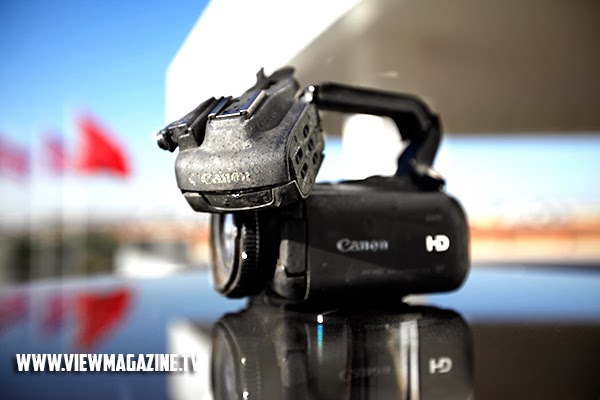
Take this pic above. A young videojournalist is taking a photograph of a camera, but there is a deep history behind this camera. Up close, the next shot shows the scars of the camera.


The camera belongs to the brother of the videojournalist taking the pic. The brother has been abducted by either the free Syrian army or government forces. But on the cameras chip may be clues to this mystery. The scars on the camera come from an explosion.


Carousel 3


Back in London, and the absurdity of segue way from war into the prosaic of music. One evening I was invited into a house of a friend of a friend. If you've heard of living room restaurants or underground restaurants, this is the underground gig.

But there is one significant difference, the host is an Ivor Novella award-winning singer/ song writer. Her friends e.g. Heidi Vogel,  like her fill out huge venues, but they're going local and intimate. Why?


The reason why this is significant and will have a meaningful effect in 2014 is because of what Beyonce did a couple of weeks ago. Friends, fan base, call it what you want, but by going intimate with your friends you raise social to a cool new meaning.

And in the UK, South London, the home of cool, this social matrix will revolutionise the music industry. As one friend, Q put it, why does Jay-z come to London all the time and quote Magna Carta in his records?

When Prince Charles met Prince Jay-z

Carousel 4


We are Social. Some months back I attended a BBC social meeting. Anyone who was anyone in the world of Social was there. Look carefully and you might just spot me.

But here's the question, why is it that most journalists don't have as many socialees as non journo types. OK, whilst some journos have huge followers, I am making the point that there;s something inherent in appreciating social networks that most journos need to unlearn.

Journalism is hierarchical, Social media isn't in that naked way, though by default the share acquires social power. I'll explain more of this in several projects I'm involved in. One of which is working with one of the UK's leading comedy houses to find out what makes different cultures laugh.

Carousel 5


This is the film that started it, back in 2005. The first UK newspaper videojournalists, who I trained and then turned this into a film. Since then, the same methodology has been extended to Egypt, Lebanon, Chicago, China, South Africa and the Financial Times UK.

So what have I learned and what can you learn from the interviews I have conducted?

Carousel 6


I dug this picture up from back-in-the-day. +ILICCO ELIA one of the UK's leading mobile technologists said recently "come back 2007". I took it to mean in 2007, as the industry was in stasis, people like +ILICCO ELIA were turning it upside down. I shot this below when he was at Reuters.

They pushed hard with their ideas, but institutions, Foucault stated in one of his philosophical musings that big business has a way of bending creativity to suit its own needs. He called it discursive formations.


In 2007, I had strong ideas myself and was invited to speak to the ONA about videojournalism. Those pictures were beamed to Time Square.

Seven years later my exhuberance has not diminished, but I am bound by a different type of curiosity. If I thought I knew what I did then the way I do now, my future would be different. In 2014, my PhD draws together. Six years of intense research comes not just from contemporary knowledge, but an understanding of the past.

Wow! One of the biggest revelations was to learn that what we're going through now is akin to what our grandparents went through in 1920. Technology was on the verge of breaking in a big way. It was a carnival of ideas.

If anything between the period 1930-90 could be argued as the destructive in terms of creativity. It's the period when the artisans give way to convention. When the suits came to dominate creativity through structure and finance.

I'll post more shortly, explaining other new structures to viewmagazine.tv

Thursday, December 19, 2013

Reputations - David Dunkley Gyimah


A few experts who have spoken about David Dunkley Gyimah's work.

1.


2. Jon Snow is one of the UK's leading news anchors


jon snow on david from david dunkley gyimah on Vimeo.


3. SXSW is the largest creative gathering, which happens in Austin Texas. Getting to present at SXSW is a rare and huge honour. Here's what some of the delegates said below.


4. NewsXchange is a crucial gathering for the world's news media. David spoke there as a panel. Below is what the organiser said about David's contribution.


5. Invitation to speak to the BBC's leaders.

Dear David  

We are currently organising BBC Worldwide's annual Leadership Conference in October which is aimed at the top 150 senior leaders across the company. We would like to invite you to speak at a session focusing on 'Creativity and Innovation: Creating the Winning Idea' which currently has speakers including Innocent; Ten Alps and Bebo. 

The session will run on Thursday 5th October from  11:20 - 13:30. With your fantastic experience in both old and new media and your insights into next generation TV both in the UK and US, you would be a valuable addition to the panel. Your slot would be around 20-25mins, followed by a 60 minute Q&A panel session in which you would jointly answer questions from our staff.

About the Leadership Group Our Leadership Group consists of around 150 of our senior staff from across our seven business areas: Global TV Sales, Global Channels, Content &Production, Magazines, Digital Media, Home Entertainment and Children's. They are a lively and talented group of people who would greatly enjoy the opportunity to hear you speak and we very much hope that you will find the event interesting too. 


Head of Communications

BBC ( name with held)


6. Four-hour presentation to National Union of Journalists in Denmark


Hi David, 
Just want to say thank you for your performance at VP. The VP-thing was better than we hoped it to be, and all the reactions were more than positive. Danish jouranlists go to a lot of conferences, so they are not just being polite, and they - and Søren and I - were overly happy with your performance. Hope you have time to come again when we do it again this summer?! 

Kind regards,

Martin RamsgÃ¥rd 
Video Play, Denmark (NUJ)


7.  

8.
9.

 10.  Michael Rosenblum is the father of videojournalism


About David

David has won or been nominated for several international awards in media, journalism and innovation. He has worked in the media for 27 years and combines consultancy with his work at university.
This year he is a chair of the jury for journalism innovation for the Royal Television Society. (RTS). The RTS is one of the UK's most prestigious bodies for media, journalism and communications. You can contact David at david@viewmagazine.tv or via tweeter @viewmagazine

You can find out more about David's work from Viewmagazine.tv and this blog viewmag.blogspot.com


Saturday, December 07, 2013

EPIC VIDEOJOURNALISM We Are Syria - International Award Winning Videojournalist describes the process behind cinema as journalism in videojournalism


Filmmaking can often betray a lot of ignorance.  It is a language not in itself, but because its language has been created by remarkable people. Metz said this more eloquently.

In my six-year PhD, backed by interviews with experts including the great Robert Drew,  I'll explain some of the historical techniques that have shaped one of the most recent film forms - videojournalism.

I'll explain how in fact it is not new, but has the potential to be. I'll take you through different film making knowledge based on ideologies from different countries and demonstrate how we can be EPIC.

I'll prove how the industry intentionally reworked videojournalism into a traditional model to suit their needs. I'll show how audiences respond to the original forms of videojournalism.

This film, We Are Syria is about 15 extraordinary Syrian filmmakers. They are extraordinary because they are the hidden faces behind the news you see from Syria.

They put themselves in harms way to create films. Many have been tortured for what they do and do well.  And many would like to tell you what it means to be them. I was with them for a week near the Turkey-Syria border. In itself that is a story, but for the meantime here's the trailer We Are Syria.

The film is being made to be published by a potential international media publication. Any offers, meanwhile, will be welcomed.


About David
David Dunkley Gyimah is an international award winning videojournalist and Knight Batten Winner. He has been a journalist for 25 years working for BBC Newsnight, Channel 4 News and ABC News in 1994 in South Africa to name a few. Some of his work has been in  hostile territories. He completes his PhD in the future of news in 2014. David is behind the award-winning cinema journalism site  Viewmagazine.tv. ,This year David is chair of the jury for the RTS Awards into Innovation in Journalism. The UK equivalent of the EMMYs.

Pic below David's presentation pics beamed into Time Square from NY conference.


Thursday, December 05, 2013

Nelson Mandela - The election, the fight and the resilience of South Africa


South Africa's finest hours: Nelson Mandela is free, Nelson Mandela is president. 


Between 1991 and 1994 I was based in South Africa, Johannesburg (Yeoville). I first visited the country in 1991, whilst working as a presenter producer on BBC London, where I interviewed South African embassy officials about Apartheid.

These three reports detail some of South Africa's finest hours involving Nelson Mandela


The inauguration of Nelson Mandela. It was electric. The whole country came to a standstill.


Violence grips South Africa. The Townships e.g. Soweto has become a conflict zone between ANC and Inkatha factions. This a report from Jo'burg and Durban on the violence. Its scary!


In 1991 I report for the BBC's internal magazine, whilst coming back to the UK to work on BBC Reportage.


It could have all gone wrong . Working for ABC News as an Associate Producer and freelancing for the BBC World Service a bomb explodes on the eve of South Africa's election. Could this be the ene of the dream?

David Dunkley Gyimah reporting from South Africa 1994 - on the eve of their historic election


Right wing groups attempt to destroy the elections. A bomb explodes in Johannesburg, killing people.


South Africa circa 92 - a pending election brings political violence to the front Nelson Mandela Tribute Concert 1990 Wembley - BBC Report with Peter Gabriel, Natalie Cole, Anita Baker, Neil Kinnock MP and Nelson Mandela.


South Africa keen to attract foreign investment hosts US secretary of state Ron Brown and delegation. The backdrop was the ANC's perceived anti-capitalist stance to business.


How doctors are travelling to South Africa for work. One of many reports from rural South Africa for the BBC World Service


My most memorable. BBC Radio 4 commission a one hour documentary. I call it the Successor Generation. It becomes the only international documentary report bought by the SABC and played on the eve of their election.  It features some of SA's emerging talent who are voting in their first election.

I will post that as a special tomorrow.

Sunday, December 01, 2013

Journalism's ageing and decrepit profile - Knight Batten award winning journalist and senior lecturer presents a future


We hold certain immutable rules about journalism upheld through its long and well documented history. Those rules mean something. They separate gossip from fact, or hearsay from the industrial application of journalism's art.

Before the Internet, when a fixed number of channels informed us, they were sacred. Audiences learned that TV journalism stations in Britain  and in the US were exercising a form of writing and broadcasting that was a bit like the legal system is fixed.

If you're a student or a professional you will undoubtedly be told to learn the laws of broadcast television. How to film, why to film, what you can say and so on. Intricately fixed with this regime is broadcast news philosophy.

It's exegesis appears entrenched: we might argue the toss about what objectivity and impartiality mean, or whether balance constitutes fairness, but we accept we need these qualities to make journalism function efficiently and fairly.

We need these systems, just as we need directions for which way cars drive down a street, or that you buy a ticket before you board a train. Systems create order, minimise variability, allow us to make sense from right, wrong, what works and doesn't.

Journalism holds to these equivalent immutable laws. However, something's broken, something's not working, something's fighting against the current status quo, and we're not sure what it is?

Some blame digital and its tools. Others the business model that underpins journalism, and others still to use Ayittey's phrase the cheetah generation out to do in the hippo generation. It would not be unheard of to accuse the cheetah's of being intemperate or seeking to challenge authority at every whim.


Videojournalism Training from david dunkley gyimah on Vimeo.


Every generation has had its cheetah's since the cheetah proper roamed the earth.  The 60s, the 20s, the whenever. When the Russians drove their film industry under lenin, Vertov, Pudovkin Drankhov were all young. Doublier who travelled around with the first camera to record moving pictures was 17.

Yes something's broken, something profound, which digital exposed, and cheetah's found favour with. It's become plaintively clear in a transparent environment that the business of journalism was ripping us off.

We spend this for a newspaper, that for a subscription to a broadcast networks' news, when the CEOs were inflating their costs to buy their villas and yachts. Though the latter, is a rarity amongst the pragmatism in journalism.  But how do you put a price on journalism, just as how do you put a price on art!

Yes its broken, because it was never fixed. That doesn't imply a flaw or fault line in journalism, but that it was and is a human construct bound by principles that worked during periods when all agreed and turned an obvious blind eye to its inadequacies.

The art of storytelling to tell factual stories was always someone's version, but if that version was given by men and women of high value, it was considered immutable, the truth, IT.

Whilst others could be mendacious with the truth, journalism eschewed this. Honour, integrity and impartiality reigned. But here's the problem, with all the greatest human qualities just mentioned, someone telling a story, is that still that someone's story.

And if there are opposing subjects in the story, there will always be a point of view that someone, as much as they tried to will be anaemic on the one hand and stronger on the other.

Journalism is a bit like a dictator state being held together by a heavy hand of the state and once the heavy has gone, the minions start to interrogate and see what was wrong. That is not to suggest that journalism is corrupt.

No, journalism is a noble and honourable profession. It has provided me with experiences which have been richer than any other profession I can contemplate.
David Dunkley Gyimah in 1999 as a videojournalist using a two camera shoot, London. 

One minute I am with a throng of journalists interviewing Mandela. Next its Quincy Jones. Then it's the former head of the CIA and then spending time near the border of  Syria working with some of its cheetah journalists.

Whats happened has been a gargantuan shift in societies understanding of storytelling as defined by news. This is no secret ergo the hypodermic needle theory. the post structural approach. What these told us was that societies change and by their interaction with news making yield a new model of association.

What's happened now, particularly from the Net, and in areas of academic and industrial scrutiny is that news and they way it was defined, can no longer stare bare faced at its audience and proclaim a truth which is based on the tenants of old.

The most powerful of all story forms was and is cinema. Cinema is to the moving picture what art (paintings particularly) is to the static picture. Yet the most powerful of these forms presented a gnawing dilemma for the founders of news.

Anyone alive today, without reading the history of news, sits on shifting sands when they proclaim the sanctity of news. That is, it cannot, will not, does not, change. From the 1700s Addison and Steel and Daniel De Foe, it did.

David being presented award at the National Press Club in Washington DC for Innovation in Journalism - Knight Batten Awards

Within each generation it has wrestled with the internal machinery, but the system was maintained because it still worked and there were no uppity cheetahs outside of the system that could speak and be heard about the system's failings. There was no Net to disseminate wider understanding. But share a thought for the Italian Futurists at the turn of the 20th century.

They too were cheetahs. We know about their exploits. They made an impact, but it was limited by the power of broadcasting to others.

Imagine if in the 1920s radio became a synchronous communication pathway. It didn't, but imagine it was. It would be a system a bit like the Internet. Where then would have journalism been during its nascent stage of development as an electronic media?

The power of cinema in journalism
In the 1900s Russia influenced by the French launched their industry of cinema. At the beginning, it was factual referred to as topicals and actuality.  When the Russians came across Alphonse Daudet's play L'Ariesienne ( The Girl from Arles), the name of the game changed. It's the early 1900s. Dramatic cinema is about to make a firm play and become an industry in cinema.

Some resist this. In the West the label documentary is about to be born, but the Russians, particularly Vertov stick by cinema - a coming together of emotion and fact.  But it represented a unitary vision of one person - Vertovs. In the West, this was a dangerous premise. The idea of owning a You Tube account, if that were possible in the 1940s was propaganda waiting to happen.

The state needed to control this way of communicating when it could influence many.

In Vetov's world and for a while Alexander Drankhov cinema had little to do with the theatrical plays or dramatising events. The drama of life was cinema. There is a promotion video on the BBC which ends by saying sometimes fact is stranger than fiction.

Yes this is cinema par excellence. The ability to take an event and arrange the raw material so it works like drama is something the Russians held to, and that new filmmakers have revived. Can you remember the fuss over Michael Moore's early films when critics argued that the temporality of events had been changed. A followed B followed C had been corrupted so C became As followers and the B emerged.

This was one person's vision. Cinema like art may have a collective behind it, but it is attributable to the the visionary. The visionary listens to a team of experts, but she must give the nod to this collective contribution. We shy away from the word auter and I neither seek to resurrect it, but to say that cinema shares with all those who practice it an authorship, a particular point of  view, is paramount.


When we witnessed the birth of videojournalism, which has many names and idioms, we were embracing the idea of the author and cinema.

I create cinema. Yes I do! I have said this publicly at many events, such as journalism.co.uk SXSW and the BFI. I don't have to evoke the spirit of Vertov, and neither do I need to align myself with a tradition of documentary making.

I use the visual and the aurality of the event to create something that is factual and objective, but it is my subjectivity. By the way this is not tautology. You can be objective and subjective at the same time and in my lectures I demonstrate this. I maintain my objective position is without rancour or intentional prejudice.

If an elderly woman is crossing the road unaided I will help. I work in an industry whose purpose is to expand our horizons and mind - academia. But I am a practitioner too so these are not airy fairy ideas.

These are foundations by which journalism was shaped or abandoned at will. I can give you 10 reasons why news journalism artificially ditched cinema. It worked then, but does not work now.

And that now needs to be looked at in greater detail. We have entered a period of great understanding. We suppress these ideas at our peril. Or saying that it is time for the cheetahs to leave hippos on the barren plains. The Net in a couple of years will truly expose these faltering lines.


About David
David a lecturer and practitioner in media making and management. He is a chair of jurors at this year's RTS Awards. He completes his PhD next year in future media. He has 26 years media experience working for some of the world's leading media. Find out more on his website viewmagazine.tv

Sunday, November 24, 2013

How to spot innovation and a television winner


And the winner is?

To the left of the RTS emblem a jury convenes to award practitioners in the industry the coveted statuette and moniker RTS programme of the year; RTS journalist of the year and so on.

As awards go, the RTS is television news' Oscar or to be more precise EMMY. You'll notice it on ITV's continuity, or the end of credits on Newsnight or Channel 4 News.

Major awards bring recognition from within the industry,  and outwardly to sponsors or potential employers.  You may thank the whole of the team when you receive an award, but in reality, quietly at home, you'll do a jig, look at the statuette and mutter "Mum I have done it !".

Then your partner tells you to take the rubbish out, the bin collectors are coming.  I chuckled when I heard a golfer say how his partner brought him back to earth after winning the Masters.

Back in TV land, the RTS are a couple of months away.

Digital and Social Networks have made the awards particularly in the innovation category interesting. Last year Channel 4 won the award for its disability reportage campaign. It built a seamless number of programmes connecting studio interviews with transport executives,  and commuters with disabilities who had to wrestle with London's inaccessible transport. The whole idea started on Twitter.

One year, The Stream from Al Jazeera was the victor. Youth TV tackled weighty issues by combining an array of digital tools. The look and feel of the show mimicked a make-shift studio in a student's home. It worked. The next year, The Stream, 'upgraded' the show. It now looked like any other broadcast.

What makes an innovator show or idea? There's a criteria the jury adhered to. But how do you judge evaluate something within those parameters?  In many ways its the same criteria as an academic I would use to evaluate Master's work. The context though is different, but the cognitive approach is similar.

This year I am chair of one of the jury panels, so I'm thinking of detailing the cognitive procedure within the decision-making process of analysis and evaluation. I can do it this year because I'm not actually going to making my views known in the jury procedure.

The process may appear ad-hoc, but the it brings together a series of interpretive schemas and rationalising - the study of signs. Cues, patterns, themes, rhetorical arguments... we're not aware we're making them, but they constitute the body of evidence that we use to analyse programmes.

And the process of analysis is dependent upon social and literary values. So what might be innovatory now, many not be tomorrow. Let me know what your thoughts and whether it would interest you as a post. I'll trace winners from over the years and why they won.

David Dunkley Gyimah as a previous juror at the RTS Awards


BBC's Hostile Environment training for journalists - a review


A feature length of this article is being considered by a popular UK news website.

Be prepared to die.

It doesn't get any blunter than that. Last thursday I attended an event at the BBC - possibly one of their best open fouum for journalists.

The BBC could have packed in the nation's aspiring journalists, but on the day a mere 200 plus had the opportunity to gather in new broadcasting house's radio theatre to learn about hostile environment reporting.

And that's where the BBC's MIddle East editor Jeremy Bowen made the remark: when you're going out on a foreign assignment consider the fact you may not return. So why do it then?

The adrenalin rush, making a difference, you'll never experience anything like it, was the response.

This was grim, but poignant advice for would-be journalists in a digital age where the dangers of reporting have become all too apparent.

Analogue versus Digital
David Dunkley Gyimah reporting from South Africa 1994 - on the eve of their historic election

In South Africa (92-94) as a journalist in the analogue days, you went into a hot zone, reported and got out, or headed for safety. Digital, said one of speakers, has led to an increase in workload and the reality that you end up testing your luck in the zone.

I still multiskilled: worked for ABC News (TV), made programmes for South African independents (TV) freelanced for the BBC World Service (Radio) write articles, but it wasn't relentless to the point of having to stay in a hot zone.


The inauguration of Nelson Mandela. It was electric. The whole country came to a standstill.


Violence grips South Africa. The Townships e.g. Soweto has become a conflict zone between ANC and Inkatha factions. This a report from Jo'burg and Durban on the violence. Its scary!


The problems Today
So far, for a number of different but connected reasons 35 journalists are missing in Syria. Reporting from the region or any other conflict zone has spawned an underground digital reportage industry.

If you're lucky you'll make your name, if you're not, you've become another number. This was the sort of discussion that the 200 were privy to.

I'll report on this in more detail in a post for a publication that reflects my career reporting from hot zones, as well as more recent work in September 2013 working 3 hours from Kilis on the Syrian border.

I'll talk about my motivation and how the lack of black journalists getting breaks irked me. I have done things therefore when I was young to prove to myself and critics who were less prone to hire people from minorities.

I'll also reflect on how that has spurned me on, and my ambitions to correct a narrative in journalism, specifically videojournalism,  that requires reevaluating. The results thus far has rendered videojournalism  anaemic. That's the subject of my PhD.

Then I'll round up with my experience as both a journalist and academic, how the next generation could strengthen their involvement in a journalism of empathy, affectivity and cinema.


David Dunkley Gyimah is an academic and journalist.

He is a chair of the jurors for the UK's RTS Awards - the highest awards in the UK for professional television journalists.

Go hear for more on his background covering conflicts in South Africa etc.


Sunday, November 17, 2013

The Lone Videojournalist, has ended - Next its the Super Collaborators.

For sale - the serious side of me
By David Dunkley Gyimah connect on Google 


I have put myself up for sale - a risque move amongst those who will fail to see the point.


Awww! Do I really need to spell it out? So, like, I'm not selling myself, but my attributes, which obviously come with me. So yes, I'm selling but not in that maladroit way.

But I am making a finer point.  If you're the uber digitalist working alone? You shouldn't be. Collaboration is about to get supertanker big, or at least if trend extrapolation is anything to go by, it should.

The videojournalist, YouTube loading, self-twitting individual is dead!  Here comes the epic collaborator. Let me explain!

The title of this post then is a reworking of French philosophers Barthes and Foucalt's insight into the author and imminent death of the author.

Having found their voice in the renaissance, the concept of an author marking their work with a distinct signature had waned for these two towering figures.

Barthes main point was the moment you attach authorship to the text, you limit its potential.  It may sound existential but what Barthes is getting at is to remove the identity of the author and in many ways enjoy the product for what it is, not the name of the person.

Would One Direction's Best Song Ever, be a great song, if you didn't know it was One Direction?  Er don't answer that nearly 157,000,000 have. Barthes obviously wasn't thinking about Boy band branding.


For Sale. I can do the work look. David filming on the Turkey side near the Syrian Border

The Author
However, authorship or identity is a difficult thing to achieve. As Focault noted, everyone can write, but not everyone is an author. Similarly, and this makes sense  - not all twitters, videojournalists and social networkers are the same.

But there's a broader point and its the economic scarcity principle that provides an alternative argument to the death of you, the lonesome twitter dancing, You Tube uploading, Instagram mover and shaker, author.

The more something becomes available, the less desirable it become. Its price, the level of entry removes its mystique.

If you remember the frenzied days of 2000 to 2005. To blog was to becoming, to video was to look venerable. To tweet before anyone else had (circa 2007) built you a loyal following very quickly and was considered outstanding.

David's name tag presenting at SXSW. Austin Texas, about videojournalism and social.

The room all of a sudden got very busy, and very crowded - all for the right reasons. Because, now we're hearing from people whose views could outdo guests on David Letterman or strip Paxman of his king of the media jungle label.

No! Even if you had the world's foremost 500 brilliant people to listen and follow, when does your life begin?

Sea Change in Education
The change from the individualist to a collaborative group happened in education about 2005, albeit implicitly. Lecturers woke up one day to find Gilmor's aphorism of the Wisdom of crowds staring them in the face.

Now, for the first time in public, the combined intellect of a wisdom of crowds of students congregating on Facebook could challenge the pedagogy and authority of the academic. Few institutions had an answer, rather than roll with the punches and devise new methods, the ostrich scenario dominated.

Many educational establishments survive because of their analogue knowledge [see last post]. Some provided a glimpse of new working-educational practices to match the sign of the times. One of those has been a government-run programme called KTP.

The knowledge transfer programme  (KTP) sees a recent graduated hired by a company to drive a project and mentored by an academic. Er, I happen to be one of the KTP advisors.

Meanwhile back in the industrial world, the notion of the videojournalist, twitter and You Tuber being dead then can be viewed as an inevitability. It comes with the dynamic swings and roundabouts of society. Societies change and when they do their needs alter.

One minute in the 1920s the film industry said it was about collaboration. Next thing in the 1960s the French said it was about the auter, then years later we tired of the self-publicity seeking auter to go collaboration again.

The difference today is we're living out decades in a matter of years. Years have contracted to weeks.

The new Authors
Tarantino, Soderbergh, and Spike Lee may sound like they did it themselves when the film trails " a Tarantino film", but even they know it's a collaboration between many workers and that only a sleight of hand seeks to reward them as the progenitors.

The film industry is a good barometer in how to respond to the market place. It is one of the most durable industries second to the arms exports in the US for the money it generates. Throw as many invectives at the studios as you can, they're skilled in the warfare of driving their businesses.

If you were to note an overwhelming change to the movie world in view of the social, digital world of everyone-can-do-this, it's been about raising the bar to a level of super collaborations.

World War Z ( read Rosenblum's take on this) Avatar, The Great Gatsby...Films, have gone epic. The list of collaborators is the size of a small country and eveyone is a winner.

There's evidence of this success in journalism. 18Days in Egypt,  Storyful, and these little known about digital student class in India generating digital heat by bringing everyone together.

Collaboration isn't a new thing.  Ask Brian Storm of Media Storm - one of the new agencies in digital media which is blaizing a trail.

Also, Viewmagazine.tv - my site won it awards for its collaboration, as did another project called the Family, coming second place at Channel 4s Digital Awards.  It's just that collaborations this time has a more visible value in a market where so many people have the same or complimentary skills, and you don've time to read what 500 people continually say.


At SXSW when they said do Epic, they weren't kidding. Now its super Epic
Size matters! Size and quality makes for an even more interesting mix. Admit it, when Michael Fassbender, Penelope Cruz, Cameron Diza, Javier Bardem, Brad Pitt and Rosie Perez are appearing in the same film - and think of Pacinno and De Niro being featured too, that's epic.

So I am for sale, and you should too. For the potential of the outcome to do something epic. I have done a few, but time to raise the bar.

One aspiration I have is to be involved in a new type of university that marries multi-disciplines in a way that we've far from accomplished at the moment.

And lets start it off in Africa, Ghana, where the difference would be palpable, otherwise I'm good anyone else. email David@viewmagazine.tv


Read The theory of videojournalism - one of the site's most popular blogs.


David Dunkley Gyimah  presenting at the ONA NY relayed at Time Square. David is a senior university  lecturer completing his PhD into a future of media. He is an artist in residence at the Southbank Centre. This year he is a chair of the UK's foremost television journalism awards The RTS.

Thursday, November 14, 2013

Viewmagazine.tv's David Dunkley Gyimah laments the lack of digital thinking to analogue problems


By David Dunkley Gyimah connect here with him. David has worked for some of the world's leading news outfits. He is a chair of the jury panel for the Royal Television Society Awards, the UK equivalent of the EMMYS. 


I'm planning on going back to Ghana at some point. It's where I was brought up in secondary school.


It's also an area, which is flourishing with new ideas and opportunities. Many of my friends whom I shared time with growing up have either gone back or are planning to do so.

Many of them have made an impact and for some it’s gone disastrously wrong. In the latter case it's for all sorts of reason, but there is a convention that I wish to share that helps us understand one of the main reasons, which is closer to your home. 

As a lecturer, I’m intrigued by three areas of making sense out of things.

  1. common sense
  2. learned sense
  3. and deconstructed sense.

By common sense, I mean what we use to complete tasks by some basic common knowledge. How you email, how you like a friend's page on Facebook. You're almost expected to know, even though at some point you had to learn the process.

Try this exercise! In a room full of secondary school students, ask whose done anyone of those and you get a flurry of hands going up. 

Learned sense, yes it’s not a word per se, but it should be, is something you’ve had to learn. You actively engage it. Do you Pinterest, data scraping, create cinema? All of the sudden only a few hands are left in the air.

You top up your common sense, which is more cognitive (invisible learning) by actively learning. 

For instance everyone can read and comment on a film, but few people know how to critique a film based on implicit or symptomatic readings. So, John Lewis' cuddly animation of a paternal bear is not about Walt Disney type animation,  but a clever attempt by one of the UK's leading consumer's to let you associate nostalgia and sweetness with their brand.

i


How common sense is defunct
Thankfully, the common sense way of doing things in the media, the analogue approach is still widespread. We might live in a digital world, but even if you were Sherlock Holmes you'd be hard pressed to find digital's DNA way of doing things after a full day's snooping. 

Digital may purport to bring us closer, contract the world through eroding borders, but in making us digital penpals what are we doing with it that signals a change in cognitivism.

Twitter lets me know what my friends are doing and what did I do with that info? A digitised world, without a digital revolution.

Here’s the rub, if you are at college and the person delivering knowledge comes from the common sense, analogue world, then you might want to think about how your future is shaping up.

Television’s continued dominance stems from this integrity of the analogue. If the media is the message, then digital turned out to be the slave master of analogue, because digital hasn’t changed the message. 

It’s quickened it, even given it wings to fly off in all directions, but a bit like putting a Ferrari shell on a mini engine, who are we fooling? It's still the model we so love and subscribe to nostalgically - just like the Lewis commercial.

The deconstructed sense interrogates common sense and what you’ve learned in an analogue world. The really innovative managers have it. Whilst other executive return from a conference and buoyed by what they’ve learned at a social network festival command their staff to implement a social policy. The justification is someone else tried it and it works.

The deconstructed ask about phenomenon and why it works. What is it that digital could do to create a new fabric of knowledge flow, to create new solutions to old problems, to reframe common sense and what we’re learning in our quasi-analogue and digital ecology.

Take the calamity from Typhoon Haiyan. Another typhoon, another human tragedy on a large scale, and our analogue response is near enough the same.  Russell Brand was right about politicians and the complicity... well it envelops media as well, you could argue.  

From a response and communication position, having read, seen, and even is cases witnessed porn-disaster - the gratuitously well-made up correspondent selling voyeurism of a hapless people, is this still the media response?  

It's much of the analogue same; this is not the media’s fault. We’ve gone digital might be akin to a flat screen television, higher fidelity, and green screen, but the social dimension, and I don’t even need to use the word “social”, is wanting.

Is the notion of reportage, which is just over 50 years old in television, so immovable that in 2013 we’ve not been able to devise an alternatives to address, in this case, human suffering?

Not our job, the analogues with common sense will say. But that’s precisely the problem. Any one who deconstructs the status quo knows there’s something wrong, but the source of their solution comes from a place, which is itself deficient. How could a digital thought process look at this recent tragedy? Here's a scenario.


A digital solution to one major problem.

Reporters get to the disaster scene with their equipment. No aid agency is present yet. Their feeds first go to a coordinated response of the Disaster Relief Agency. Survivors on the ground are handed 'pennys'. These are prototype transmitters and cameras. V. Cheap. They connect to a crowd map similar to Ushahidi, which combined with Touchcast [see previous posts] gives control over to viewers. Correspondents curate the info flow.


What is the Ushahidi Platform? from Ushahidi on Vimeo.

The Philipines is digitally mapped. That technology and process already exists through the military. A series of mobile - make shift outernet systems are implemented [ see apple presentation]


Matched across different territories e.g. Hyde Park, Times Square and strategic locations in the Philippines citizens can openly communicate with each other. The Philippines is digitally mapped to give the impression how the disaster would look like in your area [see wag the Dog - the Sarajevo scene]. This creates empathy.

Students learn from students in Philippines in adirect contact exercises - a new form of empathy journalism

The whole event is scheduled into an educational module - "Digital Responses" facilitated by the Disaster Relief Agency. School children, universities and business's around the world have access. How do you solve such huge intractable problems? This involves a new form of empathetic ( digital) journalism. It is cause and effect. How do you use journalism to uncover a problem, then what do you do to help?

You can even pick your doppleganger – someone in the region who shares your same birthday and likes by data scraping medical records from the cloud.

School Children talk to other school children, university PR and journalism courses to Philippines equivalent. Everyone maps out different solutions accordingly. One major feature is the game theory approach. Mobile copters provide further images, the feed from Philippines is costing you one cent, but once you get on board, you can set your own tariff, which is money paid to help survivors.

Using similar tokens in Moshi Monster e.g. price card, users pay to be involved in the real life exercise. Payment is direct to survivors. which users control. But by doing so you’re explicitly paying to the relief of survivors.

The whole event is paid for by philanthropists, so there is no conflict between analogue rules of objectivity....


David Dunkley Gyimah in Ghana

David Dunkley Gyimah with US Special Forces in Ghana circa 1996. David is a senior lecturer and International award winning videojournalist. This year he is one of the chairs of the Royal Television Society Awards. His PhD he is completing looks at digital and news filmmaking.  For more on David's work - all on one page go to guidelines videojorunalism.

Postscript
Channel 4 News twitter response which led them to look for a family stricken the typhoon was an example of a digital response.