Saturday, March 30, 2013

Understanding changes to 21st century media, journalism and videojournalism


How artistic practice played a role in BBC executive interview Peter Horrocks for a Vlog Butterfly

You're a student journalist, a traditionalist, pragmatist, entrepreneur, or media dean of a university. Everyone tells you journalism is changing - even your three year - old niece.

Listen out for the upcoming series on News on BBC Radio 4 next tuesday.

Largely, and I haven't heard the contents of the BBC programme, but gurus of the media attribute changes in news to digital, some to social, others to a generation of news consumers having different brains, or even blaming climate change - who knows?

Their reasons aren't necessarily without some truth, but as a former broadcast professional, still practising video journalist/ designer/encoder and filmmaker, an educator/trainer and consultant, I have wrestled with the question.

The question: how the journalist is changing and her impact on pedagogy? By that I mean how the rhetoric of her argument is grounded in academic rigour and research as well as pragmatism.

But the question is itself vacuous and irrelevant were it not for its prompter. That prompter says how do you know what you know?  How do you become knowledgable and deliver information that is truly relevant to others when:
  • There is a sea of information you could drown in. So how do you access the appropriate bits?  
  • Public bodies and private companies conceal information that is highly relevant to citizens and if we could find these it would enable us to make meaningful decisions.
If the people of Cyprus knew of the EU's raid on their banks beforehand, would they have acted differently?  Did Rumney's view of the electorate, made evident from a secret recording, contribute to image as a potential partisan president? Does this article provide any intent so far about how relevant it could be?

Conflict of ideas
But first the conflict. The one experienced by mediast and parties in this field of enquiry, which is a perennial one. If you're a lecturer,  student or journalist look away now.

Practitioners, the argument goes, with years of experience in the industry will give you a real world account of the media and in the process pour scorn on the codswallop of the theoreticians.

Meanwhile, the statement you've also encountered is that the theorists who have been engaged in deep joined-up thinking develop sound knowledge of the media ecology and thumb their nose at those practiced-based luddites.

The divide between the two is so defined in academia they occupy different departments. I claim no special status in this debate, but I do make a claim to understanding both sides. As with most things in life, a little bit of the other would not be a bad thing.

The changes I express, as both a practitioner and theorist, is presented as a many-media presentation on viewmagazine.tv.  It's been a joy putting it together and given its organic nature it will grow and in the process overwrite most of the articles on my site. Here goe's then.

The image as it appears on viewmagazine.tv will be accompanied by the html text, making it easier to read and is an edited version from the one found on viewmagazine.tv

Presentation


1. 50


1. WHAT'S THE LAST VIDEO NEWS YOU WATCHED AND REMEMBER?
EXACTLY! IF IT REALLY WAS THAT IMPORTANT HOW COULD YOU FORGET IT.

Mainstream news storytelling uses 50 year-old values and processes  to produce its content. And whilst you may think you've seen changes,  a 6-year PhD study conducted across the world shows the biggest change is on its way.

Also, how pivotal artistic practice is to communicators and business.


2. PANELIST DAVID TALKS AT ONE OF EUROPE'S BIGGEST JOURNALISM GATHERINGS, BARECELONA.

If you think you're creating news, then today you're thinking the wrong way. The reason is the definition of news is so immutable as to discard many things that have value. A documentary can be news. A tweet can be news.

So, you're creating stories, particular meaningful types of stories, that are actionable and have a high value for the end user.

And those stories framed under journalism are, says Michael Schudson, a cultural construct, dependent on societal changes and literary traditions.

When one of those variables changes e.g. culture, the story form re-adjusts to these changes. It changes.


PHOTO MOVIE

The story of the first 100 Days of US President Barack Obama, told as a series of powerful stills to a live orchestral score, written and conducted by composer Shirley Thompson.

The film was produced overnight, with the kind assistance of White House photographer Peter Souza who directed me to the pics and my friend former Washington Post Video Editor, Tom Kennedy, who provided the contact. It was screened at the Royal Festival Hall, London.

Influenced by Chris Marker's La Jetée, "Obama's 100 Days" plays on art historian Ernst Gombrich's aphorism that all art [media] forms are variations of the past.

Innovative story forms trade on this ethos, so the Sound slide that blazed across the net was nothing new as I explained presenting at SXSW, Austin Texas and Apple Store in London.

APPLE STORE, LONDON


Digital as a phenomenon is the physical manifestation. Ones and zeros replace analogue in data transmission. Yet, there is an underlying causality that comes from innovators wanting to do something different.

Take film directors, Ang Lee and James Cameron, both created new technologies that assisted them in creating their dreams. Technology then becomes the enabler re-feading change.

Videojournalism is another example. It arrived before the digital explosion, but the group who pioneered it already had grand plans. How do I know?  I was fortunate to be part of that wave.


SOMETHING THAT HASN'T BEEN DONE IS WAITING TO BE DONE  (ARDEN, 2003)

Channel One circa 1994, 24 people chosen from 3000 to pioneer something called video journalism. So, what was it about those 24 that enabled them to take on one of the most challenging, but innovative jobs in the media?

The Internet wasn't public yet, but we were all made aware of what lay ahead. Videojournalism back then was different in many ways to the one you probably know today. To understand this, is to dwell into something the French philosopher Foucalt referred to as 'discursive formations'. I'll be presenting this to Denmark's national union of Journalists again in June 2013.

There are different points of invaluable contact in any data interpretation. Broadly, just before something has begun [the nascent] which means focusing on the surrounding environment, after its started [inception],  and then years after its matured [growth].

Most things need time to mature before its possible to frame a more meaningful longer trend analysis and that's what's happened here. Now those cues begin to yield amazing data from once unsighted DNA, which is extrapolated to map new digital trends and future story forms.

Today, from the former Channel One group, you'll find award winning authors, A BAFTA winner, an MBE, several stars of the BBC, and er, me!

Want to see what Channel One looked like? Click viewmagazine and goto page 5.


Whether its interviewing CEOs and VIPs, such as R. James Woolsey, Director of the CIA (93-95).


Working with the Heavy weight boxer Lennox Lewis at his filmmaker, designer and writer, fighting the likes of Mike Tyson.


Or collaborating with World Press Photographer winner Yannis Kontos on his ceremony acceptance film. The approach to these and varying projects is underlined by a particular philosophy


Artistic Practice
It may see obvious to call this dancer an artist, but she had to learn to use her body to communicate, to tell a story. 

This short film I made demonstrated how various groups of young people abandoned 'technical competency' within their disciplines to go further, deeper into uncharted collaborations. This understanding elides with what Heiddeger calls phenomenology.  

Others may euphemistically state you must be able to "think outside the box", but anyone who is familiar with Johari's window, of known knows, and unknown unknowns made famous by Rumsfeld, will know you can't think outside the box, if you don't know what the box is in the first place.

Artistic practice describes the overarching method of enquiry and interrogation deployed by the individual who assimilates varying number of interests to build knowledge and enhance their practice.

If you still think that defines journalism, the major difference is the lack of a conventional approach or what I would called 'traditionally framed' approach that's required without breaking any laws. There is no specified routine, or  definable route to problem solving, but many that undertake different perspectives.

It is not a quick fix panacea, and artistic practice is difficult to define, otherwise there would be many more Truffaut's, Picasso, Spanish football teams, Ed Murrows, and Darcey Bussel.

The Spaniards afford one of the best examples. Everyone in the beautiful game will tell you how you ought to position your line up: 4:4:2, 4:3:3 then the Spanish football team came along reworking a new style called tiki taka.

Now instead of playing in a rigid traditional formation, the Spaniards were playing as if they had 10 forwards, 10 midfielders, or 10 backs.

Artistic without the Art


Masters Students reacting to artistic practice in learning to self critique


You do not have to be an artist to be engaged in artistic practice. But it's interesting, how many journalists when asked avoid the term art for its presumed pretentiousness. Furthermore, artistic practice is not taught as a core subject in journalism schools.

If anything the value of artist thinking is so minimised that its arrested before we enter secondary or high school.

Artistic practice too is so individualistic, though you can teach people the skill to begin to understand their own artistic temperament, that you cannot separate the practitioner from their art.

I regularly engage in the practice when I'm lecturing Masters students, often saying to them it is not the marks and artefact, but the problem-solving state, the art of self-critique, and meaning-making by looking to other disciplines. 

So, I'm a creator of videos, either earmarked as news, promos or documentary, a designer, a journalist who's reported conflicts and interviewed CEOs and executives e.g fmr CIA boss R. James Woolsey and I have created creating multinational projects, a deeply embedded artistic practice is core.

But you also don't have to have a fixed discipline; it's the approach and the real problem identified is that its not a method that is taught or encouraged when we go also nothing of the above. I'm not a videojournalist per se, but artistic practice provides the room to do things innovatively

David Dunkley Gyimah completes his PhD this year examining the corpus of story form. His research has taken him to the following countries where he has taught and gathered data
  • China
  • Sheffield Doc Fest
  • BBC/ BFI executive meeting
  • Presenting at SXSW
  • Training in Tunisia
  • Training in Lebanon
  • Presenting and training at Chicago SunTimes


-
Next post - understanding the unnews
How artistic practice is crucial for journalism and businesses.

Sunday, March 03, 2013

The Human Cyborg, Videojournalism, and laissez-faire

David in Tahrir Square February 2013

I'm often amazed at the number of videojournalism courses or documentary courses I come across, which attempt to neatly package these various media forms. 

Often they're littered with dogma, offering quick and easy solutions to a dialectic language that is anything but simple. When I helped set up the Press Association's videojournalism programme that would train legions of regional journalists from 2005 onwards, this was a primary concern.

There is a fundamental reason for the lies of a quick fix. It mirrors film making at its inception when the camera's scientific purpose, its ability to capture an image was paramount for Lumiere and co, and furthermore the commercialisation of the process trumped any aesthetic representation.

To make money from the process charlatans learned to deliver an intoxicating ikea- assembly formula, which appealed to its recipients.  After all how could they make a living.

This, however, obscured the wider point. Telling you how to do something as the only mode of comprehending film making obfuscates the discourse of this fantastical medium and its ability to invent language.

In essence teaching videojournalism, documentary or film making is not a formal process, but an artistic one. It resides in the power of thought, in the lecturers' ability to stimulate how you think and for the students rationale at refluxing those thoughts, returning them with interest.

Behind every great director of filmmaker you've ever known lies a student once who pursued the craft with an intense curiosity.

In Detachment (2011) Brody's character,  a supply teacher to problematic children sums it up when he says, If I give you the images, where is your power of thought.  He adds you need to be constantly assimilating knowledge.


Dampening our senses

That's problematised because we've entered the era of the cyborg, the human cyborg, not a computational being of prometheus power, but one which requires an ecology of byte-size command signs. Here, quick fixes, gibberish and physical tasks mimick heroine's quick hit as the norm.

The power of thought is reflexive and in generations to come, 140 words, a singular manipulated image, and a point-and-shoot camera will probably give room for nothing else. It's not your fault, that's technological progress of sorts.

But if those that teach negate to tell their charges the other world, the one which offers an alternative deep richness that require meditative attention, then we have wronged a society. Bordwell captured this as the implicit (hidden) meaning lauding Hitchcock as the master of thought-film.

In Cairo, while addressing the Arab league summit, this was my message. Film communicates to us in a way that the signification of verbal language cannot and vice versa. When the conversation tipped to the acquisition of knowledge, western knowledge, I was firm in pointing out that the answers to cinema journalism in Cairo rests in their own literature and the likes of Naguib Mahfouz.

David speaking at the Arab league Summit in Cairo

Meanwhile to talk of digital now as the new collapsible economy, blurring of boundaries, and multiple disciplines, wholly ignores the golden period of the early 90s which Tom Gunning refers to a Cinema of Attractions.

Cinema journalism, that I practice and teach, is itself a well worn path, but we can certainly tease out strands that have a specificity about them in the millennium. That's the power of thought.  And that power , as witnessed by Malick's "To the Wonder (2012)" can become so intricate that in the end  words, the signifiers, will not do.

In Malick's world we're invited to think within thought, a philosophical quest that pushes the language of film to its extreme, careering towards Sigmund Freud's  psychoanalysis. Confusing, perhaps, but it's the one thing we must nurture through debate, discourse and trial.

On viewmagazine.tv I'm about to post a trailer from Tahrir, as a follow up, to Tahrir Memento. It features no dialogue, but as Dirk Bogarde would tell us, the camera's ability to portray thought.

It's the thing that we cannot afford to let go.

David Dunkley Gyimah is completing his PhD into the documentary making process. He has been a journalist and filmmaker since 1987 working for the BBC, Channel 4 News, ABC News and WTN. He is the recipient of the US Knight Batten Award for Innovation in Journalism, and an International Award winning videojournalist from the Berlin festival. lectures at the University of Westminster.

Wednesday, February 27, 2013

Masters in online journalism visit ITN

Images from the visit of Masters students to ITN. 


Thanks to ITN for welcoming us and also hearing the Masters students pitch and providing a critique.  ITN's Jason and Emma were also very generous with their time and they spent a full two hours with us. 

Full write up to follow. 


Friday, February 22, 2013

How Channel 4 News won the RTS innovative news section, 2012

David arrives early at the judging meeting at the RTS

The winning entry for this year's innovative news read as follows on the RTS's website


Innovative News

No Go Britain, ITN for Channel 4 News
“The winning entry stood out for the novel way in which it helped to give a new look at one of the year's big stories. It built upon the strength of crowd sourcing and social media and then added the clout of a broadcaster to build up the channel's continued commitment to people with disabilities in the year of the Paralympics.”
The Nominees were: 
  • 50 States: 50 Voices, Sky News
  • The Olympic Torch Relay, BBC News for BBC

Within the glitz, as well as, sombre mood from remembering fallen journalists, the industry gathered at the Hilton to crown the victors. A couple of months earlier, however, the business of finding a winner and why fell to ten of us gathered at the RTS headquarters in central London.
Jurors are pulled from across the industry, as well as academia, from where I come. It's an interesting area to diagnose. What does constitute 'innovative'? We have guidelines and the mood is relaxed, yet business like to soul search, if the need arises.
So why me, how did I get involved? I can't be sure. There's a panoramic look across industry for people with the skill, and presumably, the fact I have worked for BBC, Channel 4 News, WTN, ABC News and a host of others might suggest I possess some understanding of the broadcaster's production process.
In 2005 I won first place in the US' Knight Batten Awards for Innovation in Journalism, a decade earlier was one of the UK's first videojournalists, and am completing my PhD which examines innovative news. So I guess I have a penchant for the innovative, which I try to reflect on my site, viewmagazine.tv.
Now, it would be grossly unprofessional to write about our conversations when judging, in that common courtesy alone dictates I should at the very least contact my fellow jurors. I also feel a bit of Chatham House rules  applies to be frank about our conversations, so I will only reflect on my thoughts on 'No Go Britain' and what caught my interest. I'll do the same for '50 States' and 'The Olympic Torch Relay'.
Also, a myth buster to friends who have asked. The voting is such that I genuinely have no idea who has won, until it's announced on the night.

No Go Britain
Awards Night at the Hilton
'No Go Britain' did something that broadcasters rarely have time for, because of the news agenda. They took an off diary event, that is people with difficulties getting across London because of disabilities and contextualised it  via a bit of advocacy journalism. Or as Katie Razzall, C4 reporter put it: 'This was about empowering disabled people to lobby for change'.
The plight of anyone disabled trying to get by on London transport may seem anecdotal or at best isolated, but the programme followed a couple of subjects around as they negotiated their way across the capital, evoking Robert Drew's mantra of 'being there'.  But how did they get their subjects or begin to understand how deep the issue went? Old media and the not so new in twitter collided.
The twitter discourse allowed the programme to pull the issue together. and once it turned from tweets to taped interviews, the subjects within the film were invited to speak on the programme. The shift had been made now to good robust studio debate. It could have been left here, but the producers now made the issue an open platform for the disaffected to meet and discuss on air with execs. 
If there's one thing new media by itself still has yet to do well,  its the clout and platform to call on high profile interviewees, in this case transport bosses and let them face their accusers. When John Major, from the Confederation of Passenger Transport spoke about changes that would take place in 2017, presenter Jon Snow tells us of an audible gasp from panelists, before Anthony Wilson quips: we live in 2012, not 2017.   Good television.
Channel 4 News then announced it would be taking on further campaigns and execute a similar strategy. So what made it innovative?  Tying all those elements together rather swiftly, mixing old and barely new media. Twitter was not incidental, but strategic.
A couple of years earlier CNN used twitter for the world cup in an innovative means. Nope, this doesn't mean you need twitter to impress. But C4News made it look integrated. Other factors included:  letting the stakeholders tell the story, finding strong interviewees who could articulate their concerns and were not fazed by the studio or even the execs they were meeting. 
Finally looking at the workflow, it appeared seamless and the thought did cross my mind of the strategic use of resources and personnel. 
As an acad-ournalist or hack academic ( both horrible words) a critique, such as this will hopefully provide ideas for up and coming practitioners, online media and Masters students looking to understand programme making. C4 News provided a text book case on how to leverage a story. I might have gone slightly further with the videoing, using the Go Pro 3 so the subjects could bring back vérité videos of the troubles they face, but that's a moot point.
Tomorrow I'll talk about 50 States and The Olympic Torch.
Click here for previous posts
David in Tahrir Square, February 19th 2013
In this post I talk about the debilitating effects Egyptian journalists say social media is having on finding the truth in Egyptian politics
David in Chongqing working with universities
In this post I present some pictures towards the shoot we did between new and old China.
On another related matter  I am convinced that Chinese narrative, with its multiple foci in painting, holds an important understanding for elliptical narratives and new media story form.
Speaking at NewsXchange in Barcelona
Here I spoke about journalism and its fragmentation, which is a natural cause, given that journalism, as Schudson says, is a social construct.


Thursday, February 21, 2013

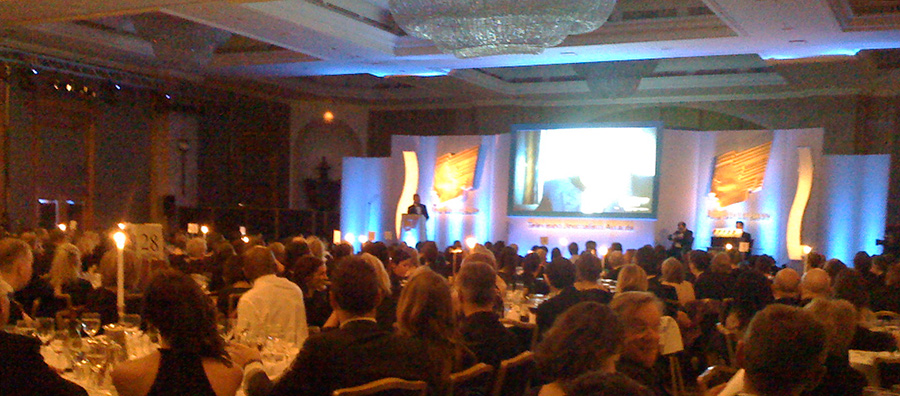
The best in TV journalism celebrate the best

To the queen!

Most venerable institutions would do nothing less, particularly when Ma'am or her siblings are patrons. In Soho, the quintissential location for men's tailoring, similar choruses can be heard at their events.

'Can you remain standing for grace?'

Truthfully, I shouldn't be here. My friend and sometimes training partner Rob Montgomery will be amazed to realise I dragged myself to the awards.

12 hours earlier he was shepherding me on to a plane as my frame began to crumble under the weight of a chest infection and cold. Put simply, I looked like a monkey's arse.

But awards only come once a year and my motives are more enterprising than merely social.

For there is no better way of inviting a tv personality to the university, where I teach without seeing them face to face.

There's also a masked syndrome. It goes like this, if you're here, you must be doing something in journalism. In reality, I'm no longer a network producer or reporter, though my site viewmagazine affords me this lifestyle.

Yesterday I was in Tahrir Square, a few months before in Denmark and before that in Barcelona taking workshops or presenting amongst international journalists. Soon, I'm in Lebanon. As a hackademic or journaemic, I balance practical journalism with theoretical findings and what they mean.

No, the reason, I wanted to be here, spluttering unforgivably as the three course meal was served: beef and potatoes etc, was to catch the attention of the likes of the BBC's Ian Pannel.

Arguably, one of the UK's stalwart and fearless reporters, cited by his colleagues for his seat-of-the-pants incisive reportage, Pannel and I crossed paths in 1988 as reporters starting out at BBC Radio Leicester. He remembered me and the invitation to get him along to the Uni to talk to students about international reportage looks very possible.

Similarly, Rageh Omar, whom I know from my days at the BBC African service in 1996.  We exchanged hearty 'hellos' and I mentioned the Uni, to which nodded. Jon Snow, Alex Thomson, Tony Morris ( Newscaster, Manchester) all too said they were up for it.

Result!

Now though I'm paying for one excursion too many. So my trip to Dublin to consort with colleagues where we are in my PhD submission, will have to be done remotely.

At one point over the last three days,  I averaged 3 hours sleep and my diary went: PhD bibliography, Students web site, knowledge Transfer programme, and Arab League presentation.

Now, lots of Vit C. etc and probably the odd antibiotic are highest on my agenda.

Next post. how did they win those awards. I give you a wee insight into the judging at the RTS


Wednesday, February 20, 2013

How videojournalism came unstuck in Cairo

David speaking at Arab league Conference in Cairo
Hello Mr David!   Folks from Arab states tend to call you by your first name and the prefix,'Mr'.

'I'm a video journalist, how can I learn more?' This is often followed by a swift move to retrieve your email, for presumably later discussions. 


Questions like this are not uncommon, but they're loaded. What my good delegate friend means, is how can I make stories like you.


On the panel opposite me, another delegate rolled her eyes as to say 'Insha Allah'. She continued: Mr David, when you were here five years ago, you were talking about video journalism, and I was thinking how can we learn this, now you're talking cinema journalism, and I'm thinking the same thing.


There was a chuckle from everyone else. The implications being, yep, if you want to stay ahead of the maddening crowd you need to step up.


I love a creative fight club!


Attendants at News Rewired 2010 will remember too me saying  lets have a creative fisty cuffs, because only then can we begin to sort out, by the powers of rhetoric, what this thing means.


If you'd read Moses-knows how many books from my research, a fraction of which I turned into this banal art work below, you'd want to be challenged.


Sample of books I studied. I'll supply a lis in due course


In Cairo, at the Arab league of Nations conference, the more pressing problem mirrors the state of the country's politics. Everything is in transition.


If the BBC had Cairo as its place of abode, it would have a field day. The stories and issues fall about you. You're only literally a stones throw away from tripping up on some other issue.


Yesterday, the Egypt Gazette reported President Mossi appointing a friend, a dentist, as his new IT specialist. Dentists are very clever, yes, but you wouldn't bet on router issues and the intricacies of transmission frequencies figuring in their muffled debates with patients.


Hello Mrs Rabia. Drill at the ready, I'll be over to fix your download speeds afterwards.  


No, what's really eating at Cairo is the amount of people who are publishing, and in so doing wanting to be credible, but engaged in internecine journalism.  In part it's about the dash for dollars, who publishes first and fast wins, never mind whether they're wrong, its out there. 


Secondly, it's an ideological battle, with no sense that the poor lot caught in the middle are citizens who gulp down facts, rumours and figures, without the wherewithal from the professionals to help them distinguish fact from fiction. 

Meanwhile tourism has tanked and the nation is slipping into abject ruin. Oh dear!

If the West, through its sheer willfulness could beat its chest about the benefits of citizen journalism, in Cairo, they're beating their heads. Too much can be a bad thing.

There's no sense of credibility. This isn't about the tools, it's about the attitude. As I said yesterday, what's needed is a social change.


If you don't know your objectivity from your subjectivity, why being partial is perhaps far worse than balance, how being balanced can level the scales, but it doesn't have to be "he said, she said', and that at the heart of all this is a fairness, truthfulness, integrity that you wear in your heart, it's time you found a credible journalism school.


Me, I have done that, but I also believe the experience of the many years working in mainstream, BBC and Channel 4 News, has conditioned me, so that even when I do cinema journalism, I can defend a subjectivity to eke out the story.


The pic at the top was taken when I was working in BBC Radio way back in 1987. Provenance I told another speaker, provenance. 

Subjectivity, actually correspondents to this all the while, as I said to Cairo's new Sweden correspondent. Trust, is something that is earned. There's work to be done, and truthfully, what makes it exciting and both alarming, is 


  • Those statues which were laid down to combat yellow journalism apply.
  • But, there are local nuances that redefine the philosophy of any journalism.

Take the concept of the vox pop. Both a brilliant filler, but a barometer during the blitz for how individuals felt. Their experience mattered. It's now a feature of many a reports. At best it provides a credibility for the network being in touch with audiences, at worst it amplifies or deadens an issue, because of 


  • The notion of balance
  • The reporter picking anything


If you follow Schudson's notion that journalism is a cultural construct, and it is by the way, the vox pop to individuals might be better fashioned as the the 'vox pop familia'. It's when you interview families, the patriarchal, and matriarchal and siblings that you come away with not only good sots, but the tensions or harmonies in households - a reflection of Egypt.


In the West the family bears a huge brunt of being dysfunctional or safe. Not in Egypt, though western values are reeking change on this nucleus.

Someone who looked at the family  well in his featured piece was Inigo Gilmore for Channel 4 News. Gigi is battling her sister, whilst their auntie (I think)  exasperated asks why can't everyone just stop this nonsense.  In my own film Tahrir Memento Sara talks about the revolution in her household and how h
er dad now asks her opinion. 

As the youngest that's uncommon, but Sara fought a good campaigning fight during the 18 days revolution and was recognised for doing so.

The old trusted hegemonic ways of journalism create interesting tensions in these regions. Cinema Journalism may just compound that, but they're willing to give it a go. I have been invited back to Lebanon and Egypt later in the year.


Time to get really ambitious. There's amazing stories to be told. 


For more go to Viewmagazine.tv
I'll post some new films shortly.


Monday, February 18, 2013

Post videojournalism to cinema journalism -struggling to tell a story in Cairo


Guys stay close.

Our host, himself an Egyptian and a seasoned journalism, was matter of fact in his tone, as we filed out of a conference into the cool breeze.

That coolness morphed into a chill. Tahrir is not the square I knew before the revolution in 2007, when I first came here.

Neither was it the strangely homely place residents had built to oust a president.  The current occupants  we were told are cynical, factional, partisan and more hard edged.

True to this picture, minutes later we are accosted by three young men.

'Who are you filming for ?', they ask.

We ignore them and pick up our heels.

In Egypt there's a bipolar attitude to this story. Some are tired of its dominant symbolism slowly atrophying the country's international tourism. The other, says, a delegate is that it's badly reported and the stalemate here looks like continuing for a long while yet.

There's no police in sight and its being run as an autonomous enclave.

I'm here at the invitation of the Arab league, speaking at a two day conference, and using the opportunity to to wrap up my findings into videojournalism.

Now everyone has a camera; citizen journalism is as ubiquitous as the acrid air from Cairo's congested cars and their fumes.  And the effect of the democratisation of shooting isn't helping, we're told.

Fifteen years ago, Itemulang, a bright 20-something in South Africa, spoke to me of the political change in South Africa for a videojournalism film for Channel 4 News, but, he added, we haven't had a social one.

In Cairo, the do-it-yourself approach appears to have detonated a wealth of social networking, without the social responsibility.


How do we ensure we get the truth, a senior figure connected to the United Nations asked. My reply, rather long-winded, was you can't.  A former student of mine, Rabia, urged public programmes of sorts to educate the public.

The whole tenure put into context any ambitions I might have to share my research into cinema journalism. If videojournalism was the new new thing, 20 years ago, which has only just been discovered, then the innovators are moving into cinema journalism.

Don't be fooled, it's not new either. We can look to Robert Drew, the father of cinema verite, whom I had the pleasure of speaking to a little while back. And before then, don't underestimate the Russians.

Cinema journalism though separates the unique videos from the  garden variety videojournalism. But it comes with huge risks. That's what I aim to talk about.

And whilst the surge may be to create cinema, which by the way is not predicated on the camera look.

So a 5D gives you creed, but doesn't guarantee you the story.

No! Cinema journalism is a particular brand of story telling which requires craft skill. That's the message for tomorrow, as I deconstruct the form in my session.

See you tomorrow for an update.


Friday, February 15, 2013

Cracking the knowledge bank in video and net content

David speaking at Innovation conference in Cairo

You put it in, read the markets, and then rebuild.


Welcome to the dynamic, transient knowledge economy, where you might sometimes think you're chasing ghosts.

If you're lucky the deal is symmetrical. By the time you've finished, exhaustion is tempered by the understanding you've given your all, and you've learned something about the journey and yourself.

My week ends where it started. Three death marches, which in the Net world of Soho means 20 hour working days from dawn to dawn.  You smack your lips at 5 in the morning.

A bibliography of ten pages, needs rechecking to the standards of Harvard referencing and thanks to Dreamweaver CS6 responsive design in CSS just got a whole lot easier. Two disparate worlds collide.

But now, even the BBC, 'the market' is looking for journalists that can code.

The weekend sees a flying visit to Cairo to speak at an international Forum for Media Innovations. 

The 'put in' is a presentation: the end of news' hegemony. The 'read', the markets concerns over what is the new 'must have content'. The 'rebuild': it's strangely about news and info that is transcendent. There are better ways of devising news content, but it depends what you want.

By wednesday, following the BAFTAs, it's the turn of the RTS to celebrate and honour its talent. This year I judged the innovation entries. They were exemplary . The victor was a hard choice.

Thursday sees me off to Dublin for last preps for the submission of my six years-in-the-making thesis. I'm starting to call it the missing chapter in the development in digital media.

The 'put in', I certainly couldn't have done this by myself, and I'm very grateful to some of the world's respected film makers and thinkers lending a hand to my new theories.

The 'reading of the market': now this was serendipitous. Last week Britain's communication regulatory body OFCOM handed the contract for a local London television to The Evening Standard.

Deja vu. 20 years ago, one of the groups in my study launched Channel One TV. The 'rebuild': there are enough lessons to be learnt from this study to deliver a local station that could be head and shoulders above anything ever produced.

By Saturday revisions to my site coding in jquery, nailing down the script for my first fictional shoot, the Masters students readying themselves for their launch, should carry me over to the next. After that anythings possible!


Wednesday, February 06, 2013

IM VIDEOJOURNALISM - Knight Batten winner retrieves lost chapter in the story of video journalism

Homage to Mentor Mark Cousins's story of film

Described as the zeitgeist of media forms, videojournalism was the first in a line of contemporary A-list disruptors to impact the protected fortress of traditional media. 


It involved a way of rethinking media, not in the camera per se, but in its practitioners' approach to that philosophical matrix word, "realism".

Vertov's eponymous film, made a decade short of a century ago, Man with a Movie Camera, tells us that much. It really isn't the camera, it's what we express as alert conscious beings that mostly matters. Then, only then, can the camera come alive.

The snag with journalism, its tyranny, has been its corporatisation and a dulling of interpretation that abrogated its original art form. Instead, we became and invariably are entombed to the tick box of five journalistic paradigms: Who,what,where,how, and why. 

Let me rephrase this, all communications, journalism included, involves a filter: you reinterpreting what the journalists herself has interpreted: a filter within a filter. 

This post for instance which is a piece of journalism will mean different things to different people.


Morphing Journalism


Morphing Videojournalism and its  breakthrough in Africa in 1997
Journalism, as it emerged three centuries back would have struck scholars, witnessing its evolution, as an Art form. 

The very idea that writers could deliver a script with, confusingly for our generation, no perspective, and no predilection to interviewing people, would have meant Daniel Dafoe's new writings was a particular art.

Defoe, who wrote Robinson Crusoe, is often credited as a pioneering journalist.

Ever since then, our reactions to a constipated status quo understanding issues: literary journalism of the late 1800s; Gonzo of the 1960s, have involved renewed efforts and new expressions.

Furthermore, those five "W" pillars, suited for its time, can often be found wanting. It's as if the 2 dimensions of linear journalism required a z-axis, a new consensus, to fulfil our penchant for narrative. 

Videojournalism fell into the aforementioned. Its newness, its genetic makeup was unlike any other before it. Unfortunately, that has been lost on us, almost.

Now, following a six year study, which has been rasping, exhaustive at times, across four continents and some of the world's leading minds and emerging talent, I'm almost ready to share what I see as a remarkable story.

The claim of an unwritten text may seem nonsensical. What more can be said of this thing that has not been said? Everyone's doing it. The camera in the tech advance world is like the air we breath. Ubiquitous!

"And what makes you think you have got something worth listening to?", you might ask.


8 Days - a video journalism film from Mrdot.co.uk

Videojournalism

Firstly, google "Videojournalism" and the chances are you'll come up with this site on the front google page: 
It's from the site: Mrdot.co.uk, which features the first UK regional newspapers learning videojournalism from the UK's biggest and most respected news agency: The Press Association.

It says this of videojournalism:
Videojournalism is an advance on television news production - a shift away from the predictable approach television has stuck to doggedly since its inception.
It is next generation television: story telling in which you are not be bound by the many constraints of traditional news production....More on video journalism
That seems obvious now, yet there lies in this text a deeper story, more nuanced, providing greater clarity and purpose, which I have pursued in "The Story of Videojournalism", if you're interested.  

The text and site on Mrdot.co.uk is connected to me in various ways: 
  1. Mrdot.co.uk is one of my earliest net accounts from the late 1990s 
  2. I trained the journalists in the film, 8 Days, which I also made.
  3. I helped the Press Association create and launch their programme.
I'm grateful to everyone who has engaged with its meaning and sometimes contacted me to understand more. 

So where has this new knowledge come from and what might it mean?  New knowledge is like the embers of a log fire. The more smouldering logs you bring together, full of potential, the brighter the fire burns. 

Knowledge invariably, is not the product of one person and depends on a critical understanding of first finding knowledge nodes. These can be artefacts in books and films, or the experiences of expert people. 

And then secondly, interpreting what is gathered so, as Gestalt theory proposes, patterns and cues appear, is not a given.

But all knowledge is transient. It's only as good as the time; its temporality, and this can be for a number of reasons. One of the most pernicious causes is what Foucalt, a celebrated philosopher, called discursive formation.

Lets pretend Twitter went out of business today. What are the chances that we might begin to think that far from tweets being a way to connect with friends with ambient messages: "my bikes been stole!", its most vital role is to inform people of the more formal things you're doing. 

And if the latter were the case, then people/institutions with content, would gather the most followers. This has often been the charge of traditional media, that twitter is their echo chamber.

The most brilliant ideas don't necessarily start with the institutions, but history has shown us that they will appropriate and use them for their own ends. Twitter for the media is a way to push for contacts and promote their own programmes, not to say, we messed up on the Jimmy Saville story.


And then in paying homage to a great teacher, I give credit to the Mark Cousins, an incredible filmmaker and historian, who spent time evaluating my work and study and with great generosity deconstructed it.

The Telegraph called Cousin's 15-part documentary on film, the cinematic event of the year...extraordinary.

The implications for this study I hope affect our cognition of story form within videojournalism, the way its taught, and how audiences are changing.

Visionaries often pave the way to the future. This studies' trajectory threads content from various visionaries  and a logic I hope will open up dialogue to how, we do what we do in these different times.

End
++To contact David Dunkley Gyimah, who is an artist-in-residence at the Southbank email David.dunkleygyimah@southbankcentre.co.uk