Sunday, July 31, 2011

Reflections in Integrated Multimedia Videojournaiism before the storm


The pictures above represent a few of the highs in a profession over two decades in the media. Just a few.
  • Presenting at SXSW - a historicity in video.
  • Presenting at The ONA (Online News Association) in New York, with Naka Nathaniel and Andrew Devigal, the multimedia Editor at the New York Times.
  • Concepts in design for PCs in 2005, how we might access articles. No, I hadn't thought of the IPad either, though a similar device I came across in 2002 presented some ideas.
  • Training journalists from State TV in Cairo over the last three years, which I have folded into my thesis, gives me much to chew on.
  • And - a series I'm still proud of made in 1997 when working with a CNN executive we took videojournalism to Ghana state TV and South Africa. In a months time, I have been invited to Nigeria to talk about and share ideas.


So why all this? Somehow I feel I'm re finding my feet, or different feet, something more discursive, more evaluative, more dialectic, less sophist...  In the past few weeks I have been delivering a lecture to students entitled Illogical Rationalism. It includes or attempts to justify certain aesthetics.

Take this for instance. The 5D Mk II is great, but why will it soon come to represent something ordinary?  Because history has shown us, business has demonstrated to us.

 At some point innovation becomes comodified. Ouch! Artists have shown us that all great artists work against the norm. Go look yourself. And finally then when we can all show great pictures, it''ll become a game of spot the emperors clothes. Form and content will come back with a vengeance. Invest in a super 8mm now (LOL).

However I digress. For the meantime I'm giving my head a rest from blogging, before I assess the wonderful work our masters students have been doing. Then it's back to Husserl. Happy blog-break  :)

Tuesday, July 26, 2011

A movement beyond classic journalism

A horrific scene...
Chaos...
Infamy...

Superlatives fail to somehow induce a comprehension towards the events in the last few weeks.  Some things are just so big, in awe and shock, that we struggle to convey meaning.

The scale of famine in Somalia, the struggles of those eking a living in Haiti, the murderous act and deaths in Norway.

Pictures do the job. They try, often post - event within the structural narrative of broadcast reportage. Professionals convince survivors of their contribution for recounting events. Find a survivor.  Perversely, given the trauma and shock, their account is of value only if it can articulate - they are reluctant narrators.

The aftermath yields scars of immanence - forever seared on the mind; the hungry, the young, the blanketed youngsters seeking solace from breaching the cold to escape death. That often these events  happened outside real-time scrutiny e.g. cameras means our imaginations conjure up attempts to fill in blanks and seek rational answers.

On BBC Radio a presenter somewhat skillfully, gave to parallelism interviewing a Norwegian videojournalist, whom have previously been embedded in Afghanistan, segued with affairs in Norway. The form of narrative exposition can sometimes itself feel elasticated, in spite of the good intent.

At least there has been, or appears to be from the media humility and some dignity. Lessons learned. Virginia Tech Shooting I blogged about set a disgraceful example. Mark Hinojosa, Director of Interactive Media at the Detroit News and I spent time discussing journalism, its limitations and strengths in unimaginable scenes like this.

My thoughts turned to Turner Prize winner Jeremy Deller, whose work Baghdad 5 to illustrate the conditions in Baghdad resulted in him touring the US with a bombed out car lifted from the region. Visceral, disturbing, a confronting of reality knowing lives were lost in that vehicle.


This was not a normal exhibition, but then Deller, whom I have on occasion the chance to speak with (We are both Southbank artists in residence) is no ordinary artist.

Just in case I am misconstrued. I am neither advocating such for the atrocity this past few days, neither  do I seek to in any way shape or form to enter into a discourse over such an event for the sake of art. That would be heinous enough.

In speaking to Hinojosa, we stopped and pondered what it must have been like to be shot at for 90 minutes, with the amount of rounds the Gun man let off, when five minutes must have been an eternity.

Or what is it like to go without food for so long.

In the frenetic lives we lead, thess thoughts become fleeting. We imagine, ponder, then the door bell rings. It's the postman or something. Tomorrow, the next week, unfortunately those events will have moved from the temporal screen ( TV), but findable online

For the circumstances surrounding these, there are causalities.

The rich nations in 2009 spoke of a commitment to address drought and another pending apocoplyse. They did not hand over the money. In Norway, the police arriving 40 minutes after this unspeakable act is a taxing debating point. Why? Does the country lack an emergency response strategy?

What is it like to be shot at? I have been privy to a barrage of gun fire before, in downtown Johannesburg on the country's road to democracy back in 1994. Everybody and anybody walking the streets, and there were many, scrambled to the sides or ran across roads hunch-backed to avoid being sighted, or risk injury.  The shots though were not close range, at least as I recall a 100 metres away, but the anxiety around us was raw.

Dellers mission was to make us, the viewer, attempt to understand some more what war and carnage is.

Within the swathe of responsible reportage and post analysis, trying to convey an hour and a half of fear, human suffering and "being there" is something journalism in its present form attempts, partially succeeds (to degrees) and also struggles to convey. Within the boundaries of realism and journalism of probity it claims rightly so to make sense. But that is a matter of semiotics and narrative.

We know more now that we would a decade ago, but the formalised story telling form has constraints, constraints which as a well known sociologist Stuart Hall said are molded around conventions, handed down from one group to another. Reporters can't show emotion, so the matter-of-fact delivery reveals, often for me a strange haecceity.

Art practice, ( I don't like the use of the word "Art") can be unfairly judged on occasion, skewing facts in a regard for "impressionism", or its lack of deference to the reality of the event.  Yet in he right hands it answers questions that appear far-reachable.

In Alfred Cramerotti's Aesthetic Journalism: How to inform without informing, Cramerotti skilfully navigates toward a germane area, though perhaps greatly unexplored for journalists, where artists seek meaning through journalism-practice.

What can we do to raise more than the temporal interest in these monstrosities? Journalism under its current guise seeks to do its job, report. Yet ask yourself in the absence of the word "journalism" for something else "accountable story telling" ( and I'm aware the word "accountable" needs unpackaging, what would you do?

As a foot note, and an example, remember impartiality, balance, measure etc were cultivated into the profession in the 1900s to thwart propaganda and bias (Yellow Journalism).

Today, you might easily tell the difference between propaganda. Times, knowledge, meaning, audiencing, has changed. The argument would be we need structure, rules, otherwise its anarchy.

Conversely it might perhaps take something along the lines of an art form to gather collective thoughts for a future memorial to commemorate the young lives of those slain last week, or to bring to the world's attention Haiti still bleeds, Somalia is dying.

It may take art-journalism a middling ground between the science of recording events as they happen and the impressions of those to convey greater meaning to issues which sometimes leave more questions than answers

One and a half hours of shooting. Really!

David Dunkley Gyimah - above a pictorial account of videojournalism praxis - presenting at SXSW, the Online News Association ( New York).
His ideas on design concepts, training videojournalists in Cairo, and his critical videojournalism series made by Africans in Africa in 1997.
Click here for more and see his latest blog for a distillation of media.
David is a practical and theoritican in videojournalism. He has been teaching and practicing videojournalism since 1994 and a journalist since 1987. He has an insight into design and videojournalism which is the basis of his Phd Thesis at SMARTlab, University College Dublin

Wednesday, July 20, 2011

The Designer - If it hasn't been done it's waiting to be done.


Something that hasn't been done is waiting to be done.

At age 9 holding my art book I recall having desires to be an artist.  I'd draw planes and rockets, still life and human figures and then gaze through the window - imagination running amok.

By 16 in boarding school any notion of humanities had been panel-beating into a a career in Applied Chemistry replete with substitute nucleophilic reactions and matrix mathematics.

Science, its empiricism taught experimentation with measurable results, yet Art allowed me to make sense of abstraction e.g. benzene shapes, mental training and visualisation.

But unfortunately there was no creative life for the scientists as broadcast journalism that would immediately follow.

Yet there was a collorary. Such innate inquistiveness led me to think about programmes, stories, visuals as substrates. How did that work? Why did it work? And could it be done differently?

Listening to BBC Radio 4 Midweek I caught Douglas Edwards, one of the first employees of Google speaking about his book: The Confessions of Google Employee number 59  which is an insider guide to Google's space.

Backtracking to the Wall Street Journal, Edwards explains the interview method used by Google co-founder Sergey.
Finally, he leaned forward and fired his best shot, what he came to call "the hard question."I'm going to give you five minutes," he told me. "When I come back, I want you to explain to me something complicated that I don't already know." 
The WallStreet Journal Saturday Essay, July 16th 2011 

Knowledge, a precious sometimes ethereal commodity, we often take for granted, is being traded. So I thought what would you have said?

I might then (late 90s)  I thought have spoken about MrDot - fixed but still fledging videojournalism and design, hence its name, though at the time I had not yet made the film on the site.

Mrdot.co.uk website - design, coding and film making
To many Google may have seemed unorthodox, but there was an artistic methodology at play. Something that hasn't been done is waiting to be done - an old mantra of mine. A colleague of mine is currently completing her PhD around their creative methods.

To its pioneers if it had already been done, it wasn't worth entertaining.  This elides into a secondary theme I have been working closely with.


For the second of my lectures, tomorrow to students from Beijng University, I'll examine how convention, conscious and auterism play with each other.

And somewhere in there I'll show some of the extraordinary aspects of videojournalism and how its polysemic nature presents remediated ideas.

For one thing, I look at visual data: whether its website design or videojournalism as design-driven and whilst I can't go into it here post modernism - an infuriating word which essentially bridges cultural, societal understanding of things after the 1960s has a lot to offer.

The lecture starts with Apple and how Job's ideas ( auterism) became convention, yet also derived satisfaction from how hardwired we are to things, such as coming across an Apple and wanting to eat it.

Sunday, July 17, 2011

THE CORPORATION REPORT - intentions in seeing and making


Now showing on Viewmagazine.tv we, you we're all corporations now.

Whether you're the BBC, IBM, Mediastorm, or Liang Zhao from the Chinese Communications University (who's just joined Twitter) we continually tell stories.

And this narrative whether visual, audio or text increases, by default, the awareness of ourselves, our self-identity, our work.

Globalisation a key to a corporation's brand expansion and symbolic experience, tangible or otherwise, we can now achieve through twitter, social neural works, websites and blogs.

I once told CNN's Christiana Amanpour at the Front Line Club what I felt about her brand quotient, and she expressed surprise. But you don't need to be Amanpour or IBM today.

To qualify what I mean by brand, in my lectures I distinguish between the brand as the classic corporation e.g. BBC,  the celebrity brand e.g. David Beckham and the new meta (beyond)  brand.

On BBC's The Apprentice, the young turk calling himself the brand had a point, though hubris and the idea he saw himself as a classic brand confused his message.

This id promotion may commence low level, but its trajectory is steep and uses much of the pedagogy of classic branding, but there are new areas to discover. There is much fantastic work for brand evangelists to deliver when considering this simple yet powerful statement.


But branding is but one of the feelers in the quest for meta connections.

This deduction links into a more rigorous, fun, performative presentation I have been delivering to Corporations, big "C" such as BBC World Service executives and small "c"  individuals (young people, organisations), which I have underpinned with this aphorism.


The statement seems simple enough, but it embodies cognition, the subconcious, and how we think (conscious)  in various disciplines. It's not a grand theory, and I do my best to hide away any overt philosophical discourse to keep it entertaining.

But is asks the question, how do you know what you know within  a context of design, visual e.g. videojournalism and film making, textual narrative, cinematic space and a host of pop philosophy theories?

For instance, when you see this next picture, most likely you'll smile. Why? Because you're hardwired, but when I show you the next one, your reaction may differ depending on your culture (convention). and your own individualism. This is nothing new.

Image is Copyrighted, from a good friend 


What is is the increasing array of hybrid theories to interpret events.

Incidentally this is Xun Zhou -  a talented award winning actress, singer whom I liked in the moral fantasy tale Painted Skin.

However the requirement of most creators is to ensure convention becomes hardwired, a desire becomes a need, a story hits certain points in ones psyche - the sub conscious. You may not have encountered those events before, but you're affected.

Increasingly I have become less interested in process, referring instead to an illogical rationalism, whereby convention is recognised but reworked.

Take these two images above from the same lecture. Which one appeals to you?  Possibly, the second. Many text books will deconstruct this within the rule of thirds. It's a convention which appears to arise from empirical studies from paintings.

However, it's become a construct which is consistently broken in films or distorted to achieve the effect of making you uncomfortable, as in Rob's film.

image from Rob's film on Youth angst. Notice the breaking of the third rule

Also, and equally interesting is the these conventions emerged from the dominance of western paintings and revelations of perspective. Some work in China showed me how early Chinese art disregarded one perspective in favour of multiple points of view.  For me this is quite profound.

And it's just one of many areas that I concentrate on in my lecture, derived from notes in my thesis, which I'll feed into viewmagazine.tv. More to follow.


 Liang Zhao 


@ 

Saturday, July 02, 2011

IM Videojournalism - videojournalism and site build methodology


Anyone involved in research, particularly Masters and Doctorate will recognise a deductive-inductive methodology illustration.  Methodology is one of those scary words for non-academics and is often confused with method and has core values in videojournalism.

Simply a methodology is a workflow consisting of many methods of doing something, Remember Apollo 13 the film, when they're trying from ground control to get the disabled space crew back to earth and there's nothing in the manual.

They make up a methodology, which consist of sub routines of various methods, turning things off in sequence and trying until they get the right amps to get them safely back home.

However, the world of philosophical thinking seeks to contain methodologies broadly under scientific or non-scientific (social science) routes and each yields different pathways. Understanding this allows you to devise a methodology realising its strengths and weakness ( all methodologies have flaws)

I have changed some things in the above illustration to reflect the practice of IM Videojournalism, which is the making for a film and the site build combined, which bleeds into the contested cinema-journalism.

Each sector involves further branches and there are some things, such as Literature Review, or in film terms an artistic-content review, that you can't cut corners over.

For instance, the idea of providing a POV of a horse racing, which a number of modern videojournalists might have executed, was first performed by Abel Gance in the early 1900s.

Similarly narrow, or short depths of field as it has previously been referred to is evident in early Japanese films around the mid 20th century.

A good work-flow is one that can withstand various tests. If you've worked for a media organisation e.g. the BBC, ITN, ABC and WTN TV, Channel One TV, several independents in journalism, design, advertising and the web, as I have each possesses a unique workflow to accomplish a task.

The award winning BBC 2 series Reportage, which David worked on featured on his website viewmagazine.tv. Thus far no other programme has been able to catch the zeitgeist of MTV style reportage with strong journalism

Now if you combine that with say my background working for BBC Radio, domestic and International, they too possess defined workflows. Now what if you could take from that and build your own methodology for a new constituent.

Effectively you become a walking library cataloging tried and tested methods that can be passed on, which facilitates, if you're that way inclined, creative thinking.

Creating thinking also has methodologies, which my PhD colleague Alison is researching which defines how and the best places to come up with those innocent excited finds.

For example why do companies place the water hole, or should, away from the desk configuration, because the act of walking, specifically movement creates liminal thinking. How many times have you left your desk for the cooler only to rush back saying "aha got it".

David interviews James Woolsey - fmr Director of the CIA
Take this interview I conducted as videojournalist a decade ago. I return to it, because the interview unveils a methodology to interviewing executives, which I use in training programmes and my Artist in Residence programme. You can see the interview on Viewmagazine.tv

Depending on the reception of the interviewee when we first meet; here its more about visual clues, I can determine how long I have and how what I want from the interview can be richer.

Here's a simple method I used in this case, I asked questions that reversed the chronology on events.

It's a simple technique used by psychologists when interviewing. If you ask questions in sequential order interviewees will often resort to automotive answers. If you ask questions that reverse time sequences, the interviewer has to work harder and you should produce a much more in-depth interview.

Incidentally the technique is widely used to catch criminals who are telling lies and good talk show hosts. Try it next on a friend. Let them invent a lie and attempt to unravel it.

Exploding myths through experiential learning
Take this simple observation of the double-headed presenter in news, pioneered by US TV, which is now a staple of TV across the world. But why two?  In the UK, the solo presenter reigned in the 60s until that is the nature of newscasts became complicated.

There were so many things that could go wrong, the idea of having another hand nearby, who was presenter material, but could sort out glitches before the next item, drove ITN to have another presenter. These are the words of Geoffrey Cox, one of ITN's most illustrious editors. How did I know that?
  1. Experience - from once working at ITN where someone told me that story
  2. Confirming it through research 
And going back to Apollo 13, the fact that the third earth-bound astronaut was so experienced, helped him to become creative to devise a new methodology to save his friends and crew.

One of the main planks in turning around practice into theory into practice and sometimes vice versa are added constraints I place on the process.
  1. It, website or film, should be at a reduced cost
  2. It should have an impact
  3. It should be made quickly
Anyone who has shot on 16 mm film on one spool of film and worked for a major organisation will spot 2) and 3). 100 ft, a mag, works out at about 3 minutes of film time, which many news people were taught to shoot in or were shown the door.

As  a film maker first and now a researcher, I have been able to rework and adapt various methods for clients and corporates I work for.

I'll explain more of this over the next few weeks. This week I'm off to Dublin to meet with my PhD cohorts at the SMARTlab on campus at University College Dublin. Here's the Dean of the school explaining SMARTlab and this link goes to my page on SMARTlab talking about the experience


p.s btw, I'm using a specific technique, which should be invisible in writing this post  - a method that feeds into the total sum of site buidling.

Sunday, June 26, 2011

Why we need mavericks and thought-provokers

Scene from Bane a' part - Goddard. Tarantino liked it so much he lifted the dance and the name for his film, Pulp fiction and Resevoir and his production company
The net's main goal as seen by those prescient lot in the 70s and 80s such as Gene Youngblood  was an opening up of conversation, the delineation and devolvement  of power to you.

It's worked. Here are you and I talking - something we couldn't do a while back. Yet no one quite banked on the fight corporate dom would stage to colonise this discursive ground.

In every walk of life, just as soon as that thing emerges that spawns new thoughts, ideas, rationale, at some point it is enveloped and consumed by large bodies. If you can't own it buy it!

This is capitalism and this post is not to espouse the pros and cons of this system, but to take a more skewed position that perilously these lower organisms, by food chain distinction rather than intellect, disappear at our huge loss.

Everyone creates, but occasionally someone creates better. We stop, look, say "hwum" - in that release of breath way and move on. Then we see them again, sometimes years later - if we're lucky!

This is the maverick. We all know one from any profession. They do not seek fame per se, but that their voice and what they want to say find an audience. Paradoxically, today that is tantamount to fandom. Though there is a difference, in seeking an audience and attention.

The maverick is so left field, that you'd be forgiven for thinking he or she needs help, in an institution.

Which leads me to the core of my debate: education. In the next year, in fact in the next couple of months, British education is about to be radicalised, with new fees and presumably new gene of a student.

The result perhaps is the loss of the experimenter, the left-fielder. Because when you're forking out 9k for any university across the land, chances are you'll be looking for a specific experience.

I hope I'm proved wrong, because I rather like the left-fielders.

Thursday, June 23, 2011

Ozwald Boateng effect - creative thinking for future storytellers


The line in the trailer worth reflecting about is "its intuitive".

How do you know what you're doing works?

Just because you have the power of thought doesn't mean you can think said the philosopher Husserl. And the kind of thinking Ozwald or many other creatives refer to is highly deceptive.

Intuition sounds spontaneous, but its based on deep seated knowledge. Call it grounded knowledge and to get there you've got to go through intitially a tortured thinking process that is active, considered, doubtful of tradition, questioning of the status quo in a quest to build a new belief system.

Ozwald did it by disputing a venerable tradition of UK tailoring.

In one of my performance lectures in a couple of weeks time, I get under the bonnet of reflective thinking for storytelling and social networkers.

Something, which yields itself through experience or the interogation of supposed facts. A method of thinking in which a thought causes another thought, which urges scrutiny of the first.

Where to quote Kant a process of synthetic reasoning apriori is first set in train; concepts formulated by inductive as opposed to deductive reasoning. And then, they're tested further.

DW Griffith falls into this catergory having made up film making without a lexicon.

Here's an example of questioning knowledge? Why do British television News shows launch with two presenters. You could argue it's for aesthetic reasons. I would then ask you how you know. Because you do, would be your response.

But that ignores the fundamentals of reflective thinking.  As it happens according to the figure who was behind the launch of the double-headed system Cox, the double headed was a safety net towards the avoidance of on air technical faults.  As one presenter was reading, the other could be sorting out problems.

I have looked at this further with subsequent doyens of the TV world.

There's a lot of visual skill thinking or creativity I come across which is born of superficial thinking, rather than reflective and its compounded by a sign of our times and that repository of new knowledge: the net.

That is if it's not on google it's not worth knowing, which suggests a more worrying trend of the long term decline of reflective thinking.

Tuesday, June 21, 2011

New realities in Cinemajournalism - Imareality


Almost, if not all, film and visual making concerns reality; an attempt to engage you into believing the unreal.

For a moment or more you're transcended into a world, where whether its goblins or police you're there. Reality is the drug, which we imbibe from our pharmacological in-house store. Yes we're walking chemists.

In the film Matrix (1999), reality is heightened, but first co-opted. Will it be the blue of red pill sir?  Even in the mindwarping film Inception (2010), reality gets a literal kick up the rear.

Reality, without going completely philosophical dense, has been massaged via neo-realism and more recently remodelled in hyper-realism. One an attempt to make use of something almost real, the other an attempt to take you beyond what we usually accept as real.

The film 300 (2006) is a good example for me, with its maxed out contrasts of the photovisual image and violent deaths as is Wong Kar Wai's 2046 (2004).

.

Whatever it is we're doing, reality-overload, which is tautological, means we search for new ways for representing what impacts upon us.

It's akin to unearthing a new environment  e.g.  a sort of C-celebrity syndrome for some,  where you find it seductive, appealing.

In many ways then film takes us out of our own reality and places us in make-believe new one.  Film makers whether its docs or videojournalists are aware of our addiction, or at least should, which is why they constantly search for new ways of representing the visual image in style composition or mis en scene.

The question becomes how can I make you believe this? Or at least it should be. This question is not about a prefigured technique, but however much you the director can create the impression.

Here's an interview with one of the UK's most electrifying new directors, Turner Prize winner Steve McQueen talking about Hunger (2008) his award winning film.


It's obvious that there is a trend now in video making into the purposeful manipulation of the image for effect. One in which an honest video maker wants to convey something more through the image. I'm inclined to call this imareality or imereality ~immanence or immersivity of the image.

This neoligism takes care of a growing appetite to want the film to have Bresson-like -fingerprints. The moving frames are stylistically composed, the image saturated, yet somehow unnatural, and as such they have an immanence -  a trace that stays with you. You remember the film momemt or event way after its gone.

I'm minded of this trend in relation to documents telling of the first time colour tv ceded black and white and news executives could portray blood as red to the viewers. Today in cinema journalism films, that shock requires greater intervention.

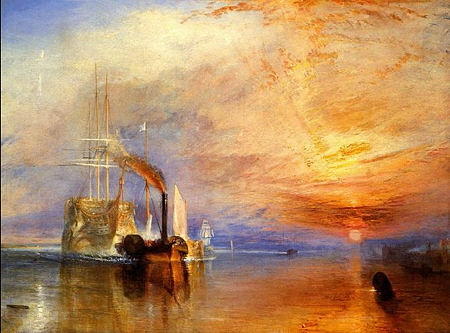
It's no one's fault. Turner did it with his paintings, followed on by the Impressionists. We're just finding more visual literacy from the audience and more visualists looking to push the form.

jm1-450.jpg
 ‘The Fighting Temeraire tugged to her last Berth to be broken up’,  by J. M. W. Turner, 1838

Saturday, June 18, 2011

Social Video (visual) technique begets social behaviour


Clever!

The screen said download Mac cleaner and install for free. I rarely do. Hoax sites and viruses you see. But this time, given my mac's been acting like its on crutches, I gave it a go.

It installed, cleaned my Mac a third of the way and stopped. Purchase the rest if you want this benefit.  Because, yes, the company had made it a benefit.

The ensuing site made that clear, buttressed by favourable online comments ( tweets and facebooks), a reduced price from 400 UKP to 40UKP and a countdown clock. I now have 2 days and counting to take advantage of this generous, no, very generous offer.

Advertisers have name for it. A national UK bank once disparagingly had its tellers mark cards of its customers: sheep and bulls.

Something you don't need, it's not particularly on your radar is sold to you with palpable tension and drama to heighten the buy and you, me, the sheep buy it.

There is the cinematic in this when we turn to the visual narrative craft - an illusion which invades the psyche that causes a reaction.


Video journalism's anti-aesthetism short from david dunkley gyimah on Vimeo.


Social Motivated
Many of the films you'll watch online you did not intend on watching; you browse and then sometimes you're stuck.

Whether by serendipity or design the film maker has got your attention and sold you the visuals/narrative for your time (the currency). They heighten the visual affect through a whole series of techniques.

Hollywood has packaged this as an elixir. Hitchcock could read the audience in his sleep. Horror movies at their visceral best have the measure of us. We're hardwired you see. But the thing is we can learn these techniques.

Newton summed up one of his laws of motion as an action causing an equal opposite reaction; cause and effect in our daily lives. We do something and nature gives us something back in return.

Film making an artificial pursuit in practice, but an intrinsically mental activity obeys this law in spades, but it's incumbent on the practitioner to understand what that is.

To many film makers, and good ones, it's stating the bleeding obvious. A good film causes social reaction. We all talk about it. The cinema is a social space - we all gather to watch a film, albeit in non-conversation circumstances.

But the real work for social is predicated before we get to the movie theatre or your website in question.
Make the film, cut the promo, sell the promo and with the use of social wares get it out there.

Some do this for a living - commercial advertisers and public relations. Others attempt it in their films as a course of good storytelling. In news the explicit is eschewed.

Getting it right
I had three different groups email me recently to deconstruct their films. In each case the news piece resplendent with information, forgot, or discarded the affect the film could potentially have.

This is not a flaw per se, for both reside on differing semiotic approaches.

BUT, and it's a big one, the philosophy of our times calls on a differing approach to consider. Firstly what are you covering. Secondly what's likely to be its effect, and then here's the hidden issue.

If the latter question is answered it'll be spoken about.

But a word of caution social video technique is not a bolt on. It's film making intrinsic to the subject. It's an ephemeral, cerebral, poetic, didactic quality. It's also behavioural in its outcome and its not new.

Leni Riefenstahl knew exactly what she was doing, when she produced the epic documentary Triumph, which galvanised the Germans and other nations with differing effect.

Social video, and mind you we're prone not to call it that is more affective around the ecology of what's now acceptable, yet on the other hand as the former boss of ITN news would say, Geoffrey Cox, the public don't know what they want until it's given to them.

Now, do I go and download that file?

Thursday, June 16, 2011

Tahrir Memento - Sheffield Doc Fest


Tahrir Memento from david dunkley gyimah on Vimeo.

Egypt's Uprising. I'm back in Cairo a couple of weeks on, but nerves are still raw. I have six hours after presenting at a conference for videojournalism and through my friends Salma and Ahmed, make this -  15 minute film.

This is my latest project; the trailer for Tahrir Memento was shown at the Sheffield Doc Fest recently in line with my interests about memory and consciousness - Bergsonian.

Though something you'll pick up on in the film is how Egypt's young are loathe to tell their parents they're involved in the revolution.

I am interested in beyond the news ( meta). I have been a journalist since 1987, starting with radio for four years with the BBC before Television again BBC, ABC News and ITV, . Then in 1994 I combined this with videojournalism and being an online journalist. In 1998 I worked for an Ad company and doc coms.

For me a segment of news making has not kept up with current philosophy - after post modernism.

When it captures an unfolding event of value news tends to come in to its own, however beyond that when the issues become complex, the propensity is too often to distill the narrative and construct to make simplistic the affairs - TV's Achilles from the 60s (Neil Postman).

Poster for Cairo Videojournalism programme

Though self-filming is the norm now, I'm more keen on the creative directing of a story. That means everything from the filming, creating the posters using (photoshop), building the site using CSS and Flash for interactivity and SEO-driven write ups. In principle I don't have to do it all, but I understand the language to communicate intra-discipline.

As an Artist in Residence at the Southbank Centre that helps me conceptualise and see through projects; as a senior lecturer at the University of Westminster I pass on this knowledge. I shot this on a Canon 5D Mk II and there were aesthetic as much as practical reasons ( See Pics and last post: media methodologies).

Firstly, I'd been stopped previously by the secret police with my JVC cam and escaped any consequences by producing a letter ( I have kept) that gave me permission to film a 5 mile shooting radius.

With the stills camera, though it was inspected, I was left alone to take pictures, except I was shooting video.
Filming on the Canon 5D behind Tahrir Square. Really wanted to be inconspicuous so the Camera helped

There is a further backdrop to this story. For the last three years I have been training young grads from Cairo and the American Uni to videojournalists iat the state broadcaster Nile TV. I have filmed rare footage working in their state broadcast complex and am looking to put on an exhibition of that work and the videojournalists work too. If you're interested do get in touch here. 

Here too for post on Sheffield doc fest: why we'll be talking about Danfung Dennis for a long time Filming in War Zones.
Filming and training Videojournalists on the JVC GY100 with lens adaptor Dec 2010


Filming on the Sony A1 in 2007


Training State TV Journalists with the Sony EX3. We had to get special permission to film on the streets


VIEWMAGAZINE.TV PUBLIICITY IMAGES FREE USE BELOW  (Creative Commons) for blogs, twitter and other publications referencing the blog viewmag.blogspot.com and viewmagazine.tv. If you're interested in 300dpi images please email david(at) viewmagazine.tv stating re:Image use in the title. The use of images does not waive moral rights of owner and therefore warrants being used for purposes described above.

Image size 500 px x 245 px 


Image size 500 px  x 245 px

Sunday, June 12, 2011

Hell and Back Again- Sheffield Documentary Festival and why we'll be speaking about Danfung for a long time

Danfung Dennis in conversation with Beadie Finzi @SheffieldDocFest

Why do you wanna be a soldier?
Because I wanna kill people.

This and other mind-gnawing exchanges emerge from  Hell and Back Again (2011)   one of many memorable days at the 2011 Sheffield Documentary Festival. Thus far the film has punched through the independent cinema festival circuit garnering accolades and awe, as well as awards.

The World Cinema Documentary Grand Jury Award and World Cinema Cinematography could just be middle-layer, because you suspect the topping could be the Big- O, though Hollywood's predilection to narrative -issue NIMBYISM, doesn't bode well.

Twenty-five year old Sergeant Harris says in the film the army's recruiting team said that was the best answer they'd ever had.

(Fade to black - Sheffield Documentary Festival Day four closes )


Hell and Back Again clip
  Danfung Dennis on Vimeo.


Off limits
There is a conversation that resists being shared when going into conflict. Individually, it weighs on your mind, but you don't speak about it. In any case, skill, experience, maturity and providence are meant do their job.
Reporting from Ghana on US Forces training ECOWAS forces for Liberia campaign 97 and South Africa reportage from Townships in 1992
I believe I know this because I grew up in a country which was shaken by military coups: Ghana, in the 1970s and 80s and that much later I would re-locate to South Africa, reporting at the time of its taut transition from Apartheid to democracy.


David reporting from the troubled townships of South Africa. A freelance report broadcast on the BBC World Service circa 1992.

Yet, comparisons to Danfung's Hell and Back Again, though relative, are diametrically starkly different.

At the Sheffield doc fest, in conversation with Beadie Finzi of C4s BritDoc Foundation Danfung is peeling back layers of the "how" and "what" for Hell and Back Again and the result gives rise to liminal thoughts about "this conversation".

The audience learns how Danfung, a photojournalist already embedded with the US army is looking to be dropped with Echo Company going the farthest into Taliban territory.

The soldiers were destined to be there "for a long time", and the intel and hollowing emerging from later  arms exchanges suggested they had little idea of the Taliban's strength. Electricity and water would either be absent or hard to come by. Danfung with all this knowledge is set on going.  Beadie's pensive look and sharp intake of breath could be an acknowledgement to "this conversation".

Just before boarding the Chinook Danfung's tells us his camera button jams. His inner voice poses the question, what is the point of me going, if I can't shoot anything. Weaker minds would have capitulated.

However the malfunctioning button is resolved by the same ingenuity and tenacity that's become Danfung's trademark in either his camera set-up, the rig, or Condition One - the new immersive viewing screen he's pioneering. This time it was his finger nail digging out the dirt to set him back in course.

Inside the Kill Zone
There is a scene in one of my most absorbing war movies: We Were Soldiers (2002), starring Mel Gibson as Lt. Col Hal Moore in which a young photojournalist Joe Galloway boards a chopper to the LZ zone - the kill zone.

The soldiers have been been stirred by their Colonel. All of you will be coming back, but not all of you alive. Joe Galloway played by Barry Pepper witnesses a deeply horrific mind-numbing assault on the unit by the People's Army of Vietnam.

The morning after, pool photographers and TV camera crew are flown into a sanitised kill zone. As a gaggle, they search for motifs to relay this bloody battle and then come across Galloway.

That conversation now!  Galloway has become the story doing something the rest of his colleagues could either not do or would prefer not to. Forty six years on, Danfung has become Galloway.

When the audience applauds, I find myself doing so not just because of his film which is shot with the hand of Malick, the eye of Lelouch and coruscating brutality of Lu Chuan (City of Death 2011), but that he also had the kwai to tread into the unknown - the kill zone.

That is the conversation. Invariably it's one FOCs (Foreign Correspondents) talk about when the beers are flowing, when they might also light-heartily joke about near-misses. It's all about trust, says Danfung in relation to the unit he was with, which was reciprocated by Sergeant Nathan Harris et al - who would become his main character.

Self belief and trust can be endemically unwavering. In 2002 when I was assigned to be Lennox Lewis' videojournalist, I entered camp with a a hint of doubt. What if Tyson actually won. I was chastened not to think that away. Two weeks in camp I was a convert. There was no way I now thought Lennox was every going to lose his heavy-weight crown to this bruiser.

The Art of War
At the Southbank Centre, where I am an Artist in Residence, last year about this time I'm spell bound by a clip online called Battle For Hearts and Mind*, later changed to Hell and Back Again. I email the photojournalist and he promptly replies.


For two and a bit hours given the bent of my research  my questions to Danfung have a specific line of enquiry. His answers are illuminating and in my guise as artist, journalist and academic, I'm continually digging and documenting precious responses.

Then Charlotte Cook, one of the most erudite, social media practitioners I know, who is part of that august outfit, the Front Line Club emails to request whether I wouldn't mind being part of Sheffield Doc Fests debate on Cinema Journalism.

She's looking to Danfung as one of the panelist. She's hardly finished the sentence and needs no convincing before I nonetheless weigh in: "You gotta get Danfung, You gota get Danfung".


The Cinematic discussion
Restrepo (2010), by the the brilliant Tim Hetherington, whose life was cut dramatically short showed war as the new breed of photojournalists would realise it. The Bang Bang Club (Carter et al) painted South Africa behind the news headlines in 1990s. Yannis Kontos I have had the privilege of working, a World Press Photographer Award Winner and some 18 other international prizes, continually delivers on the immanence of the image.


PIXELS WITHOUT BORDERS from david dunkley gyimah on Vimeo.
Yannis Kontos Promo I produced for his 2006 World Photojournalism Award. For more go here

Yet, Danfung, many affirm, has done something quite different, so different.

 Hell and Back Again and the small team that shaped it: Roast Beef Production Producers Mike Lerner and Martin Herring; the editor Fiona Otway whose Felliniesque intercut and parrallel editing weaves silk through the film. In addition, Sabotage films, Thought Engine and the Britdoc foundation are contributing to Gombrich's schema plus correction model for narrative-art film making.

The cinematography is lush, the characterisation indelible, its narrative reflexively beautiful, the finished product - a must see.

Academics, and I am one of them in film will reflect on the frenzy. We're not being priggish. In wars gone by (WWII) many photojournalists and cinematographers assigned to the US Army's photographic unit shot with small Bell and Howells.

In contemporary history, Vaughn Smith of the Front Line Club covered wars with his Hi-8 in the 1980s; Inigo Gilmore a one-man-band whose work I deeply respect, also a panelist has too covered conflicts; Veteran film maker Bill Gentile, now of Washington State who is pioneering Backpack journalism has the eye of Odin.

So what's changed? The reconstitution of cinematography and full-feature narrative (parrallel storytelling) designed for the cinematic space.

A profession whose technical and creative efficacy would traditionally have tapped many skills and which points to an uncompromising epistemology of non-fiction movie-making is problematic to emulate.

For Hollywood et al to approve of Hell and Back Again, as it did giving a nod to Restrepo is to acknowledge finally the world is no longer flat; civilisations of DSLR technology exists beyond the horizon and they're coming. Oh Yes they're £$££@@% coning. And they debunk the Fordisation structure for professional film making.  Woops!

Danfung, in his calm and collected way refers to it as Immersive film-making. Immersive for the viewer in its aestheticism, yet the embodiment of its filmmaker in hostile territory to get the story is overwhelmingly impressive. That conversation!

+++ END

* thanks to Saeed Taji Farouky for pointing out

Coming Soon: What camera to use where and visual hallucinations on film


Tahrir Memento from david dunkley gyimah on Vimeo.


David Dunkley Gyimah was a contrributing panelists to Cinema Journalism at the Sheffield DocFest. He's been a journalist since 1987 freelancing for BBC, ABC News, and C4 and has covered conflicts. As a dedicated one man band videojournalist since 1994, he now teaches videojournalism and cinejournalism to clients such as the FT, PA, in  the UK and around the world. His film Tahrir Momento - about Cairos revolution was previewed at Sheffield. He is an Artist in Residence at the Southbank Centre and is completing his PhD in film and news. He publishes viewmagazine.tv.

P.S to comprehend more on cinematography study Turner 

Saturday, June 11, 2011

The Great Maysles

He needs no introduction in the documentary world.

He was one of the pioneers and remains highly influential. His films have been cited amongst the top twenty five documentary films of all time in the US.

Tomorrow I'm looking forward to attending his masterclass. His film -  a must see for all doc makers- Salesman is a studied and torturous obs doc on door-to-door bible salesman.

His name is Albert Maysles

Thursday, June 09, 2011

A Masterpiece and flawed original movie - Louisiana Story (1948)


What is the point of contemporary history, whilst we all clutch our flip, phone and DSLR cameras?


To some it's quite obvious: how the past relates to the present. In that guise, one of yesterday's masterpiece movies carries the torch for why we must continue to live through past events.

At the library room, Sheffield doc fest, 17 people have gathered in a spacious empty auditorium to watch one of the finest films made.

Some of you may already be acquainted with Flaherty's finest hour and a bit after his overwhelming success with Nanook of the North.

The evidence from yesterday's spartan audience suggests we need to revise and understand how the past works the present.

Louisiana Story is a fictional drama from the father of documentary. It's a film which simplifies the story of oil drilling and its benefits through the arc of a young cajun boy, whom barefooted roams and swims through his wilderness with a pet racoon supposedly devoured by a crocodile.

There!

It's flawed masterpiece. In recent years, I have come to hear how Flaherty fancied himself as a Hollywood director, but did't quite make the grades of the Fords or Stroheim.

There's nothing here I'm saying that hasn't already been said by a litany of film scholars and movie fans. But the significance of Flaherty's ouvre bears witnessing now, because of where we are in film documentary canon.

Yes its out of synch, the plot line thudders, the acting is terrible. But in its time it was writing rules that today we look at and guffaw. Its cinematography though is still mesmerizing is thanks mainly to a young cameraman at the helm who we found reason to pay tribute to a couple of months ago: the great Ricky Leacock (RIP).

On Saturday another figure from the early days of film technique, David Maysles takes to the stage to talk about his work. It's a real treat. If you're at the Sheffield doc fest, lets say hello.


Sunday, June 05, 2011

Media methodologies to win friends over

Crew filming at the Southbank Centre. Look carefully and there's a reporter, camera person, director, soundman and out of shot another cameraman. Why?

Here I am as a videojournalist working a canon Mk5II. Why?

Two diametric photos above. Each a methodology, but why, what makes us do what we do? First though, I received this email from some new friends in South Africa whom I had the privilege of working with.

Hi David

We've just spent a very insightful 2 weeks with Michael Rabiger, author of Directing the Documentary. He has been working with our students implementing his notion of dramatic character development in their stories. He has managed to speak to them in a very inspirational way, giving them a sense of their purpose in making voices heard.
I also told him of your specific approach starting with the students' instincts and based on this teaching visual composition, sound, etc. He sounded very interested and spoke about this matching his idea that theory follows practice.


A


How interesting I thought. Rabiger of course needs no introduction in the documentary world; a giant! But what got me going was the ideas of methodologies.


Tom Hanks in Apollo 13. Where's the rules when you need them
Put simply it's a plan for doing something, successfully. There's a moment in Apollo 13 in which faced with certain disaster, the flight crew turn to mission control for help. The rule book said something, but not about the eventuality they faced, so they improvised.

A methodology has as its worst enemy improvisation; conversely it's also its best friend. Improvisation here must be inspired, brewed and fermented from loose concepts, hunches, so to speak. It's not about serendipity. 

Yet methodologies emerge themselves from improvisations that work and empirically are then tested in some way; a theory becomes practice.

And, this is the bit that Rabiger is alluding to, and the bit I'm fascinated by and hopefully gets you going as well.

Methodologies: It's why so many television broadcasters can teach videojournalism, some extensively, others to varying degrees. There exists a fundamental grammar for television laid down in 1915, or in the 1800s. Yes, really!


What we know


One of the benefits of freelancing when I worked the media as a day job was how each media company e.g. BBC, CNN, ABC had a methodology for how they achieved their ends. And within each institution there would be different, sometimes minor methodologies. When a new manager joins, they invariably tip out a new one.

There was a time when I was freelancing across several networks at a time; confusing, yes! But on reflection these methodologies imbricated with new ideas and fuse to form new methodologies.

The perfect job for training is not so much to teach your methodology, but to work with a nascent or fixed one of your delegate to work through its strengths. If you're new and bereft of any, then initially it pays to grapple with a dominant methodology first, which is what I do with our Masters and new converts to videojournalism and online storytelling.

Here, all the worn shoes from freelancing seems to have paid off, as well as the years trying to work out what Husserl or Hegel meant. You're going to be taught something at college, a job or university. You're probably going to accept it blithely, but the question I ask and attempt to answer is: why do they do that?  

Sometimes the question may seem absurd but that in itself is relative. A child asks: why? and we chuckle. A grown up asks why and we smurk One of my first and most enjoyable lectures has students try and explain why an Apple is green, or even red.

In video, why do we do the Hollywood shot-reverse-shot, when french film makers discard this 'barbarism' - remember it's all relative.

The ultimate question for me then is to not be prescriptive. Yes, that's the way it's done first, or not, to become part of the club, your own or an established one.

But then at some point the artists gaze, the vision thing in you becomes your methodology. It comes from a never ending dialogue with others in an artistic permission way; it comes from being on the edge. It comes from knowing that you're never get there, but somehow you're always inching closer to that thing you seek.

If you can get to to this BBC programme: Something Understood before it disappears it's really inspiring along these lines.


So rationalising the shot above: a five man crew working a Z1 camera? Why?  Perhaps, that's the methodology whereby they've come to accept excellence and that paying $10, 000 for hiring just for the shoot demonstrates forcefully that equation that good things come at a cost.

And then me with my Mk5? I still prefer my cinecams, but I'll confess in a place like Cairo, where it was still a bit volatile, this camera masked the event I was shooting film and not pictures.


shooting Tahrir Memento -showing clip at doc fest or you can watch here
Also as you'll see from this shot, there's a nomenclature I played around with using a stills cameras to get this interview. Like I said it's all in the methodology.