Saturday, January 29, 2011

What Dorothea Lange's Photojournalism could teach videojournalism

Migrant Mother- Dorothea Lange - from Wikipedia Creative Commons

To any photojournalist worth their salt this iconic image should be part of their long term memory.


To any visualists (videojournalist, multimediast) this photo has never been more relevant, with regards to an era of digitlization which is drawn to immanence - the now.

To anyone watching Egypt unfurl; angst and angry crowds in the streets, this photo is telling us something profound, which goes beyond the non-nutritious commentary provided by international broadcasters from the region.

I watched a network television reports from Cairo thinking, how caught off guard, fly-in journalism had become the de facto informant. Where once it may have worked, dropping-in reportage can only but provide information based on one's immediate perception, yielding pros and cons.
 

The documentarists
"Migrant Mother" - the story of California's migrant pea-pickers during the austere, depressed period of the US in the 30s, showed how its author Dorothea Lange would capture that of news value yet also provide context to the news at large, The Great Depression.

There were others, who loosely or as part of the RA, the Resettlement Administration, documented across the US what may have been known, but not seen.

They included Walker Evans, Margaret Bourke-White and Roy E Stryker who was charged with heading up the RA and coined the aphorism:

“documentary is an approach, not a technic, an affirmation, not a negation".

They pioneered the photo essay, and gave depth to the evolving form of documentary-photojournalism.

From the work of these figures came the likes of March of Time, US Newsreel par excellence; it was like no other newsreel in its documentary approach, as such calling itself a new form of journalism, and  then there was Pare Lorentz, The Plough that Broke the Plains (film clip)


Seeking new methodologies
What is videojournalism? A gathering of videojournalism professionals at the BFI photo by attendee Don Omope

Two days ago, a group of like minded film makers, onliners, creatives et al  gathered at the British Film Institute ( BFI). Parralleling meetings over the years; in the 1950s the gathering sought answers to Free Cinema; what is it and how does it work.

Well, this group's common cause was videojournalism.  The questions the group asked in many ways  put Lange's photos into perspective.

Mark, a BBC videojournalism trainers asked: "What's different now? What has videojournalism added to the body politik of news and content that hasn't been done already. [1more on that event in another post].

In Cairo, over the next few days, and for the past few, we've had TV Networks reacting to events, attempting to explain them; generalisations,  and the ocassional hyperbole.

What we need is Dororthea with her digital film camera, whom behind the headlines would give us context; not for what she solely thinks ( after all she's choosing the shots) but what she can make us think by within context.

The notion of if it bleeds it leads is still a strong draw in news; after all it invariably involves an event which pulls on the curiosity of our voyerustic-rubber necking nature.

The event has bystanders asking each other, what happened, with each shrugging until we stumble upon that person, untrained in observations ( aren't we all?) who saw something and attempts to interpret it.


Going beyond the obvious 

In subsequent broadcasts, the comments will fly again, we might even be afforded a background piece, strung together or is that shaped to provide knowledge of the now, but even that in sociological terms is flawed.

In a day and era where cameras are cheaper, we should and could be doing more to inform; and no doubt somewhere on YouTube lay those videos: on the web is the blog and Flikr, but what really of videojournalism?

Temporal time perhaps is the Achilles, but it isn't solely the cause. 

For the pro-reporter there is much to be hopeful about, if we can surpass our instinct to fall on the tried and tested methods e.g. give em dramatic shots of streets burning, that'll bring in the audience. Yes, but it's half the story.

In the last three years I have had the opportunity of working with a new generation of videojournalists in Cairo. I was last there in December 2010 and was able to see the fruits of the videojournalists' endeavors. For the first time they were sourcing new stories - naturalism or realism stories.

  • The vendor selling kebabs
  • The woman eking a living selling cheese
  • The souvenir makers who fuel the tourism industry
  • The struggling actor wanting to emigrate

These stories gave context to understand complexities.

I likened it to my first visit to South Africa, where through the fighting spirit of one amazing BBC producer I was allowed to make the radio documentary, First Time Voters.

It involved documenting four young black South Africans about to vote in their first election who over 40 minutes educated me and hopefully other listeners about their country.

Context doesn't have to be a matter of obsfucation, at least that's why reporters are paid to do their job, but neither can it rest on the default reacting to unfolding events in which 2 minutes will suffice.

It requires going beyond the news. That's what Dororthea did, that's what videojournalism can do ( Michael Rosenblum tells his strory about his work from Gaza in the 80s and how he helped inform one of the major US TV Networks).

But to the question Mark from the BBC poses, that too needs sorting: What can videojournalism do in programming context, content and aesthetics that hasn't been done yet?

The group hopefully will meet again soon to figure out.

Sunday, January 23, 2011

A brief history of Videojournalism - redux


A brief visual history of videojournalism from david dunkley gyimah on Vimeo.

We meet on Thursday. We're trying something new. Practitioners and academics, theorists and the practiced based, the realists and neo-realists.

This vision language can be learnt, but it involves a range of cross-disciplines, which many of us have begged, stolen or borrowed from previous jobs.  In itself videojournalism is difficult to qualify, but then depends what your definition is.

I drew a circle for my Masters students. Inside I placed docs, motion graphics, videoslides, video art and then rather ostentatiously drew a videojournalism wrapper around it. To justify this I then set about arguing a definition for "journalism".

So to a visual journey of Videojournalism, here's to the BBC's reportage, working with newspapers in places such as Beirut, Channel One TV, Channel 4, BBC World Service Radio and to the many times we've all tried something and it hasn't worked.

Wednesday, January 19, 2011

Videojournalism United - an anglocentric POV

And so for a good while these men: artists, politicians etc who shared a common passion of painting, would keep each other company at a local diner opened all hours called the Andler Keller.

It might have stayed inconspicuous, as with the many other bars  in Paris, except that it soon came to be known as the Temple of Realism, where some pretty nifty ideas were cooked up in between the truffles of course. Of course.

We have much to be thankful to the group, for without them the idea of capturing ordinary people (realism) on camera may have been delayed or perhaps not have happened at all.

Granted it's the 1850s and the movie camera has not yet been invented, but there's a strong argument to propose as Bazin does that cinema had already arrived and artists, cine-philes were looking for new subjects, fresh material and techniques.

Today this scene plays out in many an area e.g. local school, church and yes the local diner where groups of like-minded people meet and thrash out ideas and next week we'll do the same. Temple of Realism this is not, but we have an idea nonetheless.

Working with the David Hayward from the BBC Journalism college and Paul Egglestone from UCLAN, we're curating a gathering of some of the UK's leading videojournaists at the BFI. Some pretty impressive talent have agreed to attend from international film makers such as Claudio Von Planta to well know videojournalists who make films for Channel 4 and BBC.

The first session seeks to define the form, not as simplistic iteration of the status quo, but what it means, its potential and where it's going. IPad watch out. 

I'm hoping we'll use an artistic practice called Creative fight club to capture and record the outpu which will become a piece of art in itself.  More on that soon.

But this evening I also popped over to the Apple store in London. Apple have been really supportive in the past and speaking to their theatre manager I may be back there to give a fuller account of what we're up to.

I'll keep you posted.

Sunday, January 16, 2011

Deconstructing RTS Prelude blog

Continuing the conversation, Mike kindly left a short message on the last post about The RTS - best of the best prelude blog.

MikE: Really struggling to understand any of this. Perhaps I'm thick. 

I have wrote this below in response.


Hi Mike

Sorry bout that; I'm forever struggling through Lacan, Husserl and the rest and though you're using ( my assumption) the term "thick" self-referentially, I'm guessing there are subjects you're passionate about that no doubt I could easily struggle to follow.

If I hear another deconstruction of Inception as psychoanalyss, I'll lose it.

But I hope this below helps

Cinema is said to be built on how you're affected by what you see, feel, hear. News is about delivering information ( a talking head would do).

Cinema is about fiction. News is about fact, or the expression factvity.

Cinema needs drama (dramaturgical), fictional drama; News needs drama ( factual) to interest us.

Cinema craves something being real for you to suspend belief, even though its isn't; news/docs need their subject to be real, even though frankly in constructing the events, its the author who's producing for you their events as real.

e.g. When broadcasters tell us a helicopter straffed insurgents, we see the video and believe it to be real. Then Wikileaks reveals tape with onboard dialogue and says this is real Chopper staffing journos .... (this is just one of many examples)

What's happening is we're building firmer bridges between fact and fiction modes. BBC Radio 4 Presenter Ed Stourton said of the Gulf war, the danger was cameramen/producers looking to shoot scenes such as the chopper against the sun, like Apocalypse Now made the film look like cinema.

I think he meant the journalism was being trivalised. What's really happening today is the cine-mode has come full force. Question is can we the audience distinguish the two. Certainly, photography has achieved this distinction.

As a journalist first before becoming an academic, I used to rile against words such as "Verisimilitude" or say "Hacceity", but I have come round to seeing how specific arguments around content require a use of word or construct that is highly appropriate.

Oddly enough I now find myself using Ashanti words ( my parents' mother tongue) to express something. Nothing new there, we Brits have done that with the french language or German: "Ouvre" or "Zeitgeist".

The thing I guess is to write for the audience, or is it. I'll go through days when its free-form, then as someone put it Pseud-corner.

If you've got some time on your hands grab
Rethinking Documentary: New Perspectives and Practices
Thomas Austin. Includes an interesting chapter from Bill Niichols on realism.

It's a fab book for making film makers re-think that we've taken taken for granted. Then something on Realism e.g. Art- the definitive visual guide.

Saturday, January 15, 2011

RTS Award Prelude- juror for best of the best in journalism

RTS Judging package arrives with DVD


Nestled between CS5 and code hints and introductions to polysemic documentary making,  I can see on my diary, RTS awards.


[Read here for response to Mike looking for further explaination  of RTS Award Prelude]

T
his will be the third year running I have been invited to sit with a panel of experts to adjudicate which UK TV or newspaper takes the Innovation award for Journalism.

Two years ago, it was for me unequivocal: 10 Days to War by BBC Newsnight - an impressive dramatisation of the lead up to the Iraq war involving what looked in the end- a hand in glove fit between documentary mode and drama (fiction).

The programme didn't have it its own way. A rigorous vote ensured from a shortlist, which itself proceeded arguments for and against contenders.

Sitting down to Judge the awards. In shot Toby Castle ( ITN), Nigel Baker (Chair) APTN,  Iain Dale, Deborah Gorbutt (APTN), Martin Turner (BBC)

What got me thinking was how the concept flagged up the notions of embedded videojournalism. That wasn't the casting vote, for by itself 10 Days was an imaginative piece that tackled a subject which wrestles the collective conscious.

It was a sort of Green Zone - Dir. Paul Greengrass, but more newspaper journalism than novel-cinema.

Its relevance can't be over emphasised enough. What really happened and why the world (a US-axis with Europe et al) went to war is still as contentious then as it is now. The programme should be made available for all secondary schools to study.

I pondered though, what if programme makers got videojournalists into these pivotal events?  In  cases, some of the scenes were predictable according to the press. Almost any follower of the build up would have known from the media that Colonel Tim Collins would be delivering a rousing speech.


"You tread lightly there. You'll have to go a long way to find a more decent, generous and upright people  than the Iraqis. You'll be embarrassed by the hospitality they offer you even though they have nothing. Do not treat them as refugees in their own country".

The above from the loquacious Shakespearean actor, more recently the director of Thor, Kenneth Branagh, underscores the paradoxes of war.

Two years later, I caught up with the figure behind the series. Peter Barron, an old acquaintance from my Newsnight days in 1991, who also hired me to work on Channel 4 News from 1997-2001 and is now a senior executive at Google. Peter reflected on the programme.

"It was bold", I said, "What of fact-fiction storytelling?"

It came with huge risks and must be treated with due care, he cautioned.

Last year that latent thought materialised in the shape of photojournalist and self-taught cineist  Danfung Dennis  Battle of Hearts and Mind. ( Please note there's swearing and some scenes could be considered not appropriate for youngsters)


Here was a film that had the affectiveness of cinema wrapped around factivity. Zeitegiest! I interviewed Danfung - an incredibly humble and self-effacing person at the Southbank Centre - as part of a programme for my artist in residency.

Danfung had thrown film form's vividness into a dramaturgical cauldron wrestling verisimilitude . 

By that I mean the notion now of what's real in cine-mode, resurecting debates around neo-realism, and dramatic constructs of  Honore' de Balzac or more recently epic realism of Brecht.

[Added notes next day to clarify: the cinema mode is not just the screen look e.g. Shallow depth of field, but founded on several principles refined since cinema began. Video as a format has struggled with this, read David Bordwell]

Show the two videos side by side to the screen generation in secondary schools and they'll be hard pressed to consider Danfung's piece as verity outrightly. Is that cinema? it looks real one youngster told me during an exchange with a group talking about modern day filming. 

On the night of the awards, I couldn't make it to black tie do, for I was many miles away in Miami at Wemedia, where thanks to the huge support of Dale and Andrew, its founders I was being treated untold generous hospitality - shortlisted in their game changer award.

A year later and a submission would raise the bar, courting a wee bit of controversy from us jurors. but that's for another story.

.. continues next week
End

David Dunkley Gyimah is midway into PhD study on hyermedia film and is a juror member for RTS 2011 Innovation in News Journalism Awards. He lectures at the University of Westminster and publishes Viewmaagazine.tv where he showcases processes and techniques of the digitalisation of film form e.g. Interviewing with former CIA chief.


Friday, January 14, 2011

The medium is the message and instrument

It's that infallible aphorism from Marshal McLuhan.

Marshall interpreted the future at a time when the second wave was yet to come; the first was the 60s, where the likes of Allan Kay, Vannavar Bush, Alan Turing, where either establishing themselves or had done so.

Theirs was the processing revolution; the onset of miniturisation - diodes and valves becoming antiquated, combustion engines enough to fly a man to the moon

It was a fertile period for the development of TV too; hence his saying. It came at a time of pending transition from film to ENG, accompanied by a change in social philosophy.  

The riots of Paris 68 crystalised self-expression, individualism. Euro Cinema was mounting a fight back.

The 1960s was truly big sociological lab.

Today, the epistomology is along the lines of digitalisation, interactivity, hyper-management. The medium may still be the message but it has acquired new purpose. It has become the instrument.

TV's medium shapes an aesthetic and semiotic which to that extent fixes what we say and hear. The Net does otherwise- a rebounding echo; symetrical, multiple pronged.

Is it any wonder we're unsure of its thingyness - or to give it its academic term hacceity has no fixed form. Everyone's a producer and consuler. If TV and video was the medium with corresponding message, in the digital realm of video, it's become the medium that is expressive, malleable, hyperised.

You can take a video of a dog; it's barking, happy - the message is clear and unambigious, but with the subteltly of art, a faster camera, a wide lens, a melancholic sound track, the message changes. The video has become an instrument to extract different emotions.

Curiously, its the reason why video, news, cannot be neutral, that realism is always questionanble, because of the subjective involvement of the author.

I wonder today what McLuhan would have made of it all.

Sunday, January 09, 2011

Intentionality - videojournalism alt-directness


If thoughts are the pathway to impulses: you think and so you do, why don't we give "thoughts" a hierarchy in news filming?

We do in literary journalism: Minister what did you think? Yet so far we fail to give it enough precedence in non-fictional filming.

Our thoughts; the subconscious are unsecured, unguarded and if anything giving it prominence in filmic narratology may open us up to not just thought, but intent, which is convictable.

Man: Yes I was going to murder him ( film shows how)

In the plastic arts, such pathways are encouraged; they're the stuff of flashbacks, entertainment par excellence as in Minority Report or Dream Sequences: Jacobs Ladder and last year's mind bender Inception.  Mental content directed was the basis of Intentionality by Husserl.


Memories from david dunkley gyimah on Vimeo.
This video references the past, but not just as literal recordings of events ie news, but an essay, reflexive thoughts, that could be the basis of non-fictional interaction.

In non-fictional, the canon of "cause and effect" and evidentiary purpose leaves "thought" still a figment.

Evidence, what you see and hear from an event only acquires the status of fact if it can be tested, both outside the discursive arguments by people of repute. As Bill Nichols puts it: "Facts become evidence when they are taken up in discourse; and that discourse gains the force to compel belief through its capacity to refer evidence to a domain itself"

Policeman: Tell me who saw you thinking this?

Doesn't quite work, does it and only in films do subjects interact with each other in the same plane.  What makes Nolan's Inception all the more fascinating is the shared consciousness - call it social networking dreaming.  Coming to a screen near you. Stick that up your bonny clyde!!

This is all dandy so far, but can it, does it have a legitimacy in non fictional filming? As an emerging currency for videohyperlinking and spatial videojournalism, why yes! The DVD extra now becomes part of the body politik.

This is the emergence of spatial cinema post "24", as captured elegantly by Inception, repurposed not just within the screen but the narrative. See the cube on viewmagazine.tv
Though limiting at the moment; it was an expression, more than the finished product, it relays screen based frame watching, with a leaning to vid- hyperlinking ( see article that features David's thoughts in The Economist)  and hyper narratives.

And in a world of varying truths, re: wikileaks, what we thought was true and now realise what is and isn't require a bit more than reflexive paragraphs.

We might not give it much exposure now, as we're still locked into a mimetic language of films of record - point and shoot, but as we become more video narrative literate, we'll begin to borrow more from fictional-film.

The power of thought materialised really means " you mustn't be afraid of thinking a little bigger, darling".

Tuesday, January 04, 2011

Media innovation in the UK

For the last three years I have been a juror in the UK's highest awards for television journalism, the RTS.  

As I get ready to provide my critique and nominations for the innovation award, I will be looking to reflect on how the last three years square up between what TV has been up to and how outthere compares.

I think it'll make for an interesting exercise talking about some of the issues that I feel I can talk about which frames how and what constitutes innovatory TV work.

Fab. Robot pop video on Canon 5D


This is a video involving Ryan Jackson as DOP, shot on the Canon 5D Mark-I

I met Ryan about three years ago when I was giving videojournalism seminars in the US ( Chicago etc). He'd signed up and produced in a couple of days a nice vid, though that's nothing in comparison to what he's doing now.

Enjoy this and then ping over to his website where he breaks down the whole process - story board and all

The Cathedral and Visualist, and Videojournalist

For a moment discard all labels: video maker, videojournalist, VJ, Solo VJ, Videographer and the rest and imagine as you would the following.

You're faced with a scene: an event such as a man running down the street being pursued by another man, wearing a uniform. You watch, observe, unpicking the scene, taking in scraps of information, though that's not how it seems to you.

To you, you're witnessing a major scene and as either a journalist or blogger possess the skills to relay that in text. It reads well, it's real; you're a natural. A man is being purused by a policeman. Why?

Unbeknown to you, you're doing something remarkable aided by your senses, your sensory perception to be precise: eyes, ears, smell, even the breeze of air are being interpellated and interpreted by you.

Unconsciously you're going about a task, not that unfamiliar, for which you possess the ability to make some sense of.

A new scene
Imagine now the scene was a riot. If you're unfamiliar with such surroundings, you may feel intimidated, unsure. You're capacity to witness is heightened, though you may be fixated on particular scenes. The man yelling at the police etc.

You're subconsciously imbibing the scene again, based on differences in the texture, complexity, difference in what would be the norm of the scene. The hundreds of people looking on are not so as interesting as that man yelling at the police.

Then you remember you have a camera in your bag. You take it out and commence to shoot. There's a problem because the settings of the camera aren't giving you an account of what you see unaided.

By now you're spending considerable time on the camera. The world's still turning and for seconds and minutes your attention has been procured elsewhere.

Then the camera works, You begin to record. What you saw with your eyes is being recorded by an instrument; an instrument which intelligently makes a record of what you see, but cannot interpret the events for you.

The camera has yet to become your haptic device - an extension of your arm; the equivalent of the game console for the gamer.

When you play the recordings to a friend, he or she will be relying on connecting the dots in a manner they see fit.

What you didn't see.
But remember when you were filming, the woman standing three metres away crying. To your left 100m a phalanx of youth are storming a building. All around you something is happening; some more engaging than others.

Very little of that is recorded on your device. The youth who shoved the policeman man to the ground did it with a force that had the policeman laying postrate.

You got that on camera, but some how the venom of the shove is less than it appeared in real life. The dazzling of the lights and fuse of colours diffused.

What then if at the point of impact you were in a position to capture that event with the camera compensating for its lack of intelligibility.

In other words laying lower that the two figures you capture the arm foregrounded, huge on the screen and then the shove.  What then you might think would that look like if it were a macro lens magnifying that push?

The account I have just given plays off a logic for consciousness provided by Husserl which I have adapted for my own ends.


A new unconscious understanding
What the eye sees

Imagine for one moment that your ability to interpret events live, not hindered by a camera, but aided by it. That the ecosystem of the event, not just the panoramic, but the detective's gaze a perceptive figure who reads crime scenes,  was your visual palette.

That your skill at recording unfurled a narrative of questions and answers, but always with enquiry.
That so unconscious are you of events that you captured scenes that in playback surprise you.

The camera has become your eyes. Impulses lead you to film the event, but also frame along the axis of N.E.S.W. ( North. East. South. West. South - NEWS) and then the i-component.

The cathedral that embraces a true account of that event is an unobtainable one, but you, skilled unconsciously at bridging and welding the literary, with sound and video-sight, yield an account of the scene which is emotive.

Unlike the mere physical or mechanical recording of this scene you have delivered an interpretation true to your principles of wanting to tell the truth.

The result is your film: a collocation of reality in life and on your website.

This thing you do is but a strand of your malleability, because the timing and texture of a riot is diadactically different from comedy or the country side - other areas of interest.

Think for a moment if you had a name for this. Videojournalism might do, but its tainted; it appears limiting to others when you try to explain this church to them.

Then you remember from readings of plato that our comprehension and beliefs because they are in perpetual change, at least in liberal societies, that conclusions are not finite.

Every new enquiry which is legitimate opens up discussions to tweak or radically change our positions.

For the moment then videojournalism will do. You are a videojournalist.

And you can tell us why. This is the growing church of the visual- narrative story teller.

NB Remember your answers to questions are not based on experience alone, but by causal links that are stregthened by rigorous defence. However the more widespread your experience, the more sharing and participation you've been involved in, the more your perceptions and beliefs are changeable. Nothing as they say is finite - even death is contested, religions tell us 

Here for what makes a good reporter
Many students have now graduated, some have found jobs, others will join an unofficial club reeling of letters and CVs.

Having been on both sides both in the media; I still have all my BBC rejection letters and then got into a position to recommend others for broadcasters and newspapers. Now, I'd like to share some of my thoughts. More here.

David Dunkley Gyimah is completing a PhD combining experential learning as a practising videojournalist over 16 years and broadcast professional from 1987. You can more about his work and commissions from viewmagazine.tv

Thursday, December 30, 2010

2011 winners & losers - Mashable.com


End of year, popular tech blog Mashable.com's ceo Pete Cashmore rounds up winners and losers
Up - Facebook, IPad, Market apps e.g. Flipboard and tumblr, google
Down - Diaspora, Chrome, Rockmelt
?? Playbook - for Blackberry

Wednesday, December 29, 2010

Fame, Bachs of journalism- diary of a journalism educator


Fame - you're going to love it but really on

The line is peachy. In the film Fame, a young performer rails against Bach. He's boring he says.

His teacher counters with an apology that 300 hundred years on, will anyone even know who Victor  (the student) is, let alone recall any of his music.

The enduring appeal of Bach is not that he is Bach (famous, is how he may be known) , but that his music is technically and creatively brilliant.

Standing on the shoulders of giant: the saying is well worn enough in the creative arts: poetry, dancing, acting, painting - and then it trails off.

In storytelling you might study Hitchcock, Luc Godard or Ozu; giants, and then there's journalism. You know where I'm going.

Do you know your Munroe from  Murrow? Is Pulitzer the brand name for a prize? What of  Nellie Bly, Veronica Guerin or any number of countless exceptionally talented journalists whose words create indelible worlds, whose voices cut the torpid air, whose resilience shone through their craft?

What of them?

For all sorts of reasons they may not figure. In the digital age often information of sorts and witticisms may lead you the blog, a host in fact and there's not a lot wrong with that.

Writing is indeed a living art, evolving in tempo and style, and modernity has yielded new exemplars, but then...!

Teach me
As a journalism educator, you might have come across this one: "You're my teacher, teach me". On the odd occasion it's because a student was not sure what words to use as a tag, or the button to press that will post the blog.

There's a bigger challenge I might counter afterwards, one that removes you from literally the "button push" of journalism and requires diving into that rich past world - the place where critical theory is formed.

Learn this and absorb that, but you negate the giants at your folly. In a digital world flooded with information and absorbing more by the second, the years ahead, experts cite, will be about selectivity and sharing - as if we weren't doing that already.

No, the years ahead, in part to stand out, in order to find a business model for journalism will steer to  the sort of content/form and writing that made generations stay awake, made you cut out passages from a newspaper, made your revisit a thesaurus, search out more of the author's writings, spend an eternity on YouTube watching their technique.

Yes!

Interestingly we're entering what's the equivalent of the holo-deck for agenda theory. Where once journalism's professionals set the agenda for us, if you believe in these claims.

Now we're in a user-agenda theory - a quasi world unformed fully but an echo chamber of agenda theory, where arguably main stream still plays and we participate.  Next year philosopher Jacque Ranciere's Politics of the aesthetics is about to expand into your living room -as Youtube, Apple and Google subsume the physical television.

Look forward, it's never been so prescient, but look back too, not for nostalgia, but to appreciate, learn from and endevaor to stand on the Bach's of journalism.

Monday, December 27, 2010

Solo Integrated Multimedia Videojournalism - 2011 look foward

The transition in which the image gradually becomes clear on viewmagazine.tv is allegorical of video story telling I have been going through since formally from 1987.

On viewmagazine.tv I have included the following:

SOLO INTEGRATED MULTIMEDIA VIDEOJOURNALISM
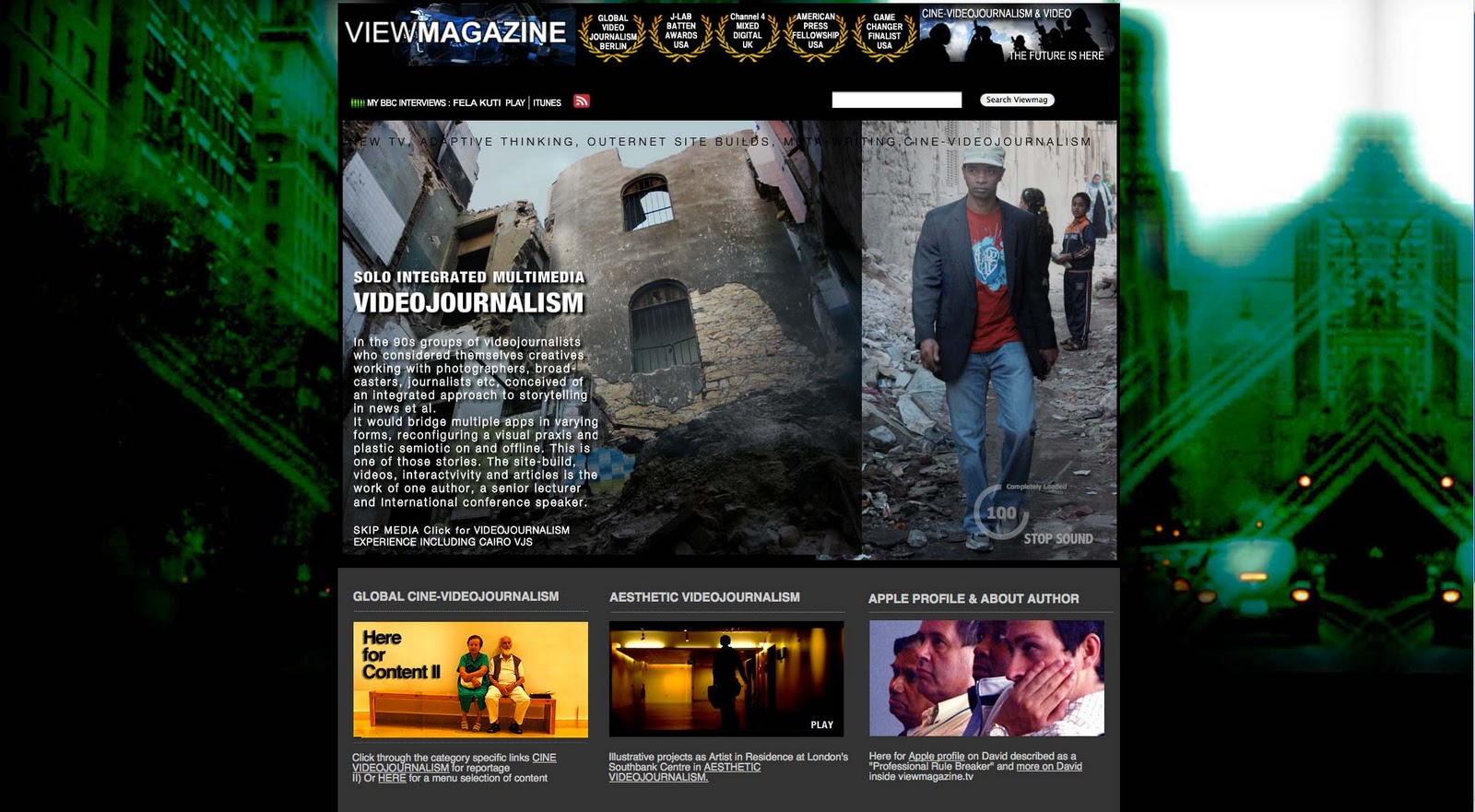
"In the 90s groups of videojournalists who considered themselves creatives working with photographers, broadcasters, journalists etc, conceived of an integrated approach to storytelling in news et al.

It would bridge multiple apps in varying forms, reconfiguring a visual praxis and plastic semiotic on and offline. This is one of those stories. The site-build, videos, interactivity and articles is the work of one author, a senior lecturer and International conference speaker".

SKIP MEDIA Click for VIDEOJOURNALISM EXPERIENCE INCLUDING CAIRO VJS

The Retwitter Show titles - journalism 2046 from david dunkley gyimah on Vimeo.

Put another way, in the 90s groups of videojournalists begun to crack applications like Flash and Director, mixed with After Effects. The visual praxis is a reference to change in style and language over the years.

If you look at a 1960s film there are things they do, that today would be considered outdated. The average news interview cut was 30 seconds plus, 43 in cases. Today, 3-12 seconds and you're out. What's the point of the SOT (sound on tape) then other than a reinforcing of the authors inherent bias or point of view.

Similarly the visual praxis has altered from 16mm grainy to 35mm glossy to mimicry in HD.  Academics would say HD mimesis :)

Plastic is a term used by the Arnheim and later Andre Bazin, one of the first film scholars, to describe film; referred to as the plastic arts.

So back in the 90s for want of a better name videojournalism assumed this all encompassing medium. It became plasticine, highly malleable, incredibly adept and frankly as limiting as ones imagination.

Videojournalism programming

Traditional programming which we can't jettison yet, mixed with idea forming for the net age, looks simplistically like this above. Each module represents a wider circuit of ideas.

Now here's the fun bit, which we're all having a nice little ding dong with at the moment.

If you cast your eyes across the book shelf of multimedia (Flash) film, art or music in your library you'll be lost in the sea of hardbacks, but when it comes to videojournalism - what do you see?

One of the best books for multimedia journalism using Flash is  Flash journalism by Mindy McAdam's.

In the 90s in the absence of any notion multimedia had any relation with journalism we sought out books like Masters of Flash, featuring the likes of the the fabulous Hillman Curtis, Brendan Dawes, Joshua Davis  - they became our mentors for most of Soho in the 90s. By default we looked for answers beyond classical journalism.

I remember it well when one senior BBC manager exclaimed: What's with this thing Flash? and he was a head of interactivity.

Advances in coding structure of Flash is such that today Hillman's site advises against purchasing his mega seller, but you only have to look at work like this to see how far ahead he was. My favourites are:
What made them exceptional wasn't just the creativity, but the functionality trying to push flash down 56k modems. That they did was genius and is still a function of google indexing today. The faster the site loads, the more appealing you are to Google's SEO robots.

In fact I can own up now, the coding structure - which I learnt helped me land the job as one of Lennox Lewis' promo, site and film makers. Lennox at the time was the heavyweight boxing champion of the world - about to take on Mike Tyson.

One of those sporting feats and occasions I'll never forget.
Filming Lennox Lewis training for his big world fight

There were magazine's galore as well e.g Computers Arts that showed the dark art and also inspired, today usurped by .Net magazine.

Cast your eyes - what do you see?
So when you look around for videojournalism, what do you see? There are a smattering of books - all good by the way starting off with Videojournalism: The Definitive Gudie to Mutliemedia skilled Television Production.

The book is out of print by the way and the author is an old friend from the group of videojournalists from 1994.

But the interesting thing is just as there are a million books on all the other creative fields, so there will be room for this nascent form, videojournalism to be scored in books a plenty.

Though I admit at this stage I agree with my publisher who sought a name change and different direction for the book I was/am writing. "The discipline is too limiting at the moment", she said. She's right.

It's not so much that you'll want to learn videojournalism, which can often be television masquerading in see through-clothes, but that you'll want to understand what the artist you're reading knows and how.
  • Where do they get their ideas from?
  • How are they inspired?
  • What are their epiphanies?
  • How do they deconstruct and construct their work?
  • What is their methodology?
For every artist, willing to submit themselves and publicly contest the artistry of their form may have something to say, that may interest you.


That's not to say you have to be over 25 to say something expressive [yes that can be patronising] since experience is independent of age, but we can't also discard the fact that if you reported the Vietnam War, you'd have experience to have reported the Gulf.

There's a reason why many journalism professors tend to be post 25, because aside from their knowledge, what you really want to tap into is their experience.

When ex-students talk to me about the job market in the UK, I remember my own private battle and the closed TV shop of the late 80s/ early 90s.

My sorry predicament would lead me to board a plane to meet a contact I had never met and defacto emigrate to South Africa to report from the danger zones of the townships.
David reporting for the BBC World Service from Kaylesha township

All of a sudden experiential learning begins to play a part.

They, multimediast, all have some back stories that compelled them to do things we might marvel at. There are obvious caveats to the form. In the latest work in Cairo, Salma- a newly minted videojournalism says she loved the independence, and flexibility.

To you it may be something beyond Salma's experience. How do I reconcile the mechanical camera with my own subjectivity? What is real and what isn't?

The award winning British journalist and documentary maker John Pilger opens up a debate that the camera, the device we place absolute trust in, can lie.  It can lie because it's not recording the truth, or the journalist or videojournalist is being too selective, because they can or are unconsciously being hoodwinked.

By the way this criticism wasn't beyond being levelled at the father of documentary, Robert Flaherty in the 1930s.

So our interest in the form is predicated not on just on normative values, but the experience of using a camera and failing, and learning from that to succeed. We read stories about stories. The stories we try to conceive ourselves laden with passion, conflict, information, hold us together.

And to keep our interests we look to cultural theorists e.g. Brian McNair to guide us, to keep us ahead of the creative curve. Take the concept of John Caldwell's 'Second shift aesthetics', where a multimedia story supports its television version, or how we think and that method of how thinking is changing.

A colleague of mine is presently researching the next generation of collaborative thinking. She used to work as a researcher for NASA, so her research I venture will have huge interest.


New Visualisation

Meanwhile, 3D TV is taking off,differentiating itself from online. Now a 3DTV every 7 minutes is going to a home near you from one of the big high street chains .

That surely will affect the 360 panoramic of video making because say the experts depths must be enhanced for the effect, camera positions and rapid cuts will be kept to a minimum to allow the aesthetic impulse to take effect.

"Some stories won't work", adds Brian Lens, Sky's Product 3D development, talking on the BBC's You and Yours consumer show.

 Then there's tablet visualisation. Take this interview I did in 2005 in Norway with Phillips's Frank Daems about their new e-reader - the birth of the tablet. How it's all changed. Or think about the apps market, or as they rounded up on You and Yours, the future of social space from the laptop to the living room.

So the future of the video form, still growing looks bright indeed, and just as there was a group of bespoke multimedia artists using video in the 90s, in the 00s we have videoists specialising in multimedia.

The fields wide open.

End

David continues to be excited by developments and in 2011 will be a juror for the Royal Television Society's Innovation in Journalism

Solo Integrated Multimedia Videojournalism - 2011 look foward

NB: This page will be deprecated. Please see next post for reposted version.
The transition in which the image gradually becomes clear on viewmagazine.tv is allegorical of video story telling I have been going through since formally from 1987.

On viewmagazine.tv I have included the following:

SOLO INTEGRATED MULTIMEDIA VIDEOJOURNALISM
"In the 90s groups of videojournalists who considered themselves creatives working with photographers, broadcasters, journalists etc, conceived of an integrated approach to storytelling in news et al.

It would bridge multiple apps in varying forms, reconfiguring a visual praxis and plastic semiotic on and offline. This is one of those stories. The site-build, videos, interactivity and articles is the work of one author, a senior lecturer and International conference speaker".

SKIP MEDIA Click for VIDEOJOURNALISM EXPERIENCE INCLUDING CAIRO VJS

The Retwitter Show titles - journalism 2046 from david dunkley gyimah on Vimeo.

Put another way, in the 90s groups of videojournalists begun to crack applications like Flash and Director, mixed with After Effects. The visual praxis is a reference to change in style and language over the years.

If you look at a 1960s film there are things they do, that today would be considered outdated. The average news interview cut was 30 seconds plus, 43 in cases. Today, 3-12 seconds and you're out. What's the point of the SOT (sound on tape) then other than a reinforcing of the authors inherent bias or point of view.

Similarly the visual praxis has altered from 16mm grainy to 35mm glossy to mimicry in HD.  Academics would say HD mimesis :)

Plastic is a term used by the Arnheim and later Andre Bazin, one of the first film scholars, to describe film; referred to as the plastic arts.

So back in the 90s for want of a better name videojournalism assumed this all encompassing medium. It became plasticine, highly malleable, incredibly adept and frankly as limiting as ones imagination.

Videojournalism programming

Traditional programming which we can't jettison yet, mixed with idea forming for the net age, looks simplistically like this above. Each module represents a wider circuit of ideas.

Now here's the fun bit, which we're all having a nice little ding dong with at the moment.

If you cast your eyes across the book shelf of multimedia (Flash) film, art or music in your library you'll be lost in the sea of hardbacks, but when it comes to videojournalism - what do you see?

One of the best books for multimedia journalism using Flash is  Flash journalism by Mindy McAdam's.

In the 90s in the absence of any notion multimedia had any relation with journalism we sought out books like Masters of Flash, featuring the likes of the the fabulous Hillman Curtis, Brendan Dawes, Joshua Davis  - they became our mentors for most of Soho in the 90s. By default we looked for answers beyond classical journalism.

I remember it well when one senior BBC manager exclaimed: What's with this thing Flash? and he was a head of interactivity.

Advances in coding structure of Flash is such that today Hillman's site advises against purchasing his mega seller, but you only have to look at work like this to see how far ahead he was. My favourites are:
What made them exceptional wasn't just the creativity, but the functionality trying to push flash down 56k modems. That they did was genius and is still a function of google indexing today. The faster the site loads, the more appealing you are to Google's SEO robots.

In fact I can own up now, the coding structure - which I learnt helped me land the job as one of Lennox Lewis' promo, site and film makers. Lennox at the time was the heavyweight boxing champion of the world - about to take on Mike Tyson.

One of those sporting feats and occasions I'll never forget.
Filming Lennox Lewis training for his big world fight

There were magazine's galore as well e.g Computers Arts that showed the dark art and also inspired, today usurped by .Net magazine.

Cast your eyes - what do you see?
So when you look around for videojournalism, what do you see? There are a smattering of books - all good by the way starting off with Videojournalism: The Definitive Gudie to Mutliemedia skilled Television Production.

The book is out of print by the way and the author is an old friend from the group of videojournalists from 1994.

But the interesting thing is just as there are a million books on all the other creative fields, so there will be room for this nascent form, videojournalism to be scored in books a plenty.

Though I admit at this stage I agree with my publisher who sought a name change and different direction for the book I was/am writing. "The discipline is too limiting at the moment", she said. She's right.

It's not so much that you'll want to learn videojournalism, which can often be television masquerading in see through-clothes, but that you'll want to understand what the artist you're reading knows and how.
  • Where do they get their ideas from?
  • How are they inspired?
  • What are their epiphanies?
  • How do they deconstruct and construct their work?
  • What is their methodology?
For every artist, willing to submit themselves and publicly contest the artistry of their form may have something to say, that may interest you.


That's not to say you have to be over 25 to say something expressive [yes that can be patronising] since experience is independent of age, but we can't also discard the fact that if you reported the Vietnam War, you'd have experience to have reported the Gulf.

There's a reason why many journalism professors tend to be post 25, because aside from their knowledge, what you really want to tap into is their experience.

When ex-students talk to me about the job market in the UK, I remember my own private battle and the closed TV shop of the late 80s/ early 90s.

My sorry predicament would lead me to board a plane to meet a contact I had never met and defacto emigrate to South Africa to report from the danger zones of the townships.
David reporting for the BBC World Service from Kaylesha township

All of a sudden experiential learning begins to play a part.

They, multimediast, all have some back stories that compelled them to do things we might marvel at. There are obvious caveats to the form. In the latest work in Cairo, Salma- a newly minted videojournalism says she loved the independence, and flexibility.

To you it may be something beyond Salma's experience. How do I reconcile the mechanical camera with my own subjectivity? What is real and what isn't?

The award winning British journalist and documentary maker John Pilger opens up a debate that the camera, the device we place absolute trust in, can lie.  It can lie because it's not recording the truth, or the journalist or videojournalist is being too selective, because they can or are unconsciously being hoodwinked.

By the way this criticism wasn't beyond being levelled at the father of documentary, Robert Flaherty in the 1930s.

So our interest in the form is predicated not on just on normative values, but the experience of using a camera and failing, and learning from that to succeed. We read stories about stories. The stories we try to conceive ourselves laden with passion, conflict, information, hold us together.

And to keep our interests we look to cultural theorists e.g. Brian McNair to guide us, to keep us ahead of the creative curve. Take the concept of John Caldwell's 'Second shift aesthetics', where a multimedia story supports its television version, or how we think and that method of how thinking is changing.

A colleague of mine is presently researching the next generation of collaborative thinking. She used to work as a researcher for NASA, so her research I venture will have huge interest.


New Visualisation

Meanwhile, 3D TV is taking off,differentiating itself from online. Now a 3DTV every 7 minutes is going to a home near you from one of the big high street chains .

That surely will affect the 360 panoramic of video making because say the experts depths must be enhanced for the effect, camera positions and rapid cuts will be kept to a minimum to allow the aesthetic impulse to take effect.

"Some stories won't work", adds Brian Lens, Sky's Product 3D development, talking on the BBC's You and Yours consumer show.

 Then there's tablet visualisation. Take this interview I did in 2005 in Norway with Phillips's Frank Daems about their new e-reader - the birth of the tablet. How it's all changed. Or think about the apps market, or as they rounded up on You and Yours, the future of social space from the laptop to the living room.

So the future of the video form, still growing looks bright indeed, and just as there was a group of bespoke multimedia artists using video in the 90s, in the 00s we have videoists specialising in multimedia.

The fields wide open.

End

David continues to be excited by developments and in 2011 will be a juror for the Royal Television Society's Innovation in Journalism

Friday, December 24, 2010

The Tax Man Cometh

It's an unavoidable societal activity for this time of the year. The quiet before the tempestuous inner turmoil.

No not the torment across the table from relatives you haven't see in 11 months. Ah yes, there was a reason you avoided them.  Nor the sibling rhetoric: "D'you remember when you mocked my pet hamster?

You: Yes, her owner has since become barking bonkers.

No, here I speak of taxes. There's a subject to wreck an Christmas dinner. Sorry!

A local tax expert, Guy Bridger I have come to know is flesh and blood; the collorary for many others - you get my point.
Guy Bridger - tax expert at the Treasury

He's also deeply conscientious having worked in the field for a good many years with a deft understanding of advising creatives.

A couple of weeks ago he had an idea, which yesterday led to a visit to the institution which over sees  national taxes, The Treasury. His idea is universal enough to cross national boundaries.

There followed an interesting conversation with an official. Unfortunately I can't say much about it, as quire rightly so, I have agreed to comply to my own self-induced NDA on Guy's behalf.

Meanwhile behind-the-scenes I have started shooting the story. It'll take many more shoots to complete the story, as it's not just about what he has discovered, but about him and his beliefs.

And if his hunch is right, and I in my small wisdom believe it so,   Christmas may be one element free of stress from the thought of an appointment with Mr T.

That was the year that was

It started yesterday and ends as fast as it begun.

Blogging continued, now a fixture of the expressor and an inescapable evidential routine: social networks, the participatory content maker, the intimization of journalism, the trans-morgrification of journalism's hierarchy.

The instability of its future has steadied; the inevitability of its future secured - it does have one, just.

My year has been equally memorable. My research thesis continues to surprise me not only in furthering my understanding of the past, which I would argue is deeply important now for both context and building on creativity.

There was Newswire organised by the good people at Journalism.co.uk where I invited a ding-dong - face to face debate on visualisation and videojournalism.

Collisions- my artist in residency at the Southbank reinforced artistic practice and how critical thought; often Art's raison detre led to questions, more questions.

This in turn has solidified my lecturing experience. This time last year  I had been invited to lecture at Rhodes University in South Africa. One of its lecturers I would meet sent me this lovely email recently
"Hi David
I was very inspired by the way you taught us and have adapted my course to reflect your more experiential approach to learning. This year I also taught a course where my students worked with ordinary people from town filming on mobile phones. Will send you link as soon as it is up. A"

 Then there was China - a deeply ingrained experience, both in videojournalism and how we learn. Art in Chinese art usually has multiple view points and perspectives I learnt.

In Bratislava I had a rare opportunity to speak to leading news makers from some of the world's independent media and more recently pushing further the concepts of the bastard child of film making videojournalism.

Yes, I meant that it ist starkest way. 16 years since I first practiced it; it's only been in the last few years that debate and new ideas amongst practitioners and creators has fermented deeper debate; some of cyclic. Yes we know the cameras are cheaper, but what else.

Next year January working with the BBC, we're looking forward to pushing it further and I'm confident the players involved will yield good new fruit.
 
Next year, based on new material and with some time to spare, I can get my own book out which captures my design video ( IMVJ) which I spoke about at SXSW and intend to do so at Apple stores in the new year.

Happy Christmas and holiday all. May the next year be more rewarding than the last

Tuesday, December 21, 2010

Tron 3D Legacy - review


Stunning, simply reviting, a film for the mobile Pad generation

Tron 3D legacy will blow you away; it represents a quantum leap in sleek graphics and draws on one of the coolest nonchalent actors around Jeff Bridges, reprising his 80s incarnation.

You could run out of superlatives, before you notice within the streams of white blinding light, there's a glowing digital elephant in the room and in Johnny Darkoesque fashion it won't go away.

Older abascus-dependent folk who witnessed Tron in their youth will have returned for the Nostalgia.

Younger folk into their Assassin's Creed will appreciate the concept of playing in a literally cool game.  The inbetweeners who fancy an itellectual as well as emotional ride may want to pick their intellectual chip on the way out of the theatre.

If they forget to, the film that dare not speak its name will be screaming all the way through this plot, which consists so much of back stories, that intertitles at the start might have eroded the need for large tracts of narrative.

Matrix! There said it!

Tron's franchise owners will feel unnecessarily hard done. They were there before the Wachowski brothers; in fact it's conceivable the brothers may have been influenced by this 80s ground breaking sci-fantasy.

If Tron 3D legacy had a lot to live up to then by its own standards, it had the looming shadow of one of the most impressive sci-flicks ever to contend with and sadly it does a poor show of it.
This was a formalist film exploring abstract ideas but not quite pulling it off. But not to worry; if it's a visual spectacle you're after, you'll be subsumed into the grid and a world of anatomical hugging fashion garments and the plotline of Bridges fighting himself is an intriguing feat of CGI.
  

Monday, December 20, 2010

Brian Hanrahan and those who knew how to write silence

In the crackling of shortwave radio, or the intermittent luminance of a television screen, I could but only let my mind wander.

Who were those who informed us of the world at large?

In boarding school in Ghana, I'd catch glimpses of Ed Bradley 60 Minutes, or Alistair Cooke. They were indelible sonorous broadcasts.

Later, I arrived back in Britain, from a country recovering from a war of crisis and coup de tats to Britain going to war in the Falklands.

Like many teenagers
I was unperturbed at what was happening somewhere in the deep Atlantic, but precociously mindful of occasionally catching the news story tellers.

"I Counted Them All Out and I Counted Them All Back" was a sight and sound I remember well.

One day, many years later a BBC Correspondent by the name of John Harrison would visit our house to complete a BBC report. Somehow that day I thought how I might swap a science degree for this ethereal thing of reportage.

In 1993, an event would bring me to ask advice of Mr Harrison. By then I was beginning to carve a career in journalism in South Africa. I never reminded him of our first encounter.

Through out my early days of reportage and even now, there were craftsmen and women I looked up to and marvelled at what they could do with words and the image.

Television's craftsmen and women
Brian Hanrahan, Harrison, Brian Barron, Trevor MacDonald, Peter Jennings (whom I would  meet to as an ABC Associate news producer in South Africa), Michael Brunson, Bill Nealy, Kate Addie and Sue Lloyd-Roberts.

Their manner was not so much to report, to inflect the voice into that forced undulating preposterous sound, but to speak to you.

I never knew Brian, but would often bump into him at Chatham House meetings, which at one point I might as well have asked for an extra set of keys I was in and out so often.

That aphorism is as deft and indelible as Michael Buerk's: "Dawn, and as the sun breaks through the piercing chill of night on the plain outside Korum it lights up a biblical...."

Though yes completely different circumstances.

The phrase stayed with me long enough to yield an interesting back story.

The Hanrahan story
Rupert Nichols - Hanrahan's Navy minder in 1982
In 2005, now a senior lecturer in journalism having had a good bat at the crease of journalism, I recounted some of my favourite stories to a Rupert Nichols.

Rupert Nichols is a retired Navy press officer,  an LT in rank who provided me a treat.

In 1982, he was tasked with minding a young reporter, a chap by the name of Hanrahan with whom he would quickly come to trust.

One morning a sensitive sortie of Harriers was planned. The reporting of the event was not so obvious, frustrating in fact because the press were not allowed to report from the flight deck.

Nichols shared a plan, he would count them all in having counted them out - off course he Nichols knew the full number and name of the pilots, but it wasn't information that could be reported.

Nichols handed over his information to Hanrahan and thence came that entombed saying: I Counted Them All Out and I Counted Them All Back".

When Nichols tells this story, his eyes light up like the quiet anonymous TV producer which a viewing TV audience rarely sees or hears about.

I mention this not as a spoiler of this great BBC reporter's legacy because he had the choice in the delivery, and lesser reporters would have fought the ocassion, ruined the sparseness it delicately encapsulated.


No, but I'm sure as many of us roll back tears, his family and close friends, one former LT Rupert Nichols will share in his own quiet thoughts when two young men met 28 years ago.

To a generation of reporters, which lest I forget included Charles Wheeler and Martin Bell, the art, true art of reportage is slowly drawing its curtains.

Bell mentioned on BBC News today, in words that only a craftsman could deliver of another: "Hanrahan knew how to write for silence".

No greater legacy could be offered to a new generation of storytellers than those who treated the television screen as a person and turned the dreams of a young lad listening to short wave into, what many of us consider something truly memorable.


His interminable silence will be missed.

Sunday, December 19, 2010

Flying copter cam from your iphone

I missed the last ONA meeting in London, but the group kindly filmed this to share.

The flying cam is something. THINK about the shots now from those aerial demonstrations

Videojournalism and David Dunkley Gyimah's camera

David in Egypt shooting on the JVC GY 100
My ode "Me and my camera" is buried somewhere in previous posts, but whilst your camera isn't everything, it can become something.

Often the wrong question is asked. What camera should I get?

I reply what do you want to do?  You make your cloth according to the party you're going to.

Of course the D50s have done a Dyson on the camera industy's hoovers.  You just can't be complacent.

But old timers, Uhum! and I straddle that grey zone will eulogise about the beasts and also the training that went into becominbg firstly an accomplishd camera wo/man and then director.

This Sky promo brings back some memories running around in the townships of South Africa. Yer gota know your filters from your white balance


No worries though, I converted to small cams in the mid 1990s. I have gone through a raft of the things - from the super VHS - yes I actually shot my BBC TV audition tape   on that and yes I got the job, to the Hi-8, Beta, digibeta, VX1000, the A1, and now JVC.

My first Mac book with FCP 1.0 and Sony VX1000

Over on Mac video the Canon XF 100 and XF300, with a little help from the 60D is cooking up a wee fuss.  I'll not be surprised if my good old friend Claudio Von Planta purchases one. Since owing the A1, he's shown an astute sense for choosing the right cameras for his gruelling jobs.


Claudio Von Planta pops by David's old pad to talk about the Sony A1

To broadcasters it's the fact a camcorder sized cam samples 422 and pushes video at 50mbit. For the techs it's all in the figures. If you're going online, the question remains, what do you want to do?

That said though, my hunch, the IPad is a stepping platform to personal cinema, so those codecs and high resolution will come in handy after all circa 2015, alongside the next mobile revolution of exclusive cloud-based media.
The monstrously superb digibeta, but at 50,000 UKP it was hard to justify when I turned to the web

So before I go DSR I'm sticking to my array of lenses for my JVC GY100 and its lens turret.

I like the feel, the balance, and centre of gravity is ergonomic plenty. You'll win no points for fast focus pulls - if you're not used to it, but apart from that avoid pointing the thing at nervous folk with side arms - you know what I mean.