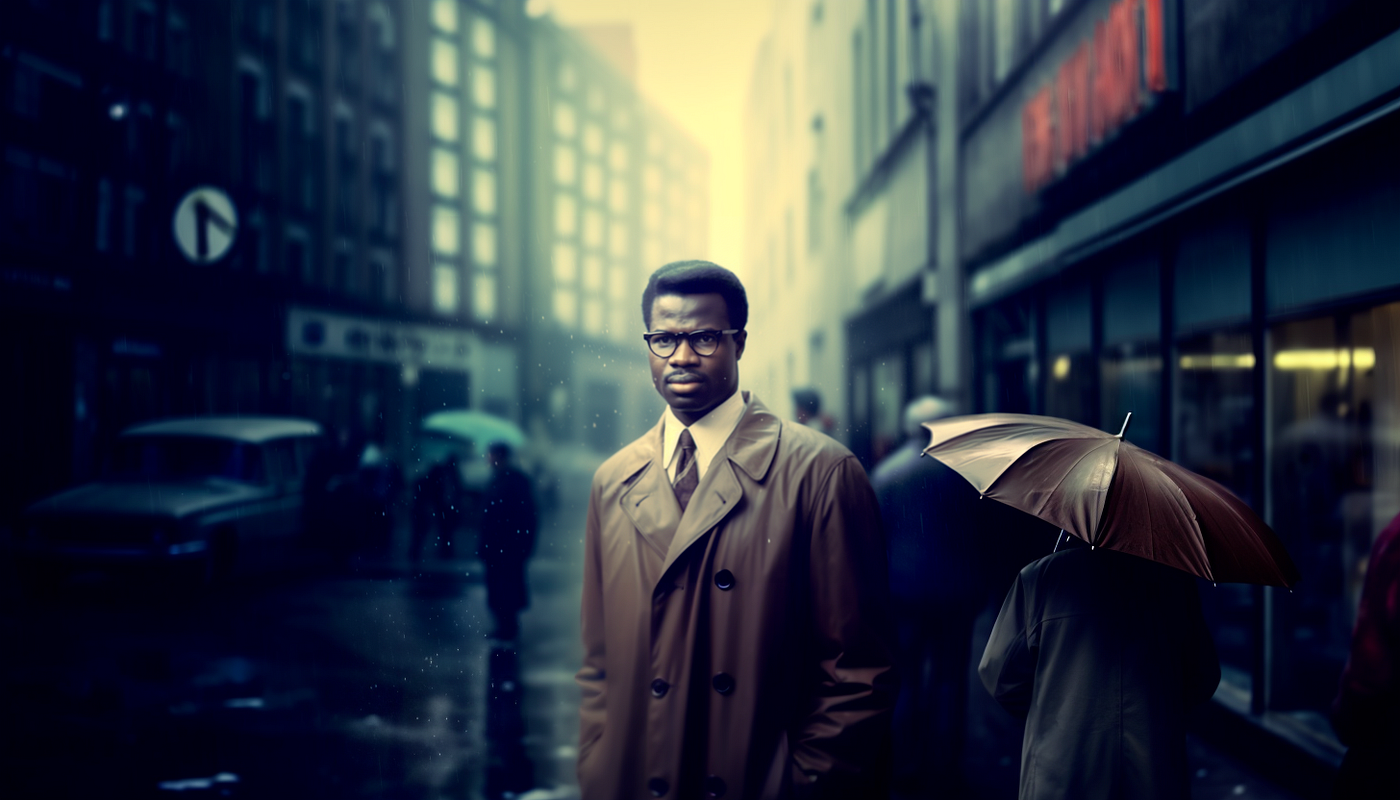
Astory about a young police officer who travels to the UK in the 1950s from West Africa seeking a new life shows a future of AI evolving filmmaking. And it will particularly benefit communities.
AI was used to recreate half of the visual scenes from researched documents.
The officer Edward Gyimah was 25 years-of-age when he travelled to Britain in 1955 on a government scholarship from what was then called the Gold Coast. The Gold Coast would become Ghana in 1957 — the first African country to achieve independence from Britain.
The story called “Chairman — The Ghanaian”, is just one of the lesser well known narratives of 1000s of West Africans who made Britain their home in the 1900s. Chairman is a term of respect used in Ghana to address a senior figure.
“Chairman — The Ghanaian” is the story of my father. I’ve been finding material (a suitcase of letters, photos and his passports) 17 years since he passed away which paints a vivid picture of his trials and travels.
The photos prompted quite a reaction on social media when I posted resulting in people posting photos of their parents too. Several people, such as Marcus Ryder MBE, Henry Bonsu and Jo Holmes left comments.
The issue I had, which is commonplace is, there was limited archive to expand on his story. But the use of Generative AI has solved that problem. The promo below is a first iteration, and already I can see new improvements and new apps I could use. By 2027, I can’t imagine where we’ll be.

Journalism and AI
I’ve been a journalist for more than thirty years and have worked for outfits such as Channel 4 News, BBC Newsnight and ABC News. And also as a technologist and artist I’ve been involved in several media innovations. The angle I come at with AI is largely different from dominant views. Some of the innovations I’ve championed include:
- Cinema and video journalism — a study and work showing how a new breed of journalists, some from the BBC, use cinema’s langue to tell stories
- Mobile journalism and VR — creating a mobile film Bass Culture, a 500k Arts and Humanities Council project, which was shown on the big screen at Regents cinema where the Lumieres brothers screened their films
- Creating platforms that have appeared on Apple’s website — creating one of the first video magazine platforms in 2004 before YouTube which would win a Knight Batten Awards
Innovation tends to be accompanied by apocryphal stories and the “industry-is-dead” themes. So what of AI? What’s so different ?
The impact of the industrial revolution on artisans provides a framing for the future. Not unlike painters who were the news people of their day reconstructing scenes from memory, Gen AI for many practitioners fulfils the same function.
Critics speak about the ethics, and that can’t be ignored, but there were ethics that were overcome with the generation of art, and photography in the 1800s. It resulted in the introduction of broadly agreeable standards. The same will happen with Gen AI.
Industrial manufacturing markedly reduced the work of carpenters, carvers and metallurgists, but in time there was a premium for having worked produced by experts.
The promo I’ve produced using AI takes the viewer through my father’s ups and downs, and his eventual return to Ghana with us, his children. His motives for coming to the UK, abandoning a career in the police force was to study and return to Ghana. His life mirrored scores of Africans coming to the UK on scholarships. He would return home almost 20 years after his arrival.
Whilst Africans have been in Britain since the 1600s. According to one of the foremost authorities on African history, Professor Hakim Adi author of West Africans in Britain 1900–1960, after 1945 there was a fundamental change which saw the number of West African students, including women, in Britain increase. Professor Adi writes:
By 1945 this figure had risen to over a thousand, about two thirds of whom came from Africa, the vast majority of these West African (mostly from Nigeria and the Gold Coast)… by 1948, divide over 1000 west African students in the country.
Today, Black Africans outnumber Black Caribbeans in the UK. The 2021 census says of England and Wales was 59.6 million:
2.4 million people (4.0%) were from black ethnic groups — 1.5 million of those identified with the black African ethnic group (2.5%), and 0.6 million with the black Caribbean ethnic group (1.0%)
In constructing the promo, amazingly I was able to create photos of dad from AI that my close family did not realise were AI generated. Whilst the impact of AI will be colossal, and will reshape the industry it won’t based on forecasting lead to AI media utterly usurping actual media and people.
They’ll be a secondary workforce burgeoning just as we’ve witnessed with multimedia, but mainstream has not disappeared, anymore than actors will. And if you’re a Trekker, seriously there’s the future writ large in front of us all.
Chairman was one of a number of ideas I took to Ghana in April and was taken to meet the former President of Ghana John Kufuor and several CEOs by one of Ghana’s leading academics Prof Kofi Asare Opoku.
The President took a keen interest in the work and requested I continue to probe.

One of my main aims is to teach a new generation of its efficacy and where it could help in media. Its hugely important that its adoption is wide and absorbed particularly by students from the Global South, where technology and media access has historically been challenging and led to deep chasms in the knowledge economy.
AI will accelerate a new information horizon and its vital data and industry participation towards shaping existing biases, that will be baked into the future alone, are addressed. But what are the odds of this? Media as a business is forever gazing at its bottomline navel, looking to new ways to up its profits. AI is its Sapphire.
Yet by itself is AI is a tool, it’s not sentient yet to think by its own, so it’s the thinking process towards creativity which has huge currency. Systems thinking, design thinking and cinema journalism are a few of the methodologies used to enhance this future filmmaking form.
To that end, I’m in talks with a number of people, academic outfits and bodies, and look forward to inviting AI storytellers, practitioners and academics, to the University of Cardiff where I’m based. We’ll share and publish work. More recently I’m honoured to have been invited to join the Pan African Heritage Museum in Ghana as a member of its academic and curatorial Council. AI storytelling will have much to say in Museums.

I’d like to thank Prof Prof Kofi Asare Opoku, Professor Pash Obeng, and Senior Kojo Yankah founder of the Pan African Heritage Museum for their ongoing suport.
I’m a reader/ Associate Professor at Cardiff University with a specialism in innovation and Story Labs. You can contact me here Gyimahd@Cardiff.ac.uk For more click here


