Sunday, May 07, 2017

What Did Journalism Ever Do For Us?


Context

Here’s my story! Skip if you want, but this is my intro to journalism
I was being moved from one foster parent to another in the UK before my Dad hauled my sisters and I off to Ghana, where he’s from. I got put into a boarding school (with a cadet military wing) set up by Eton missionaries. Exciting, but bloody hard life for a 12-year-old. I wrote an article for our school mag about the Neutron bomb when I was 13 about humanities impending apocalypse. Precocious!
Couple of boys used to read this American magazine called GQ and dress up like dandies. In 1981, I got caught up in the cross-fire of Ghana’s military coup wearing cadet garb. We boys were helping to look after an international football game when warring factions of soldiers kicked off. People had been sold this fake report that the country was being invaded by Libyan soldiers. I got heckled and pointed out because of how I looked, so had to flee home for my life, shouting in twi (native language) I was Ghanaian.
There were only one or two professions I was meant to pursue. That was the patriarchal way: a doctor, or a lawyer. Law, uh, uh! I baulked at medicine, when I was shown a face being peeled off by medics. Nearest stop was pharmacy and I was pretty close, before at Uni — De Montford Uni in Leicester (It was a polytechnic then) — I discovered journalism and started freelancing for the BBC and writing for our university mag.
Thirty years on with journalism in turmoil or in an excitable state, depending on your point of view, and a doctorate that explores cognitvism and storytelling, a friend who always refers to me me as Geezer asked me: What Did Journalism Ever Do For US? Apologies to Monty Python followers.


Wecan all tell stories, but journalism’s structural form of storytelling is predicated on the psychology of crowd behaviour. It can be learned by mimicry, hence you don’t need a Masters which acts to accelerate the process of comprehending the dynamics of words and images on our emotions. Hence, that’s why citizen journalism was never a contested form, and the lines between journalism and marketing is a blur . What did journalism ever do for us? It taught us how to reduce what could be complex events and issues and reduce them to easily accessible experiences. It taught us, consciously to intuitively, how to produce breathless adventures that tickled the amygdala of our audience — that part of the brain that controls our reaction to stimuli — accentuated by visual, auditory and kinesthetics regions of the brain. Take South Africa’s first all-race election that @MsAlliance tweeted about yesterday. It was a momentous event, which I had the opportunity of reporting and producing on from the ground for the BBC World Service, BBC Radio Four and ABC News.

Then there’s stories I’ve produced near the Turkey-Syrian border, China, Egypt, a training project with journos in Russia, and a diving expedition in the Dardanelles looking for WWI ships. You become a story teller by dint of experiencing and recounting these things. The manner in which we unreel the plot of a story, something Russian formalists detailed, altered the reception and desirability of the story. In other words we could both have the same information, but one of us could alter the structure of our reportage, we’d have a different affect on our audience. However journalism offers a particular social framing and linearity for storytelling with conventionalised rules. In television, its methodologies are creaking under the weight of cultural and tech developments e.g. the Net and VR.

2. MEET OTHERS OUTSIDE OF YOUR FILTER BUBBLE

The ideal in journalism is to understand quadrants of a story that are unreachable by standing in one point, by listening to a point of view, therefore at its best journalism gives you access to share the company of diverse, interesting, and on occasion unorthodox people outside of your now nominal (Facebook) filter bubble. Without journalism, how do you hear about the other side or meet people you normally wouldn’t? I interviewed South Africa’s arch racist Dirk Coetzee who ended our interview by saying if I’d been this close to him ten years ago, I’d be looking down the barrel of his gun. When a couple of Afrikaners found out I was a Brit they urged me to atone for the British use of concentration camps in SA. My tax advisor, a former Storm Model thirty years ago wants to revolutionise the British tax system and asked me along to a meeting with Tax revenue department which I filmed here. What an experience. I was in Russia recently working with regional journalists getting a different and nuanced perspective about events in Russia. Journalism provides you with a legitimate excuse to explore the other side if you’ll take it?

3. FORCES US TO GO TECH

In the 90s I was recruited as part of thirty people in an experiment to become this strange animal called a videojournalist — journalists who could shoot, direct, edit and report, as well as produce stories in multiple forms. I was watching Anthony Joshua’s world title fight on TV with Klitschko and thought back to when I was one of two videojournalists employed by Team Lennox Lewis to document his fight with Tyson in the US. Journalism as a discipline/vocation needs technology to develop as a business.
Urging the industry to introduce new technologies in the 1970s, without wanting to pay for it, television execs realised tape-based stories could cost less and allow more stories to be produced that film. Technology is a bottom line issue.
As an individual it forces us to be entrepreneurs and to engage with as many different technologies, trying to find fixes to new ways of telling stories and figuring why they work, and what they bring.
About ten years ago I was invited, as part of a ceremony, to speak at the Washington Press Club after designing and building in HTML/CSS/Java an online brand about multimedia story forms ( see end of piece). Unfortunately, the word “Journal” and “ism” is moribund. If you were a Martian landing on Earth, you’d rightly ask “where’s the journal?”. We no more write in a journal any more than engaging in the public perception towards the fixed ideologies from its ‘ism’. Hence each tech piece that could liberate us from the narrow confines of story telling drags us, sometimes kick and screaming back to the 20th century. Are there are parallels between Newtonian physics and Quantum states with journalism circa 16th century and today?

4. BECOME AWARE OF LIMITATIONS

Journalism is piquantly constructed stories created to appeal to targeted audiences. News journalism is but one of its many strands — as documented in Andrew Marr’s My Journey. There is no such thing as objectivity, though rightly we strive towards it and the boundaries between PR and journalism are paper thin. Rather than provide us with all the answers, as we’re led to believe, journalism should be an adjunct, to make us more critical of what we see and hear echoing the mythical sentiments of one Mr Paxman who’s purported to have said, why is that lying bastard lying to me. In its poetic form it gets under the skin of power, and brings comfort to the oppressed. Too often though its television and nupes form can be a blunt 5-minute instrument, filler, crude and sensational troll to our irrational fears. The world is too important to be left to journalists, said someone, because they assemble complex issues as if they were IKEA packs.

5. AWARE THAT EDUCATION AND DIVERSITY MATTER

For all it says turning spatial and temporal information and data into cause and effect narratives, it is significantly dependent on the journalist — as a matter of interpretation. Apriori knowledge matters in shaping narratives, not withstanding craft skills. Our beliefs, Descartians “who we are” infect our stories. Who we are, how experiences shape how we think, how our brains are wired is so concealed we ignore its potent force. For that reason, approaching a story from different sides means allowing for diverse views, diverse people, genders, and points of views — if we desire a more rounded story. However we routinely ignore these. Journalism should make us aware that education and diversity are critical in political spaces, if we believe inclusivity is paramount to development.

6. SEARCH FOR ANSWERS

If we allow it, journalism by its own shortcomings, urges us to search for alternative answers to problems. In When Old Technologies were New author Carolyn Marvin paints a picture of the development and usefulness of emergent technologies. By the time a technology becomes public facing, much of its philosophy and psychological use has been pre-shaped by a few people. There’s a moment in the 196os when the father of cinema verite Robert Drew captures cinema as journalism on film and shows it to a network editor. “You’ve got some nice footage there”, the editor says blissfully unaware that the footage was the story. VR, 360 Presence Reality, Bots present new possibilities to crystalise information but through whose prism and hegemony. Thus far, journalism has found little answers to Dr Ernest Dichter’s depth manipulators. One of the ideas we advanced at the Digital and Interactive Storytelling LAB is fashioning videojournalism alongside a broader palette of image and textual narrative — something Drew did, and Vertov did before him. It’s called artistic videjournalism or cinema journalism and we’ve used it effectively on a range of stories and teaching the next generation.

Postscript — Filming in China

Does VR fundamentally shift the heuristics of making a movie and hence its biggest failure thus far is a) our wanton application of Euclidean thinking to understand circular geometrical space? b) What’s its aural sound equivalent? c) Does revising its conceptual production mean going beyond our nominal way of 2d spatial geometry? Is mobile journalism real or an invention by marketeers, and if it is can I tell a mobile production shoot as its USP apart from a conventional camera shoot? Is our predilection to shiny objects and the fear of being left out the reason we rubberneck into attending tech conferences?

End Notes

It’s invidious to use the word “Us” inasmuch as who is “Us”, but I thought of leaving that open to interpretation.
Dr David Dunkley Gyimah heads up the Digital and Interactive Storytelling LAB and publishes viewmagazine.tv


Sunday, February 19, 2017

Millennialisation and the Fusion Approach - Seeing where your cohorts’ talents take them.

The Dean gave me a padlock, a metaphorically one. The current key represented the status quo of university learning, the polished well honed modular structure many of us have benefited from accruing knowledge and acumen for a range of careers.
For journalism it’s typically the pyramidal writing skills, broadcast reportage, law, principles of multimedia journalism, to name a few.
However this lock needed a new fob that read ‘millennialisation’. Millennialisation negates fixed frameworks in favour of fluidity, a start-up culture and the ability to ‘pick and mix’. Former IBM and Price Waterhouse consultant Chaudhry Faisal Mushta, now the chief executive of Roots Millennial in Pakistan, sees knowledge becoming uberised.
Today’s students have a “new set of values and cultures”, he told The Times Higher Education, adding, “If you can uber a cab you will be able to uber a qualification or an audience”, with costs, accessibility and security high up on the power point slide.
Doing the same mechanised thing from a single syllable has been the norm, however for millennials that no longer cuts it. There’s a dissonance which must now work, to be ‘a jack of all and different trades and master of them too’. Take journalism or any subject for that matter at higher education, it’ll have to be more agile offering the opportunity to build your own learning zone guided by educators who act as trouble-shooters, curators and knowledge and pastoral providers.
Fifteen years ago, pre-multimedia journalism we were one of the first to teach student journalists how to build their own sites using HTML, CSS with Flash action scripting, and film and edit their own reports.
Rania below was one of my MA students from 2006. I met up with her in Egypt in 2009 for the first time which I recorded in this video. In 2015, I wrote her reference for a new chapter in her life studying an MA in film and documentary outside of Egypt.
Today a spectrum of learning outlets offer higher education curricula — from online Lynda.com to one day skill training at, say, The Guardian newspaper or the full YouTube experience for €1,705. They may not look like they’re in direct competition with the university ecosystem, but the governments’ attempt to make the education sector more market-driven will no doubt be the impetus for new players.
To that key then. What do millennials want and what can universities give them, or to be precise what can that key do to move our cohorts ahead of the curve? The answers are wide ranging, but that fob says ‘fusion’ and ‘beta labs’.
Returning to journalism as an example, what if we took journalism in its digital and analogue manifestations and fused it with cinema? It’s an unlikely and perhaps contested relationship. Over the course of a six-year part-time PhD at University College Dublin I wrestled with that relationship and its concomitant cognate fields: cognitivism, semiotics, memory, diversity in storytelling etc., and a literature review that delved into storytelling’s multiple theories.
US professor in journalism Michael Schudson writes journalism is a social construct influenced by literary and social conventions. Cineastes might easily say the same of cinema. There appear obvious differences but cinema, its visual language, montage etc. from which journalism gestated with a strict set of guidelines, is a major influence for millennials.
If you’ve watched Scott Pilgrims vs The World, there’s quite enough cues that could influence fresh deliberations in journalism, as exemplified by AJ+ below: the intense continuity, jump cuts, graphical overlay, irreverence, language syntax — all of which contributes to an accelerated cinema approach as cited by visual visionary Matt Hanson.
It’s interesting to note that AJ+, which riffs off this and MTV genres is barely three years old, but has made a significant impact in visualisation. Is there more out to be captured, particularly geared to the Net — which is ruleless? Yes!
 If you’d like to see what AJ+ would have looked like in the early 1990s, this is what the BBC offered on an award-winning programme called Reportage, and yes I look like I’m five years old.
In fusing the two, and understanding their limitations and strengths, we re-explore territory opened by Robert Drew, Vertov Chris Marker, Forough Farrokhzad, Kathryn Bigelow, and Steven Soderbergh, and many more about how to capture and create language that is meaningful to audiences in rich, explicit and sometimes implicit ways. This doesn’t render traditional journalism obsolete, it’s seeing journalism from the millennial lens.
Think how many films today start with the monocle: “based on a true story”, e.g Hidden Figures (2016), and what if we had the means to sight such content and shape it before our big screen colleagues weave their magic.
Yes in some cases access would be an issue, but when I reflect on some of the stories I have been privy to, South Africans de facto voting to end segregation as a government policy, Chongqing’s burgeoning tech, and a journalism training programme in Lebanon, I see now missed opportunities. With the South African story, I covered this in 1994 as a radio doc for BBC Radio 4 and in 1999 for Channel 4 News as a feature piece.
No media is free of the influence of its creator, even journalism, so diversity, identity politics, philosophy and social behaviour become a necessity in cinema journalism. In traditional journalism these and others are tucked behind the cabinet — hidden figures indeed.
In spite of a reliance on tech, cinema journalism’s dependency revolves around critical thinking. Every frame counts . Critical thinking is a much oft used word, but not always made good on. Take social media, it’s viewed as a monolithic entity, when it’s not. Students and journalist cite tweets to confirm their own biases, without understanding the author who has 12 followers and tweets once a year and list hobbies wholly inappropriate to the story, discredits their credibility.
Cinema Journalism was one offering joined by interactive factual narratives — how coding beyond websites and apps can create fresh interfaces for engaging stories — then there’s photography. We’ve called this combo the Digital and Interactive storytelling LAB ( disLAB).
This fusion of disciplines, in which bots mix with business and journalism goes farther into machine learning, provides a framework for learning where discovery builds new theories to accompany the multiple ones that already exist. The myth that we can neatly explain the world in unitary grounded propositions discards the myriad cultural philosophical approaches.
How Trump won the US election cannot be so easily packaged into the anti-establishment mood of an electorate, anymore than Neil Postman’s ‘technology-sedating, consumption-engorging, instant-gratifying bubble’being the sole reason.
This calls on a greater onus on creativity and innovation as flagged up by a number of reports from the creative and business industries e.g. PWC surveying CEOs about what’s required for their workforce in the future.
In the new learning environment of millennials, hackathons, active learning in the community on real cases, collaborative learning with lecturers, trial and effort with failure built in as an index towards success the next time around, and more informal settings may be the other set of keys. Fusion sees students being in control, with educators seeing where their cohorts’ talents take them.
This is a story I made about three of my MA students whom I shared quality time with on their final projects. They graduated in 2014.

Dr David Dunkley Gyimah leads the Digital and Interactive Storytelling LAB, at the University of Westminster.
His postdoctoral work explores language and structure around ‘journalistic’ content, and how innovation is used to propel, enhance, and sometimes obfuscate meaning. He is behind the Cinema Journalism movement — a group of video journalist who are platform agnostic absorbing tech to create factual cinema.


Tuesday, January 03, 2017

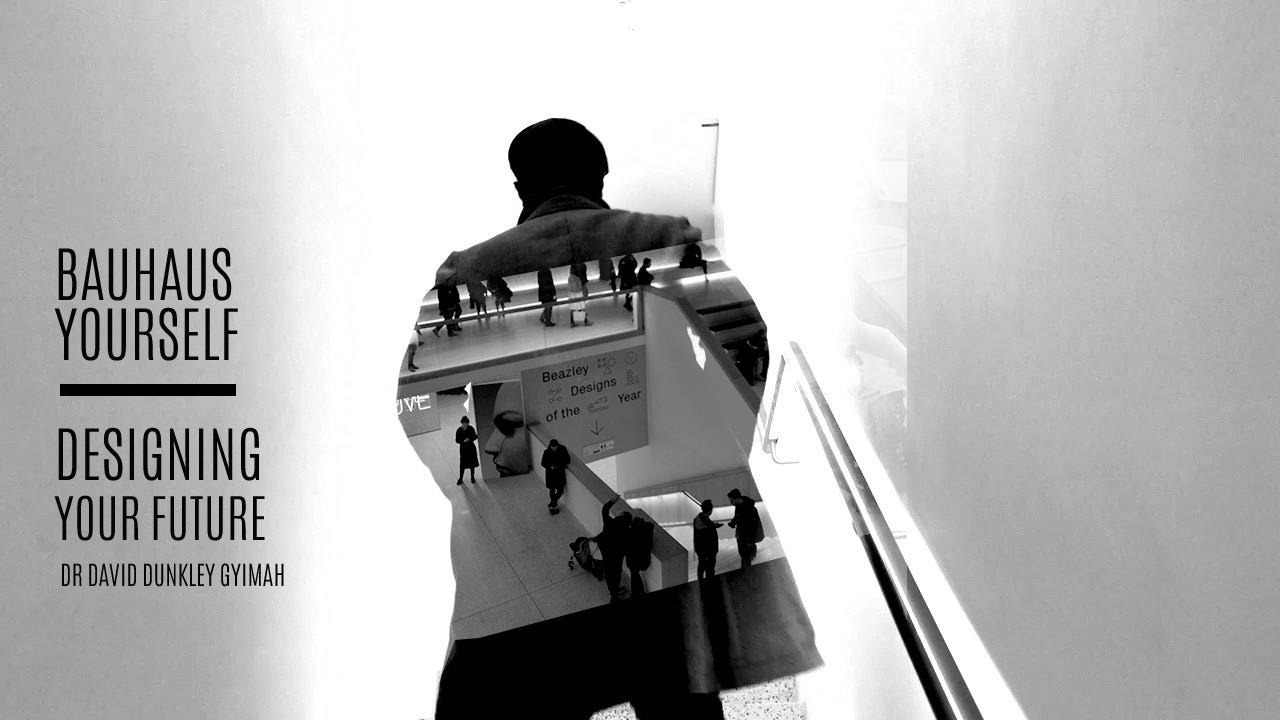
Designing your future in 2017 plus


The future isn’t what it used to be. It lives in the minds of dreamers, idealists, and artists who see its long shadows. We only bear witness once a moment in time has decomposed, when our minds play an affirmative truism game. It was always meant to be, we end up saying. Coincidence takes on the veneer of determinism. Can we tell what we’ll be saying a year from now?
As 2017 rolls out its carpet we walk its path. In ‘The future isn’t what it used to be’, a speech delivered by Steve Jobs at a 1983 design conference, Apple’s co-founder extolled simplicity. Our approach, he said in Walter Isaacson’s profile: Steve Jobs: The Exclusive Biography will be:
Very Simple, and we’re really shooting for Museum of Modern Art quality. The way we’re running the company, the product design, the advertising, it all comes down to this: Let’s make it simple.
Job’s concept of the modern world was lifted from his fascination with Bauhaus, a design philosophy originating in 1920s Germany that affected architecture, furniture, craftsmanship, art and society.

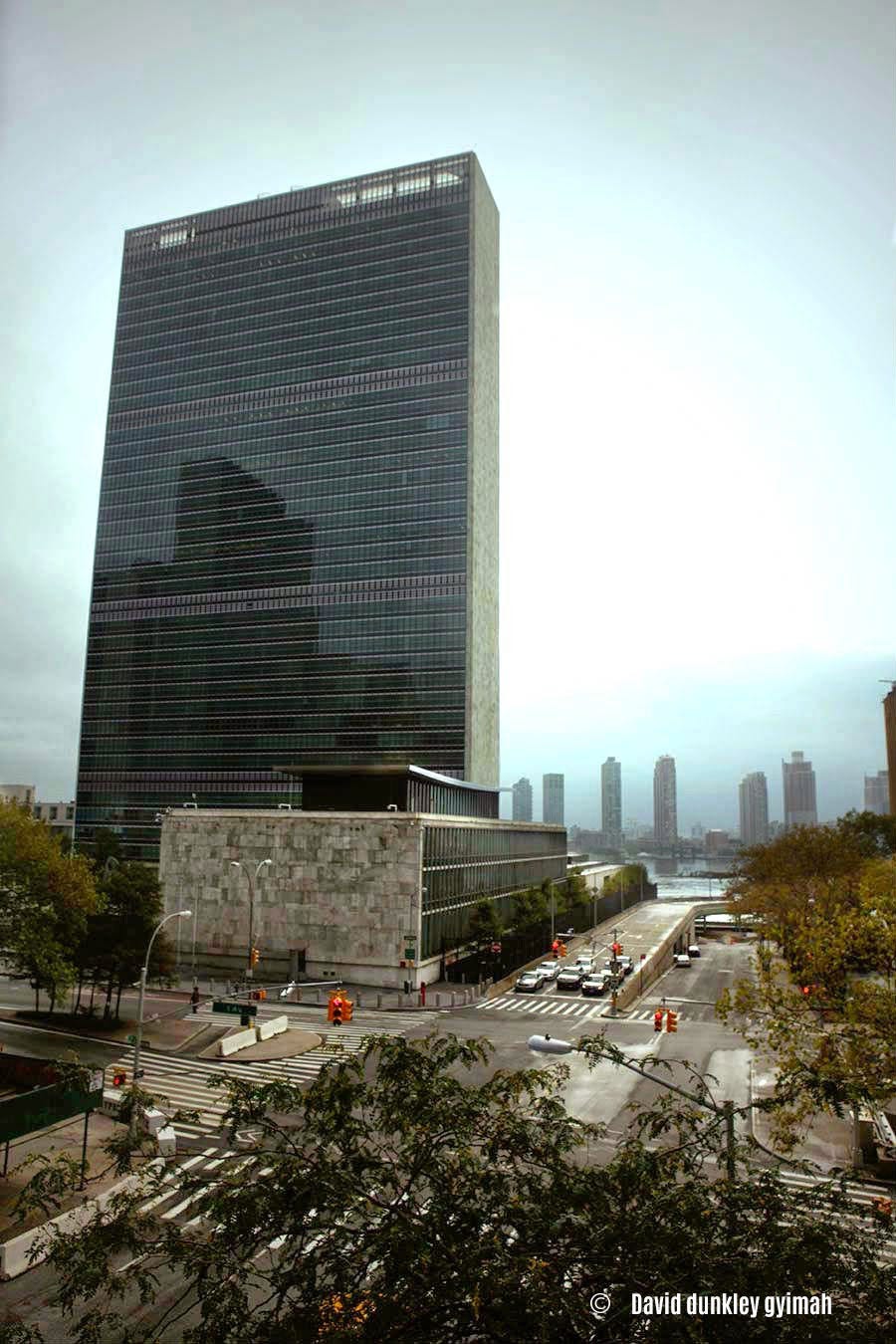
New York, overlooking UN

It was a ‘thoroughgoing romantic yearning for unity and harmony in autonomous shared work’, which was ‘dedicated to art and faith’. ‘Less is More’, ‘form follows function’ and ‘God is in the detail’, said its scions Walter Gropius and Ludwig Mies van de Rohe.

Though this aesthetic has spearheaded Apple, invigorating its many disciples; in 1999 I travelled purposefully to the US to buy my first powerbook then boarded the next plane home, 2017 could hardly be more pressing for an upgrade of, among others, Bauhaus’ principles.

Those other movements, speaking at Apple store London, include Impressionism, a faithful attempt at the recalibration of then 19th century rule-governed reality. The most powerful controllers of content, the French Academy who were the MSMs of their day designed what audience could see. Paintings needed to be life-like in form, empowering VIPs, and on message. Then these proto — Star War’s rebellions (impressionists) came along. A radically different presentation of truth and realism would gradually ( Impressionists were ridiculed and ostracised first) too hold of society.

Bauhaus, like Impressionism, less a movement, more way of life, is prone to a characterisation of the application of clean lines and haptic functionality, and art that captures fleeting light and small gestures, respectively.

But Bauhaus original was a reaction to political and economic elitism, militarism that had absorbed art and craft for industrialisation (WWI), and the iniquities of demagogue elected officials. ‘Form follows function’ and ‘less is more’, are invariably wield out by experts as universal truths, but they were reactions to what Bauhaus aficionados saw as unpalatable ostentatious, elitist practices at that time.

Design assumes an approach to fulfil a motive, to create solutions and invariably ask questions. I like to talk about designing news, documentaries, mobile and cinema journalism in the vein of impressionism, or a Bauhausian way. These aren’t fixed aesthetics, but a reaction to the status quo, yet enveloping recognisable design principles. 


It sound absurd, but the production of these forms involve design processes, in which innovative artists open themselves to lifting ideas from one discipline to another. Impressionism emerged from Japanese Woodblock painting.

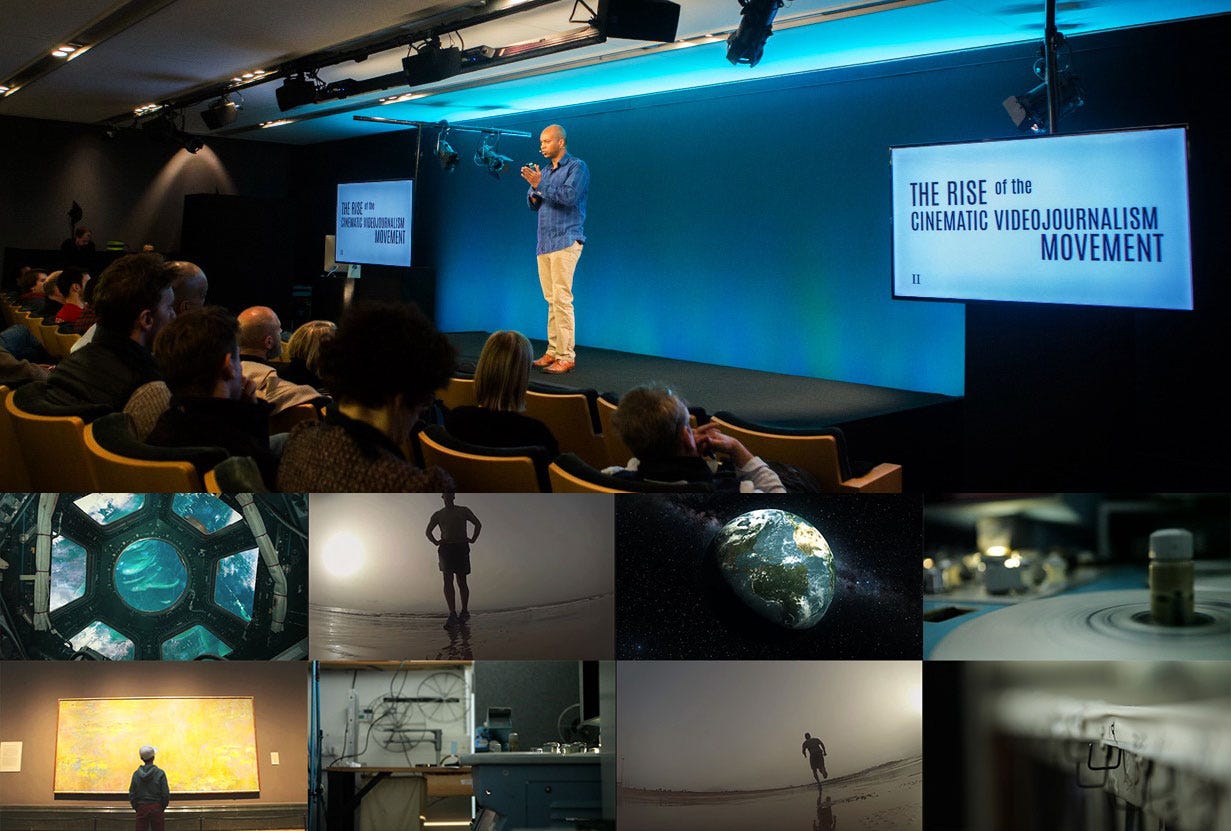
Dr David Dunkley Gyimah speaking at Apple Store, London

If Bauhaus inception sounds like 2017, French poet and essayist Paul Valéry’s 1937 essay recycles the future, with his, the future isn’t what it used to be, stating:
The future, like everything else, is no longer quite what it used to be. … We used to consider the unknown future as a simple combination of already known things, and the new was analyzed according to its unoriginal elements. But that is ended. …[T]he rules of the game are changed at every throw. No calculation of probabilities is possible. … Why? Because the … modern world is assuming the shape of man’s mind. Man has sought in nature all the means and powers that are necessary to make the things around him as unstable, volatile, and mobile as himself, as admirable, as absurd, as disconcerting and prodigious as his own mind. … If … we imprint the form of our mind on the human world, the world becomes all the more unforeseeable and assumes the mind’s [own] disorder.
Art and Innovation in some context then becomes that which happens when history comes around again, and affected generations have no memory of its original presence. It thus masquerades as original. Within innovation, new invention is what gives that reality a new spike.
In 2017, as MSM continue to talk to their own, recycling Fake News debates, helming information that control the status quo or rubbish Social Media, politics and economics once again come full circle.

It’s the 1920s again. History tells the future, art and innovation is ripe for its next revolution. What will be saying in 2018?


Dr David Dunkley Gyimah from the Digital and Interactive Storytelling LAB, at the University of Westminster, will be speaking at the DroneHack. His postdoctoral research work explores language and structure around ‘journalistic’ content, and how innovation is used to propel,enhance, and sometimes obfuscate meaning. He is behind the Cinema Journalism movement — a group of video journalist who are platform agnostic absorbing tech to create factual cinema. (see 2 minute promo below)


Saturday, December 03, 2016

Rewiring story telling - `journalism's Minority Report


Hello! We’ve not met. I hope we can after this. Because what I have to say works better in person. I’ve met a fair few people on my journey in the media, including some tech giants like Apple who wrote this flattering article about my work a decade ago when we were trying to figure out multimedia.


Then I spent six intense years completing a doctorate (PhD) — a global analysis that took me around the world, examining story form, people and identifying an emergent group of award-winning newsmakers. 

What it is, I asked, that draws our attention in stories? How do these award-winning newsmakers go about producing their work, and why are we drawn to them? What was the strategy behind their craft? And what influence did tech play in their work? 

These were just some of the questions in which I searched for answers. Madly, I video documented the journey, as well as producing a range of short films. 

I used multiple approaches:
  • Deep interviews with experts (100 +).
  • Tracking down and evaluating the work of the UK’s first videojournalists in the 1990s. [You can see a clip of the film I made on them here.]
  • Deep interviews from tracking down 14 of the world’s new generation of newsmakers — known for their world expertise in something called videojournalism ( which might be different from what you know). They’re global award winners.
  • Putting myself for scrutiny on the basis I’d won international awards and have been practising videojournalism over 23-years. Some of the experts who critiqued me were Mark Cousins, a critic, award-winning filmmaker and author the very popular, The Story of Film.
  • And then a diachronic examination of film, art, video and photography and memory studies.


Those travels included: China, Cairo, the Turkey-Syrian border, Lebanon, India, Chicago, South Africa etc. And before then working with people like Lennox Lewis as his filmmaker fighting Tyson, Danny Glover in South Africa, filming Moby in France, and diving to examine WWI ships in Gallipoli for the BBC World Service. Each one of them yielded their own fascinating stories.
What I found out was both exciting and alarming.
Scene 1
Take this structure below. You’ve seen this before. In fact many times. You’re so familiar with it that you pay it no critical attention. Every news outlet is shaped around this, with variations. It is the universal model for news story form. The problem is millennials are non-plussed by it. Actually so was Generation X, from 1994 onwards in UK studies.
This is how it manifests itself on screen from one of my reports for ITV News.
 

Broadcast journalism outfits around the world use this formula, but why? To understand this, we need to go back to the time when the ‘news package’ as it’s called was conceived
The BreakThrough
When ITV, NBC and CBS refined the news package in the 1960s, it was a brilliant piece of story form engineering. But it came with conditions. It had to be short around 2 mins. News execs were terrified people would switch off. It had to revolve around a reporter. And, it would be framed by execs’ fab four framework: objectivity, impartial, balance and fairness.
But then in the liberating 60s new ideas arrived and pioneers such as Robert Drew, whose film Primary(1960) was picked by the Library of Congress for preservation at the United States National Film Registry because of its cultural, historical and aesthetic significance.

Drew argued for different ways of news making, but the networks took little notice. They took my equipment he would say in this interview below, but not my ideas.
 Long story short. Execs loved the news package, and so did the public for a while but as generations became more tele-literate, they sought something else. Problem is, TV didn’t and hasn’t been able to find an alternative. Before NBC broke the glass ceiling appointing its first President of News Deborah Turness, I spoke to Turness about the news package. Her answer — she’s trying to find the holy grail — the next story form.
 Around the world, the original fab four framework and the lattice of the package has become so porous from sustained assaults by public relation firms, businesses and politicians that you could drive a Boeing 747 through its idea of integrity. In fact if I were devising a new journalism course for the 21st century, I’d teach how the mind works from psychoanalysis and cultural anthropology.
News makers haven’t helped themselves either. Take false equivalence as an example. Television news will interview 99 people who will tell you climate change is real, but if one person says it isn’t, exec feels compelled to give equal weighting to both views on air — shooting to bits the idea of fairness and impartiality.
The Last Leg
On the border of Syria, one of my last assignments, the data and patterns confirmed something, that whilst tech e.g. Snapchat, Facebook Vine etc. any social media seemingly frames new behaviours, the way we think, how our visual cortex works, how memory shapes us, is based around age-old philosophies, and aesthetics far more than were made to believe. I posted a trailer of that assignment yesterday to a warm response.


Where we are now

Unlike the sciences where new findings are eliminative, journalism is palimpsestic — it’s a strength and a weakness. Largely, given the costs and resources that goes into traditional journalism, rather than radically changing, it retains behaviours and workflows — some of which turn viewers off. And as a legacy this may well continue. We also have a problem explaining journalism as if it’s a unitary form, which I address here. [ And #Epicfail in Journalism and ways to fix it].
And what of all the new areas of journalism, such as Data, Drone, Mobile, Social? There are an amazing array of articles and authors that cover these a in illuminating ways. Paul Bradshaw @paulbradsha on data, Glen Mulcahy @GlenBMulcahy for Mobile, and Sue Llewellyn @suellewellyn on Social.
However, my focus while respectful of sci-tech (I’m a maths/chem grad) mines areas we tend to ignore, cognitivism and meaning making.
 Hence, whilst video below is made on a mobile phone, for a £500K project, it’s not the mobile that excites me, but our ingrained, as well as changing perception to aesthetics to stories, news, docs and otherwise.

Not the end
Dr David Dunkley Gyimah has been a journalist for more than 25 years working for some of the biggest brands in journalism e.g. Newsnight, Channel 4 News. He is the recipient of a number of international awards including the (US) Knight Batten for Innovation in Journalism. He currently leads the Digital Interactive Story LAB at the University of Westminster and is a juror for the Royal Television Society Awards. You can contact David ( ff @viewmagazine)at David@viewmagazine.tv or through his site www.viewmagazine.tv
Please pass on/ share if you liked this post