Sunday, June 10, 2012

To the things they are - Journalism. How we shouldn't teach


WATCH THE FILM-REEL ON VIEWMAGAZINE.TV

The question was asked and produced the cacophony of predictable responses. "To show what's happening", "to root out corruption", "to inform us".

Asking what the purpose of news is, is the equivalent of tatooing your forehead with "imbecile". It's puzzling and denigrating to you and the great doyens of the profession.

As a former broadcaster, who still practices independent videojournalism I could be equally irked, but I have an itch that requires scratching.

Working for ABC News in SA.
So what's the purpose of news in the media machine age?  My thanks to Paddy Scannell whose ideas have catalysed my own. [fade to black]

A hypothetical experiment, for it can only be hypothetical imagines, like the crew of Aliens, we awake from a deep coma to find out we live in a world such as this in which various technologies exist, such as this, and that we try to describe what it is we're faced with by building knowledge that has not been filtered through others.

Michel Foucalt referred to it as discursive formation. It is when, say, a new technology is formatted around  the institutional settings of a previous technology. Hence an expressive ingenious creative form such as twitter becomes redefined by the act of (instant) broadcasting, when it had a previous aim.

This embodies the train of thought employed by phenomenologists who urge us to look at things the way they are, and sadly phenomenological enquiry is not practiced within media according to Scannell.  In the 1970s academics opted for sociology - studying forms within society - but you the individual, forge-labou-it.


Inside the Matrix


Freelancing  for the BBC 1987 onwards

A super academic word, phenomenology, it seeks to understand the world by asking questions about everyday things, which we often take for granted. You can trace it back to the daddy in Husserl, but more contemporary experts include Harold Garfinkle.

To gauge a meaning of phenomenology, place a teenager next to a baby boomer who has no knowledge of the new machine world or for this sake is like one of the crew from Aliens - they've been asleep for a while.

The teenager assumes the world was always googlable. The baby boomer remembers a world without instant search and the machines world's acceptable Tourette's writing syndrome - Twitter. The baby boomer learns by assimilation, and what if that boomer had a fertile skeptics brain?  What would she make of twitter?

Now this all sounds terribly dense and academic, but I'm not the academic type and I'm neither looking for dense debates.

In the practical scheme of things, how does such thinking help? If we consider things by themselves, then we begin to see things by themselves and what factors impact on them.  I'll provide an example.

Journalists are taught to be objective and rightly so, a position valorised in the late 19th century to stop this band of new professionals, calling themselves journalists from lying to readers. You must be objective.

100 years odd later, the chorus is there is no such thing as objectivity; like the emperors no clothes, it was an illusion that held.

So today new positions are being adopted, such as "transparency" and "pragmatic objectivity". The latter by Professor Stephen Ward is a basic questioning of ... can you really be objective? Since the answer is no, but the word "objective" has become tainted, Ward's "pragmatic objectivity" will suffice.

What he says is equally interesting, in that objectivity was never meant to be dissociated from personal feelings, it just happended.  Here comes the fascinating thing now. If you ask a 100 journos what they think objectivity means, you'll more or less get the same answer.

The meaning of things
Foucalt's discursive formation is at work again. We know what we know because often it is filtered to us from the fruits of a tree that at some point became poison. So you ask the question: what does objectivity mean, and what you realise is that even if the word has not changed, the conditions that we live in from 100 years ago have.

Scannell makes a point in his writings that suits me too. It's not I'm claming to be clever, oh nooo, but when conditions change, its beholden on us to find ways of adressing those changes.

So even as Ward states the word has not quite been interpreted correctly, in today's machine world we need to look at the word again. We need to perform phenomenology.

Why this matters, not the example per se, but this way of thinking is because it orientates us into considering things we should not take for granted.

That is to look at journalism in ways that ask what is it meant for. Or if that sounds too existentialist to start educating a generation where they question what they're told.

At the very least it revives a "get out and find out" attitude. You want to know the facts, go and find them.

This is precisely what videojournalists did almost 20 years ago with television. They asked why should it take on all the things television does.

Now in case you thought that question is a imbecilic, I did some work with Ghana TV some time ago and was quite taken to discover the management looked on television as a socially cohesive force.

In the Machine World, journalism and many other professions require far more actioanable thinking than we might think, without being wedded to Occams razor - which is the path of least resistant thinking.


Tuesday, June 05, 2012

Video is not a succession of photographic images - just say no!


In 1994 a Vj applying for a job, who would later become one of the best submitted his first shoot with his camera turned vertically. So what did the hiring team do?

The stuck the camera in the television, firstly all of them clocked their heads sideways. Then someone thought, hey..... and turned the TV on its side.

Just as well as the Vjs career was born. Anyway... this video is more funnier than that!

Monday, June 04, 2012

How the world of film is questioning issues within digital media


Ridley Scott's much expected mega-cinematic release confirms if we did not know already our pursuance of that horizon called self and identity. A journey that repositions that perennial question, "who we are" and "what are we doing?".

Hollywood has often been a metronome, as well as echo of the social realm for how we feel in society. Film Noir, in the 1950s was the legacy of war and the fear of the enemy amongst us.

The 60s was liberation, the Paris Riots and the spirit of youthfulness in the Graduate (1967).... fast forward to the 90s and the flux of digital and analogue following a period of 80s excess.

And now, Tree of Life (2011), Inception (2010), , 21 Grams (2003), and Prometheus brings us back to what's there but cannot be easily seen, an era of self-questioning and consciousness.

Who are you, twitter might help you confirm. How do you see yourself, Facebook provides the illusion, but it's only that  - a simulacrum.

Who are you?
The renewed interest in Heidegger (Time and Being); Deluze et al,  is further testimony. Yes, Prometheus could be seen as nothing more than a solid film, but without a plot that cuts to the heart of our deeper emotions e.g. fears, angers and angst - the zeitgeist - it would not resonate so much.

And given what the film world has next planned inplementing psycho-responses courtesy of the sensum to measure in real time how you feel, technology, Baudrillard would be horrified to know is now mining our feelings.

Getting access to implicit meaning, (existentialism) that unwittingly drives us, could me more valuable than anything we've known so far.

And then the echo effect. A movie captures a message and then amplifies it so often it becomes popular culture.  When fictional Wall Streeter Gordon Gekko emerged from jail, 23 years later, despite the fact he couldn't shake of his greed, its director, Stone would wish human value should in the end triumph.

But there's something else more intriguing to observe than the quickening of pace the digital era has wrought, which has its mirror in the media.

The men behind the big busters are children of pre-digital generations. In Ridley's case post-WWII.

There's an interesting theory in this which emerged from a BBC radio feedback programme, in which editors were questioned why they took various choices to feature in controversial programmes e.g. a troubled teenager at home, and broadcasting live from an abortion clinic.

Their response was measured, if not, overall, at times not convincing. Being in an institution allows one to gain varied knowledge, including how to gauge the "middle-bell curve" audience in say taste and decency.

But the entrepreneurial spirit of the digital age, while I am myself an aficionado, runs the risk that outside of the institutions of ingrained knowledge, the individual unwittingly forfeits powerful debates which would help shape her.

That's one reason why we will continue to go into a building, with many others to study, or watch a film with friends. It's collective knowledge sharing.

Scott, the sage, alludes to that within the institution of film, yet while being outside a knowledge institution has its draw backs, what we're not seeing is the sort of bold themes in broadcasting that are addressing the very issues being projected in cinema.

Shame that. Perhaps it's time for the old guard to shake of the race for the next new thing and look at what they do best and some.


David interviewing former head of the CIA on viewmagazine.tv

Author David Dunkley Gyimah is an international award winning journalism innovator, publisher of viewmagazine.tv, a  trainer and ethnographer who's PhD research involves cognition and social effects in storytelling. He trained at the BBC and has worked for some of the world's leading news agencies and consulted for various international clients. He can be contacted at David@viewmagazine.tv 


Sunday, June 03, 2012

Why rhetoric doesn't necessarily work in the Internet generation and we need a new model


The UK government, an alliance between the diminishing third man of politics ( the lib-dems) and the Tories, has in the last week performed 33 u-turns on policies it brought in during its last budget. 

This includes lifting a tax on warm pies. Yes, you could not make this up.

Its culture secretary, Jeremy Hunt (pictured top far left) , whose surname ellicits perennial strokes of dark humour, causing on air broadcasters to bark profanities of the female anatomy kind, is also in trouble.

One minute he was being all propitious to James Murdoch about the imminent victory of their multi billion pound bid to take over BSkyB, then minutes later when handed the portfolio by his Prime Minister had discovered probity.

Whatever his feelings that day, his love would not get in the way of him acting proper. Er!

In Syria, as in other oligarchic regimes, unimaginable inhumane acts take place with governments blithely denying any knowledge or wrong doing.

It's unfortunate that this example should occupy the same space as the aforementioned, for they are considerably different things, but they share a common trait.

That trait is the power of rhetoric.

Anyone who has taken part in a school debating contest will understand. The issue is not whether you're right or wrong, but that whether you can be persuasive enough through a choice of logic-deductive themes, whilst ignoring others that hurt you.

On the other side of the fence your opponent's goal is to lance your position by supplying equally powerful themes, in destroying your argument and building their own case.

To do this, they need evidence, which helps if its free of partisanship and there's an audience that has power to take measurable action. It often matters little whether you're liked or not, so long as the power levers to officially usurp your authority is in check, whilst you still crave power.

Anyone who has been to a public school, will probably acknowledge the putative rights society confers on them. " You are born leaders", they will likely be told, and you can alway call someone a blithering idiot if you don't like them.

Then again you don't need to have been to public school, but it's not uncommon to be imperious.  I went to a boarding secondary school in Ghana, set up by Eton scholars, which has churned out some of the country's elites. Its motto was at least "Sound knowledge and mind" Suban ni Nimdee.

Rhetoric sits at the heart of media missives. Facebook's IPO had many believe it was fair and just. Someone somewhere was able to pierce through the media message with a different message - one many wanted to believe.

And that's the point with rhetoric, it takes the form of enthymeme such as a= good and nice, b= looks like a, therefore b could be good and nice, otherwise rhetoric is wrapped up in what literary essayist call topoi - a figurative speech that captures the mood, speaks to your audience e.g. "We're all in this together".

Similarly rhetoricians will find an example and magnify its import. It is the reason why anytime a film is reviewed a critic is likely to focus on one area- the narrative, technical themes or the style.

Rhetoric is one of the key areas as a critique of films and websites that we teach. In my experience it isn't by any means easy, because the power of good rhetoric lies in understanding the exemplars in your field and then constructing an argument through them, without always mentioning their name.

Yet at a time when greater transparency has become a prerequesite for an internet generation, dialectisms perhaps might be a better discourse promoted. Here the logic is a reasoning within an argument to produce a credible narrative of truth.

That's effectively what the Net and Twitter in particular promotes. Anyone acting pompous, gets hammered (figure of speech) and rightly so.

It means we must sometimes hold up hands and claim we're wrong, and whilst that goes against political ideology of now, perhaps its something we should anchor down into our classrooms and try and prevent new generations from believing they're owed something.


Saturday, June 02, 2012

Great film making and a brief visual history of UK videojournalism


Two young children play in the background, we never see their faces. Their father needs to get in touch with them. Their mother is set to commit suicide. 

Through a series of flashbacks within flashbacks, the father finds redemption.

Guess the film? But before you say Inception, think again.

The film is the Phantom Carriage by Swedish film maker and director Victor Sjostrom. It was made in 1921 during the silent film era and is believed to be the first film which employed flashbacks and flashforwards.

In fact so innovative is the film that there is a flashback within a flashback followed by a flash forward which still doesn't bring you to the present. Please watch this if you want to increase your film knowledge.

Less we in the 21st century are feeling a little superior about our film making, film experts believe a large swathe of our film syntax and grammar was laid down before we entered sound movies in the 1930s. And better still the nonsense about will audiences understand...forget that!

Just when we thought we had it figured out, we realise we're standing on the shoulders of giants and their giants.


This video is the first draft cut; the second features Michael Rosenblum.

There's a case to be made with videojournalism as this video that I strung together above shows. The year is 1994 - when President Mandela became South Africa's first black president - a story that still leaves with me as I broadcast live from South Africa on the BBC World Service. (see sidebars)

But the kind of non-conforming programme making, or a break from conventional forms can be attributed to the BBC in the 1980s/90s. Though they rarely speak about this.

The essence of good programme making is to understand the myriad of different forms and styles and then make a choice to produce your material. I'll be speaking about this and providing other tips in a series of workshops in London, Cairo and Dubai, so if you're around be good to talk.


Wednesday, May 30, 2012

The Future of Videojournalism

On the video on viewmagazine.tv looking at the future of videojournalism, I show how videojournalism was around in 1994 and how prior that creative film making emerged from such discursive programmes as BBC reportage.

The video contains some rare footage from 1994 of the 30 videojournalists chosen from 3000 candidates and that the explicit meaning of videojournalism has usurped its more implicit capabilities.

The video is the public cut, from the write up from research looking at future storytelling which I'm writing up at present.

In essence as Susan Sontag said of photography, if you take a picture of drawfs, you get dwarfs. Yet Roland Barthes would also draw our attention to hidden meanings that existed in text and pictures, that subconsciously the reader.

The aim as I draw on this extensive research is too strengthen the global training programme that's been used in the UK for the Press Association;  in the US, at the Chicago Sun-Times, China, Egypt...


Below are frames from the short film. You can see more on viewmagazine.tv giving an insight into a different notion of videojournalism.


Click here for insight into major new findings on

What is videojournalism on the web, in multimedia and offline - a major study and film - and why it matters

Friday, May 25, 2012

The humble football and the future of news media


How wondrous is this round thing I thought, as I pondered what I would say to a class of fifteen year olds about the media.

The humble ball fitted the answer.

We can trace this round thing, documented as football, back to the ancient Greeks, though its conceivable Neanderthals kicked around a round object.

But at some point the modern game emerged. It was rowdy, played by peasants and many attempts were made to ban it. Then on the posh plains of English public schools the apocryphal story emerges of a pupil picking up the ball and running with it.

Modern rugby was born, whilst in the US Princeton Uni students started playing a game called "ballown" and with a little influence from Rugby, American football made its presence felt.

Across the world in no particular order you had an assortment of ball games, Australian Rules; Handball with its rules set by the German Max Heiser and friends; Volleyball, and so on.

Now we haven't even got around to this round ball's smaller siblings and how they're played: cricket, Tennis, snooker, I could be here all day.

The point is certain rules defined the way we interacted with a ball. These may have been played by masses, but then they wanted acceptance universally - within something like the Olympics.

The media is this football and news one of the universal games. Everyone knows, or thinks they do, but just as Rugby or American Football was being devised, so fresh iterations from news are emerging.

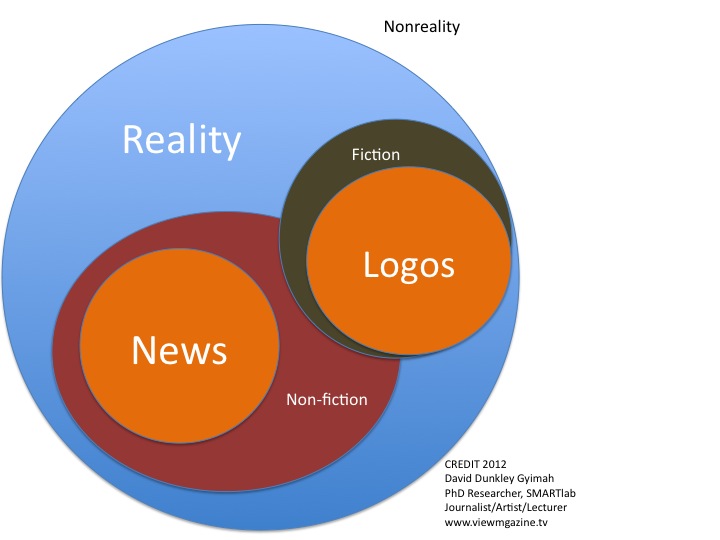
Now news must not be confused with reality as this diagram below shows. If reality represents that out there that in consciousness we can experience, then news is a construct within that.

Another popular supposedly polar opposite construct is cinema. That too lives in reality yet unlike news is thought of being non-fiction.

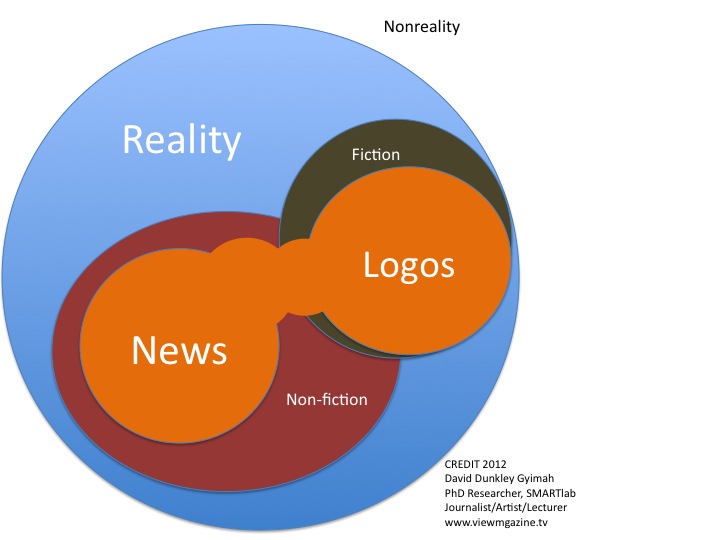
What's happening in the world today is these definitions that fixed what we knew are being erroded or to be precise diffused. In effect society is evolving. We want a new game beyond football. In essence that's what Postmodernism and Jean Francois Lyotard's essay is about.


So Logos that in ancient Greek and academia stands for "to tell", or speak, such as in opinions in say blogs and personalised films is also finding itself overlapping amongst classical news to represent something news worthy that I will call something else...

Firstly, a slight detour. Now the classical news construct works like this. The reporter on the right has a story she needs to corroborate or to find. She speaks to the man on the right and writes some notes,


 She then speaks to another man, supposedly with a contradictory view in the hope of achieving balance or objectivity or the same view to reify her point of view.


Then for good measure a third person is interviewed, often an expert who sheds light on the issue from a non-partison point of view.

The construct is completed. How the reporter puts it together is entirely her doing.

She'll probably monitor what others are doing, or publish on the strength the story adheres to a number of features and an Aristolean quality of beginning, middle and end.


So back to that something else...


That thing that now combines what was once news and your logos is "capital". I quite likes this word for two reasons. I came across it being used as slang, and then from a period film used in the context of "good", "wicked", "cool".

But also that Capital as in social capital, monetary capital is something of value and things that have value are often rmemorable, news programmes are not!


So what does this all mean and what has it got to do with football?

That chiefly words by themselves are fixed, but society moves on and in so doing either moves a word on or revises it to something new. Not content with the game of football, all sorts of other games emerged, such as Rugby, but football still exists.

Similarly news will exist but the impact of digital and technology is questioning how we participate, handle or devise new ways for dealing with this classical construct.

But to devise a new something we need to be able to substantially defend it, and that's would take a while here, but that's what I do on viewmagazine.tv  so why not take a peak on viewmagazine.tv


David Dunkley Gyimah has worked in news since 1987 and is a lecturer, artist and award winning content creator and videojournalist completing a doctorate around news.

Wednesday, May 23, 2012

Asymmetric social media trumps social?


Out with Nato forces in Norwegian seas, various teams are practising how to thwart one of the biggest threats to its forces - an asymmetric attack by a small craft, such as the one above.

An elite super force at the mercy of those who don't play by the rules, asymmetric is a term that also has a great deal of currency in post-media.

Simply put it's the one sided relationship between two bodies and its become a prominent issue in the world of social media.

Where once it was the elite media that controlled the conversation flow, and still do largely, social utilised the one tramway that was truly untaintedly social - the Internet.

Ninety years ago when engineers cracked radio transmission, that too could have gone social, but the capitalists in communications and advertising smelt big dollars; ham radio was the nearest thing to a symmetrical relationship.

But is social today in danger of losing its USP, and reverting to its sibling's capital traits?

There's no denying success stories that have traded on the technological-social use of social, and by that I mean how Face book, Twitter etc have altered communications patterns.

But now we're fast approaching asymmetric flows and what could be called privilege-redundancy. How so? Simple.

Firstly the very products that are being social, unlike Berners Lee's Net are capitalising on our increasing use of their products in an asymmetric way.  That's fair though because, access to Facebook is free. Free that is in terms of monetary value, but not now the new currency which is privacy.

But a more prominent asymmetric relationship has emerged. A new tranche of mediacasters who so understand either how to market themselves or their stories that the relationship they establish is almost as disproportionate at traditional media.

There's some rationale to this. If you're the former technology editor of a large media company, then it's likely you have a rich vein of contacts and stories that will be equally alluring  now as they were with your previous company.

Media companies with a well of stories will always have the advantage, but back to the individual. Competitive advantage means from what was an obscure, confusing piece of software in Facebook, now we all know it.

Facebook now possesses privilege-redundancy. The surprising thing is not that any company or individual isn't using social media, it is that saturation is nearing and strategists have no idea yet how to gain competitive advantage.  The field isn't quite levelled, but..

So the oxymoron is that companies through some darwinian process are ensuring their asymmetric advantage, a number of individuals with strong content  can ensure competitive advantage. Yet for many of us the tools that we all share will soon give us no advantage at all.

So what's next?  Media theorists and philosophers, more used to trying to understand trends than singular entities might are useful studying. The Clay Shirkey's Here comes Everyone, Lev Manovich's Language of New Media, and Henry Jenkin's Convergence Culture all caught behaviour patterns at the right time.

And by looking at the variables

  • less privacy, more social interaction
  • more video literacy
  • Web 3.0
  • search for more competitive advantage
  • The internet will move on from Facebook -it's natural media Darwinism

And the one I have seen, where you can turn on your device to hear your name being mentioned in any part of your world is with investigating. More tomorrow and why it pays to be understand the methodology behind technological critiquing


Sunday, May 20, 2012

Videojournalism stories in digital cinema - Re'P'lay


Four years ago in one of the highest buildings in London in Canary Wharf I was invited to a meeting of some of London's creatives.

There were about 50 of us seated in a circle and the idea, on the day, was to act as a giant think tank.

Chaired by Jude Kelly, Artistic Director of the Southbank Centre, I had a couple of ideas. The one that got Goldie agreeing was a Sims Olympic 2012. Now that would have been something.

But the one I really wanted to get off the ground was the Outernet and web based stories.

My research bringing together all the major outfits I had worked for, such as BBC Newsnight, Reportage, Channel 4 News and Soho Ad agency Re-active, identified a crack - a contemporary method in story form and presentation.

One of those focuses around Deleuze's Time image, where we come to love stories for how they play with time, though Deleuze's concept is much deeper than this.

I used this to make the short film Tahrir Memento showed at the Sheffield Doc Fest last year.

character wall
We love stories that involve characters and bring us into a film-mind world. In researching how they would work I created this giant map  which exists on my study room wall and acts as my methodology - an approach to storyform

I have decided to go ahead with the project, tieng it in with my Artist in Residence position at The Southbank Centre.

I am calling it Re'P'lay 2012 - a play of words on relay - which features in the games.

A rather unorthodox approach, but the first trailer gives some idea of stories and from there I'll hope to pitch for sponsorship. So if you're a company, exec, individual interested in where art and journalism meet and tell stories that make us lose all sense of time, please drop me a line at david@viewmagazine.tv

Below are images from the trailer on Viewmagazine.tv


Saturday, May 19, 2012

Solo producing stunning web-based stories & online docs

Raquel Villanueva


As with Videojournalism, the turn of 2000 would produce a new crop of digital creatives who were equally at home encoding as they were filming.


Flash couldn't support video, so you had to create the illusion of movement with bitmap images, and when it did you'd be hard pressed to have a control panel.

It's one reason why if you look through some of viewmagazine.tv my sites early work there's no player.

If video wasn't the in-thing before 2000 what was? Simply, text and images and the daddy of the story form was one Matt Owens, who launched his voluminous site called: Volume One.

Matt, from Austin Texas became the icon for many design/video companies, also popularising the Death March - working 16 hours a day.

What is it with Austin Texas, with the likes of Owen, Rodriguez, Slacker generation and SXSW?

Web-based storytelling is now a lucrative field and an integral part of the final project modules I supervise at the University of Westminster, from design, broadcast and agency experience over the last 14 years.

Interestingly, and perhaps somewhat disappointedly its workflow has inherited Television's division of labour, with the producer, researcher, writer and so on. I do away with that.

Yet also it's understandable, given web story form has become the primary job of the designer and encoder as one, and not videoists. That shouldn't have happened.

The television industry's insouciant attitude to all things digital online was the cause. When they sat down to regroup, it was to dust off a 30 year old idea of going HD.

The web would never compete with us now was the thinking, though that's a fallacy for anyone who knows Gilders law.

Web-basing grand stories
But to become a true tour de force, whilst web docs do well for online, the psychology of solo story telling in scale, quite literally, can be lacking.

Filmmakers in Residence - superb
That said, a number of web-based story forms have become indelible, such as the Filmmakers in Residence project, and Soul of Athens - both group projects.

Below are some outstanding pieces from previous Masters students.

First how do you approach web based story?

Online multimedia story form follows a similar logic to database storyform, redolent of computer programming. Though it's based on textual ( print) and video ( TV) codes, it's killer app is online's hyperlinking. So choice and arcs (emotional and narrative) can be inbuilt.

1. Determine what the story is. The more compelling the content, the more you'll be able to use emotional or conflicts arcs to create your jump off spot. Think page-turner of a good book
2. Map the story out, building in contingencies for uncertainties and attempt a linear narrative.
Invariably sub stories will find their way into the story. When that happens go back to point 1.
3. It's all with the front page - the window into your site. Get that right and it's a good start. There's singularly one place online which groups some of the best front pages, designed to sell you that one story. Apple Trailer site
4. There's a very common theme on the site. See if you can spot it. Philosopher Deleuze refers to it as the affective image.
5. Now comes the delineation of the story, which is where personal supervision comes in to determine how and what apps to use to create the maximum impact. In part it involves project management and a willingness from the student to push past their comfort zone.

Here's Six of the best of our Masters

1. Romana's work about cigarettes and its new restrictions was an emotional journey.

A drupal expert, she had to grapple with videos, and a design aesthetic which worked to give the site an aesthetic and themed feel.

I'll remember the debates we had around the sum of individual parts  cohering to provide something bigger. Romana now works for a design company in Germany.


2. Yixiang's site, though it took on a traditional narrative, its excellence was in profiling the Royal College of Music's incredibly talented solo pianists.

Entitled Pianism (it's no longer online) Five experts perform especially for the site.

Yixiang now works for Reuters in Hong Kong specialising in writing about Finance.


3. Karunya's Free Culture and Open Source demonstrates what's possible as narrative without a heavy reliance on video.

Well thought-out and a good resource.

Such was her work ethic and understanding in our SEO profiling that if you google "multimedia journalist" she's usually on the front page.


4. Raquel's Saving Burlesque deconstructs the playfulness of Burlesque, incorporating several narratives.

I recall how a series of exchanges had her nail the front page. Its an Apple Trailer site!


5. Murielle's London Air project method has become her design agency.

She worked hard to get this to work, and when she thought it was all over feedback had her redouble her efforts.

The result is a cinematic grouping of photo-stories explaining London's dire air.


6. Stephy's Echoes of the Mountain examines the plight of a small village in China, which the author claims is indicative of many others.

Breadwinners leave the village to earn a living, leaving their children with elderly citizens.

This is a heart warming and wrenching story. The site's margins are out, since last reviewing it.


David Dunkley Gyimah creates and lectures in online video story forms. He publishes the award winning site viewmagazine.tv which includes projects such as  Collisions at the Southbank which covered a week of creative work between artists. And previewed multimedia forms at the Olympic 2012 pitch gathering. He's currently completing an web story around his four-year videojournalism programme in Cairo.

If you'd like to contact him to talk, etc. you can at David@viewmagazine.tv


He's looking to re-develop grand multimedia projects on the Outernet. Here for more details.