Friday, October 31, 2008

When David met Jayz


Well the truth is I did and I didn't.

I was reflecting on seeing Jay-z in full stride in the arts programme Imagination on BBC TV.

David meets Prince Charles
Two years ago at the University of Westminster, Jay-z, Run and Russel Simmons gathered. I was standing next to Jay-z for a considerable time and I couldn't think of a single question to ask him.

Actually I turned to one of the students and told her what she could ask, after she said" "Er what's he done, music wise". Yep I fell apart laughing. LOL

I dd kick myself afterwards cuz I remembered my niece would have even loved a "hello'.

Ah well. Happens doesn't it.

David filming Moby in Washinton DC
But I have had a few gem moments with other artists.

There was Grace Jones in South Africa. I'm watching her now on Jools Hollands later as I post this. She was scary then. She's scary now. Cuz she's not afraid to tell you off.

She was pretty sharp with me. Woops she's just called modeling prostitution and stood up gyrating her body. This is a car crash. Luckily Jooz Holland has an anti-ruffle gene.

Quincy Jones also in South Africa.
Cameo, Larry Blackman in Leicester
Fela Kuti, Roy Ayers Ertha Kitt and London and a few more.
I'll see if I can find some of the recordings and post, but if you skirt to viewmagazine.tv and enter say Maceo Parker or Roy Ayers into the search you should find a recording.

If not I'm a numpty and should post.

Follow David on Twitter- who has recently been appointed an Artist in Residence at the renowned London South Bank Centre.

David working for ABC News in South Africa in 1994 was one an associate producer with Danny Glover

Finalists - Game Changer for Wemedia Miami

David has been nomintaed as a 2009 wemedia finalist game changer for creating Integrated Multimedia Video Journalism, as a viable training course.

It involves a cinematic accelerated production of news and story telling, which earlier this year he shared with journalists at Camp VJ in Chicago.

To vote for him, please go to wemedia and ping his name

p.s David would like to point out he did not write the subbed submission on the wemedia site. Er, it's a bit brassy eh!

David says: "Thanks every one for your support and all that!

The Future of Video Journalism - Conventions continues

The Future of VideoJournalism is part of a three post article looking at the conventions of videojournalism. You can read the most recent here and the first post here.

Cinema and Video Journalism meet
"You might call me a doc producer, and you might be right. You might say I make news features and I might consider this. You might say the pieces I made look like motion graphic packages and I might not disagree. And then you might say actually what do you make? ...
And I might reply all of the above and none so specifically. No one owns video journalism. It can neither be prescriptive nor easily defined. It is what is is to those that practise it".


1996 - West Africa, David reports and interviews US Special Forces training Ecomog soldiers, preparing for tours in Liberia.
Neither exclusively reportage nor videography, Video journalism occupies a rare and evolving genus. So much so that it's found itself at the centre of a tug of pedagogical and industry war.

At stake is the notion of dictating a prescribed set of rules, attract a following and have commerce do the rest.

If you disagree with the body politiks of any of its major communities, then you risk ridicule.

There's nothing new there. Thomas Kuhn captured our propensity for protectionism and a move away from fixed discourses in his pronouncements: The Structure of Scientific Revolutions.

So where might video journalism go?

The seeds lay in the past, even a more immediate one. Or as John McHale, a cyberneticists explaining American Culture would say:

"The future of the past is in the future. The future of the present is in the past. The future of the future is in the present"

The Immediate Past
In 2005 as the first UK newspaper journalists to practice Video journalism, the Hull Daily Mail, Liverpool Echo and Press Association journalists,rolled out of the Press Association following three intense weeks of video and narrative discourse, we all agreed on one thing.

Video Journalism is not TV.

There were reasons the regional journalists wanted it so; distinction, difference, a fresh outlook.

Mine emerged from the 18 years or so in the media, many of which involved working either as a journalist, producer, reporter and in some cases video journalists for some of the most respected networks around.

What I had experienced and seen what Video Journalism could do was different, not always necessarily better than TV , but different, tailor made for this new web platform.

The wondrous nature of video journalism's origins give some idea. TV its most obvious cousin emerged from the silent movie reel with a lot of help from radio.

In fact the first coterie of TV reporters e.g. Cronkite (US) Dimblebee (UK) almost exclusively came from Radio, and before that print. They were the finest of their time.

The classical nature of TV news mirrored in many respects Hollywood's formulae for story structure and resolution. But whilst different genre conventions began to evolve in film e.g. avante garde and documentary, TV News maintained its set of codes, though different house styles emerged for different corporate authors.

For example ITN reports differently to BBC; ABC will have its house style as will CBS. If anything the form that creatively mashes up TV with a sub genre e.g. 1st person narrative versus omniscient is documentary.

Video Journalism has thus gestated from TV, where as a broader, richer canvas would be a hybrid of cine/photographic language and radio/TV reportage, which a growing number of VJs are reveling in.
Scott Rensberger, [right. pic] one of the US's most celebrated multiple award winning video Journalists talks to David.

The latter sets up an interesting proposition. In order to critique film/video we need to comprehend some of its language and distinguish our analyses from the audiences' expectations.

The former of these resides in what might be referred to as an evaluative assessment. Who's the audience? Did it satisfy their needs? Were the graphics good? Did it meet what often is a reference to classical story arc?

These are instincts often you build up and again depending on the target audience will differ from one group to another.

An interpretive analysis of film presents huge problems and is the stuff of critics, whom themselves may differ in opinion, but they often have one thing in common: a rich historical understanding of the product.

Video Journalism's Achilles
Why is this problematical now?

Because whilst you wouldn't ask someone who's had a limited knowledge of newspaper design to present to the board a critique and launch of a new newspaper, it has parallels in an interpretive analysis of video, if your knowledge of video is limited.

This is by no means qualifies only those with the scars of a camera to talk meaningfully about video journalism. I personally wouldn't dare profess to knowing it inside out. I am a student of its form with a particular perspective.

Whilst conversely not having looked down the lens doesn't disqualify those new to the genre. You don't need to have been a video journalist to understand any of the forms of the video journalism.

Our collective televisual maturity provides some fallback.

But it does mean when we critic its form it would be expedient to have a broader understanding of analysis deployed. Story form, a play with the form, comparative analysis, technical innovations, tone and delivery - just some of the things that matter I would say in Video Journalism's increasing diversity.

This last statement sets up a segue for point of this post: "the many forms of video journalism".

The future of video journalism is and will be a break into different forms, as witnessed at the 2006 Video Journalism Awards in which you could distinguish between genres like: breaking story, video feature, independent, self reflexive and so on.

And then there's the unknowns, or trend extrapolated thinking knowns [ sounds tautological, blame Rumsfeld, better still Lacan].

Unlike the media of television which delineates its product linearly, notwithstanding styles such as Flash backs and Flash Forwards, the web is spatial, and so we might well see a style emerge that captures spatial story telling. In 91 Manovich gave us a reason to see this with THE FAMILY at 56k modem speeds.


For more contemporary and innovatory forms I strongly advise to look at Richard's Multimedia Shooter.

That void is being touched with multimedia, but we still can't be sure of the shape of things to come. When video hyperlinking breaks, what next?

  • When the video configurational size jumps from 620 to full screen, what next?
  • When virtual life meets real life, what next? [ incidentally I'll bring you a report from the Science Museum, in which I hosted a panel of some of the UK's most talented multiplatform story tellers including one who mixes real and virtual life using his mobile]
  • What happens with holographic video? Remember wag the dog!

What we can hope for at the moment with this nascent form is a healthy debate and discourse.

No one owns the form.

At the moment it is without form [ unless you prescribe to its TV tendencies], we have the ability to create a new visual stanza that just as TV borrowed from its antecedents, it takes and moves on to boldly......[ you're ahead of me :)].... gone before.

One which takes into account narrative and exposition, montage and sequencing [ spatial as well] and the new technologies that are likely to come on stream.
++
  • The Future of VideoJournalism is part of a three post article looking at the conventions of videojournalism. You can read the most recent here and the first post here.
+++


David has been nomintaed as a 2009 wemedia finalist game changer for creating Integrated Multimedia Video Journalism, as a viable training course. To vote for him, please go to wemedia
++

David Dunkley Gyimah is researching the Outernet for his Phd, integrated multimedia video journalism and is researching with a colleague a Video Journalism doc, a remaking of Darwin's cell theory.

For more on David's ideas around videojournalism go to www.viewmagazine.tv, in which he's about to add some fresh material.

Thursday, October 30, 2008

Power of the mobile


Power of the mobile.

In light of the BBC's Paul Branan, editor of emerging platform's talk a couple of days ago, this dropped into my email box.

An interesting, an event in Helsinki, Oslo and Trondheim 1-5 December, prising open the future according to mobile.

Click here for more info

The Madness of Britain

If you're flying in to the UK today and in the serenity of your hotel or eventual resting place, switch on the television, or Tele, as we might say here, brace yourself.

The lead and subsequent running story might have you clutching your bag and signaling to your partner: "Sheryl, I think we should leave the UK. I think there are some terrorists on the loose".

Therein, the images of two white adults will flash across the screen; one with a trademark Barry Whitesque facial hirsute, the other clean shaving with Barry White esque Loreal hairstyle.

For the next hour or so, they'll keep cropping up. The baffling bit is the footage that follows depicts middle class people, greying hairs and rinsed wigs not looking fearful, more outraged.

If you're lucky you'll catch an image of one of the perpetrators hosting a radio show and probably scream at your partner. "Sheryl, that bad man is hosting a freakin show, you know like David Letterman..".

Partner: "Oh yeah, lovely suit, what has he done".
Male Partner: Haven't a darn idea"

Mad Britain.
Britain's gone mad.

A crime has been committed.

Now lets not underestimate the crime; here's the background.

Two talented performers, one a major chatshow host, the other a fly-by-the-seat-of-your-pants stand up, a sort of David Chapell on a really bad day, played a prank that went horribly wrong.

They rang up another performer, an old skool one, you know, someone from the: "Bewitched" era, except this was Fawlty Towers [ I know, I know, that means nothing] and said lewd things on his answer phone.

Things like, oh I have slept with your grand daughter and when you hear this you might commit suicide.

It was bad, pretty bad.

After making the programme, it sat on a shelf ready for broadcast a couple of days away.

The victim of the prank, a pensioner, is said to have pleaded they don't broadcast this recording.

He was ignored and then some days later the broadcast went ahead. On the day itself there were a couple of protests.

Then the newspapers got hold of the story, the Daily Mail, a paper that appeals to conservative England.

Then to use that proverbial expression: "the S*** hit the fan". 30,000 complaints and rising.

As the days unfolded, I thought "oh dear, no one from the BBC's talking".

Then again, I thought if the BBC responded to every event then would they ever make any programmes.

Anti Customer Service
Consider this 'one off' story for instance relayed to me by an acquaintance whom I worked with whilst at the BBC. Our mutual friends is now a senior reporter in the organisation. He picked up the phone from a viewer complaining about something.

After listening to the complainant for a while he said:

"Er did I give you my name".
Complainant: No
"Well **** off then.

So you see the BBC gets complaints every hour, every day.

Yesterday, the two top flight performers were suspended, one then duly resigned, but that wasn't before the Prime Minister, the leader of the Opposition, had weighed in.

And now the BBC is holding emergency meetings.

Yes this is code red: the Madness of Britain.

Comedy is now under threat, the direction of the BBC as a vanguard for young people is under threat. More resignations and sackings are expected.

Damn the BBC might just implode, and then we'll find at last the moon is made out of cheese.

So what's going on?

Ah drama par excellence. Spleen venting of a kind that has its roots elsewhere and has slowly been simmering away.

The financial collapse, fat cat payouts, anger, avarice, gluttony and excesses in the financial system added to the mix.

Ingredient for a distaster
Here are the ingredients.

Jonathan Ross, one of the pranksters, is one of the highest paid presenters £18m ie around $29 dollars give or take some change and this swinging exchange rate. Too many that's obscene, way obscene.

Jonathan Ross presents a number of programmes on the BBC. So if you're not a JRoss fan, you're already complaining about why you should have to put up with this.

And it gets worse for you. His deal lasts till 2010.

Russel Brand, the other transgressor, is also paid a nice sum £200,000 a year for his radio 2 show

Then there's the BBC, whose relationship with the Daily Mail might be described as er "non existent". You might say the Daily Mail thinks the BBC is a $£@^&(()&^%$£@!!!! and the BBC might return that compliment.

The BBC, to its detractors, is the firm you love to hate, you see. Funded by tax payers but with no accountability, if it went to the wall, we'd go psychotic. Yet at the smallest of windows, you'll find groups complaining, sometimes even legitimately.

Then the issue of its funding pops up. Grrr! Why the papers argue are we paying a tax towards an outfit we have no control over, did not elect their management, and they rarely cater for your taste.

Damn if it does and if it doesn't really. Newspapers fearful of their future criticise the BBC's expanisionist ambitions. Must bring em down a peg or two, so this latest saga plays right into newspapers' hand.

And finally the misogynous, aegist and indencency nature of the crime. An apology simply wouldn't do.

So there you are, a warnng to you if you're flying into the UK and want to make sense of this Madness of Britain.

A crime has been committed, those guilty indeed do need to be reprimanded, but a root and branch look at the BBC???

Well then that's it. The press had mooted it, post Sutton, commentators had poked at it in their columns. Think back to another talented performer Chris Evans resigning from his radio show complaining of fatigue to his boss Mathew Bannister.

THere was going to be an endoscopy of the BBC at some time. Thank goodness Jonathan Ross has provided means.

end
p.s
Of course this isn't the first time Ross might be cast into the wilderness. Following on from his highly successful shows in the 80s, the Last Resort and into the 90s, Ross hit rock bottom. He's recounted this story so many times, so will he bounce back.

Yes. In two weeks time all will be forgotten and we'll move on to something like Gordon Brown's masterful curtailment of the banks [ yeah! ] or why Brits hate boxer shots.

Meanwhile did I tell you he story of me when I used to dance on Britain's Soul Train in the 80s while a chemistry maths undergraduate and a rather bossy floor manager kept on prodding us where to stand. His name Jonathan Ross


.

Wednesday, October 29, 2008

Burying the lead -Media Tip 102

I'm shattered 96 hours of full on with little sleep, but it was worth it.


Firstly our Masters students put together a blinder of a show today; 6 sessions of online culminated in a 5 hour news cycle towards their online newspaper.

There were many highs; one student pursued at least 6 different potential interviewees before getting her quote. Persistent pays. 

Secondly, and following on from today's live newsroom, it was a dash across town to the University of East London for my annual review of my Phd.

I'm through to the next year, and now the fun starts...

But burying the lead - media tip 102?

There are some advantages if you can call it that for working online. A huge slice of it is processing. Take a cut here, rework that para from that site there, grab a quote somewhere else and you're done.

But when you're the primary news gatherer and you're still grappling with the idea of news worthiness, how do you spot the lead from the mass of copy?

The Cat Sat on the Mat
The Cat Sat on the Mat is one of the games, it's easy.

Cat, Mat and Sat have to be used in the first para of a make believe story. 

Then you go Jayson Blair, creatively constructing  a story of 350 words.

It's a pretty hilarious exercise, revealing some active imaginations. But when the laughter done ask your students where the lead is.

Most often its buried and thus the expression, the cat sat on the mat become an allegory for the lead being buried.

As journalists we get paid to execute some fundamentals:
  • Asking the right questions
  • Using words accurately
  • and spotting the news story
Of course there's more..., but these are some of the basics


Tuesday, October 28, 2008

Paul Brannan BBC on mobile phones - talk


Blogging live: Paul speaking for about 30 mins.


You can see a short video of Paul at London's Online News Association, when we gathered to hear reuters talk about mob phones

Paul Brannan,editor of BBC Emerging Platforms is talking at the Uni about reinventing the future.

A precise follows as he highlights changes in the industry.

Paul talks about " 13,000 job lost in US - Source Garret co Inc.
Penetration of newspapers down, 2007 steepest decline in a while.
At home UK losses in ITV and Channel 4".

Inventing the future through the past
He later goes on to speak about Paul Chappe ho invented the pre-telegraph 1791.
"If you succeed you will soon bask in Glory", he notes in his presentation.

Chappe's invention was picked up by Napoleon who helped push it along.
But being first does not guarantee success, he adds. Chappe did not benefit from his invention.

Brannan takes a stab of the future and shows a picture of a mobile from the 70s and more recently the 90s explaining how technology has changed.

Nokia calls it the age of the 4th screen, ff on from Cinema
Some stats he reel of from the BBC and those getting content 47 percent users survey used mobile. 50 + percent said they used it to surf the web.

Uses DVDH signal ie the phones, but the problems receiving signal.

Slide of Hellen Boaden, director of BBC News shown talks about 2m gone because of the nature of news. It says fewer that 24 percent of 15-24 watch 15 consecutive minutes of BBC News on TV in any given week.

Paul explains how mobile picked up last images of Saddam Husein

Paul then segues into UGC and talks about how the power now lies with the audience.
References Nokia 95 phone then points to Kyte which runs UGC, then Qik -allows streaming to sites, and then there's www.flixwagon.com and 12 seconds.

Disparate content from RSS readers such as netvibes, Paul adds is his mode of surfing online. If the news headline doesn't work he's off.

Zoopy contacts with friends, synchronous data, to give context. Trusted places site ensures you give credible info otherwise your rep suffers.

Here's Paul's advice to about 140 students gathered in the conference room

  • learn the basics
  • embrace change
  • innovate
  • learn every tool
  • recast journalism's relationship with the public
  • listen collaborate enable and serve
  • add value avoid commodification
  • and have fun

Q an A
Paul goes on to explain the sort of person he'd employ if he were in an interview.
  • - good writing skills
  • - knowledge of online apps
  • - some coding skills if they have them.
  • - enthusiasm- a zeal to learn

Quesions ff on Trust
Paul explains Trust is everything.. defending the BBC

Question of those who took pics at Bunsfield fire. Were the people there irresponsible?
Paul points to strict guidelines that the BBC uses to guide those who submit UGC

Question on hyperlocal TV
Paul says BBC not doing hyperlocal, however imminent decision due soon on this matter. See my previous posts

Sunday, October 26, 2008

Origins of Multimedia meets Video journalism Flashback 2001

The piece is called The Family - a finalist at Channel 4's Digital Awards. Click here to launch

It's something else to look back on this piece of multimedia work from 2001. One of the first attempted integrated multimedia video journalism pieces.

I need to tell you a few things.

  • Few people outside of the design community knew what Flash was. We were on Flash 4 going into Flash 5.
  • Flash did not support video, only bitmaps which you had to animate to look like video.That meant you had no video controls. You had to write code.
  • We were on 56k modems, so we had to encode these to unfathomable small sizes to today's standards [using load movie scene variables] because broadband resided only with big companies who could afford T1 lines.
  • IMVJ was the dream, that is matching video expertise with Flash. Credit here to Rosalind Miller the designer and encoder.
  • We filmed at a boxing gym set up for urban kids, quite a few from troubled backgrounds, in Islington.
  • We collected sound using a sony walkman and video with a Vx1000.
  • I got hit in the ring operating a minature steady cam. Yep suffer for your art.
  • The piece had no navigational direction, it employed play and spatial theory. If you've never read Lev Manovich - The Language of New Media, go order it now. It's where I got my epiphany from
  • Heavyweight boxer Lennox Lewis' team on seeing this hired me to work with them. I had the time of my life witnessing the fight of the century Tyson vs Lewis
  • You can read about it here in Blue Print - an article that I think has some currency now as it did back then.
  • I was introduced to BBC Commissioning Editors to consider some more "circular docs", though it never came off
  • It lead to me meeting Hillman Curtis - The Flash Guru -awesome!
  • Read up further on video hyperlinking - something I believe will be the next disruptive method/technology. The Economist rang up for an interview aferwards. Gobsmacked!
  • If you look at the credits ask yourself now if you could perform all the known disciplines, because that's where we are with IMVJ now.
  • This week I'll pull out another Flashback from 1996 - an ad broadcast on CNN International, made in 24 hours and whose renumeration you could only describe as "silly!"


Saturday, October 25, 2008

All quiet on the front

Has it all gone quiet on the front or is it me?

Some business advisers refer to it as the seven year cycle.

Innovation all done, we're in the maturating phase, where that clever gadget, new way of life, becomes a product, business must turn over to make money.

I wonder if an audit of past and present were performed whether we'd spot any great upheavals.

Thing about bedded down technologies is that when they're good, they're good, and when they're mediocre they stay mediocre, or do they?

I suppose it's all about process now. Who can stay lean, fast and efficient.

And from a business point of view turn over a profit.

The best time to be disruptive is when you sense calm.

Me, I'm considering shredding viewmagazine. It needs an overhaul.

And then some

Friday, October 24, 2008

creativity in the work place

The last few days have been pretty extraordinary.

And then the question was asked: why would anyone want to do a Phd?

There are many reasons I have heard, but an over riding one from the cohorts at Smart Lab.

Many of us want to examine the status quo, and find some context for our own passions. And then look to see whether there are alternatives.

And it's not the end per se, but the journey of discovery that's a heavy draw.

This week we did the ologies. By that ontology, phenomenology, ethnography, videography.

I was reminded of a well known BT advert were a Jewish mother character, Beattie, played by Maureen Lipman praises her son for his sucess at one of the "ologies".

There are few places its said when you can take a team of people from different disciplines, place them in a room where they undertake pecha kuchas. You should try this.

This meaning more or less chit-chat in Japanese, but really amounts to power point slides in break neck speed, and then watch the strands of different opinions emerge into a creative soup.

Frankly it's a wonder my Master students are doing that.

The added ingredient to fostering a safe place amongst this very eclectic gathering is the location. A creative zone or to use one of my colleague's, Camille's expressions, inspirational zone

Anyway more on this latter, I have got 5000 words to consider

Thursday, October 23, 2008

Have blogs been kicked to touch by twitters asks BBC?

Has blogging had its day? Does twitting now rule?

There must be something in it for the BBC's Today programme to give almost 6 mins of air time to it this morning.

Worth listening to here and see whether the argument holds water?

Wednesday, October 22, 2008

Sonic Conversations and films

It was designed to repel teenagers gathering outside shop fronts.

The mosquito emitted a high frequency noise only audible to teenagers.

However shop owners had not anticipated the black lash and the civil rights implications some youth groups would raise.

But then some youngster got wise and transformed the noise into a ring tone.

And the ring tone is not only a device to thwart teachers but also keep one step ahead of parents and the police.

Just one of the things discussed in a session today on sound crafting at the Smart Lab which included a fascinating talk around sound war fare and sonic water cannons.

The latter sees how you can send a stream of narrow audible sound, even subliminal messages so unless you're standing in an exact particular spot, you'll hear nowt.

Tomorrow we'll be down at the Dana centre, part of the science museum, looking at citizen film makers.

They'll be speakers on avatar-characters, collaborative film making and mobile phone features.

The questions have been asked before, but we've moved on a bit, so could this new discourse in film ever challenge the status quo.

How much is this new quantum in film making innovation over substance and is it only the preserve of niche audiences?

Creating an Ad aired on CNN International and some

It's Phd away week, where thirty or so of us, all with different fields of interest gather. More on that and what may be of interest with its terms and frames of interest.


Today I interviewed a prominent expert in child development and play who had some fascinating things to say translated across journalism.

Tomorrow at my presentation to colleagues I aim to illustrate how size, speed, content and aesthetic may well matter on the web regarding video stories and video journalism.

Later in the week I'll post a 30 sec spot, one of a few, aired on CNN International. The story behind the story was being rung up by a client who had paid for airtime but had nothing to show and wanted to know if I could create an ad in less than a day.


Tuesday, October 21, 2008

Training Matters -redux

In this I outline why journalism training has never been more pressing in today's climate.
I was a speaker at this year's 15th World Editors Forum of the World Association of Newspapers in June in which I spoke about training to hundreds of editors. This is a redux of an earlier article.


***********
In the twenty years I have been a journalist working across various disciplines, five of which I have combined as a senior lecturer, few issues rank higher within the space I ocuppy as training, whether it's in the lecture hall or newsroom.

In those twenty years I have been fortunate enough to work with, train with, or train scores of journalists.

Some of my earliest international memories include working in South Africa in 1993 alongside the International Federation of Journalists, the Media Workers Association of South Africa and South African Union of Journalists creating a Training the Trainer programme.

Soon after arriving from South Africa on his first trip in 1992 David wrote this Dispatches for the BBC's In house newspaper, which would catch the attention of a number of South African media institutions.
  • South Africa Report for BBC Radio 4, the only non- South African documentary played on South Africa's public service radio during the historic 94 election.

  • The need for training was something South Africa's institutions readily embraced for a post apartheid regime.

    More recently I have consulted for a number of newspapers in the UK, including the Press Association and FT.

    What's clear amongst many editors and proprietors is the need for training -not just as an away day exercise to bond staff, and that is necessary - but as a means of keeping the working environment fully active: to enrich the iron in the blood.

    The motive is not just to be on top of the game, but in front of it.
  • What's media scape like?
  • How can we strategically stay ahead of the game?
  • how can we respond to the the changing needs of journalism?


    TRAINING DAYS

    I am perhaps one of the thousands of fortunate journalists to have experienced some of the best training around during my newsroom years.

    The BBC's Training Unit, which does not exist in the form it was in the 80s and 90s, saw its fair share of me for voice training and various journalism practices.

    I once even served as a guinea pig for broadcast managers to interview an ethnic minority and assess whether their interviewing style needed changing or whether I was simply hopeless. I had worked for some of the biggest outfits, but not via interviews with personnel, but by managers seeing my work and calling me up.

    BBC Radio Leicester, the first local radio station in the UK, where I started my career was where I received some of my best training under station manager Leo Devine, now a senior BBC figure.

    And I was reminded of that culture of training recently when a broadcaster approached me at the Royal Festival Hall and reminded me that I trained him in 1988.

    David in an edit suit in the days of physically cutting tape recorded on a Uher
    Other than that, like most news rooms you just got on with it - de facto training on the job - for which I have also had some tremendous experiences working on the likes of Reportage and Newsnight.

    Training, is either the thing that dare not speak its name of our career, quite unsexy in one guise, or a fall back position, a safety net that ensures a broadcasting outfit could maintain its professional status quo by bringing up staff to the water mark of best standards.

    Without playing down challenges in that era and the commitment from those that could afford this expense, there appears some startling differences between then and now.

    It was no genius on my part that when I graduated from journalism college , Falmouth, following years of the sciences and a degree in Applied Chemistry, I landed a couple of prime jobs.

    Serendipity played a part- right place right time - but truthfully I'd been maxed to the head with training.

    And truth, as a former chemist more used to writing chemical symbols than essays, oh I needed training.

    *******

    BACK TO THE FUTURE - TRAINING

    David presents his ideas to a critical audience of leading media practitioners at the prestigious National Press Club in Washington DC before collecting the coveted Batten Award for Innovations in Journalism.
  • National Press Club report here featuring Adrian Holavaty - a VJ report back then we more or less knew journalism and any scenario planning of trend extrapolation provided a fairly comfort zone ahead.
  • What's the worse that could happen?

    Oh we're launching a 24 hour news show, which requires multiple feeds from the journalist.

    Difficult and daunting YES, but in the broader sense of the word it was still journalism you understood.

    Today, no such luck, the seams of a profession are being picked and rewoven into a new, some say exciting, others believe a shapeless tapestry.

    Added to the normative variables of journalism e.g. storytelling, ethics and writing, we're witnessing new parameters - which in many cases we might argue have nothing to do with the profession.

    It begs questions, many ones, wider ones.

    What, if we can afford to train our journalists, should we train them with?

    Scary!

    Where do we start?


    ALL THINGS GREAT AND TRAINING

    Interactive documentary, The Family, made in 2000 using Flash and Video Journalism was a runners up in Channel 4's digital media competition
    The buzz word at the moment is multimedia, a discipline that pulls in a wide facet of journalistic talents nominally spread amongst a team.

    Now it's expected, within foremost the emerging generation and to an increasing extent those already in the profession to be the passport to keeping their career going.

    We're in the evolving era of jack of all trades and masters of them all.

    We will still need specialists, journalists who have no need to master these things, but the trend suggest a collapsing of interdisciplines into one.

    It's a Niagara Falls chasm of a leap from the days I remember at the BBC when friends where being asked to become bi-media.

    From bi to sex and counting; soon you'll be dec skilled - that's 10 separate disciplines.


    CONTEMPORARY BREAK THROUGHS

    David training the first UK Newspaper Journalists to become VideoJos resulting in his award winning film 8 Days

    In 2005 working with the first regional journalists to attend the Press Association's (PA's) Videojournalism training session we proved that print journalists could indeed learn TV.

    And if you're long enough in the tooth to remember the BBC's excellent journalists training schemes where 12 cohorts become the chosen ones across the nation, you'll be no stranger to the mantra surrounding the once mystic art of TV making.

    The feeling was: "If you haven't got a double first from. . . you're ahead of me here, you're not coming in".

    Now print journalists shoot, cut, edit, voice their reports and we're training them to do it swiftly and produce appropriate visuals for their chosen platform.

    Video online can either using one person be video journalism for television of video journalism for video journalism - the creative gonzo form.

    And along the way of what I refer to as blank paper syndrome, there have been noticeable success.

    One that tickles me after taking a call from one of PAs early training adopters was from the Liverpool echo - David how much can I charge for news footage?

    The Echo made a nice tidy sum that day selling their story to the BBC and commercial broadcasters.


    MANY MEDIA OFFERINGS


    The International Video Journalism Awards in Berlin. David top of the shot can be seen filming minutes before collecting an international award
    However, videojournalism is one arm of as the name suggest multimedia - a many tentacle beast.

    But those that can are having a go and making good on their online ventures.

    However one of the biggest tasks besetting training, a sort of pot-noodle of a word, is not necessarily the technical and theoretical skills we need to learn, but the paradigm and creative bent that is required to comprehend changes; changes which don't look like slowing down.

    Contemporary attitudes, re-engineering our approach, mixing technology with the traditional, thinking spatially rather than linear ( see post for Journalism.co.uk), writing for human eyes and artificial one e.g. robots are just some of features we're having to wrestle with.

    Has training ever been more crucial?

    Well no not really, this is all relative; each by gone era will trumpet the importance of training

    But that doesn't diminish the profoundness of training, here and now.

    Is it crucial now?

    Absolutely.

    In fact I'm thinking of tagging on RnD to the word training, which often still evokes thoughts of Open University lecturers looking like fallen rock stars wearing hush puppies.

    RnD because in the current climate training is not, or should not be about ensuring staff are kept up with good practices but prepped for disruptive forces and how to seize initiatives.

    I use an old image illusion to make a point that if you can't see it, it doesn't mean it's not there.

    Or as I have said in the Video journalism manifesto, if it hasn't happened it awaits to be done.

    Go to the web young journalist said Anthony Moor, editor of OrlandoSentinel.com on a posting that oozed passion and foresight. ( I apologise it does reference me as well)

    For examples of if it hasn't happened it waits to be done you can look to the British media's relation with videojournalism.

    After Channel One, the BBC would take up the reigns of this new media form as a viable asset, seven years on from C1s beginnings and in between that period no one would dare try for its lack of a broadcaster's endorsement.


    WHY DOES TRAINING MATTER?

    Why does training matter?

    It doesn't if you're not interested; you'll get by.

    By why it matters otherwise is it is the engine that drives our progress: the swan syndrome, looking elegant on top but webbing furiously.

    Here and now, it provides us an in, to what might come.

    There are many of us, you who believe the tower fans of change are yet to gather force; the net at a standard 16mb plus will drive a medium of unimaginable power e.g. live net broadcasting, IPTV.

    As I write this I have been made privy to software in the making (I'm under an NDC) that when it comes off will completely and utterly change the landscape.

    There's work to be done; present forms are evolving, new ones are emerging.

    Journalists are having to think like graphic designers, motion graphic artists, action scripters, SEO analysts and as they slay one form, within the core disciplines the experts are raising their anti.

    Cubism turns to futurism and then constructivism emerges.

    Online, the foundations of what we once did might still be sound, but the style is (meta)morphosing.. futurism to a new futurism.

    The flash documentary I made with my colleague in 2000, runners up in Channel 4's Unleash the Talent, I believe still holds, but it's old hat; we've moved on.


    WHY TRAINING MATTERS MORE

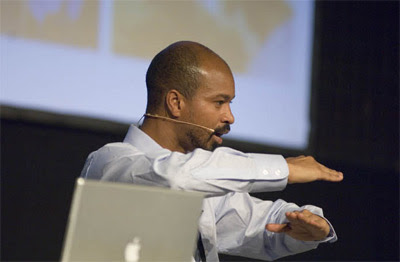
    David presents from Flash on the Beach a gathering of some of the world's best designers using Flash or otherwise, while below he talks training and new digital techniques at Apple's store in Regent Street, London.


    Training matters because it's about progress, not the fag end of budgetary expenses.

    Three years ago a colleague and I conceived an online learning tool for journalists built in Flash.

    Last year the BBC acquired its intellectual engine, and us as consultants to make its own version to launch its flagship Journalism College training.

    Why does training matter?

    Because there is no certainty for those who remain complacent.

    Big companies can and most likely will conceivably go to the wall if they don't change.

    Doing nothing now is no longer an option - hoping this thing called the web will blow away.

    We (more so in developed countries) occupy one big mother board so if you're not innovating, someone else will and your CEO will have no excuse to shareholders when that tech company down the road launches the next big journalistic tool that you should have had.

    Brrrrr Final Cut Pro!

    It matters, in a bizarre twist of fortunes because large swathes of university grads are leaving the nest with fabulous skills - that much we know from within the BJTC - but there are cases where some fail to find homes that can use their new skills.

    I see the timetunnel of Channel One looming in which of the hundreds of VJs - some very good , some er, perhaps needing more journalism training made choices to move elsewhere as the market did not support VJs

    Today only a few have survived from the days of Channel One.
    Former Channel One Entertainment star Julia Ceaser is today a Presenter and Business Correspondent on BBC News 24
    Can there be such a thing as over skilled?

    £$%^&*@@! No!

    But what the present generation know, what they can do is so awesome that it leaves managers bereft of ideas what to do with them.

    In a recent posting I say tongue in cheek go hire a teenager for Christmas.


    NEW JOURNALISTS

    Students and Lecturers report on Nato troops during an evacuation order in which real special forces were deployed
    The Nato programme at my university is unique.

    Students get a chance in a lifetime to be in a make believe war zone environment as Nato forces battle each other, setting up their own game theory scenarios and letting these new journalists loose to report.

    Students by then will know how to shoot video and stills, pod, sat. back to base, get an idea of rank and procedures on board anything from a destroyer to rapid boats.

    Training matters because without it we become anemic, we atrophy, we become bored at what we're presented with and if not industrious we fall behind our competitors whom today are world wide.

    To coin an old phrase demo or die, train or be slain.

    The choice is yours.
  • Monday, October 20, 2008

    Virtual Worlds Seminar

    Blogging live


    Bruce Damer a leading authority in Virtual Worlds is set to outline his theory on the evolution of life simulated in virtual worlds.

    Speaking as a panelist at the Virtual Worlds conference at the Queen Elizabeth Centre, Bruce started out by road mapping the emergence of virtual platforms and urged attendants to join the matrix he is setting up.

    Minutes before the session opening, I had my body scanned. The company, 3D Body Scanner NX, behind it says this sort of emerging technology has applications for the clothing industry, but also has significant medical apps.

    I'll post more in a while

    UK's hyperlocal TV revolution


    In Norway to talk about video journalism I shared a presenting programme with Tim Burke, Editor BBC English Regions, driving the video journalism movement.

    His presentation was rich in statistics and polls indicating how well accepted a VJ trial programme in the midlands, Birmingham, had gone.

    I later interviewed him briefly and will post that sometime this week.

    Local TV, the more acceptable term used within the BBC to describe their move into broadband news reportage will have a huge effect.

    For news competitors it also presents a significant challenge, highlighted here couple of days ago.

    At a time when ITN News is pulling out of the regions, the BBC will be able to display its hegemony without contest.

    While like millions I'm reliant on BBC News and its many productions, I temper my news intake with variations from other sources.

    Notwithstanding what local newspapers will have to offer, Local TV will be a playground all onto the BBC.

    That must be a good thing at first as it'll illustrate how breaking down national news into truly hyper local interest should be.


    Or reporting on matters for communities e.g. disputes over trash/rubbish can be far more relevant than national matters.

    The trouble is the cost to run such a programme could be prohibitive to any outfit contemplating new entry into the news market, that is if they want to run a national campaign.

    Region by region, it's different. Newspapers already have the infra structure and local reach, but perhaps not the video reporting clout, website support and triple play potential.

    Yes, a thoroughly good report could quite easily find itself going from community to regional to national: bottom up rather than top down.

    There is one thing I believe newspapers could do and that is to adopt an agency approach.

    Mirror the BBC's activity by offering the best and some on a dedicated web site, which could be accessed at local levels.

    I'll talk more about this with Tim's interviews as well as Michael Lally, RTE's head of News', bold citizen journalism experiment, the likes of which have not been replicated anywhere else I know off.

    Meanwhile see viewmagazine.tv for mor info on video journalism

    Sunday, October 19, 2008

    Newspaper architecture and video


    A friend asked me a question and I thought I'd doodle something regarding setting up a site.

    I admit it's basic and each segment warrants its own interogation, but hopefully if you're considering going down this path, it should set you on your merry way.

    Front end
    The front end team of designers and coders with an array of language skills should do you proud.

    The chief designer or creative director should be able to translate editorial needs.

    Many newspapers employ their own in house tech development to create css pages to hold the pages of their site together.

    Most designers will speak css, ajax, html, xml, java Flash action scripting and lingo. In many cases a lot of what you might be looking for exists on the web and can be customised.

    Middle Ware and back end - a good Server provider, with strong support. There are an endless number on the market. 1&1 is a favourite, whilst Fasthosts in the UK has strong support.

    You might even think about setting up you own server, though you'll need to be on top of firewalls and setting up mysql databases.

    If you're planning a beast of a site, tune loading and balancing servers, and or even streaming ones would be a good idea.

    When it comes to video players the market's saturated with them.

    From a couple of the newspapers I consult I've had some interesting conversations and the chief quip appears to be support. How much personal technical support can they give? How easy is their CMS for uploading and what's the look of he video?

    There are other features to look for: viewing window size and web 2.0 apps, controls and of course costs.

    Colin Powell endorses Sen. Barack Obama


    In this excerpt from meet the press Tom Brokaw interviews Colin Powell who provides a detailed and considered answer why he will not be supporting his party's presidential nominee.

    Irrespective of your allegiance Powell's submission paints a poignant picture.

    Apart from how prevalent this will be reported, and that you can absolutely disagree, it'll be interesting to see how many prominent pundits capture Powell's race as a defining criteria here, rather than his judgement.

    Colin Powell endorses Sen. Barack Obama

    Saturday, October 18, 2008

    The End of UK Media - November 27th 2008. BBC's Video Journalism Revolution

    On November the 27th 2008, a decision, which will amount to a seismic disruption to UK media, principally newspapers, will take place.

    The BBC will announce whether it will introduce hyperlocal televsion.

    It's huge. A real game changer. And for the newspapers, the end of media.

    Why?

    • Because few newspapers can succeed against the might of the BBC and BBC local will be formidable. They already have video journalists for the 65 or so broadband sites.
    • Even though many newspapers are doing video, when it comes down to it, the BBC believes viewers will choose them above a local newspaper who's just started video making.
    • The decision, for once, overtly legitimises the use of video journalists as a news force.
    In 2005 precisely because of this, The Press Association, with the support of UK regional newspapers, embraced video journalism.

    Earlier this year, I interviewed Peter Horrocks, Head of Multimedia News at the BBC.

    The decision will be an explosive one and judging from this link it looks like it will get the green light.

    What's the point of a video journalism showreel?


    Martin posted a question, which prompted me to ask what's the point of the reel?

    A showreel is the business card of media types trying to show what they're capable of.

    From directors, producers, reporters, cameras.... and corporate bodies, the general wisdom is that a strong reel can provide you with that sheen to attract eye balls and more business.

    Does it work?

    Well in my experience there are variations in its rate of success for different professions.

    Perhaps the most fuzzy is the reporters' reel. That's because unless you fit the profile of what the director of presentation/ talent is looking for, it matters less whether you compiled your reel or cashed in a favour from Ridley Scott.

    At Channel 4 News, one of the senior execs was scouring tapes, a lonely arduous task clunk clinking the VHS machine [ no such luck today]. Within 10 seconds of inserting a tape, it came out.

    The programme had an idea of what it wanted, and would have been tracking its prospect.

    Running tapes would be an opportunity to confirm its findings within a larger exec meeting or just on the off chance come across a gem.

    I would say the latter happens very rarely.

    Stuart Cosgrove , a senior figure at Channel 4, was nonplussed by them, adding there was no way of verifying who was behind making the snippets of film he was watching.

    He was referring by and large to the directors' reel.


    Getting a job via a reel
    In the late 90s, an email from the BBC, which started off: "Apologies for the delay but we were having to go through a number of reels", did result in a meeting with a senior exec interested in me shifting.

    However the only success I ever had with a reel was working for the BBC's Youth show Reportage.

    Janet Street Porter's office requested I send in a VHS.

    All she asked for was a piece to camera of 20-40 seconds. I'd already met the programme's editor so the reel again was to affirm or discard their findings.

    Reportage liked its young crew to have a certain... how do I say this...confidence and if you were going on screen, that well worn phrase would echo in the room:"Does the camera like him/her?"

    The venerable and popular UK presenter Hardeep Singh Kohli, with the Scottish brogue was one producer/reporters I worked with in 1992, so you'll know what I mean.

    I did my piece to camera in my backyard and was later ribbed by the Reportage editorial team and also told what Janet said when my tape came up, which made me laugh.

    Reporters' reels are nay impossible to sell. At best showing off on screen with a montage of favourite reports will not do much, unless that is you've a habit of interviewing top celebs.

    However the template appears to be:
    • a piece to camera/stand up.
    • interview with a well known figure or live broadcast
    • and then a short news package is more than enough to convince the watchers you've got the 'hire me' factor.
    Reels for directors work differently. The film makers' signature style is on display. My boss and friend Jon Staton ( Ex Saatchi head of TV) watched them regularly for commercial shoots.

    The short list were then rang up or met for a chat to see how likeable they were and what they might contribute to a shoot.

    The producers' reel is also selling something else. The success of a show hangs around a producer pulling everything together so if a reel is eminently watchable, then credit goes to the producer.

    The editor, camera, lighting have their own reels.

    A curio however for me is the editors' reel. Editing in film, generally differs from editing in video features and news.

    In film the editor constructs the dailies and very much crafts the story. In news and features the editor can often find themselves being strongly directed by news reporters.

    The video journalism reel is so nondescript, it could take up chapters. For it's an amalgam of all the above.


    The emerging Video journalism Reel
    The market place I believe isn't matured enough to look on VJ reels as a revolving door for jobs.

    Though there have been noticeable successes from newspaper VJs, I have exchanged ideas with, moving into television.

    In both cases Andy now working for sports network s Setanta and Vicki who's at BorderTV are story tellers and the camera likes them.

    Many video journalists prefer not to go on camera, so it's their film skills they're touting.

    My colleague at Channel One, Sacha Von Straten, makes the point on Rosenblum's site [Sorry it starts off with a halo buff] that he hid his VJ skills after Channel One in preference of being taken seriously as a producer/director.

    So the show reel is a literally now from this image a electronic business card.

    Corporates swear by them; they're more commercial orientated in this case. And the media has a certain ambivalence depending on which profession you are.

    But one thing is generally accepted, good ones tend to be a hit with viewers.

    The producer/director behind Usain Bolt's video after his amazing 100m run has a job in the media for life. The whole film is testimony to their talent - blogged here.

    If it were me I'd submit that with my job hunt. Trouble is directors/producers want to be current, so it's more than likely snippets of this wonderful video will find its way into the video producer/ director's reel.

    Friday, October 17, 2008

    Can video journalism up ante for multiskilling?


    Two way Live report - war games from david dunkley gyimah on Vimeo.

    As a piece of narcism I look like I'm 12 years old, but this video tells a story behind the broadcast.

    It's an amorphous word, "multi-skilling". What are the limits?

    For video journalism there's the obvious roles: shoot, edit, report

    But there are other facets which can be nurtured, and our bosses were keen they were deployed within the work flow.

    Thus it wasn't uncommon to complete a story, then with a sat truck nearby re-connect your camera with cables, pause for thought, fit your ear piece and then have a live 2 way with the studio.

    Intel
    The story here in itself is a fascinating one particularly if you're into Bond 007 cum real life intel.

    Here the UK's government allowed a one off visit to its war games room in Northwood several feet below ground.

    It was an eerie, yet stimulating journey.

    The rooms were cavernous, protected at the entrance by huge immovable doors and a sentry armed stood guard.

    Inside the room murmured giant wall sized computers and an oval table with VIPs names etched on it.

    There was a pool of crews and we had a limited time to get our story.

    This led to perfecting a style called "track and rushes". Here with the visual image and memories of the sots (interview clips), you found a quiet place, wrote out your full script with annotations and voiced the piece.

    The idea was any editor or colleague could take your tape, digitise your voice over and cut a piece the way you would have wanted.

    The skill of track and rushes, which was honed into minutes ( 20 mins) certainly concentrated the mind.

    In some ways it mirrored the old practice of wire reporters feeding live copy down to their newspaper miles away.

    And as soon as that was over, the studio rang up asking for a live 2way.


    Multiskilling in Video Journalism
    Video journalism did not launch my journalism career but it did bolster areas of it e.g. live 2 ways, long format productions and news presenting.

    Here's a fuller list

    • Writing - knowing how to write for different platforms.
    • Reporting - making 1-5 minute pieces with accompanying Q and As
    • Producing - bringing together the elements for a balanced story, or not sometimes.
    • Directing -Where to place the camera and subjects. Increasingly, many of us learned to direct without overtly guiding our subjects. In other words films were made in situ.
    • Camera work and Lighting - Working an array of cameras from $50,000 digibetas to DVCams. That included understanding white balancing, back focusing, choosing appropriate lenses and filters. Getting to grips with steady cams, dollys, blondes, redheads..
    • Presenting-Voice projection and inflexion.
    • Presenting and packaging. This was also helped by 8 years of BBC radio work
    • Interviewing - Getting to the point or sometimes being forensic. You didn't have time for extended interviews, unless they were extended interviews.
    • Graphics - using Photoshop and After Effects. Eventually making motion graphic pieces
    • Mixing and Post -Riding levels on sound desk+ Cool edit
    and later:
    • Interactivity: Flash and Director with lingo
    • Web: Dreaweaver and CSS, Fireworks and basic java
    • Creating long format features 40 mins plus.
    • Compression - codecs , difference between bits and bytes.
    Were all of these necessary. No!

    Did they help, Yes!

    And where they helped the most wasn't in selfishly trying to undertake everything, but understanding the working habits and vernacular of specialists working these seperate fields.

    This often meant being able to combine technical, creative and an editorial understanding of a project and serving as an interpreter between sizeable ( 30 upwards) teams.

    Can video journalism up the ante for multiskilling?

    I think so.

    Video journalism convention continues some more

    Breaking conventions in videojournalism is part of a three post article, this is the second piece. You can read the previous one here and the third posts here.


    - Martin Scorsese's Shine a Light is the first full length concert film without a single audience cutaway. True or False?

    Peter at ShootingbyNumbers, whom we regularly exchange ideas on video, responded to yesterday's post on conventions in video journalism and I thought it might be interesting to continue the exchange here.

    Here's Peter:

    I think perhaps the notion of drop-ins, cutaways and b-roll is becoming identified with an increasingly unfashionable aesthetic - which promotes "high production values" over simplicity/authenticity.

    what value do they really add?

    - Martin Scorsese's Shine a Light is the first full length concert film without a single audience cutaway. True or False?

    I haven't seen the full Rolling Stone gigs just the odd trailer. Yep Peter I can hear you muttering "sacrilege you haven't seen it".

    I don't entirely disagree [ politicians answer eh] with what you say, but I think it's a question of language. Perhaps even my use of the words, and I can see where there's some ambiguity.

    The terms e.g. drop in, C/As don't necessarily have to be the preserve of the high enders, multi-camera shoots.

    The trailer of the Stones provides some examples of drop ins and cut aways, but here's the rub, my notes might have read "reaction POV" for C/A- which is a clumsy word really.

    ... Cut away.. cut away to what an inexperienced film maker might ask.

    You're talking about the concert itself, which I'm obviously not qualified to answer factually because I haven't seen it.

    But I might imagine that a conscious decision was taken by Scorsese not to cut to the crowd... woops, get reaction povs, leaving hyperfocus attention on the Stones, and that would work.

    Have we seen enough of fainting men and women swooning, wooping and barking.."Man I love you, You're the ****ing best man".

    Or, that wee comment by Mick Jagger about cameras all over the place on the trailer negated any camera crew threading about on stage despite the great shots to be had there.

    However at the pace Jagger moves you can see how a Steady Cam operator would eventually, quite literally get a mouthful.

    Like any piece and I'm sure we both agree the shot and eventual edit has to be motivated. Often when I'm tagging, I'm looking for the verb in a shot. If its doesn't exist, then I'm not going anywhere.

    Motivated cuts could be the theme for these two films, high end as they are: Snake Eyes and Bonfire of the Vanity, dir. Brian De Palma.

    Snake Eyes dir. Brian De Palma

    This is not the opening, but a selection of scenes


    Bonfire of the Vanity, dir. Brian De Palma

    This is not the opening, but a selection of scenes

    The director is bold enough to run about five to ten minutes of the opening without a single cut.

    If I'm in a theatre of good action I can see how I'd be motivated by the same style.

    Ultimately there are so many styles and thoughts emerging within video journalism that there's a path for all, but as you said a while ago it should look to push at the edges otherwise it's in danger of being a surrogate of TV, when it really is something on its own.

    That something for me is a mashup of photojournalism, reportage, motion graphics, cinematography, gonzo and above all experimentation.

    p.s Trying to locate a James Nacthwey's video of him shooting stills in a conflict with the a video camera mounted on his still

    • You can read the previous convention in VideoJournalism here and the third posts here.

    Peter's latest response
    certainly worth seeing for the cinematography. Scorsese used top camera ops - the guys that shot Babel, Bourne etc.

    sacrilege? there is not one single low-down wide angle shot of Keith looming over the camera - aka "the mythic shot". Now that is sacrilege!

    One other interesting thing about the performance is that the band all use in-ear monitors - which are used to feed a silent count-down to all the musicians - so the start of each song is like an explosion - extremely expensive but very stylish.


    David
    Hahahahaha. Now that's how you choreograph a show. Even talent needs hidden help

    Thursday, October 16, 2008

    Art by offenders

    Miniature models painstakingly depicting an orchestra made out of music manuscripts

    Extraordinary, but for reasons many assume offenders and convicts are not creative.

    That at least was the reception I got when I made a film on this in the 90s.

    I can't show this film because the inmates serving life sentences at the time may by now be out of prison and I did not have them sign any release forms. News rarely does.

    And the Net was barely crowning.


    But at the South Bank is an exhibition to inmate art, featuring a range of extraordinary pieces.

    I asked if I could take photographs and the security warden said it was OK.

    I merrily set about taking pictures down stairs only to be told by a curator I couldn't.

    Fair enough I thought.

    However it did occur to me that as a policy, someone higher up in the organisation that's behind this should allow for photographs, [ attributing the artists] if that is they want to you to see it or encourage you to go.

    p.s the pics were taken with the Cannon HD CMOS

    Sandy Jadeja - The man who predicted the crash shot on the Canon HD CMOS


    The man who predicted the market crash from david dunkley gyimah on Vimeo.

    If I could ask you to do one thing first and that is to google [ google don't like it their name as a verb] "Sandy Jadeja".

    I have reposted this on the front page of viewmagazine.tv having effectively telecined it which removes some artefacting and provides mood, coupled with the its accompanying music.

    This was shot on the Canon HD CMOS.

    What do I think about this 500ukp baby?

    If you're intending on shooting semi or pro, then it's not for you. There are a number of hoops you have to jump through to ingest the footage and then bring it into FCP.

    However pays you money make your choice, this is an excellent camera for its price range and the non fussy shooter. It certainly also has the advantage of stealth in shooting sensitive scenes.

    Would I have one on location?

    No, because the A1 without the matt box and camera is almost the same size but far superior in quality.

    But if you gave me one, I wouldn't say no.

    Convention breaking in Video journalism... continues

    Buddy and cameraman director/ video journalist Charles Amponsah lighting England Footballer Anita Asante with a gold reflector for this story.
    Just one of the many conventions to consider in TV News and video journalism.


    Versatile journalist Chrys Wu posts about the rules of Video journalism on her blog Richochet.

    "When it comes to video journalism, most news organizations have a rule: Do not use any sound or music that didn’t occur while you were filming the story. Audio holds powerful sway over our emotion and therefore, can distort our perception of facts and events. If you’re skeptical, check out the trailer for “Sleepless in Seattle” and this remix". More.
    She asks whether motion graphics might be worth considering illustrating her point with a motion graphics video.

    I posted back with the following which I've expanded here some more.

    Traditionally, News, particularly if you worked at the BBC eschews music for reasons that it can embellish the story. Music conveys its own emotions and news is supposed to be objective and impartial.

    A poignant example could be a distressed scene, an accident etc. The pictures and narrative should tell the story, without interference.

    This also applies to the use of language. Cliches such as .. "his dream became a nightmare", and "Will her situation improve that remains to be seen?" are at best clumsy, at worst fight the story or provoke the proverbial urgghh drone.

    And then there's the earnest look, which again takes away from the story itself placing the focus on the reporter.

    Drop-in shots and Archive
    Belatedly I hear how some advise against using drop-in shots. If it didn't happen whilst you were there, you're not allowed to use it, is the refrain.

    A similar way of thinking was enforced by dogme - the movement wanting to pursue a verite position in their manifesto for film making.

    Drop-in shots are a necessary part of the dialect of news. They give context where necessary and provide a line connecting the news maker's understanding of recent events. But it's how you use it?

    And most certainly when you build up your stock of footage and in a time to come want to illustrate another financial meltdown, you'll be reaching for today's footage. Better still 1997 if you have it.

    The aformentioned aren't rules per se, but matters of house style and what might be termed "ethical news making". Though one person's ethics is another persons, well!

    Other Conventions, hidden ones
    There are further hidden or often unknown subtleties which affect a story that I have come across in my reporting career:

    • Camera angle - where you place the camera denotes power or not.
    • Lighting - Now this is really intriguing, not just for the subject matter and interviewees, but the reporter.
    I freelanced as a reporter for a London TV Network and the camera man, Australian, was particular at lighting me for my stand up/ piece to camera.

    I was fascinated. Though I'd rarely had the time to be lit with a reflector because of pressures.

    But here the camera man was insistent using a gold part of the reflector, adding the caveat, "You've got to know how to light black skin".

    Wow I thought. Now I say Australian because there are many Australian news camera men in London and they've picked up reputation for truly being to use the exact word, "the business".

    BTW that doesn't mean I'm saying others aren't.

    • Composition - where you're placed on the screen gives meaning. In the 90s there was a bit of a hue and cry on the Big Breakfast Show at where they always placed the male presenter.

    And it's news folklore that Margaret Thatcher while Prime Minister crafted a softer side to her face -image, so would only want the camera on that specific side on sit down interviews.

    I could go on here:
    • Noddies - c/a nods to the camera
    • Walkies - establishing shots, which can often look contrived.
    • Mis en scene - where you place or film. Background books says "learned", though I'm yet to understand what "the potted plant in the background look" signifies
    • Representation- Did you hear the story about a news feature film crew requesting their interviewees go home and change out of their suits into hoods before filming?

    Back to the main story.
    Features, bordering on mini-docs can be a different prospect to TV News relying more on the arc of film making where music and other techniques such as montage, verisimillitude [sound crafting for effect] can matter.

    Video journalism follows the same line of enquiry, however there are other rules it can break that TV wouldn’t.

    Motion graphics, a branch in itself which Chrys's mention could be one of them. Though if you’ve been watching British Network news interpret the financial meltdown, most of its being reported in motion graphics or vertical film making.

    Digital Basin's Mike Jones in Australia [ again, LOL] is brilliant in this area. I recommend you read his posts.

    Visual composition [doh! typo, grammar on Chrys's site] and mis en scene are most certainly one of the areas video journalism could use to distinguish itself from the status quo of news making.

    Peter Ralph at shootingbynumbers makes some interesting observations in this area.

    Ultimately in the adoption of video journalism, editorial needs to understand the 'rules' and how to break them.

    Because breaking them, even the use of say, music, can turn a package around.

    And it's in understanding how this affects the end film that should motivate whether a style is used, broken or not, depending on whether a film is an objective, an advocacy piece or otherwise.

    But here's an interesting point.

    The antecedent to today's video journalism movement circa 1990s looked to Vjims as the personalisation of news.

    Call it self authorship of even auterism. Video journalism offered a hitherto intimacy and closeness to news making not known in TV News.

    You could capture the elements raw without the set up shots and you could follow story lines with a great deal of flexibility. The cameras and methodology allowed for that.

    It wasn't exactly new. Photojournalism went through its own shift in visual language when they became portable mid 1900s and the photographer could inject their own personalities and styles into their work.

    ++

    Breaking conventions in videojournalism is continues here

    Wednesday, October 15, 2008

    Pixels without Borders


    PIXELS WITHOUT BORDERS from david dunkley gyimah on Vimeo.

    Acclaimed and multiple award winning photojournalist, Yannis Kontos work is explored in installation form - a section of that, the video, is posted here.


    A seven minute version of this was shown on giant screens (above) in Amsterdam at the World Press Photo Awards whilst Yannis collected his prize for first place contemporary issues for an assignment in Sierra Leone

    Yannis Kontos at the awards.

    For more visit his website YannisKontos.com and on viewmagazine.tv you can find other promos, by entering Yannis' name in the search

    They've done it - the paperless newspaper - a breaking story, literally. Future of newspapers


    The BBC's national news talk programme, Today reports a Cambridge based tech company has cracked the e-newspaper, an innovatory newspaper made out of plastic heralding the future of newspapers.

    The company Plastic Logic [video here] mooted the idea a while back and has de facto been in competition with the Tablet reported on viewmagazine.tv here.

    I first came across both devices from an invitation to to speak at Knock Knock the Innovation Lab two years ago, where I met Plastic Logics's Vice President Business Development Simon Jones.

    On our flight back to the UK we spoke some more. One of the issues, Simon said, was finding an affordable cost- effective price for producing the device, with the Far East being considered.

    Plastic Logic's CEO Richard Archuleta announces on this video that the first commercial factory is running in Dresden, Germany.

    So what effect will the e-newspaper have on the industry?
    Pros for e-newspapers
    That's the talk that will now split the industry, but there's no denying its benefits:

    • Light
    • Durable
    • Ability to download newpaper of choice - depending on what newspaper is part of their download service.
    • Reusable
    • Easy on the environment - if you see how many freebie newspapers on the subway/ tube are left behind the e-paper may have some currency.
    However to corrupt a well known phrase: "I love the smell of newspapers in the morning. it smells like...victory".

    The epaper will certainly grab headlines and lead to more end-of-days talk for newspapers.

    It may well spawn a new industry of jobs, e.g. designing for a mobile screen in tabloid form and put pressure on existing ones.

    To start off business's will simply take their existing product to the screens before behaviourists determine more suitable compositional layouts. Note, the trend of newspaper publishing to the web.

    And what about its reception from consumers?

    Perhaps at least for the mean time - it's a generation thing- the two will co-habit. Just as the Net and video is doing so with TV.

    Philip Meyer's google stakes are about to go drive up again.

    FAQ Video journalism - the five most popular responses

    David presenting at the World Association of Newspapers.

    In Czechoslovakia over the weekend in a few weeks talking video journalism with an outfit looking to aid those who would like to leap frog the digital status quo, perhaps even make long format films.

    I looked at the blurb and thought interesting. These five questions always come up so I'll share with others.

    It's going to be one of those "did I really go there visits?"

    Last one I ever did was a mad trip to New York for the ONA, which had me in NY on Saturday morning for a conference in the afternoon in which I pretty much stayed up all night to fly back to the UK for lectures Monday morning.

    I have never felt so whazzed. Took me ages to recover.. still am. Those five to be posted shortly.


    Net habits
    2 a.m I should catch some shut eyes but I'm on one of those customary death marches looking at some css coding, wordpress and some.

    Oh the good ol days of the dotcom boom circa 2001 when we stayed up with fizzy drinks trying to fix some alwful bug before the morning pitch.

    Next week, the science musem in the evening involves some really innovative stuff which I have been asked to chair.

    Involves collaborative film makers similar to Swarm of Angels where you buy into the film and control its process; plus Machinima and purpose-built software to make your own movies and finally award winning mobile film making.

    Hopefully see you there.

    Tuesday, October 14, 2008

    Pixels without borders -photography and videojournalism


    Here's the link www.viewmagazine.tv/pixelswithoutborders.html


    I have removed the different states I've been working the format to for a presentation next week. If you're on a real fast connection you may stumble across something.

    For this production, the rostrum effect is minimum. Yes, you could do the same in Soundslides, though I'm using AE and FCP, Director and Flash action scripting .

    Please be advised a couple of the images are disturbing.

    Sock Puppet takes Film Awards


    Meanwhile this press release from Filminute, which has found a winner

    LONDON/BUCHAREST, October 12, 2008 – Maniacally competitive sock puppets, an innocent take on the proverbial “quickie,” and a sci-fi rendering of the wonders of antacid take top honours at Filminute, the international one-minute film festival. The 2008 Filminute Awards were announced today at a live event at the Orange Concept Store in Bucharest and on a televised special on ShortsTV in Europe.

    Filminute’s seven-member international jury awarded the Best Filminute to UK director Oli Hyatt’s animated romp STITCHUP SHOWDOWN – GYM JAM. Produced by Blue-Zoo and Nickelodeon, Hyatt’s animated film features sock puppet warriors in a death-defying gym work out.
    more
    Viewmagazine.tv helped in producing a pre-awards show, now being shown on Adobe's player with interest from a TV network


    Determined by a worldwide audience from more than 90 countries, Filminute’s People’s Choice Award goes to Hungarian director Pici Papai’s QUICK, which looks at an adult relationship through the eyes of children.

    VideoJournalism Awards event cancelled, competition date extended

    This from the organisers. Putting together an event of this kind is an herculean task in organisation, so my heart goes out to the Award's Execs, which is relatively small team. I'm certain it wasn't an easy decision to come to.

    We regret to inform you that due to a cost schedule our conference planned for November 28 - 29th, 2008 has been cancelled.

    Instead to this conference we are organising a press conference including the award ceremony in the last week in January 2009. The exactly dates will be advised in advance.

    For this reason the Jury member´s meeting in October 23rd, 2008 has been cancelled as well.

    BUT the competition keeps still online and we need as usual your outstanding support.

    Due to the big volume of attendants for this competition the deadline to provide the films has been extended till December 1st, 2008.

    Till the end of November, I will contact you in order to forward you more details about the Log-in for the voting.

    The end of the voting is January 18th, 2009!

    Monday, October 13, 2008

    When Obama Wins Versus When McCain Wins? - the programme

    video

    In 2001 I would undertake one of my last network television positions; it was time to try other things.


    The last programme would leave me on a high in a high period as well.

    It was the UK election and I was one of the political producers on Powerhouse, a Channel 4 Political Show, which had some of the best producers and reporters I had worked with Michael Brunson presenting and one Andrew Brown at its helm.

    Micheal was one of those reporters every reporter ought to have studied. Among many things he turned pieces to camera around on the spot and with no notes.

    Andrew Brown is the brother of Gordon Brown, Prime Minister.


    Who Wins Concept

    The show played a format idea pretty well imagining what life would be like under a Conservative, Liberal or Labour Government.

    It was a mind bender to make; I produced one of the last ones, but the outcome yielded interesting results and dynamics amongst the parties.

    In a sense, a classic piece of provocative TV, provocative in one case for Labour's team to take umbrage with the show when we assumed they would raise National Interest rates.

    They'd made no such commitment thus far. But using the accountants BDO Stoy Hayward we crunched some numbers.

    Looking at the US elections, Powerhouse thoughts began to take shape.

    A programme that assumed firstly Obama had won and taking his pledges and running with them, attempting to determine the cost financially and the feel good factor he would bring or not.

    Then a similar one for McCain.

    Truth you wouldn't need a huge budget to do this; Powerhouse had a relatively small one compared to other network programmes.

    You'd need to pour over their manifestos and archive to find how they're selling them for added info, then with the help of some graphics and avid supporters of both candidates set about with a non partisan number cruncher.

    Like I said the results can lead to some interesting follow up exchanges and the films shouldn't be bad to watch either.

    That said chances are it's already been done to death.. hasn't it?

    Video Journalism -How to be dismissive

    You're probably setting up a Video Journalism outfit or you're in the mix at the moment enjoying the wealth of talented video journalists showing their ware.

    And some fine products they are as well.

    You're asking questions. Many. Some are obvious, others sound cuckoo.

    Any attempt to resolve them appears an act of absurdity. Like many you've got this thing sown up. What's black is black, the others white. No room for greys.

    So you'll gather plenty of info, then refine, then come to your own conclusions.

    With video what it is at the moment, the battle lines are drawn up for ownership of this form and its knowledge economy.

    This expert this, and that expert that. Frankly it's tiring, and who can you trust?

    If the answer you seek is outside your scope and you can't find the appropriate tech head, the simplest thing is to be dismissive.

    We all do it; the more obvious for me in the next few weeks will be The Turner prize. I still might not get it, but I'd love to speak to the artist to understand how an unkempt bed constitutes art.

    Answer, because the artist says so. Et Voila!

    It's a highly personal medium. Video journalism is highly personal.


    Video Journalism
    14 years ago a newspaper outfit, Associated Newspapers who publish The Mail and Standard among its portfolio, wanted its own TV station.

    It was the silliest idea you ever heard. They also wanted to advertise during the Super Bowl, but that never happened.

    Some of the UK's most respected newspaper men e.g. Sir David English , and you won't find a bad word about him anywhere, hatched a plan.

    They hired video journalists, many from newspapers. In 1994 and if you can remember what you were doing back then and what the industry was like, you'll understand the context of this:

    They hired newspaper journos to become VJs. What the ^%$£* is a VJ?

    And the pieces they turned in were pilloried by the industry.

    "IT IS NOT POSSIBLE FOR ONE INDIVIDUAL TO DO VIDEO AND SOUND WITHOUT COMPROMISING THE STORY".

    That's what they said back then. Question is as you go about your video journalism today, does that statement bare any truth for you.

    After a while the comments stopped, and the VJs moved on, many now to television, the BBC for instance, making award winning TV films.

    Fancy that, newspaper journalists and photojournalists turned Vjs now making TV programmes and winning industry awards.

    How sweet was that for those involved. But then really, TV's had a habit of taken print journos into TV. Read Andrew Marrs a short history of British Journalism.

    And if you're reading this from outside the UK, Andrew Marr is Scotsman journalist turned BBC Political Editor, now an-all-about-town radio and TV host.

    Ponder still , the idea of newspaper men and women winning TV awards; sounds very much like the Guardian Newspaper which recently won an RTS ( UK's Emmy) last year.

    Incidentally though the award winner looks to function like a video journalist he won it as a film maker. More of that in a minute.


    How the Net grew up
    In 1994 when we first went on the Net on 28k modems, 240X120 pixels was the viewing size, then broadband in the shape of ADSL and T1 lines got busy.

    We could go 320x240, even 480x360 if we were lucky, but the codec, Sorensons, still tested us.

    Later at 2mb upwards the experience started to get even richer, the h264 codec kicked in and sites like Vimeo and Blip now encode at wider, less, compressed sizes.

    And if we trend extrapolate that idea, in the wings soon we'll be a hosting player, or you might even be trying it yourself at the moment at 800 by 400 pixels.

    Actually you already do it when you expand a video full screen except that the video's native size is often much smaller so you lose detail on the blow up.

    If anything Apple Trailers encoded in different size formats offers that true experience.

    Newspapers will continue to eschew television, solely because of the TV's own policies and licensing, plus the cost factor, but if any newspaper were offered a TV broadcast opportunity for free, what's the bet they won't take it.

    Anything that leverages your product is a gift.

    TV never the altruistic sort is in it for the money, so if it rings your newspaper asking for your video, even agreeing to pay for it ( you know what I mean) then it's a tipped hat to your work.

    To that end Travis Fox and his films like: Rebuilding a Fortress, Rebuilding a life - the story of sheet metal worker Michael Flocco who lost his only son at the Pentagon on September 11th, is what most media orgs e.g. newspapers, websites would like.

    Travis site says the ff:

    Portions of the video aired on MSNBC and NewsChannel 8, a local Washington, D.C., cable station. CNN, NBC, and Maryland Public Television have also expressed interest in airing parts of the show. Finally, ABC will end their daylong Sept. 11 coverage with a re-broadcast of the story on Nightline UpClose.

    The new film makers
    Mighty impressive!

    Something else happens when you're watching Travis' film and a host of others I could mention. You're watching a film; there's nothing to say this is a piece of video journalism.

    This is the grey area I mentioned earlier.

    At this stage there's very little to distinguish the way Travis works to someone like Molly Dineen - a highly respected British documentary maker who works her own camera.

    With deference to Dineen and Travis, her starting base of docs might be different to Travis, but they're touching each other in their work covering long formats.

    Video journalists making long format documentaries might just be panned as another silly idea.

    But it's an obvious transition for anyone interested in pushing their art.

    Many one person camera-sound crews renowned for their work resist the word video journalist and you can see why.

    One of the strongest voices is the incredible Scott Rensberger (US)- one of the most awarded journalists in the business.

    Scott knows stories, just like Bo knows football. And when we spoke in Spain last year we shared a lot of things in common. A good story is a good story and the label, well?

    Why would you want to limit yourself?

    By the way Scott fans, I wouldn't countenance for a moment comparing what I do to Scott. I said we shared similar thoughts. [Phew! You know some people....]

    So there you go.

    There are other questions, whether you a Video Journalist should film "smash and grabs" or work only constructs.

    BBC VJs are strongly advised from ambulance chasing and filming incidents such as accidents etc, so said one of its Vjs to me.

    Should your Vjs be allowed to work the beat, or work to a daily news belt?

    Should you need a VJ sub editor to act as a second set of eyes or do the VJs publish straight to sites.


    In 1994 we went through very much the same cycle of questions; some were resolved better than others.

    18 years on the passionate debate and swiftly dismissed points of view continue.

    If anything for some of us history is repeating itself and that is sad as some of the clues to the future lie in the past and by that I'm not even talking 1994, but 1966 when the first Cine (video) journalists were employed at the BBC.


    Pixels without Borders


    Just completed the prelims for Pixels without Borders and will post url later today.

    It features the work of the incredible Yannis Kontos, a world press photographer winner and recipient of 18 different awards.

    More recently he exhibited at one of the main museums in Greece, following on from a Picasso exhibition.

    In line with early work circa 1999, [ see Blue Print article] this is a theme in exploration and non prescriptive navigation [ game theory] in what I'm attempting in providing different states.

    There are some obvious omissions as this is an installation piece with some new ideas for accessing and playing.

    The best part of the afternoon was spent cracking the code in action scripting and phase 1 works pretty much okay, Whilst Final Cut and subtle use of After Effects were used on the pics.

    An equally remarkable set of prints will undergo the same treatment, following coyotes and immigrants crossing the Mexican border.

    Many people have died on this venture. Yannis picks up the story from both sides.

    Later today I should at some point post Laura at Journalism.co.uk a piece on video journalism etc. and then its back underneath the bonnet to get mysql and php to work a raft of new word press installations.

    Sunday, October 12, 2008

    Video journalism Kit bag Canon HDCM0S et al

    Wait for it... What's in the kitbag?

    Today I have gone Geek head.Side by side - some of my old kit- the trusty VX1000 - s0me work horse. It once fell inside the sea ( Dardanelles). We fished it out and in a couple of hours was working.

    My Nizo Super 8mm provides some lush footage when needed, and then bottom right is my Uher -a replacement of a previous version which saw action in South Africa and its conflicts.

    It uses a reel which you edit with a razor and a edit head placed on the device.


    Side by Side - so you can get a good feel of their sizes. The A1 which I recommend for newspapers journos is highly concealable, but look at the Cannon HD CMOS, cost 500 UKP compared to the Sony A1 1600 UKP

    The question is does the cannon measure up?


    In the palm of my hands you can barely see it.


    The other device in the ruck sack which replaces the uher is the Handy Recorder


    Last Friday I shot Sandy Jadeja talking about the markets and also managed to secure some work placement for students interested in working finance stories.

    I'll post the story shortly, and also give me feedback on the Canon.

    One thing to start off with. Because of the codec the camera uses, I could only ingest it into Imovie 8 on my Mac.

    And then of course the ideal package, the Digi beta 700 [cost 25,000 UKP ] - shooting for television news

    Saturday, October 11, 2008

    No Frames - photography meets videography

    "The photograph, its singularity in capturing a moment in time has held fast from its inception via the camera obscura but in a digital age, is there more that could be delivered?


    No Frames is both a digital exploration of the textuallity and aesthetics of photography and an attempt to discover different narratives states available to the user".

    David Dunkley Gyimah,

    Creative Space
    Its nearing Phd week, in which we all gather at The Smart Lab for intense sessions of methodology and presentations.

    The beauty of these gatherings is having colleagues with disciplines markedly different to your own add to and critique your work.

    It often takes a new set of eyes or someone not close to your work to help create fresh ideas within the cracks and identify new threads.

    Smart lab's
    mixture of disciplines is ideal for this with figures such as technologists: Bruce Damer, NASA work - artificial life; Allison Waugh, behaviourists in Architectural Spaces ; Rachel Armstrong, a medical doctor turned Science Artist and many many more extra ordinary people.
    Photography and Videography

    devils highwayVideo and photography - a more obvious coming together on Viewmagazine.tv. providing a backdrop.

    If you've read he Devil's Highw
    ay by Luis Alberto Urrea - a gripping true story of the wretched and fatal trek by men crossing over from Mexico to the US, then you'll want to see the photographs of Yannis Kontos.

    Yannis' photos follows Coyotes and then picks up from the US border where these immigrants risking a grisly death make their way across desert wastelands in search of a better living in the US.


    Pre Olympics
    Prior to the UK's Olympic bid, I was invited to a creative meeting at Canary Wharf, the 25th floor of a building where in a round setting some of the UK's household names in the creative industry brain stormed ideas.

    I had a proposal around photography. Sorry, call it video-photography, which I would later show to one of the key figures within Arts - Olympic movement.

    It sounds obtuse here without going into a whole lot of detail, but it would later become one of the planks of interest in innovation in story telling and The Outernet at Smart Lab [different definition from that on Wiki].

    And because life is circular, this week I have a meeting with the same key figure from the Arts.

    Some of my colleagues have already critiqued the lengthier proposal; the brief version I have inserted above and I'm grateful for that.

    Within the Arts there are huge opportunities, as well as challenges for visual story tellers, which are often delivered as personal interpretations.

    But are the two strands video journalism and digital video art so different. The obvious answer is the simpler one.

    But if we explore areas such as cross media platform working, gaming and follow the work of the Prix Ars Electronica started in 79, as video was taken off, there's a different debate to be had.

    It's worth remembering that the movement video journalism has a rich seam and lineage dating back to the 60s and in particularly the 70s with excellent work from Czech visualists [ &^! lost the link.. mist find it].


    Television and the Arts
    Not withstanding the Turners and Bookers, television increasingly finds it difficult to report or convey the Arts to a wider audience.

    Yes we all have moments scratching our heads, but there are countless moments when a story captures the zeitgeist.

    Earlier this year I reported from the South Bank how Edinburgh Festival organisers felt television had abandon the arts and a possible remedy using video journalism.

    And recently I noticed the South Bank featuring an exhibition Art by Offenders: 5,000 entrants. lifers, high security patients, immigration detainees submit their works to the annual Koestler Awards.

    That brought back memories working a story of inmates at Wormwood Scrubs, a high security prison, making works of art.


    art prisoners from david dunkley gyimah on Vimeo.

    Their art became the canvas for them to talk about themselves. I spent a weekend on the wing.

    I wish I could show you the whole 10 minute video, but by now some of the inmates serving life - which can often be 15 years - may be released.

    They did not sign any release forms at the time and even if they did it would not have crossed anyone's mind this would go on the net.

    But this was a more obvious marriage of video journalism and Art, but the challenge, the challenge, is to push the boundaries of this creative video form so that it says things only it could only do, tells a story that is not prescriptive, turns a white piece of paper into a montage of feelings, and looks for that which is not obvious.

    No frames then may not sound so absurd after all.

    Video making, Video Journalism, Film making, Film Art?


    (VIDBLOG) I Just Left - Europe 2008 from justin on Vimeo.

    I stumbled across this:

    Here's what the author says of himself

    I spent 11 days in Europe in September. I went without a plan, by myself. All I knew is that I was going to visit Berlin since I had a friend there, and that I needed to fly out of Heathrow on the following Tuesday. Everything between was more or less played by ear.

    The first days were lonely, I was lucky enough to meet some cool people at the hostel I was staying at in Paris and traveled with them a bit. Berlin was great since I already knew someone and could easily get to know all their friends. It was just such a fun, spontaneous, adventure. Exactly what I wanted it to be.

    The vidblog was edited sequentially, meaning I didn't rearrange any of the shots in time - for the most part it's an accurate, linear showcase of who I met and where I went. Enjoy.
    To his site
    Is it video journalism, Video art, video story telling. Does anyone really care, other than its really really nice!

    I don't know whether the author, Justin, is a film maker, but he's got a great eye and is playing with twin narratives, compositions, sound scapes and 369 sequences, plus the movement and music.

    Friday, October 10, 2008

    Fibonacci's man of the times - financial video journalism


    Like to reintroduce you to one of the most extraordinary people I have recently met, Sandy Jadeja, market strategist who predicted the crash, the Dow hitting 14,050 and oil run with a high degree of accuracy.

    Now I know what you're thinking because I might be equally cynical, but as I said to Sandy, when I listen to what he has to say, it's extraordinary.

    It's a sentiment echoed by many seeing email up email sent to him.

    Sandy, 20 years of market experience, uses Fibonacci's numbers to arrive at his predictions.


    He kindly replayed some of his most recent seminars and powerpoints to camera, so in time I hope to bring these to you so you can make your own mind up.

    But I'm won over.

    Pictures courtesy of Sandy Jedija
    Copyright Keith Saunders

    The Super Multimedia Journalists - The Telegraph

    (left to right) Heidi, Harriet, Jonathan Mike( their principle trainer), Nick and Rachel
    Had the good pleasure of meeting the Telegraph's trainee super journos yesterday and thoroughly enjoyed it.

    Super journos because since last year The Telegraph hand picks a handful of grads and post grads to embark on its year plus long trainee scheme, which frankly should be the envy of many organisations.

    This year five emerged from the 800 or so number, and like their colleagues last year are a truly nice bunch.

    Full of vim, able to master the intricacies of video journalism very swiftly, and brain power you'd gladly welcome on any pub quiz team.

    No coincidence they recently won the local quiz contest against local favoured teams in Howden, PA's North of England headquarters.

    Last year
    I'm told last year's lot have all found jobs and doing very well, with posts that include deputy foreign affairs editor and features writers.

    The Telegraph's programme places a strong emphasis on multimedia journalism, giving the trainees rounded skills in being able to meet the modern challenges of print and web reportage.

    And after spending time with PA, they'll be on various secondments throughout the UK with regional newspapers.

    It's good grounding and if anyone remembers the BBC's much envious 12 trainee appointment schemes, you'll recall the regions played a strong role in providing trainees with multi tasking skills and stomping the husting for stories.

    So yes I'm grateful for opportunity of meeting them and will feed some of the video I shot of them into my Phd Studies on Innovation in Journalism.

    Thursday, October 09, 2008

    Motion graphics story telling

    The financial crisis running story yields an interesting assessment of TV and online reportage.

    I posted a week or so ago how I thought newspaper video journalism was found wanting.

    Broadcast TV News must be chewing its finger nails as well.

    The emerging convention looks set on the use of motion graphics with typography at its core.

    In some cases I think they work; others, the compositions look below par.

    Motion graphics is a strong feature of graphic design, but perhaps rarely understood as 'journalism", more information design.

    It comes from the graphic department, so there!

    Online video makers and video journalists have FCP et al and After Effects to help them tell a complex story using graphics.

    And why would they?

    The reasons simplified are to help tell a a complex story, reinforced by figures and power words.

    However you get the feeling, looking at the broadcasts, that it's also down to a lack of pics.

    It's an area that video journalism should excel at being able to drive stories pictorially. Yet the evidence is yet to be convincing.

    Perhaps its tradition; traditionally finance stories have been difficult to make as they're not visual enough. But you might also add that if Vjism has little time to experiment, play around with form, it'll fail to push visual grammar into new exciting areas.

    And if you're asking film makers [at least the ones I know] do this as a matter of course, particularly in stock and say location.

    I know they're two different beasts, but there's a lot video journalism or cine-journalism borrows from its visual sibling.

    And reporting the story of the century [ early days] should be a cinch.

    Apparently they're either prepping or shooting Wall Street II in the city. Any more news on that!

    Wednesday, October 08, 2008

    Hillary Clinton speaks to Mark Riley

    Good friend Mark Riley got an interview with Hillary Clinton on the credit crunch and what happens if the US' $700 billion rescue package fails.

    There's some interference on the line and I'm emailing Mark about the rest of the interview.

    But there are some things to mull over in this.

    Tuesday, October 07, 2008

    Video Journalism Reel


    Video Journalism Reel.

    Looking forward to an important meeting next week, which mixes video journalism with installations.

    Comments welcome as usual

    Monday, October 06, 2008

    Can you tell what it is yet?

    You know here's a controversial thought.

    When you strip it off all its gubbings and place an Arri or 16mm in their hands and then pay the sound person to go off sick, cuz this new camera you have does sound ( WHAT!)
    video journalism is film making.

    BUT something else is going on and in my best Rolf Harris impersonation.

    "Can you see ( slab of paint here) wa wa wah what it is yet?"

    Multiskilling should not be entertained, broadcasters told Video Journalists

    Michael Rosenblum poked me; been a lot of chatter about Channel One lately.

    Whilst I know there were organisations that shied away hiring any Channel Oners in the mid 90s, it wasn't the station per se, it was the idea that you could be multiskilled that was vampirish.


    I mean have you ever heard anything more silly.

    You can't possibly be a reporter and hold a camera; next you'll be telling me you're Harry bl***ying Houdini.

    Back then if you said you did radio and TV, you were either very confused about your career or very confused about yourself. Mmmm might I have been both.

    I'd spent a good 18 months before then living and reporting in South Africa doing TV e.g. ABC News and the series "Through the Eyes of a Child" and Radio for the BBC World Service and Radio 4 [ First Time Voters - doc].

    In South Africa's still apartheid smouldering cities, if blogging was around then, you'd surely want to have done that too. More confusions £$@!!

    Actually blogging was around, not quite out in the open yet.

    One day I should just write what it was like reporting from South Africa: brilliant, surreal, dangerous, a world of contradictions.

    Here I am on the eve of the election. A bomb has gone off in downtown joberg.

    The impact was felt in the house I was living in, some two miles away.

    The BBC World Service rang up, and as an ABC News Associate Producer, I got down their prompt and passed the cordons to inspect the damage.

    Our camera shot some scenes, I had a friend fire off some pictures, did a piece for radio, then filed a print piece for a friend in London. Mmmm early multiskilling!!!


    BEFORE MULTISKILLING
    Prior to South Africa and just before Channel One I had seven years odd working and freelancing at the the BBC , including Newsnight and reporting for BBC's hip pre-incarnation of current.tv, Reportage - where we unwittingly used hi-8s for drop-in shots [Beep should really do something like this again].

    Channel One was empowering, but it was way, way, before its time.

    After working for them for two years and heading of to WTN and then four years regularly freelance producing at Channel 4 News, I'd meet the then head of ITN Stuart Purvis.

    "Poor you", he would say, "Poor Channel One, but you taught us everything we wanted to know".

    This was a classic case of early adopters and if you've looked back through social history and innovation, most EDs get it in the neck.

    Oh yes irrespective whether you're good or bad.

    AFTER MULSKILLING
    Today some of the most talented on screen journalists around come from Channel One.

    Tomorrow when you wake up to BBC Breakfast if you're not careful you'll be greeted by not one, but three: Chris Hollins, Julia Ceaser, and Tim Muffet in which it says on the BBC site:

    "...he cut his TV teeth as a Video Journalist for London cable station Channel One - "a completely multi-skilled approach to television, and an incredibly steep learning curve" says Tim".
    Then there's Guy Smith over at BBC London, Crime Correspondent etc..

    And behind the scenes there's a whole army, so that's that then.

    It clearly has paid off for some.

    In my next post how to tell if your spouse secretly fancies your best mate.

    Now I have just located this tape of Channel One, with the great Late Sir David English and Michael Rosenblum.

    Er, I'm not nostalgic for it... C'mon you have to move on, but I admit as an academic now it makes for great thesis material.

    Sunday, October 05, 2008

    Get the new Video Journalist Camera


    Ooops sorry!

    Actually the Panasonic Video journalism camera saw the light circa mid 90s, briefly.

    It did have some good features, but then disappeared. Wondered whatever happened to it?

    Meanwhile over at Mediashift interesting post about a lecturer requesting a student stop blogging the course.

    There's more than that, but this an archetypal scenario where technology is ahead of policy.

    I first got blogged in lecturers about three years ago. In fact some students felt I was telling them they wouldn't find jobs.

    The industry is a changing I said. " Oh dear" my thought bubbles returned a week later when I read some of their posts.

    We talked about it, but it took a couple of BBC bods et al to talk to them later in the year, before their fears were assuaged and a new post brought on a wry smile.

    I hope they're all doing great things out there now.

    Blogging Inside
    Clearly there has to be some tacit agreement on blogging et al. It's a fab tool, but can be disruptive and personalises an ecosystem where the free-flow of ideas should be encouraged.

    Also, you do need to be a wee careful. Most universities operate a policy, which while blogging may not have been considered, does cover areas related to conduct and behaviour. Check the small print.

    Me, sometimes on occasions I say all sorts of things about my work with industry, in which I'll then throw up Chatham House rules.

    But ultimately it's going to be about trust.

    Saturday, October 04, 2008

    Great TV Shows influencing video journalism


    Every major rule of TV is broken here, starting from the first 20 secs. This is a classic, two different franchised shows are meeting at the seams. Homicide and Law and Order and looks who's the felon.


    Virginia Heffernan,The Medium columnist for The New York Times Magazines has had viewmagazine.tv on her blogroll for the last year.

    Thanks Virginia.

    Her latest post: "In This Week’s Magazine: Character Issues" is about TV dramas post- The Sopranos that are so cinema-size in their scope that you almost need a Hollywood star to carry the project.

    TV is no longer the poorer screen of cinema, with a slew of ground breaking shows in the 90s.

    It allowed me to reflect on how US dramas have affected my work and I'm sure you could come up with your own show paradigm.

    So I left a comment on her site, seen here below but failed to flesh it out and pay dues to others.

    "Probably amongst a bevy of video journalists on this side of the pond, the most influential drama piece to make cross my tele was “Homicide - Life on the Street”.

    What the trio of Attanasio, director Levinson and writer-director Tom Fontana conjured was an aestheticism to grime.

    In film study it evokes the UK’s free cinema movement of the 1940s and 50s.

    The writing was natural, the characters laden with personal issues looked like they’d just rolled out of bed, and the shooting, the shooting…..

    Well, handheld, up close and personal, with audacious povs and tagging.

    It was so anti nicey, re: Crockett and Tubs…. Ah those memories, that I’d often imagine Baltimore’s real supers pleading with the show’s team to ease up because of a real drop in recruits.

    The video journalism movement, at least from some VJs, sweeping through newspapers owes a lot to Homicide.

    The quality of the show, its DNA, threads through quite a few shows now I think e.g. The Wire, Shield, and yes I might add even the Sopranos.

    Docu-drama packaged as drama at its best"

    The show however owes a great deal to Homicide: A Year on the Killing Streets by David Simon

    David, a Baltimore Sun reporter hung out with the city's homicide unit for a year and from his pieces emerged the characters of the show. Simon served as a creative consultant on the show

    There there was Stephen Bocho's Hill Street Blues "Russian two-step" camera work.

    However Homicide went a step further using high speed grain super 16mm stock, as opposed to 35mm, and hired a documentary maker Wayne Ewing, behind projects as DOP.

    What happens next is breath-taking - a total disregard for any television rule, that any lecturer, producer, or exec carved in the tablet of film making.

    Where MTV shows and pop videos did this for effect, Homicide had the camera narrative carrying the dialogue, and vice versa.

    There was a tension between the two that presciently today has come to be referred to as "Bourne".

    For Homicide, there were jump cuts, shot repetitions, and the blocking and tag [ I'll illustrate this in a future post] was like ballet.

    The 180 degree rule did not exist. Let me say that again. There was NO 180 degree rule.

    Recently, another documentary maker has pushed even harder at this format. Yep you're ahead of me: Paul Greengrass.

    Watch: Bloody Sunday, United 93, then Bourne.

    Often when it works you don't need rules, the medium becomes a creative canvas, but you need to know the rules inside out to start with, then as the child spoon bender said to Neo, to bend the spoon, imagine there is no spoon.

    To bend the rules.....


    Friday, October 03, 2008

    Metaverse journalism and digital business cards


    metaverse journalism from david dunkley gyimah on Vimeo.

    Some times an idea is ahead of its time, sometimes they've got to come around again.

    The report above looks to the future of metaverse journalism - taking in a number of areas via video journalism.

    But then it's inspired something more cine-based which I'm working on.

    But how to get it out? I could use the web etc? but what else?

    Couple of years back the digital card made its presence and as an idea before its time caused some amusement.

    But now its back in vogue and the file capacity has gone from a dinky 25mb to 100mb and more.


    Digital card for carrying anything from a full movies to film pitches

    So you can carry the trailer, the web site, the film pitch, what ever on that business card.

    If business cards are meant to ac as visual prods to elicit contact, then this digital card, the size of a credit card goes one step further.
    Box of 50 digital cards which I'll be dumping my trailer on

    The trailer should be ready before the international video journalism awards, which I hope to preview here.

    p.s Added belatedly from David ( sitbonzo) comment. DO NOT try putting these into Macs or PCs without a tray otherwise its curtains. The cd needs to be placed on a tray. Thanks David

    US election outcome - definitive

    Chatham House audience applauding end of Professor Green's perfomance presentation

    "You know many people think Obama walks on water". That line yielded one of many hearty laughs.

    But then the man standing up stage is probably one of few who's seen the long plank of wood Obama uses.

    If Professor Paul Green, Director of the Institute for Politics at Roosevelt University and a political analyst for WGN Radio in Chicago wants to leave academia full time, I'd wager he's got a guilt-edge career on the talk show circuit.

    You couldn't laugh hard enough and in case you're wondering this was politics - a particle physics journey into the underbelly of US electioneering.

    This was contemporary vaudeville politics delivered to a modern day audience. Superb!

    Dim the lights and imagine you're live at the Apollo or the London Palladium, except we're at Chatham House, that august institution whose name is lent to the sonorous Chatham House Rule.

    You know: the information you're hearing, you can't tell anyone where you got it from or reveal the speakers identity, except the wordings more taut, but stolid enough to scare anyone into thinking you're part of an exclusive club.

    BBC Reporters often make good of Chatham House rules and speakers from attending closed talks. As a producer I know I have.


    Professor Green's revelations.


    The bullet points of Professor Green's delivery:

    • Obama will win the election, but disappoint afterwards. The US's problems are too huge.
    • Obama's fund raising machine is unprecedented and you ain't seen nothing yet. Come election day, the millions of volunteers, buses etc Obama has in what's referred to as Obama Camp will simply leave you breathless.
    • On television, commercials will be interspersed with programmes, there's a visual onslaught in the making.
    Professor Green spoke about how Obama beat Clinton; how McCain doesn't have an in with value voters, a karl Rove manifestation of people who make decisions based on religion, abortion, capital punishment and same-sex marriage.

    video
    Shot on a Canon Ixus 70

    And in case you might be thinking this was a partisan lecture, he criticised liberal women reporters for their snobbish approach to undermine Republican VP runner Sarah Palin. And that McCain had given good as he gets, just that he's not so zing in age.

    "Attack her [Palin] for what she says, not for who she is", he said

    This is what Chatham House does best, attracting the best minds to share an insight into their rarefied world. Professor Green's been to more political gatherings and party nominations than perhaps he can remember.


    Chatham House

    As a member of Chatham House, and I have been since 1994, I'm pleased to see how video has become a feature of their events.

    In fact it's been one of the ongoing points I have had the pleasure of talking about to previous directors to the current one Dr. Robin Niblett:
    • Professor Victor Bulmer-Thomas, here being interviewed by me.
    • Dr Chris Gamble, who wanted to know how to promote Chatham House to a younger constituent, which led to a number of online promos.
    • Dr Jack Spence, my mentor who got me interested in Chatham House.

    For the many years I was a news producer, Chatham House became a regular haunt, with a healthy number of speakers being invited onto Channel 4 News, a move guaranteed to earn me browny points.

    Were I still in network TV broadcasting I'd surely be ringing up the news editor to suggest getting Prof Green on the programme.

    I'm told the video of Professor Green's speech will be online soon, but I also feel speaking to Chatham House's events manager, the institute could increase its reach online by having some of its video downloadable, with a creative commons license [ link back to us] and the company logo.

    Why because as a brand, Chatham House delivers undiluted news, indepth analyses, material untainted by personality reportage.

    And truth we don't have much of that around, at least from what I saw today and believe me, you'll want to see this.

    Postscript:
    The press and boggers came in for a ticking off, but if you want to follow the campaign with real indepth articles Professor Green recommends Realclearpolitics.com a listing of the best articles around.

    911 - the chronicled events should be accessible


    There is a chance a generation may be unaware of events such as the First or Second World War, The Bay of Pigs, The Cuban Crisis, Falklands War, The Final Solution or use of the word, Jesse Owens running in Berlin, Lockerbie, The Civil Rights movement, landing on the moon... and the list goes on.

    Why are they important. Do I really need to qualify?

    They're of such magnitude; they shaped where we are, attitudes, cultures, people and politics, reinforcing words such as hegemony, neo- whatever and paradigm.

    A collision of classical and contemporary history with underlying philosophies that remind us where we go wrong.

    We know of such events, even if we were not born at the time because cinema, television, radio and now the richness of the net informs us.

    Producers set out to retell these stories, to keep those memories alive which yields memorials and days of commemoration.

    Video is a powerful tool here and its ubiquity should be such that any of these historical events should be available to watch and view without remuneration. They are part of the public psyche and have their place reserved.

    So last week as I showed the events of 911 to new cohorts.

    I made the point, that the video I'm showing I have no currency to air or transmit online because the tapes belong to an organisation, most likely an agency.

    Free to use

    Now I have worked for an agency myself, WTN, World Wide Television News, before it was folded into APTV.

    But I am of the belief that some things should be free- to-be accessed by anyone to watch and reproduce. True Creative Commons at work.

    Visual material from Nasa is, and the BBC's Director General has spoken of and allowed some of the BBC's content to be downloaded and mashed-up.

    While I acknowledge how the business of video selling works, it does sadden me that to get access to such footage, you'd have to pay anywhere between 1000 UKP per minute upwards.

    Just as there are public works of art, granted you can't paint on top of them, there should be a repository of public video, so events such as the aforementioned are kept in the conscious.

    If you're a philanthropist or benefactor, I can think of one way of spending money for public good, that many, including myself would be grateful.

    In the meantime, all I can show you is this tape cover, with the stark words that will forever make us pause for thought: WTC.

    Thursday, October 02, 2008

    Gotcha Journalism - getcha life


    It's come to be known as Gotcha Journalism, a supposedly emerging dark art which Palin supporters are expressing fear over; dirty tactics from the press.

    I'd call it pap, (paparazzi) tabloid and in many cases plain forensic interviewing.

    Perhaps the coziness between the executive and the press has become too chummy. " Hi bob, Hi Sarah". Be careful what you say otherwise we'll revoke your white house press corp privileges.

    For Gotcha in many ways reveals a flaw in not being able to ask those obvious and necessary questions.

    Gotcha is about pulling those skeletons from the wardrobe. Gotcha is having a go, which as a journalist you're supposed to do.

    May be the people that bemoan Gotchaims have never been "Snowed", "Humphried" or "Paxed", three of the UK's most formidable interviewers who put the fear of a studio in just about any politician.

    Today's late Brian Redhead had a few gotchas; his the more solemn type; stealth and grace, you never saw it coming.

    And I might add I believe I have watched a few (Ed) Bradley interviews that were classic Gotchas.

    Gotcha Oscar

    For Britons, Gotcha, sounds all too familiar. Noel Edmonds setting someone up for the pranks of pranks, but that's light entertainment.

    In the arena of political interviews there was Margaret Thatcher , Gotached from a housewife,
    Diana Gould, asking why the Prime Minster sanctioned firing on the Belgrano during the Falklands Conflict.

    Gould added the Argentinian vessel was heading away.

    Thatcher's husband Dennis later berated the show's producers mad that
    his wife has been"stitched up by bloody BBC poofs and Trots.

    Thatcher's
    Defence ministerJohn Nott was famously Gotched by Sir Robin Day when he was accused of being a ‘Here Today, Gone Tomorrow’ politician live on TV.

    He got so mad he pulled of his mic and marched out.


    Gotchas make for good TV, but there is one major achilles at hand.

    If the interviewee has nothing to hide, nothing to be afraid of, is of sound mind and temperament, there's nothing to be Gotched.

    Gotcha journalism, more Getcha life, one that stands up to scrutiny.

    Films projected on the underground/subway -XTP video journalism

    It's been springing up all over London's tube/subway network; projectors showing images as commuters await the next tube.

    I looked up at it and managed a smile before swiftly firing off this pic.

    Back in 2001 my colleagues and I were approached by Viacom UK .

    They had a wonderful project and had seen our work and would we be interested as part of the pitch for an innovatory approach to advertising on the underground.

    Re-active.net, based in the heart of Soho was managed by former Saatchi and Saatchi Head of TV Jon Staton, with Rosalind Miller, a brilliant designer, now lecturing at St Martins and me mixing my prod/dir/cam skills; video journalism into something more aesthetic.

    Our office was shared with the ad copyright duo who were responsible for such advertising gems as: The car in front is a Toyota, and Audi 'Vorsprung Durch Technik' .

    It really was something to see how everyone brain storm around the room leading up to the shoots.

    Working with Viacom we
    devised 5 degrees of motion, which would:

    • be used as a pricing tool for clients wanting to advertise on the network
    • experiment with motion, which had to be risk assessed - some images psychologically may have a moving affect on commuters and were to be avoided at all costs.


    You can see the fifth version here, ( 5th degree of movement) which I produced/directed and shot, with Jon Staton, former head of TV at Saatchi and Saatchi executive producing.

    video


    Whilst the stills and animated version can be found here. by clicking XTP.

    Rosalind Miller, creative director at re-active, oversaw the Flash and After Effects work.

    We had a week or so to out together five adverts, which were eventually part of the big pitch.

    I'll come back to this when I locate the brochures and DVD.

    Funny how relevant all the playing around in early days of DVCam/ video Journalism has become.

    Financial Video Journalism - Star trader who called melt down

    Robert Peston, the BBC's star Business Editor is rightly receiving all the praise for breaking a number of important finance stories, but here's a name that won't mean much to you but garners growing admiration in the city.

    Sandy Jadeja a Chief Market Strategist of ODL and listed here on the London Stock Exchange for his trading credentials, spoke a year ago about a market set to go into hyper spin.

    And speaking to him yesterday he says it's going to get much worse. How does he know?

    Well you can watch him on CNBC where he talks market speak or you might want to tune back here sometime when I intend to do a Cine-VJ feature.

    Sandy and I crossed paths at my Apple Talk. He was in the audience and wanted to find out how he could combine some of the things he does, using complex software to read the market with Cine-Video Journalism to show how he does it.

    We've toyed with doing something but have been short of time, but now?


    Lack of Financial Video Journalism
    Earlier this week I asked why TV and VJs weren't pursuing financial video journalism stories.

    Well might as well put my money where my mouth is...

    In the future I'm looking forward to getting together with friends at Reuters and the Financial Times to talk more on financial Video journalism.

    Here's a link to previous collaborations.

    Can you fix a debate- neutral journalism ?

    The national ledge carries this story:

    "Biden-Palin Debate Scandal: Gwen Ifill in the Tank, Gotcha Journalism on Deck?"
    Gwen Ifill, it goes on to say has a book pending on Obama: "The Breakthrough: Politics and Race in the Age of Obama.", so will have a vested interest to spear Palin.

    It says Matt Drudge unearthed this partisan fact.

    The book is indeed listed on Amazon, published by Random House inc saying:
    Ifill argues that the Black political structure formed during the Civil Rights movement is giving way to a generation of men and women who are the direct beneficiaries of the struggles of the 1960s.
    And her background is impeccable:
    GWEN IFILL is moderator and managing editor of Washington Week and senior correspondent of The NewsHour with Jim Lehrer. Before coming to PBS, she was chief congressional and political correspondent for NBC News, and had been a reporter for The New York Times, The Washington Post, The Baltimore Sun, and Boston Herald American. She lives in Washington, D.C.

    So does Matt Drudge and similarly minded thinkers have a point? Given Gwen's work with Lehrer has anyone criticised her in the past.

    On Wikis Newshour site, it says the programme has run into trouble for being bias interestingly towards the Republicans:
    In October 2006, a study by the left-oriented media analysis group Fairness and Accuracy in Reporting (FAIR) accused The NewsHour of lacking balance, diversity, and viewpoints of the general public, in favor of Republican and corporate viewpoints.

    Obviously Gwen will have her own personal views. It is possible to be part of a structure and nor necessarily go with its views.

    In the UK where there are no prime ministerial pre-election debates, I thought how likely could it be to have a journalist of note moderate an important debate, and have a book supportive of a cause.

    We might know the political persuasion of Jon Snow or Jeremy Paxman, but we'd bet their do a through job on any political head.

    So is this just a political party machinery making mischief, or more so stirring a non hornets' nest to side track Palin's lack of credible international knowledge that suggests in live debate she WILL trip up on this subject.

    US politics - you couldn't make it up, or could you?

    Wednesday, October 01, 2008

    Hello this is Hillary Clinton !

    An email from a friend arrived and after I read it I went whoah!

    So what do you when you answer the phone only to hear the other person say.

    "Hello this is Hillary Clinton".

    Well that's exactly what's happened to her partner.

    And now we're working on a way to get the audio of the conversation

    Embracing the digital media economy - funny

    Back by my own ajudged demands here's the sketch that defines how millions of us may be feeling at anyone time.

    If you're new to blogs, video journalism, twitter, and a host of other doo daas, enjoy knowing that everyone at some point has felt the same.

    Even as we're led to believe in Guttenberg's era


    online and broadcast video - the differences ?

    Uber blogger Dave Lee asks the question:

    "What’s the difference between online and broadcast video?

    Plenty, I’d say, but judging by some of the online video published by even the biggest news companies, I’d hazard a criticism that no-one quite knows what should be in a good online video."


    And then goes on to ask whether say the Piece to Camera should be dropped.

    Here are my thoughts:

    TV has a few aids that are a part of its language that I wouldn’t throw away online. e.g. the cutaway, V/0 and PTC.

    But new times require new ideas.

    The PTC/stand up still has value, particularly in a crowded media space where brand value is important. That’s primarily one reason broadcasters use PTCs in their reports.

    Online it may be more of a necessity.

    However, what’s up for grabs is how one transforms the PTC to avoid looking like The Batman and here’s where video journalism offers something distinctive.

    Couple of years ago Mark Norman from the BBC picked up Circom’s first VJ award.

    He was in Iraq, when a missile exploded in his vicinity. At a skewed angle, on the floor, rough and ready, he fired off a PTC.

    He captured the moment well. It was an appropriate piece of reportage to convey his fears.In such circumstances I’d like to think many would do the same.

    Then there’s Andy Toft, now at Setanta Sports, whose use of the PTC at his previous outfit captured the zeitgeist.

    Changing Media Language

    If we look at how the language of film making has moved on to stay relevant, it leads one to ask fundamental questions about TV and TV News making.

    So for the creative video journalist there’s room to exploit.

    The loose rule is to justify what you’re doing.

    However one caveat. Video journalism is not a one-size-fits-all.

    What it is on the web or TV is an expressive language e.g. gonzoism, or I whisper auterism at telling a story creatively.

    Broadcasting in style, but does it always work?

    The credit crunch, the dour economy, the blood on the floor, now lets cut to our reporters looking immaculately cut in bespoke suits.

    There's something incongruous about the image. Reportage has become so slick, you might call it "fashionable drama reporter".

    In Ron Powers' The Newscasters - the news business as show business", we see its origins.

    The broadcast networks really did seek celebrity status; helicopters carted the super reporter from location to location.

    Those were the excess years and they've not been forgotten. Newscasters aped Dallas and Dallas looked to the broadcasters - a veritable circle of admiration.

    But then we tired of the slick and drama got busy redefining itself, splintering of to a 'look and feel' that created the impression that this was hard work.

    Compare Miami Vice with Don Johnson to The Wire

    In broadcasting, reportage has come to look so effortless in its production and delivery that it underscores one of its biggest sells; the drama that takes place in and around the story.

    It's the swan syndrome - looking good on top, but disguising the hard work below the line.

    And because almost everyone works to this template, it is the convention. But why?


    Stage Managing News
    A hardened stage managed programme that's supposed to capture the essence of this thing called: News, which is often not nice, pretty or straight forward presents an out of sorts picture.

    I believe that's what sublimely viewers are tiring of and I'd like to be in a position to show that empirically.

    When the news is utterly compelling you can forget about the background noise for a moment: the suits, looks, immaculately manicured hands.

    There's sense somewhere broadcasting from the Paris Fashion Show or Downing Street, but on the streets of crime or the grub road of failing economies, it's odd.

    It's particularly jarring when reporting from the scene of a crime.

    There is a different way to producing a programme that attempts to explain the day's events and behind the walls of development media companies and media universities is one of the prime places to show this.

    Radio discovered that in the 90s, when a slew of programmes wanting to appeal to their constituents went zoo, exposing some of the things that took place behind the scenes.

    Others looked for more live events to capture the mood; you felt you were discovering the story with the vast talents of the reporter.

    There have been signs of that this week, but no sooner has a live link ended the broadcasters revert to an 80s type.

    Anyone with a budget and up for the challenge to develop some thing new?


    blogger templates 3 columns | Make Money Online